admin
admin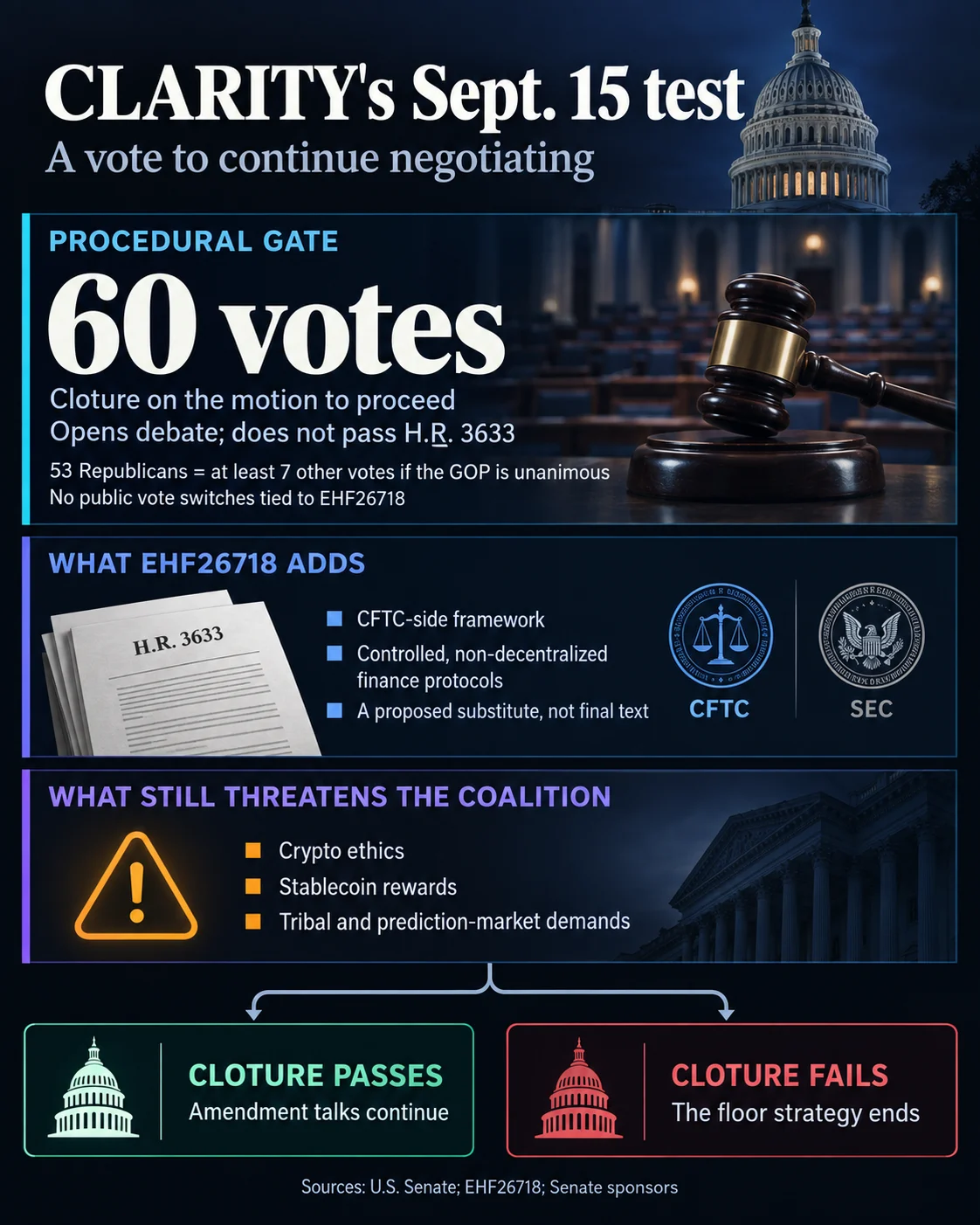
The path forward for comprehensive digital asset legislation in the United States hinges on a critical procedural vote in the Senate on September 15th, with White House digital assets adviser Patrick Witt urging lawmakers to "get on the bill and let’s keep talking." This pivotal moment, a cloture vote on the motion to proceed to H.R. 3633, known as the CLARITY Act, requires 60 votes to open the floor for debate and potential amendments. The outcome will determine whether the Senate can move past initial procedural hurdles to address the complex and often contentious issues surrounding cryptocurrency regulation, including novel frameworks for decentralized finance (DeFi) and prediction markets, alongside persistent ethical and stablecoin-related disputes.
The immediate focus of the Senate’s efforts is to secure enough votes to simply begin discussing the bill. The September 15th vote is scheduled for 2:15 p.m. and represents the first significant hurdle for the CLARITY Act since its introduction. A successful cloture vote would signal a willingness among a broader segment of the Senate to engage with the legislation, allowing for a more thorough examination of its provisions and the introduction of proposed changes. This procedural step is crucial, as failure to achieve 60 votes would effectively halt further consideration of the bill in its current form during this legislative session, potentially derailing months of negotiation and compromise.
A Strategic Amendment to Address DeFi and Prediction Market Concerns
In the days leading up to this crucial vote, Republican senators have introduced a significant amendment, EHF26718, intended to address some of the most persistent concerns raised by various stakeholders. This proposed substitute text notably expands Section 20209 of the original bill, which previously focused on "Software developer protections," to now encompass "Software developer protections and non-decentralized finance trading protocols." This expansion carves out a framework under the Commodity Futures Trading Commission (CFTC) designed to scrutinize protocols that present themselves as decentralized but remain under the control of identifiable parties.
This addition represents a targeted effort to mend a perceived gap in the bill’s regulatory architecture, particularly in response to anxieties surrounding the burgeoning fields of decentralized finance (DeFi) and prediction markets. The amendment seeks to clarify the regulatory status of these platforms by introducing a control-based test. Under the revised language, a protocol’s claim of decentralization would not automatically exempt it from intermediary regulations if a discernible individual or group exercises significant administrative control. This mirrors an existing provision for the Securities and Exchange Commission (SEC) in Section 10301, which addresses "non-decentralized finance trading protocols," but now extends a similar analytical tool to the CFTC.
The impact of this amendment is significant for stakeholders concerned about the potential for regulatory arbitrage. In July, a coalition of 12 Democratic senators had voiced strong objections, warning that broad exemptions for DeFi could inadvertently shield blockchain-based prediction markets from existing derivatives regulations. Their concerns specifically highlighted the need to limit any new exemptions to spot-market provisions, uphold tribal sovereignty and existing tribal-state compacts, and prohibit CFTC registrants from offering services related to sports wagering and casino-style contracts. The new CFTC framework for controlled protocols directly addresses the concern that centrally controlled venues might evade regulation by adopting a "DeFi" label.
However, the amendment’s reach may not fully satisfy all the initial concerns. While it provides a mechanism to assess control within protocols, it doesn’t directly address broader issues related to tribal sovereignty or the specific treatment of event contracts, which were also part of the senators’ demands. Senators Lisa Murkowski and Brian Schatz, for instance, have independently urged the CFTC to engage in extensive consultations with Native American tribes and to rigorously adhere to federal Indian gaming law as it develops rules for prediction markets. As of September 10th, none of the signatories to the July letter had publicly announced a shift in their stance based on the EHF26718 amendment, indicating that these specific points remain active areas of negotiation.
The Shifting Sands of Coalition Mathematics
The Senate’s legislative process, particularly concerning cloture, is inherently complex and demands broad consensus. Under the Senate’s rules, ending debate on a legislative motion requires a supermajority of 60 votes, assuming no vacancies. With Republicans holding 53 seats, securing the necessary 60 votes necessitates finding at least seven votes from across the aisle or among any potential defectors within their own party. This "coalition math" is a constant challenge for any significant legislative effort.

The National Sheriffs’ Association provides a recent example of how targeted concessions can influence coalition dynamics. On September 3rd, the association, which had previously opposed the bill, shifted to a neutral position following amendments that addressed their concerns regarding illicit finance. This demonstrates that specific accommodations can broaden support or at least mitigate opposition, a strategy that Republican negotiators appear to be employing with the EHF26718 amendment.
Despite these efforts, significant obstacles remain within the Republican conference. Concerns about presidential ethics related to digital assets and the potential impact of stablecoin rewards continue to be major sticking points. Reports have indicated that Senator Thom Tillis believes the bill could fail unless the White House actively participates in resolving the standoff over restrictions tied to public officials’ cryptocurrency interests. Similarly, Senator Mike Rounds has expressed pessimism about the bill’s prospects, suggesting that the internal divisions within the Republican party could jeopardize its passage. While these statements may not represent a definitive whip count, they highlight the fragility of assuming unwavering Republican support for cloture.
The dispute over stablecoin rewards also presents a substantial challenge. The sponsors’ own section-by-section summary indicates that permissible rewards could be linked to activities such as account opening, making payments, and providing liquidity. Banks, a powerful lobbying force, argue that these programs could effectively function as interest-bearing accounts, drawing deposits away from the traditional, regulated banking system. This disagreement has escalated into a public lobbying battle, with cryptocurrency advocacy groups launching a late advertising campaign accusing banks of attempting to stifle innovation and eliminate stablecoin rewards.
The Urgency of the September Calendar
The legislative calendar itself adds a layer of urgency to the proceedings. The Senate’s September schedule is notoriously tight, with limited floor time available for extensive debate and amendment processes. The scheduling of a floor date for the CLARITY Act in September, as confirmed by previous reports, signifies a deliberate effort to push the legislation forward. A successful motion to proceed on September 15th would keep this narrow window of opportunity open, allowing for the unresolved issues to be brought to the floor for amendment and debate. Failure to pass cloture would effectively close this window, potentially pushing any significant digital asset legislation to a future Congress.
A Vote to Continue the Dialogue
Patrick Witt’s overarching message encapsulates the White House’s strategy: to leverage the procedural vote as a mechanism for continued negotiation rather than an ultimate endorsement of the bill’s current text. By framing the vote as an opportunity to "get on the bill and let’s keep talking," Witt is appealing to senators who may have reservations but are willing to engage in the legislative process. His argument is that a failed motion to proceed would eliminate the very avenue for seeking amendments and addressing outstanding concerns.
Opponents of the bill may view withholding cloture as a means to exert greater leverage, or they may genuinely believe that the unresolved ethical, stablecoin, and tribal policy issues are too significant to defer. However, the introduction of the revised text and the National Sheriffs’ Association’s shift to a neutral stance illustrate that discrete objections can be addressed and can influence the broader coalition’s perimeter, even while the core compromises remain in flux.
The strategy hinges on persuading 60 senators to distinguish between the procedural act of advancing the bill and the ultimate approval of its contents. A successful cloture vote would move the contentious debates over ethics, stablecoins, and prediction market regulation onto the Senate floor, where they could be addressed through amendments and further negotiation. Conversely, a failure to achieve cloture would effectively end this strategy, leaving the unfinished compromises unaddressed and potentially delaying comprehensive digital asset regulation indefinitely. The September 15th vote, therefore, is not merely a vote on the CLARITY Act itself, but a crucial vote on the continuation of the legislative process for digital assets in the United States.