Dwi Wanna
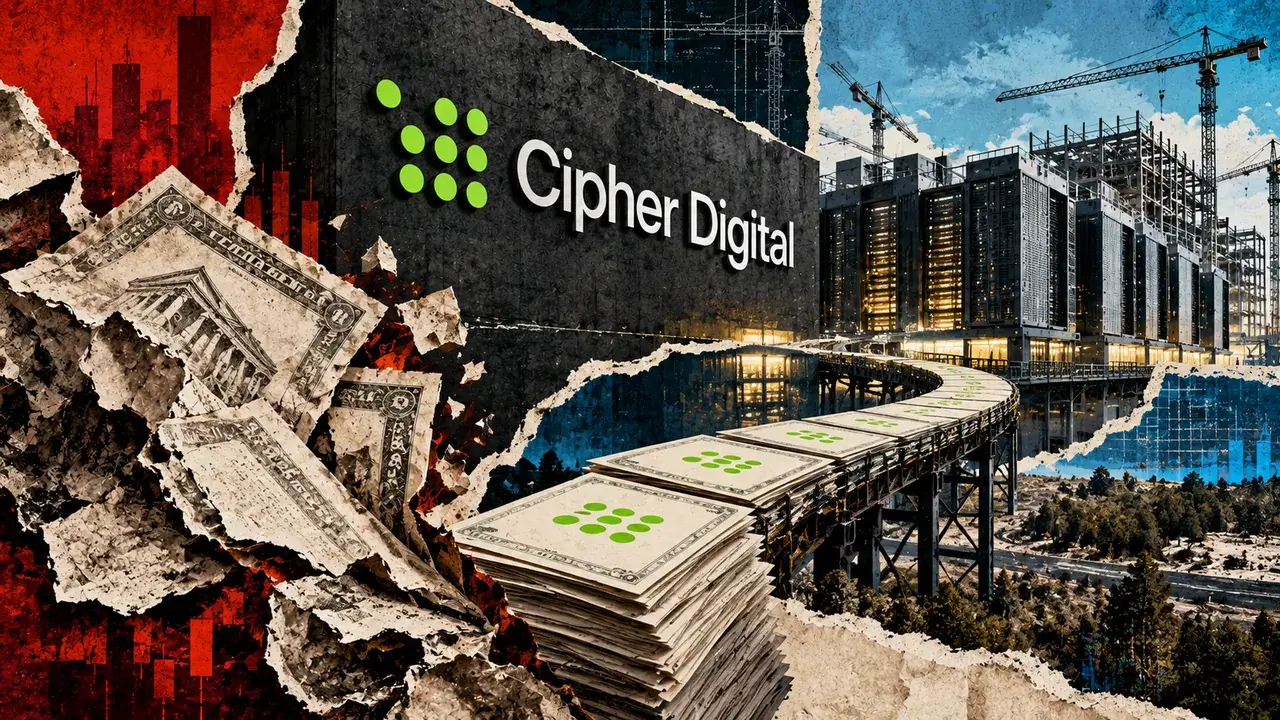
Cipher Digital has experienced a significant market correction as the company navigates a complex financial restructuring designed to pivot its core business from Bitcoin mining to high-performance computing (HPC) and artificial intelligence (AI) infrastructure. On Oct. 16, shares of the Texas-based company plummeted 10.6%, closing at $8.98, marking its lowest valuation since September 2025. This latest decline contributes to a broader downward trend that has seen the company’s market value erode by more than 52% over the past year. The volatility comes on the heels of a massive capital-raising effort, which included the issuance of 40.7 million shares to retire legacy debt and the securing of $850 million in fresh borrowing to fund its aggressive expansion into the AI sector.
The market’s reaction highlights a growing tension between Cipher’s long-term strategic ambitions and the immediate financial pressure of shareholder dilution and mounting debt. While the company is positioning itself to capture a share of the burgeoning AI data center market, the transition requires billions in capital expenditure at a time when traditional Bitcoin mining margins are under pressure following the 2024 halving event.
The Mechanics of Financial Restructuring and Share Dilution
According to a Form 8-K filing with the U.S. Securities and Exchange Commission (SEC) dated Oct. 16, Cipher Digital completed a sophisticated debt-for-equity swap. The company issued approximately 40.7 million newly minted common shares to retire $165.9 million of its 2030 convertible senior notes. This transaction effectively eliminated the bulk of that specific debt series, leaving only $6.6 million outstanding. However, the move had an immediate dilutive effect on existing shareholders, contributing to the 31% loss in market value recorded since Oct. 12.
Simultaneously, the company finalized a separate $850 million convertible bond offering. These new notes, maturing in November 2032, are designed to provide the liquidity necessary for Cipher to build out its data center portfolio. Unlike traditional corporate bonds, these securities carry no regular interest payments, a structure intended to preserve cash flow during the capital-intensive construction phases of its new facilities. However, the lack of coupon payments is offset by the potential for conversion into equity at a price of approximately $15.31 per share—a level significantly higher than the current trading price.
To mitigate further dilution, Cipher allocated approximately $89.7 million of the proceeds to "capped-call" transactions. These financial instruments are designed to protect the company and its shareholders by offsetting the dilutive impact of the notes if the stock price rises, providing protection up to a share price of $28.35. Despite these safeguards, the sheer volume of new shares entering the market has triggered a selloff, as bondholders receiving the 40.7 million shares may be liquidating their positions or unwinding hedges.
The Strategic Pivot: From Bitcoin to Artificial Intelligence
Cipher Digital’s decision to take on nearly a billion dollars in new obligations is rooted in a fundamental shift occurring across the cryptocurrency mining industry. Since the Bitcoin halving in April 2024, which reduced the rewards for securing the network by 50%, miners have been forced to seek more profitable uses for their massive electrical power capacities and specialized infrastructure.
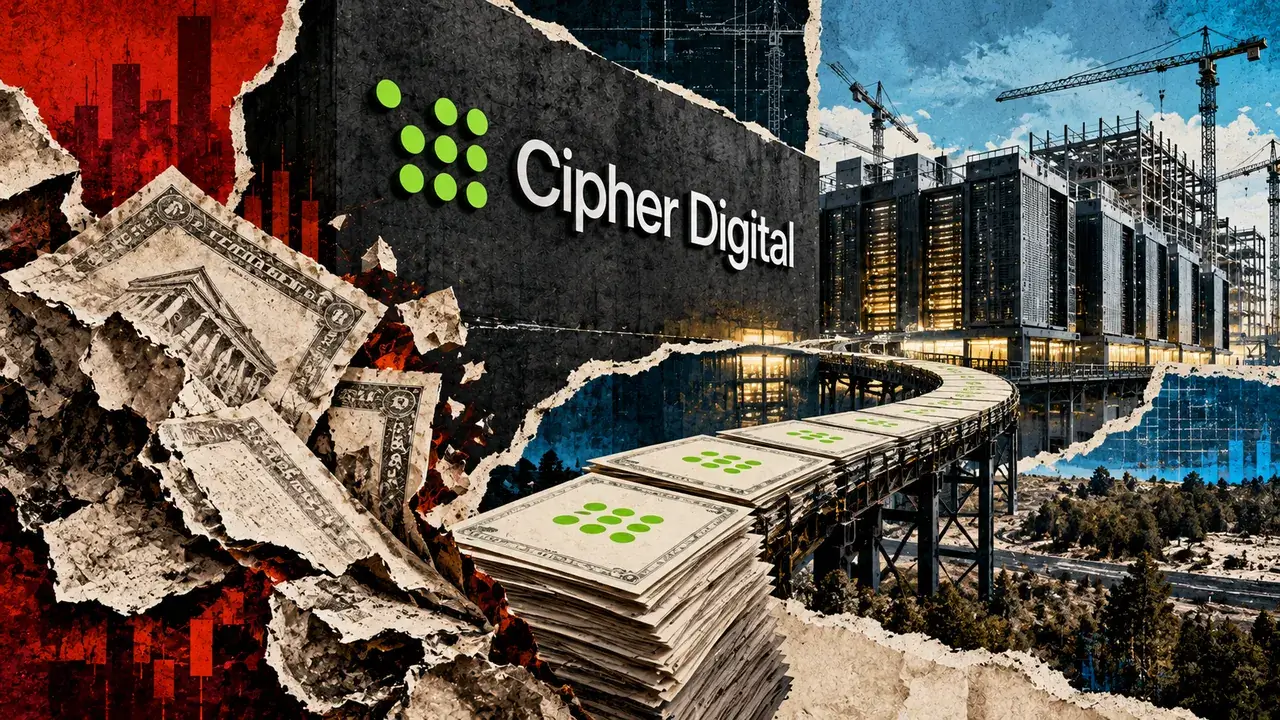
The demand for AI-ready data centers has provided a lucrative alternative. High-performance computing requires vast amounts of electricity and sophisticated cooling systems—assets that Bitcoin miners like Cipher already possess or have the permits to build. By transitioning from mining to hosting AI workloads, Cipher aims to replace the volatile, coin-based revenue of crypto mining with stable, long-term lease agreements from "hyperscale" technology companies and AI developers.
This transition, however, is not without risk. Building a data center capable of housing thousands of H100 or B200 GPUs (Graphics Processing Units) is far more expensive than setting up a standard Bitcoin mining rig. The $850 million raised will primarily support the development of the Barber Lake site and other HPC projects. The company’s ability to service its new debt will depend entirely on its success in converting these construction projects into operational, revenue-generating assets before 2030, when noteholders gain the right to demand cash repayment.
Operational Milestones and Financial Disparity
While the stock market has reacted unfavorably to the financing news, Cipher’s operational team has reported several milestones. In August 2024, the company announced it had begun delivering capacity at its Black Pearl data center two months ahead of schedule. This early delivery triggered the first rental payments from a major hyperscale tenant, providing a proof-of-concept for Cipher’s AI strategy.
Despite this progress, the company’s financial statements reveal a significant gap between its current income and its future capital requirements. In its second-quarter 2026 business update, Cipher reported revenue of approximately $25 million, but posted an adjusted EBITDA (Earnings Before Interest, Taxes, Depreciation, and Amortization) loss of $30 million. This deficit underscores the "burn rate" associated with massive infrastructure projects.
The company is currently managing a pipeline that includes:
- Black Pearl: An operational site already generating rental income.
- Barber Lake: A flagship development project intended for large-scale AI hosting.
- Stingray: An expansion project focused on increasing the company’s total megawatt capacity.
The net proceeds from the latest $850 million offering, estimated at $835.1 million after fees and commissions, are earmarked for these sites. Investors are now closely monitoring whether the revenue from Black Pearl and the upcoming Barber Lake facility can scale fast enough to offset the company’s operating losses and the eventual repayment of its 2032 notes.
Chronology of the 2026 Financing and Expansion
The path to Cipher’s current financial standing has been marked by several key dates over the last 12 months:

- October 2025: Cipher stock trades at a peak as the company announces its intent to diversify into AI.
- April 2024 – June 2026: The company secures power purchase agreements and zoning permits for its Texas-based data centers, shifting focus away from pure-play Bitcoin mining.
- August 2026: Black Pearl data center comes online ahead of schedule; Q2 earnings report reveals a $30 million EBITDA loss, signaling the high cost of the pivot.
- October 12, 2026: Initial rumors of a large-scale debt restructuring surface, causing the stock to begin a multi-day slide.
- October 16, 2026: Official SEC filing confirms the issuance of 40.7 million shares and the $850 million convertible bond offering. Stock closes down 10.6% for the day.
Broader Industry Implications: The "Power" Play
Cipher’s struggles and strategies are emblematic of a wider trend in the digital asset space. Competitors such as Core Scientific, Hive Digital, and Bitdigital have all announced similar pivots to HPC and AI. In this new landscape, the "real prize" for these companies is no longer the Bitcoin they mine, but the "interconnect" and power capacity they control.
As the AI revolution continues to accelerate, the bottleneck for tech giants like Microsoft, Amazon, and Google has become the availability of power-connected real estate. Bitcoin miners are uniquely positioned to fill this gap because they hold long-term power contracts that would take years for a traditional data center developer to secure from scratch.
However, as Cipher’s 52% stock plunge suggests, the market is currently skeptical of the "valuation bridge" between a crypto miner and an AI utility. Investors are questioning whether the capital expenditures required to upgrade these sites—which often involve replacing entire electrical systems to handle the more consistent and intense loads of GPUs—will yield a high enough return on investment to justify the massive dilution of equity.
Future Outlook and Investor Scrutiny
Looking ahead to 2030 and 2032, Cipher Digital faces a high-stakes deadline. The $850 million in convertible notes may carry no interest today, but they represent a "ticking clock" on the company’s balance sheet. If the company’s stock price does not recover to exceed the $15.31 conversion threshold, Cipher may be forced to find $850 million in cash to repay bondholders in 2030 or 2032.
Analysts suggest that the company’s success will be measured by its ability to secure additional "hyperscale" contracts similar to the one at Black Pearl. These contracts typically span 10 to 15 years and provide the predictable cash flow that traditional lenders and equity investors crave. If Cipher can prove that its Barber Lake and Stingray sites are equally attractive to the world’s largest computing firms, the current share price decline may eventually be viewed as a temporary hurdle in a successful industrial transformation.
For now, however, Cipher remains a high-risk, high-reward play on the convergence of energy infrastructure and artificial intelligence. The company must navigate a narrow path: it needs to continue spending aggressively to build its AI moat while simultaneously convincing a skeptical market that its path to profitability is sustainable. With over $684 million in additional outstanding debt principal following these latest deals, the margin for error has never been thinner.