admin
admin
The global financial landscape is undergoing a profound transformation, driven by the shift of assets, payments, and market infrastructure onto blockchain-based systems. This paradigm shift, often termed "onchain finance," promises unprecedented efficiency, transparency, and programmability. Central to this evolution is asset tokenization, a process projected to swell into a colossal $30 trillion market within the next decade, with trade finance playing a substantial role. As major financial institutions and market infrastructures, including Swift, commit to this technological frontier by developing blockchain-based ledgers, the imperative for robust and scalable interoperability solutions has become undeniable.
The Promise and Peril of Tokenization
Tokenization, at its core, involves representing real-world assets (RWAs) or financial instruments as digital tokens on a blockchain. This innovation unlocks a myriad of benefits, including faster settlement times, reduced operational costs, enhanced liquidity, fractional ownership, and the creation of entirely new, programmable financial products. Imagine a world where a share in a private equity fund settles instantly, or a bond automatically pays coupons based on predefined conditions without manual intervention. This is the promise of tokenized finance.
However, the rapid proliferation of diverse blockchain networks—both public and private—presents a significant hurdle. Each blockchain operates with its own unique protocols, security models, and governance structures, creating isolated silos of liquidity and disconnected applications. This fragmented ecosystem makes it incredibly difficult for institutions, which must operate across multiple chains, integrate with existing legacy systems, comply with varied regulatory regimes, and access diverse data sources simultaneously, to scale their tokenization efforts effectively. The current multi-chain environment echoes the early days of the internet, prior to the adoption of the TCP/IP standard, where networks struggled to communicate, necessitating bespoke, resource-intensive integrations for every connection. Without a unifying standard for end-to-end interoperability, the promise of tokenized finance risks being confined to isolated point solutions, hindering its global potential.
The Interoperability Imperative: Four Core Challenges for Institutions
For institutional tokenization to achieve global scale, it requires a comprehensive solution that addresses several critical interoperability challenges:
1. Cross-Chain Interoperability: Unifying a Fragmented Digital Landscape
The sheer number of public and private blockchains, each with distinct standards, finality assumptions, and compliance rules, creates a complex and disjointed environment. This fragmentation leads to isolated liquidity pools, disconnected applications, and the inefficient duplication of assets across networks. Institutions are faced with the daunting task of building and maintaining a growing list of custom bridging solutions, each introducing unique trust assumptions and security risks that demand significant time and resources to understand and integrate.
A universal blockchain interoperability standard is crucial to overcome this. It must provide a secure and reliable foundation for cross-chain token transfers and messages, enabling liquidity to flow freely and assets to be managed and synchronized across networks in real-time. This shared layer for data and value movement is paramount for the onchain economy to operate efficiently at scale.
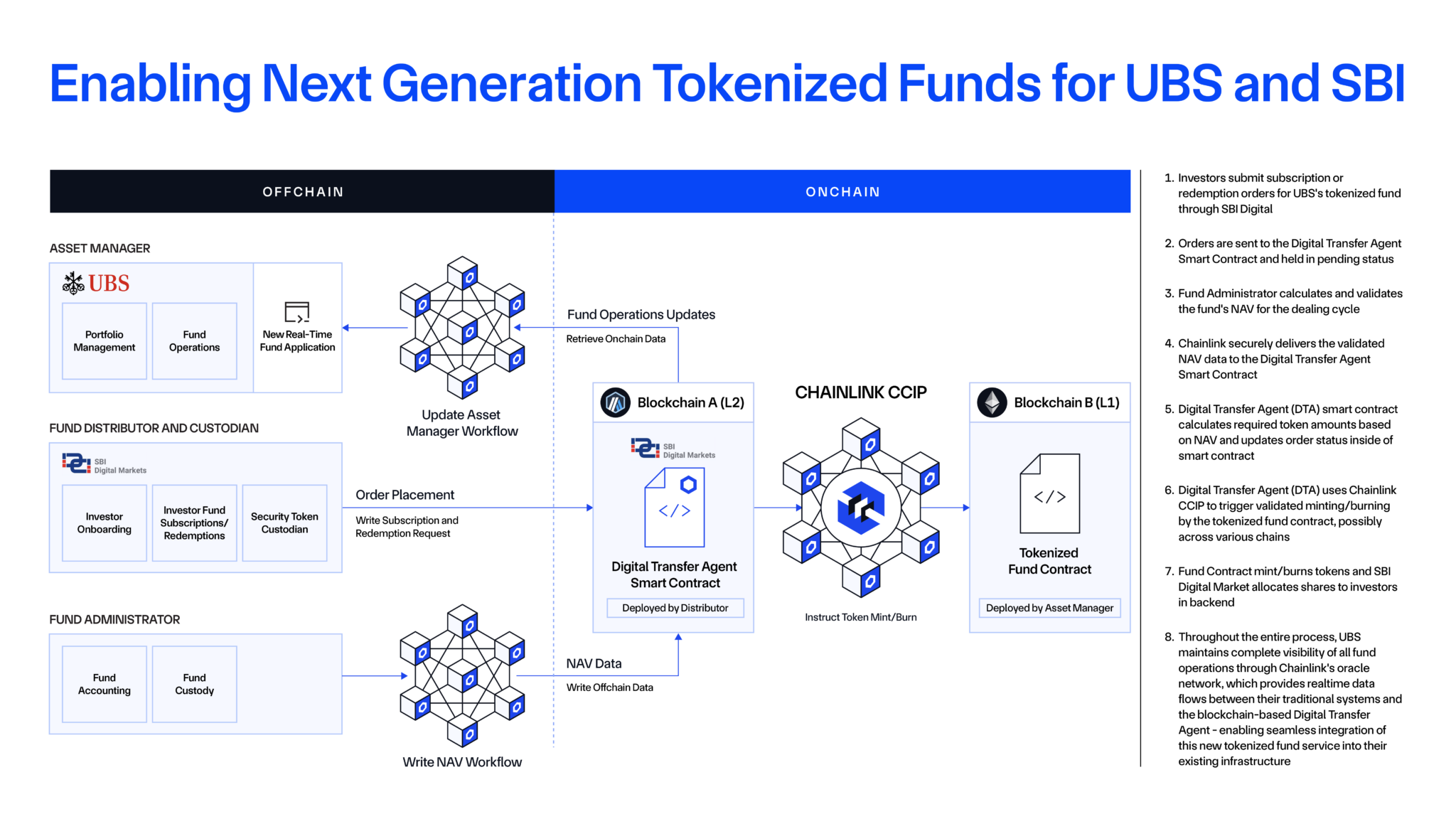
- Contextual Example: A significant step towards solving this was demonstrated through a collaboration under the Monetary Authority of Singapore (MAS) Project Guardian. SBI Digital Markets, UBS Asset Management, and Chainlink successfully piloted an automated fund administration and transfer agency using smart contracts. This initiative showcased how Chainlink infrastructure, combined with the Digital Transfer Agent (DTA) technical standard, allows tokenized funds to maintain their share register on one blockchain while processing fund lifecycle activities like subscriptions and redemptions on another using Chainlink’s Cross-Chain Interoperability Protocol (CCIP). Winston Quek, CEO at SBI Digital Markets, affirmed that this architecture creates a foundation for onchain financial products, enabling fund managers and service providers to deliver new offerings and reduce operational costs.
2. Existing System Interoperability: Bridging Traditional and Digital Finance
The global financial system relies on a vast network of established infrastructure—custodians, transfer agents, fund administrators, payment systems, and Central Securities Depositories (CSDs)—that has been rigorously tested, regulated, and optimized over decades. This legacy infrastructure is not merely obsolete; it is indispensable, securing trillions in value daily and underpinning core processes. The objective of onchain finance is not to dismantle these systems but to integrate them securely and standardly with blockchains.
The challenge lies in the fact that these traditional systems were not designed for blockchain connectivity, forcing institutions to rely on bespoke integrations that are resource-intensive, prone to delays, and susceptible to errors. A universal interoperability standard must therefore extend beyond merely connecting blockchains to define how offchain systems—including banking infrastructure, data providers, enterprise platforms, and web APIs—can directly and securely interact with onchain environments. This would create a common framework for hybrid onchain/offchain transactions, accelerating the adoption of tokenization within existing capital markets.
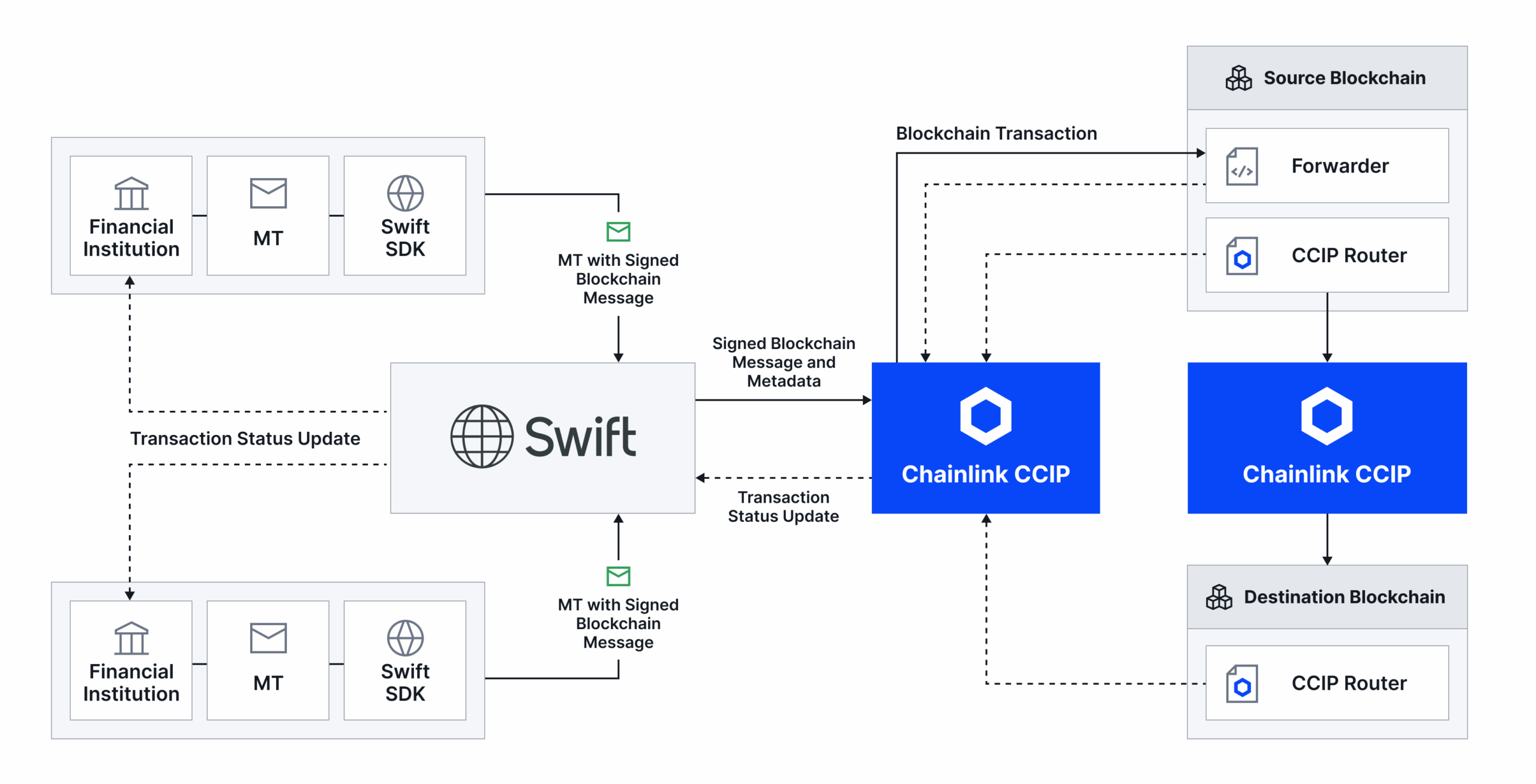
- Contextual Example: At Sibos 2025, Chainlink, in collaboration with 24 of the world’s largest financial institutions and market infrastructures (including Swift, DTCC, Euroclear, SIX, UBS, and Wellington Management), advanced an initiative to create unified infrastructure for streamlined corporate actions processing. This solution leverages the Chainlink Runtime Environment (CRE) to orchestrate and validate AI model outputs regarding corporate actions, transform them into ISO 20022 messages, and deliver them via the Swift network. Chainlink CCIP then distributes these confirmed records in real-time to DTCC’s blockchain ecosystem and other public and private blockchains. Stéphanie Lheureux, Director, Digital Assets Competence Center at Euroclear, highlighted that this industry-wide coordination around standards and interoperability is key to achieving global scale.
3. Data, Compliance, and Privacy: The Pillars of Institutional Trust
Beyond mere connectivity, a universal interoperability standard must embed the foundational building blocks required for institutional-grade tokenized asset transactions: trusted data, robust compliance, and critical privacy safeguards. Just as in traditional finance, nearly all onchain transactions require verifiable data—such as Net Asset Value (NAV), Assets Under Management (AUM), and Know Your Customer/Anti-Money Laundering (KYC/AML) information. Moreover, transactions must adhere to embedded compliance policies and conditions, ranging from identity and investor accreditation requirements to internal business rules on transaction limits and operating hours. Privacy is equally paramount, necessitated by consumer and regulatory demands. Without comprehensive support for these essential components, an interoperability standard cannot gain institutional traction for advanced transactions.
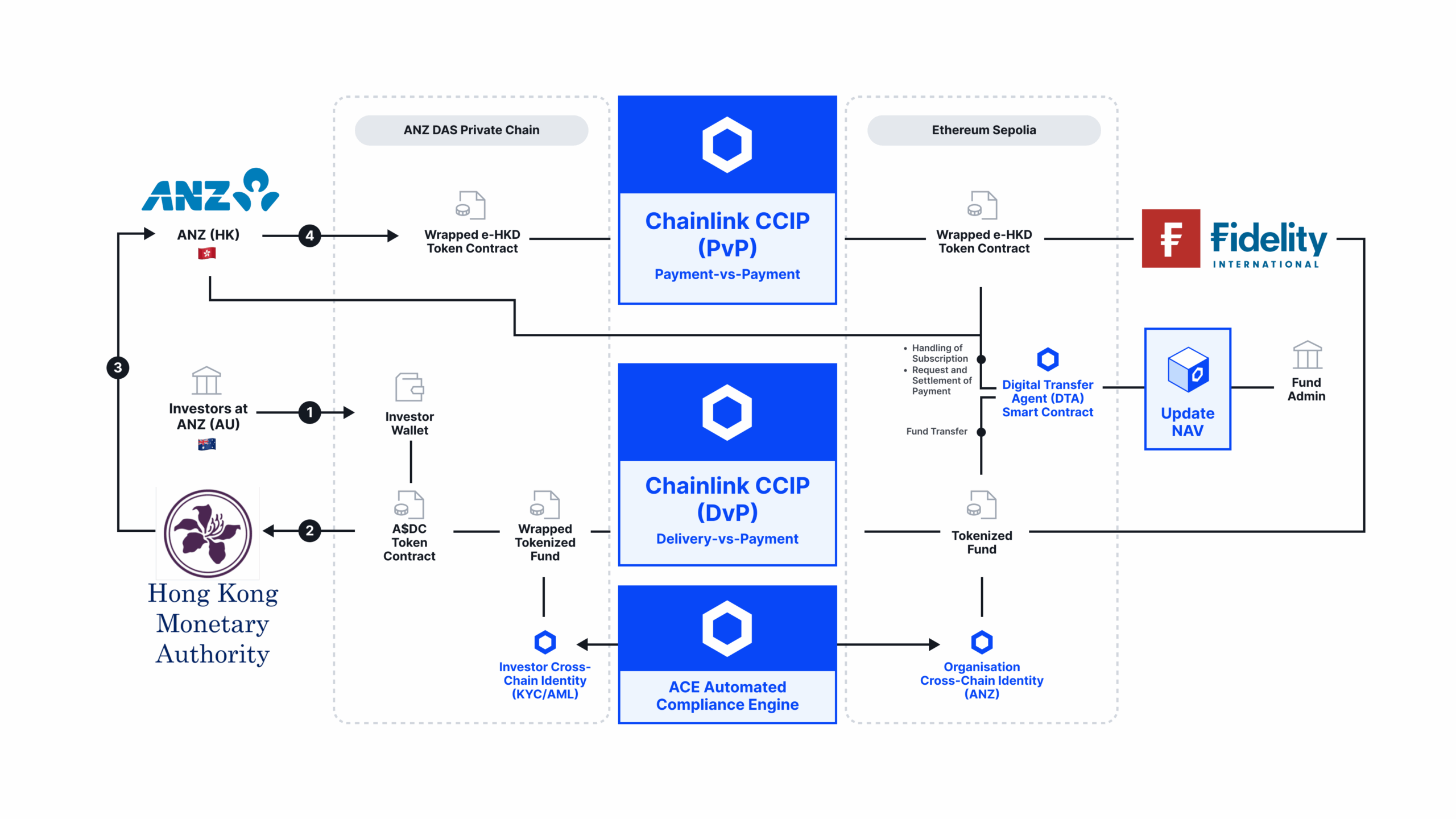
- Contextual Example: The Hong Kong Monetary Authority (HKMA) highlighted a key cross-chain settlement solution powered by Chainlink, ANZ, China AMC, and Fidelity International in Phase 2 of its e-HKD program. This solution utilized Chainlink CCIP and ACE (Chainlink Attestation & Compute Environment) to meet both cross-chain interoperability and compliance requirements for the secure settlement of tokenized assets. It unified trusted data, cross-chain connectivity, and automated compliance into a single workflow, providing high-quality data for asset pricing and transfer agent operations, enabling seamless value and data movement, and enforcing compliance by verifying onchain identity proofs against jurisdiction-specific regulatory policies.
- Chronology/Additional Context: Further demonstrating this capability, the Central Bank of Brazil (BCB) in Phase Two of its Drex project (focused on cross-border trade) leveraged Chainlink to connect BCB with the HKMA, orchestrating seamless and compliant cross-jurisdictional trade settlement. Participants included Banco Inter, Standard Chartered, and the Global Shipping Business Network (GSBN). The Chainlink platform enabled communication across Drex, the Hong Kong Ensemble Network, and GSBN’s trade finance system, with CRE translating messages and triggering electronic Bill of Lading transfers, while CCIP ensured secure cross-chain messaging for key events like contract execution and credit release. Chainlink’s work with Apex Group and the Bermuda Monetary Authority (BMA) on institutional-grade stablecoin infrastructure and with the Global Legal Entity Identifier Foundation (GLEIF) to deliver an institutional-grade identity solution further underscores its role in embedding trust and compliance.
4. Orchestration: Coordinating Complex Financial Workflows
The final piece of the interoperability puzzle is orchestration—the ability to securely coordinate intricate financial processes that span multiple blockchains, external systems, regulatory logic, and institutional workflows through a single, cohesive piece of code. Traditional smart contracts are often limited to executing isolated functions on a single chain. However, institutional asset lifecycles are far more complex, requiring data from pricing and compliance systems, multi-chain execution, identity verification, compliance checks, existing system integration, and conditional business logic that must run securely and reliably in parallel.
Without a robust orchestration layer to unify these disparate components and processes, institutions would be forced to construct and maintain a sprawling web of bespoke integrations and custom logic. This approach inevitably slows adoption, elevates operational risk, and fragments liquidity across disconnected systems. Therefore, a universal interoperability standard must encompass not only connectivity across chains, systems, and data sources but also a powerful orchestration capability that brings these functionalities together into composite workflows capable of powering real-world financial operations at scale.
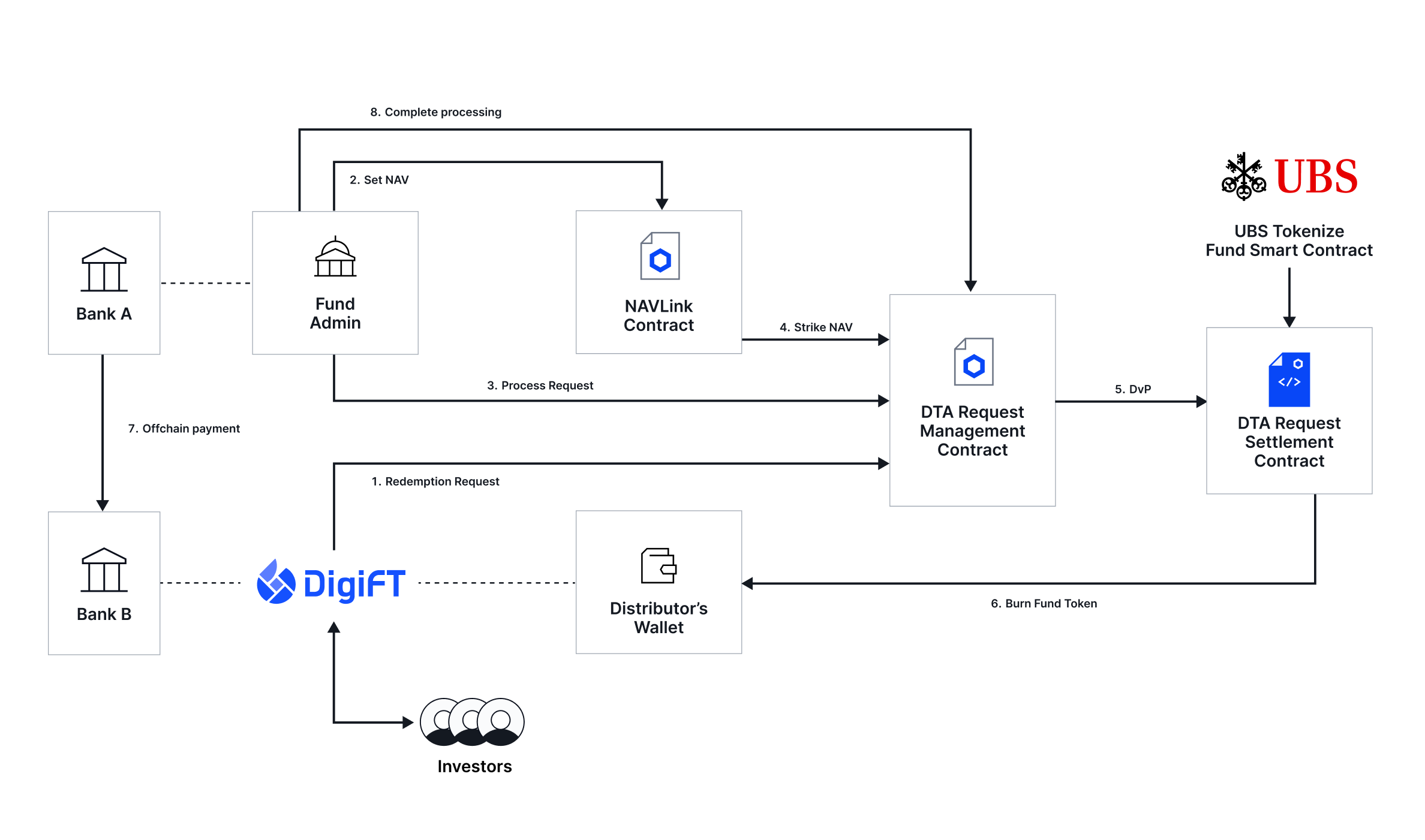
- Contextual Example: UBS successfully completed the world’s first in-production, end-to-end tokenized fund workflow leveraging the Chainlink Digital Transfer Agent (DTA) technical standard. This solution harnessed key Chainlink platform capabilities, including secure offchain computation for complex business logic, trusted data feeds (e.g., NAV pricing), and cross-chain messaging for asset transfers and instructions. This workflow covers every stage of the fund lifecycle, from order taking and execution to settlement and data synchronization across all onchain and offchain systems, demonstrating the power of integrated orchestration.
Chainlink’s Comprehensive Solution: A Unified Interoperability Platform
Chainlink addresses this full spectrum of institutional interoperability challenges by providing a unified platform designed to connect disparate blockchain networks and existing systems, while simultaneously supplying the data, cross-chain connectivity, compliance, privacy, and orchestration required for advanced onchain transactions. The platform’s modular architecture allows institutions to adopt precisely what they need, from simple cross-chain transfers to a complete end-to-end workflow stack.
At the core of Chainlink’s offering is the Chainlink Runtime Environment (CRE), an orchestration layer enabling institutional-grade smart contracts—complex financial workflows that operate seamlessly across blockchains and offchain systems. This directly addresses the critical pain point of integrating existing legacy systems with blockchain environments. Built upon CRE are open standards, each tackling a key dimension of end-to-end interoperability:
- Chainlink Cross-Chain Interoperability Protocol (CCIP): A secure, battle-tested standard for sending data and value across any blockchain network.
- Chainlink Digital Transfer Agent (DTA): A technical standard for managing the lifecycle of tokenized funds and other tokenized assets across onchain and offchain systems.
- Chainlink Attestation & Compute Environment (ACE): A decentralized compute environment for verifying onchain identity proofs against offchain jurisdiction-specific regulatory policies.
- Chainlink Data Feeds: Industry-leading decentralized oracle networks providing high-quality, tamper-proof data to smart contracts.
The CRE unifies these standards on a single platform, making them composable into workflows that interact across both onchain and offchain systems. The result is a single, cohesive interoperability standard capable of powering the end-to-end lifecycle of tokenized asset transactions while meeting the stringent institutional-grade requirements for security, compliance, and reliability.
Industry Adoption and Strategic Partnerships
Chainlink’s stature as a foundational standard is evidenced by its widespread adoption across the financial sector. Having enabled over $27 trillion in onchain transaction value, it boasts unparalleled security and reliability, underscored by its ISO 27001 & SOC 2 compliance—a critical benchmark for institutional trust. The world’s largest financial services institutions, including Swift, Mastercard, Euroclear, DTCC, UBS, and major central banks and monetary authorities like MAS, HKMA, and the Central Bank of Brazil, have strategically partnered with or adopted Chainlink’s standards and infrastructure. These collaborations are not merely pilots; they represent concrete steps towards integrating blockchain technology into the very fabric of global finance. The collective engagement of such diverse and influential players signals a clear industry consensus on the need for a unified, secure, and scalable interoperability layer.
Powering the Future of Global Finance
As global finance inexorably transitions towards onchain market infrastructure, the ability to seamlessly connect disparate blockchains, integrate existing traditional systems, and adhere to evolving regulatory standards through a single, universal interoperability standard will define the next generation of financial markets. Chainlink stands as the sole technology platform providing this critical foundation. By uniting trusted data, robust compliance, essential privacy, secure cross-chain connectivity, and sophisticated orchestration into one cohesive stack, Chainlink empowers institutions to operate fluidly across all onchain and offchain environments. By bridging the innovative potential of blockchain technologies with the proven security and reliability of existing financial systems, Chainlink is unequivocally establishing the universal interoperability standard that will power the future of onchain finance on a global scale. This integration promises to unlock unprecedented liquidity, foster the creation of innovative financial products, and fundamentally reshape capital markets for decades to come.