admin
admin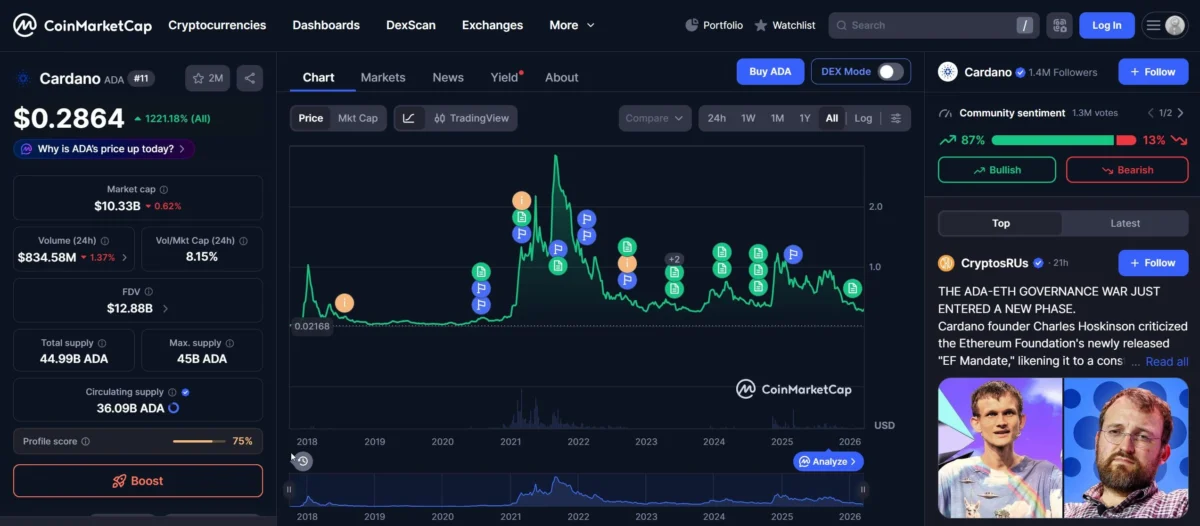
Cardano has steadily risen over the years to establish itself as one of the top 10 blockchain networks for hosting decentralized applications, with its native cryptocurrency, ADA, performing prominently among the top tokens as the broader crypto market experiences a recovery. This strong performance, underpinned by growing user adoption and significant market interest, suggests that Cardano is operating optimally and poised for considerable expansion in the foreseeable future. This comprehensive analysis delves into the foundational aspects of Cardano, its operational mechanics, the critical challenges it addresses, and its strategic position within the competitive blockchain ecosystem, offering insights for those evaluating its investment potential.
Understanding Cardano: A Foundation in Academic Rigor
Launched in 2017, Cardano distinguishes itself as a third-generation blockchain, meticulously engineered to overcome the persistent scalability, security, and sustainability issues that characterized earlier networks such as Bitcoin and Ethereum. Its development philosophy is uniquely grounded in academic, scientific, and peer-reviewed research, a stark contrast to the more iterative, community-driven approaches often seen in other projects.
The genesis of Cardano traces back to co-founders Charles Hoskinson and Jeremy Wood, both of whom played pivotal roles in the early Ethereum ecosystem. Their experience with the challenges and limitations inherent in first and second-generation blockchains spurred a vision for a new network built on evidence-based methods derived from computer science and cryptography. Their objective was to construct a blockchain capable of methodical evolution, ensuring long-term stability and adaptability. Unlike the energy-intensive proof-of-work (PoW) consensus mechanisms employed by early networks, Cardano utilizes a proof-of-stake (PoS) mechanism known as Ouroboros. This innovative design allows network participants to validate transactions, produce new blocks, and secure the decentralized network with significantly reduced energy consumption, a critical factor for global sustainability.
The Blockchain Trilemma and Cardano’s Solutions
The core problems Cardano seeks to solve are deeply rooted in what is commonly known as the "blockchain trilemma" – the inherent difficulty of achieving optimal scalability, security, and decentralization simultaneously. Earlier blockchains, particularly Bitcoin, prioritized security and decentralization at the expense of scalability, leading to slower transaction speeds and higher fees during periods of high network demand. Ethereum, while introducing smart contract functionality, also grappled with these issues, leading to network congestion and exorbitant "gas" fees.
Cardano tackles these limitations through its multi-layered architecture and the Ouroboros PoS consensus. Its design aims for high transaction throughput without compromising security or decentralization. Solutions like Hydra, a layer-2 scalability protocol, are designed to enable the network to process millions of transactions per second, addressing the bottleneck issues faced by its predecessors. Furthermore, Ouroboros’s energy efficiency significantly reduces the environmental footprint associated with blockchain operations, positioning Cardano as a more sustainable alternative for long-term global adoption. This focus on sustainability, combined with a robust security framework and a commitment to decentralization, forms the bedrock of Cardano’s value proposition.
Operational Mechanics: A Two-Layered Approach
A fundamental aspect of Cardano’s operation is its innovative two-layer architecture, which segregates core functionalities into distinct components: the Cardano Settlement Layer (CSL) and the Cardano Computation Layer (CCL).
- Cardano Settlement Layer (CSL): This layer is dedicated to the secure and efficient handling of the native cryptocurrency, ADA. It manages all transactions involving ADA, including transfers between wallets and the calculation of associated transaction fees. The CSL is responsible for accurately recording these transactions on the blockchain and maintaining precise balance records across the entire Cardano network. Its primary function is to provide a robust and immutable ledger for value transfer.
- Cardano Computation Layer (CCL): In contrast, the CCL serves as the environment where developers deploy smart contracts and build decentralized applications (dApps). This separation of concerns allows for independent evolution and upgrades. The smart contract platform can undergo significant improvements and feature additions without disrupting the underlying accounting system of the CSL, enhancing flexibility, scalability, and security. This modular design is crucial for fostering innovation and accommodating future technological advancements.
Ouroboros: The Engine of Consensus
At the heart of Cardano’s security and block production lies the Ouroboros consensus mechanism, a provably secure proof-of-stake system. Unlike PoW, where miners expend vast computational power in a competitive race to solve cryptographic puzzles, Ouroboros selects validators based on the amount of ADA tokens they own or have delegated. This system is divided into "epochs," which are further broken down into "slots." Slot leaders are randomly selected from stake pools based on their delegated stake to propose and validate blocks.
ADA holders can actively participate in securing the network by delegating their tokens to stake pools. These pools, operated by dedicated stake pool operators (SPOs), perform the critical tasks of validating transactions, maintaining the decentralized network, and adding new blocks to the blockchain. This delegation model not only ensures decentralization but also allows ADA holders to earn rewards proportionally to their delegated stake, incentivizing broad participation and network security. Ouroboros has evolved through several iterations (e.g., Classic, Praos, Genesis, Chronos, Leios), each introducing enhancements to security, efficiency, and decentralization, reflecting Cardano’s research-driven approach.
The Evolution of Cardano: A Phased Roadmap
Cardano’s development has followed a meticulously planned roadmap, structured into five distinct eras, each named after a significant figure in poetry or computer science:
- Byron (Foundation): The initial phase, launched in 2017, established the fundamental network and allowed for ADA transactions. It introduced the Daedalus wallet and basic network infrastructure.
- Shelley (Decentralization): Rolled out in 2020, this era focused on significantly increasing network decentralization. It introduced the Ouroboros PoS mechanism, enabling staking and the establishment of stake pools, thereby moving control away from a federated model towards community-driven participation.
- Goguen (Smart Contracts): This pivotal phase, completed in 2021 with the Alonzo hard fork, integrated smart contract functionality onto the Cardano blockchain. It introduced Plutus, Cardano’s native smart contract platform, opening the door for developers to build dApps and decentralized finance (DeFi) protocols.
- Basho (Scalability): Currently underway, the Basho era is dedicated to enhancing the network’s scalability and interoperability. Key developments include the implementation of Hydra, a layer-2 scaling solution designed to drastically increase transaction throughput, and other sidechain capabilities to improve network performance and reduce latency.
- Voltaire (Governance): The final phase aims to establish a fully self-sustaining and self-governed system. It will empower ADA holders with treasury management and voting rights on all network upgrades and proposals, creating a truly decentralized and community-driven ecosystem. Project Catalyst, already active, serves as a precursor to the full Voltaire implementation, allowing community members to propose and fund projects.
ADA: The Lifeblood of the Ecosystem
ADA is not merely the native cryptocurrency of the Cardano blockchain; it is the fundamental asset powering the entire Cardano platform. Its utility extends across transactions, staking, and governance within the network. Like other major blockchain assets, ADA is actively traded on global cryptocurrency exchanges.

The total supply of ADA is capped at 45 billion tokens. As of the original article’s context, approximately 35 billion ADA were in circulation. This finite supply is a deflationary mechanism designed to maintain scarcity and value over time.
What is ADA Used For?
- Transaction Fees: Every transaction on the Cardano network requires a small amount of ADA as a fee, compensating validators for processing and securing the network.
- Staking: ADA holders can delegate their tokens to stake pools, actively participating in the Ouroboros PoS mechanism to validate transactions and produce new blocks. In return, they receive ADA rewards, incentivizing network security.
- Governance: ADA functions as a governance token, granting holders the right to vote on proposals that shape the future development and strategic direction of the Cardano platform. This ensures a decentralized decision-making process.
- Smart Contract Execution: Similar to "gas" on Ethereum, ADA is used to pay for the computational resources required to execute smart contracts on the Cardano Computation Layer.
- Native Token Creation: Developers can create their own native tokens on Cardano, leveraging the network’s security and efficiency.
Governance and Community Participation: The Voltaire Vision
Cardano’s approach to network governance is a cornerstone of its long-term vision. Eschewing reliance on a central authority, the Cardano ecosystem empowers network participants to directly influence upgrades and protocol changes. Because ADA serves as both the native cryptocurrency and a governance token, its holders can vote on proposals that determine the platform’s evolution. This community-driven governance model is designed to foster a self-sustaining blockchain ecosystem where the collective guidance of the community shapes development over time, embodying the principles of true decentralization. Project Catalyst, an innovative treasury system, allows ADA holders to propose and fund projects, directly contributing to the growth and innovation within the ecosystem.
Staking on Cardano: Securing the Network and Earning Rewards
Staking is integral to the security and operational efficiency of the Cardano network. As a proof-of-stake system, Cardano enables ADA holders to participate in the validation process, thereby helping to secure the blockchain and produce new blocks without the need for energy-intensive mining.
Instead of directly mining, users delegate their ADA to stake pools operated by dedicated individuals or entities. These stake pools aggregate delegated ADA to increase their chances of being selected as slot leaders to produce blocks. When a stake pool successfully adds blocks to the Cardano blockchain, the rewards earned are distributed among the pool’s delegators proportionally to the amount of ADA they have delegated. This mechanism not only secures the network but also provides a passive income opportunity for ADA holders, aligning their financial interests with the health and decentralization of the Cardano ecosystem.
ADA Token Price & Market Performance
At the time of the original article’s context, the ADA price was hovering around $0.28, reflecting relatively modest movement during a period of crypto market stabilization. However, it’s crucial for investors to understand that cryptocurrency prices are highly volatile and subject to rapid fluctuations influenced by a multitude of factors, including broader market trends, technological developments, regulatory news, and overall adoption rates.
Current market sentiment and expert price predictions for Cardano often appear cautiously optimistic. Community discussions frequently highlight the network’s ongoing development, the expanding Cardano ecosystem, and its long-term commitment to peer-reviewed research as strong fundamentals. Analysts often emphasize the potential of upcoming scalability solutions like Hydra and the continued growth of dApps and DeFi protocols on the platform. Nonetheless, traders and investors remain vigilant, monitoring broader market momentum and the pace of adoption across decentralized applications, as these factors will undoubtedly influence ADA’s future price trajectory.
Cardano’s Distinctive Edge: Comparison with Other Blockchains
Cardano’s design philosophy and technical architecture position it uniquely against its major competitors, Bitcoin and Ethereum.
Cardano vs. Ethereum
While both platforms support smart contracts and decentralized applications, their foundational approaches differ significantly:
| Feature | Cardano | Ethereum |
|---|---|---|
| Launch Year | 2017 | 2015 |
| Founders | Charles Hoskinson and Jeremy Wood | Vitalik Buterin and others |
| Blockchain Type | Third-generation, research-focused on scalability, security, sustainability | Second-generation, transitioning to PoS |
| Consensus Mechanism | Proof-of-Stake (Ouroboros) | Transitioned from Proof-of-Work to Proof-of-Stake (after The Merge) |
| Architecture | Two-layer: Settlement Layer (CSL) and Computation Layer (CCL) | Single-layer execution environment (pre-sharding) |
| Native Cryptocurrency | ADA | Ether (ETH) |
| Development Approach | Built through peer-reviewed academic and scientific research, methodical | Faster development driven by community and open experimentation, agile |
| Ecosystem Size | Growing ecosystem with expanding dApps, DeFi, and NFTs | Large and mature dApps, DeFi, and NFT ecosystem, extensive developer community |
| Scalability | Layer-2 solutions like Hydra for high throughput, inherent design for scalability | Sharding (future), Layer-2 rollups (e.g., Optimism, Arbitrum) for scalability |
Cardano’s layered architecture and the provably secure Ouroboros PoS are designed to offer superior scalability and lower transaction fees compared to Ethereum’s current state, even after its transition to PoS. Cardano’s emphasis on formal verification and academic rigor also sets it apart, aiming for long-term stability and predictability.
Cardano vs. Bitcoin
Comparing Cardano to Bitcoin highlights their fundamentally different purposes:
| Feature | Cardano | Bitcoin |
|---|---|---|
| Launch Year | 2017 | 2009 |
| Primary Purpose | Smart contract platform, infrastructure for dApps, DeFi, and token issuance | Digital store of value, peer-to-peer electronic cash system |
| Consensus Mechanism | Proof-of-Stake (Ouroboros) | Proof-of-Work (mining) |
| Energy Consumption | Significantly lower due to PoS design | Higher due to energy-intensive PoW mining |
| Native Cryptocurrency | ADA | Bitcoin (BTC) |
| Maximum Supply | 45 billion ADA | 21 million BTC |
| Smart Contracts | Built-in, robust support for smart contracts via Plutus | Limited support without external layers (e.g., Liquid Network, Rootstock) |
| Governance | Community-driven network governance involving ADA holders (Voltaire era) | Informal governance among miners, developers, and users |
| Ecosystem Focus | Expanding dApps, DeFi, NFTs, and broader decentralized applications | Primarily focused on secure, censorship-resistant monetary transfers |
Bitcoin is primarily a decentralized digital currency and a store of value, with limited programmability. Cardano, on the other hand, is a versatile smart contract platform designed to host a wide array of decentralized applications, offering greater functionality and a more sustainable consensus mechanism.
The Future of the Cardano Ecosystem: Challenges and Strategic Goals
The Cardano ecosystem is poised for significant development in the coming years, with founder Charles Hoskinson famously describing 2026 as a "do-or-die" period for the network’s growth and competitive positioning. This statement underscores the urgency and ambition behind Cardano’s strategic initiatives to accelerate decentralized finance (DeFi) adoption and enhance its technological capabilities.
Key proposals include allocating a substantial portion of the treasury, potentially 70 million ADA, to support critical infrastructure upgrades and facilitate stablecoin integration across the network. These investments are vital for expanding Cardano’s DeFi footprint and attracting more liquidity and users. On the technical front, continuous upgrades like Ouroboros Leios aim to further increase throughput on the Cardano blockchain while meticulously maintaining its provably secure proof-of-stake design. These planned improvements are expected to enable the network to support a greater volume and diversity of decentralized applications, thereby strengthening Cardano’s competitiveness among major smart contract platforms.
However, challenges remain. The pace of dApp adoption, the intensity of competition from other Layer 1 blockchains, and the broader regulatory environment for cryptocurrencies will all influence Cardano’s trajectory. Despite these hurdles, the network’s commitment to research-driven development, sustainability, and community governance positions it as a resilient and forward-looking player in the blockchain space.
Conclusion: A Holistic View for Potential Investors
For potential investors, ADA, Cardano’s native cryptocurrency, presents distinct opportunities through its utility in staking, governance, and participation within the expanding Cardano ecosystem. The project’s unique research-driven development approach, coupled with its strong focus on sustainability and robust security, offers a compelling long-term value proposition.
However, prospective investors must carefully weigh the inherent market volatility of cryptocurrencies, analyze adoption trends across the dApp landscape, and consider broader crypto market cycles before making a decision to buy ADA. A thorough understanding of Cardano’s technology, its roadmap, and its position relative to competitors is crucial for informed investment choices.
FAQs
Is Cardano a good investment?
ADA shows potential as a long-term investment due to its ongoing upgrades, energy-efficient design, and methodical development. However, it carries high risks from market volatility and intense competition within the blockchain space. Whether it constitutes a "good" investment depends entirely on an individual’s risk tolerance, investment horizon, and personal financial strategy, as all crypto investments are speculative.
What makes Cardano different from other blockchains?
Cardano differentiates itself through its third-generation design, which includes a two-layer architecture separating the Cardano Settlement Layer (CSL) from the Cardano Computation Layer (CCL). It operates on the Ouroboros proof-of-stake consensus mechanism, which is peer-reviewed and provably secure, enabling ADA holders to participate in network validation with significantly lower energy consumption compared to proof-of-work systems, all without a central authority.
Is Cardano better than Ethereum?
"Better" is subjective and depends on specific priorities. Ethereum boasts a larger and more mature developer ecosystem and higher current adoption in decentralized applications and DeFi. Cardano, on the other hand, emphasizes peer-reviewed academic research, an energy-efficient proof-of-stake mechanism (Ouroboros), and a layered architecture designed to improve scalability and reduce transaction fees more systematically. Ethereum has transitioned to PoS, but Cardano’s design philosophy and development approach remain distinct. Ethereum may be preferred for established DeFi activity, while Cardano appeals to those prioritizing long-term, research-driven development and sustainability.
Where is the best place to buy Cardano (ADA)?
You can purchase ADA on most major centralized and decentralized cryptocurrency exchanges. Popular centralized options include Binance, Kraken, Coinbase, and Bybit. For decentralized exchanges (DEXs) within the Cardano ecosystem, Minswap and SundaeSwap are notable. When choosing an exchange, ensure it is reputable, offers secure storage solutions, and complies with the regulatory guidelines applicable to your region. Always exercise caution and verify transaction details to avoid mistakes, such as sending ADA to an incompatible network.
What exactly does Cardano do?
Cardano provides a robust and scalable platform that enables developers to create and deploy smart contracts, execute financial transactions with low fees, and participate in a decentralized network governed by ADA holders. Its research-driven methodology aims to build a self-sustaining blockchain ecosystem with a secure, scalable, and interoperable foundation capable of supporting global applications across various industries, including DeFi, identity management, and supply chain tracking.
What wallet should I use for storing ADA?
For ADA holders, official and recommended options include the Daedalus wallet (a full-node desktop wallet that provides maximum security and decentralization) and the lightweight Yoroi wallet (a browser extension and mobile wallet that offers convenience without downloading the entire blockchain). These wallets allow users to securely hold ADA, participate in the staking process by delegating to stake pools, and interact with smart contracts. Always ensure the wallet supports Cardano’s network governance features and provides robust protection for your private keys.