admin
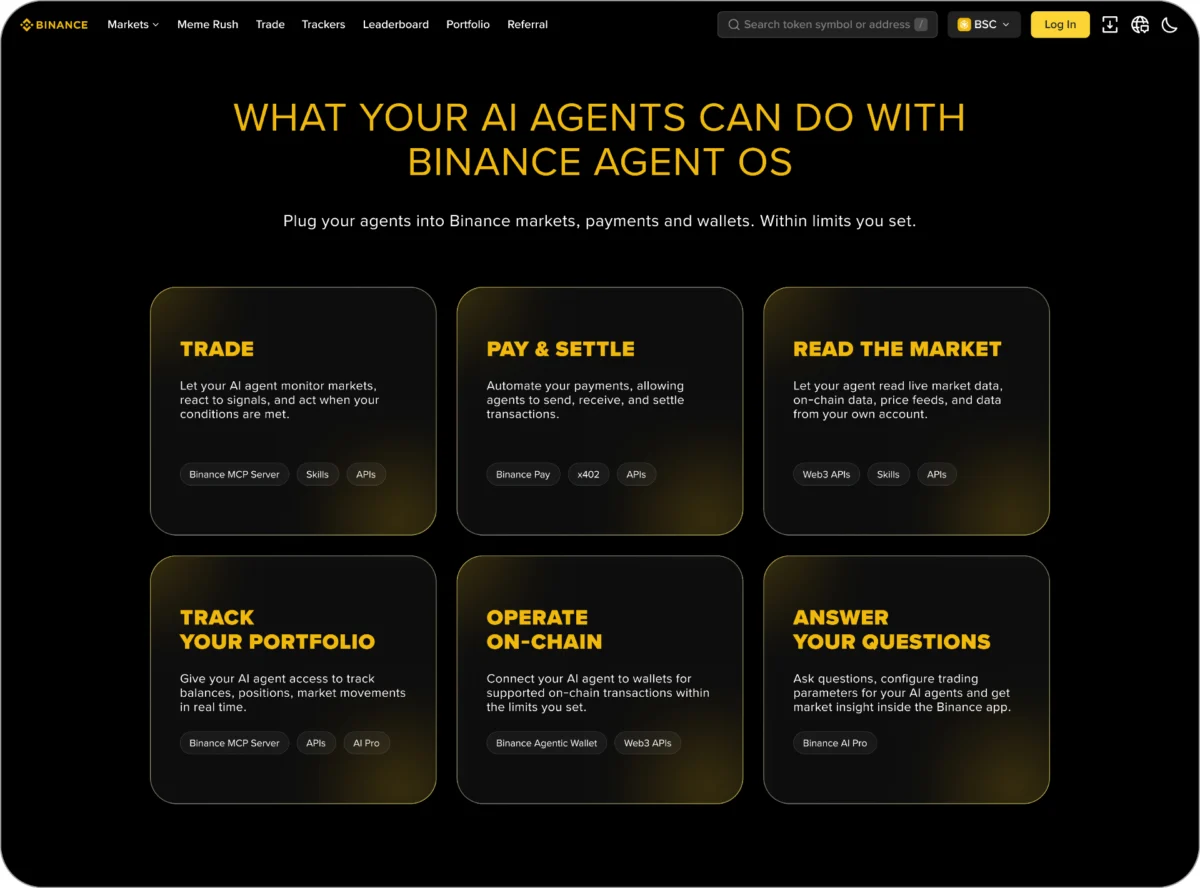
Binance, the world’s largest cryptocurrency exchange by trading volume and user base, has officially unveiled Agent OS, a specialized infrastructure designed to integrate autonomous artificial intelligence agents directly into its financial ecosystem. The platform represents a significant shift in the digital asset industry, moving beyond simple automated trading bots toward sophisticated AI entities capable of analyzing complex market data, managing portfolios, and executing transactions on behalf of users. By providing a bridge between large language models (LLMs) and the exchange’s deep liquidity and financial tools, Binance is positioning itself at the forefront of the burgeoning "agentic economy."
The Architecture of Agentic Trading
Agent OS is structured as a comprehensive development environment that allows programmers to link AI applications to Binance’s core financial services. The platform integrates several of the exchange’s existing high-performance tools, including Binance APIs, the Binance Wallet Agentic Hub, and the Binance Skill Hub. A cornerstone of this new release is the integration of the Model Context Protocol (MCP), an open standard that enables AI models to seamlessly access data sources and tools across different platforms.
The technical versatility of Agent OS allows it to work with leading AI frameworks and development tools, including OpenAI’s ChatGPT and Codex, Anthropic’s Claude Code, and the AI-integrated code editor Cursor. By utilizing these connections, users can authorize AI agents to perform a variety of high-level tasks: monitoring real-time market fluctuations, retrieving account balances, and executing spot or futures trades based on pre-defined or autonomously generated strategies.
Unlike traditional algorithmic trading, which follows rigid, "if-then" logic, AI agents powered by LLMs can process unstructured data—such as news sentiment, social media trends, and complex technical patterns—to make nuanced decisions. The launch of Agent OS aims to democratize access to these sophisticated strategies, which were previously the exclusive domain of high-frequency trading firms and institutional hedge funds.
Security Framework and the Sandbox Strategy
The introduction of autonomous agents into financial environments brings inherent risks, particularly regarding the potential for runaway trades or security breaches. To address these concerns, Binance has implemented a "sandbox" approach centered on the use of dedicated subaccounts.
Jeff Li, Vice President of Product at Binance, emphasized that the platform is designed to maintain user sovereignty over funds. "Instead of total freedom, we put the power in users’ hands to give them the granular access control of what they can do through the agent," Li stated. "We put [the control] at the account level to protect the users’ funds."
Under this framework, users can assign an AI agent to a specific subaccount rather than their primary wallet. By default, withdrawal capabilities from these subaccounts are disabled, ensuring that even if an agent is compromised or malfunctions, it cannot drain the user’s entire holdings. Furthermore, users retain the ability to set specific permissions, deciding whether an agent requires manual approval for every trade or is permitted to operate with full autonomy within set parameters.
While Binance does not impose a global cap on the total volume an agent can trade within a subaccount, the amount of capital a user transfers into that account serves as the effective hard limit. This allows for flexible risk management tailored to the individual user’s appetite for exposure.
Technical Constraints and the Reasoning Gap
One of the most notable aspects of Agent OS is the "black box" nature of the AI’s decision-making process. Because the actual "reasoning" or computation performed by the AI occurs on the user’s local machine or within the infrastructure of the AI provider (such as OpenAI or Anthropic), Binance has limited visibility into why a specific trade was initiated.
Li acknowledged this limitation, noting that Binance can monitor the resulting activity on the blockchain or the exchange’s order book but cannot see the underlying logic. This creates a unique challenge in the event of a "prompt-injection" attack—a technique where malicious actors manipulate an AI’s instructions to force it to perform unintended actions. To counter this, Binance relies on its existing suite of security and risk-control protocols, including anti-money laundering (AML) monitoring and real-time transaction analysis, which are applied to all Agent OS activities at launch.
Beyond Trading: Payments and DeFi Integration
While market speculation is the primary use case for Agent OS at launch, the platform’s capabilities extend into the broader realm of decentralized finance (DeFi) and machine-to-machine payments. Through the integration of the x402 transaction verification and payment facilitator API, AI agents can send and settle payments autonomously.
The Agentic Wallet feature allows these agents to interact with on-chain protocols, facilitating token swaps and participation in DeFi yield strategies. To prevent large-scale errors or exploits in these more volatile environments, Binance has instituted specific daily transaction limits:
- Regular Token Swaps: Capped at $50,000 per day.
- DeFi Transactions: Subject to a default $100,000 daily limit.
- x402 Payments: Restricted to a conservative $20 per day.
These limits reflect a cautious approach to the integration of AI into decentralized ecosystems, where transactions are often irreversible and smart contract vulnerabilities remain a persistent threat.
A Chronology of the AI-Crypto Convergence
The launch of Agent OS is the culmination of a multi-year trend where the paths of artificial intelligence and blockchain technology have increasingly intersected.
- 2023: Major exchanges began integrating AI into customer support and basic market analysis tools. Binance introduced "Binance Sensei," an AI-powered learning assistant.
- Early 2024: The industry shifted toward "Agentic" frameworks. Developers began building "wrappers" that allowed LLMs to interact with Web3 wallets.
- March 2024: Kraken launched its open-source command-line tool with a built-in MCP server, marking one of the first major moves into agentic infrastructure.
- June 2024: Coinbase announced "Coinbase for Agents," focusing on giving AI entities the ability to "work" and earn in the crypto economy.
- Late 2024: OKX released its Agent Trade Kit, further intensifying the competition among the "Big Three" exchanges to capture the AI developer market.
Binance’s entry with Agent OS signifies the maturation of this sector, as the world’s largest liquidity provider provides a formalized, scalable path for AI-driven finance.

The Competitive Landscape
Binance is entering a field that is rapidly becoming crowded with rival offerings. The competition is not just about which exchange has the best AI tools, but which one can offer the most seamless integration with the existing AI developer ecosystem.
Kraken’s approach has focused on open-source accessibility, appealing to developers who prioritize transparency and customization. Coinbase, meanwhile, has leaned into the "on-chain" narrative, positioning its agents as participants in a new digital economy where AI agents can pay each other for services using stablecoins.
Binance’s strategy appears to be one of "comprehensive integration." By combining its massive internal toolset (APIs, Wallet, Skill Hub) with external standards like MCP, Binance is attempting to create a "one-stop shop" for AI developers. The exchange’s 300 million users represent a massive potential market for developers who can build successful, reliable trading agents.
Broader Implications and Future Outlook
The rise of autonomous AI agents in crypto markets carries profound implications for market dynamics. As more trading volume is driven by AI, market efficiency may increase, but so too could the risk of flash crashes if multiple agents react simultaneously to the same data signals.
Furthermore, the regulatory landscape for AI agents remains largely unwritten. Questions regarding liability—who is responsible if an AI agent commits market manipulation or violates securities laws?—remain at the forefront of legal discussions. By placing the "power in users’ hands" and requiring them to configure specific permissions, Binance is likely attempting to mitigate its own regulatory exposure, framing the AI as a tool used by the consumer rather than a service managed by the exchange.
Looking forward, Jeff Li described Agent OS as a "first step" in a broader journey. The long-term vision involves a seamless ecosystem where AI-powered applications can act across both crypto and traditional financial markets, blurring the lines between software and financial advisor.
As the technology evolves, the industry may see the emergence of "Agent-as-a-Service" (AaaS) models, where successful traders lease their fine-tuned AI agents to others on the Binance platform. For now, the launch of Agent OS stands as a landmark event, signaling that the era of human-only trading is rapidly drawing to a close, replaced by a high-speed, data-driven landscape where the most successful participants may not be humans at all, but the agents they deploy.