admin
Google Cloud is pioneering a significant advancement in digital asset security infrastructure, announcing a new multi-party computation (MPC) based custody system designed to safeguard cryptocurrency holdings for banks and financial institutions. This initiative, dubbed "Google Multi-Party Compute," represents a strategic move by the tech giant to address escalating concerns over private-key theft, the growing sophistication of AI-driven cyberattacks, and the long-term, theoretical threats posed by future quantum computers. Currently in a private preview phase with a select group of institutional partners, the service is slated for commercial availability in early 2027, positioning Google as a pivotal player in the evolving landscape of institutional crypto adoption.
The announcement precedes the Digital Asset Security and Multi-Party Computation Symposium in New York, scheduled for October 28, where the technology is expected to be a key topic of discussion. Alphabet, Google’s parent company, has reportedly already integrated MPC into its internal operations, utilizing the technology to protect its own digital asset holdings across prominent blockchain networks such as Ethereum and Solana. This internal validation underscores the company’s confidence in the robust security framework offered by MPC.
The Core Innovation: Multi-Party Computation for Digital Asset Protection
At the heart of Google’s new offering is Multi-Party Computation (MPC), a cryptographic protocol that enables multiple parties to collectively compute a function over their private inputs without revealing any of those inputs to each other. In the context of digital asset custody, this translates into a revolutionary approach to private key management. Traditionally, controlling a cryptocurrency asset hinges on the security of its corresponding private key. If this singular key is compromised, attackers can gain unauthorized access and transfer funds, with blockchain transactions typically irreversible once confirmed. For financial institutions managing substantial digital asset reserves, a single point of failure in private key security poses an unacceptable level of risk, potentially leading to catastrophic financial losses.
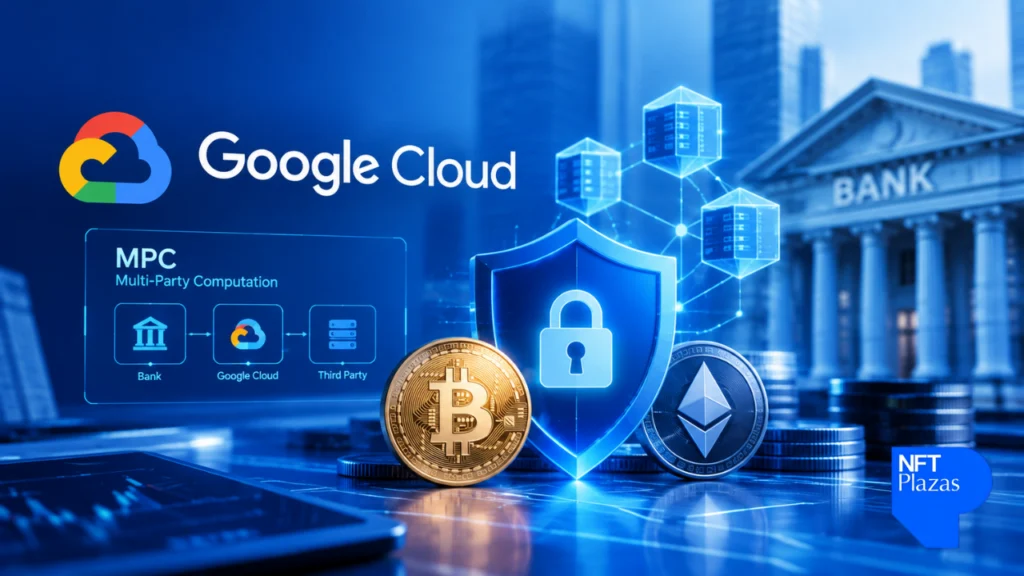
Google’s MPC system fundamentally mitigates this risk by fragmenting the cryptographic key into multiple shares. Instead of storing a complete private key in one vulnerable location, these shares are distributed across separate, independent environments. For example, a financial institution could maintain one key share within its own secure on-premise infrastructure, another securely managed within Google Cloud’s distributed network, and a third potentially held by an entirely separate, trusted third-party provider. When a digital asset transaction requires authorization, these disparate key shares collaborate cryptographically to generate a valid digital signature. Crucially, this process occurs without ever reconstructing the complete private key in any single location, thereby eliminating the single point of compromise that traditional key management systems often present. This distributed approach significantly enhances resilience, making it exponentially harder for a successful attack on one component to expose an institution’s entire crypto portfolio.
Beyond foundational key security, Google emphasizes that customers retain ultimate control over their key shares. The company asserts that it cannot access the unencrypted key shares residing on its cloud infrastructure, reinforcing a critical trust model. Furthermore, the MPC system is engineered to support sophisticated transaction controls, which are paramount for institutional compliance and risk management. These features include customizable spending limits, pre-approved destination addresses for transfers, and the integration of internal multi-factor authorization procedures. Such granular controls empower institutions to establish rigorous governance frameworks, clearly defining who can approve transfers and under what specific conditions, thereby aligning digital asset operations with established internal audit and compliance protocols.
However, it is vital to acknowledge that while MPC drastically elevates security, it does not entirely eliminate all potential risks. The efficacy of the system is inherently linked to the careful implementation and management by the participating institutions. This includes the strategic distribution of key shares, meticulous configuration of permissions, and robust management of authorization workflows. Should a sufficient number of authorized participants or their individual key shares be compromised through sophisticated social engineering or internal breaches, attackers could theoretically still execute unauthorized transactions. Therefore, MPC functions as a powerful layer of defense, but it must be integrated within a broader, holistic security strategy that accounts for human factors and operational procedures.
The Evolving Threat Landscape: AI, Quantum, and the Urgent Need for Resilience
Google’s foray into institutional crypto custody arrives at a critical juncture, as the cybersecurity landscape is being rapidly reshaped by transformative technologies, notably Artificial Intelligence. AI is proving to be a double-edged sword: while it offers powerful tools for security researchers to proactively identify vulnerabilities and bolster defenses, it simultaneously empowers malicious actors with unprecedented capabilities. Attackers can leverage advanced AI algorithms to rapidly identify software vulnerabilities, automate vast segments of their operational kill chain, and craft highly convincing phishing scams and deepfakes for social engineering attacks that are increasingly difficult for human targets to discern.
Recent discoveries underscore the escalating nature of these threats. Security researchers have continually unearthed critical vulnerabilities within various blockchain systems, such as a notable issue identified in the XRP Ledger that, if unaddressed, could have permitted the unauthorized creation of tokens, highlighting the constant need for vigilance and rapid patching in decentralized systems. Furthermore, prominent figures in the crypto space, including Ethereum co-founder Vitalik Buterin, have voiced concerns that AI-accelerated mathematical research could potentially weaken certain cryptographic systems sooner than current projections anticipate. Buterin has urged the industry to broaden its defensive posture, not solely focusing on the distant threat of quantum computing, but also on the more immediate possibility that AI could dramatically accelerate cryptanalytic attacks against algorithms currently considered robust and secure.
For financial institutions, these developments translate into an imperative for increasingly sophisticated and adaptive security strategies. Protecting digital assets extends far beyond merely securing private keys; it encompasses comprehensive permission management, real-time transaction monitoring, robust incident response protocols, and the ability to rapidly adapt when credentials or systems are compromised. Google’s MPC framework directly addresses a significant part of this multifaceted challenge by distributing signing authority across multiple environments, thereby creating a formidable barrier against unauthorized transfers stemming from a single point of failure or compromise.
The Horizon Threat: Quantum Computing and Cryptographic Resilience
Beyond the immediate challenges posed by AI, the long-term, theoretical threat of quantum computing continues to loom large over the digital asset landscape. A sufficiently powerful, fault-tolerant quantum computer could, in principle, undermine several fundamental cryptographic methods that currently secure digital assets, including the elliptic curve cryptography (ECC) used by Bitcoin and Ethereum, as well as the RSA encryption commonly used in internet security. While no quantum computer has yet demonstrated the ability to break current cryptographic standards at scale, researchers are actively modeling and examining which existing digital asset holdings could become vulnerable as quantum technology advances.

Estimates from previous research, for instance, suggest that approximately 6.9 million Bitcoin could face potential quantum-related risks due to the exposure of their public keys after initial transactions. It is crucial to contextualize this figure: it does not imply that these Bitcoin can be stolen today. The risk is contingent on two major factors: the future development of sufficiently powerful quantum computers capable of executing Shor’s algorithm efficiently, and the implementation of robust post-quantum cryptographic protections before such a capability emerges. Bitcoin held in addresses where the public key has never been revealed (e.g., those using SegWit or Taproot in certain ways) are generally considered more resilient against known quantum attacks, as Shor’s algorithm primarily targets the public-key to private-key derivation.
MPC, while enhancing resilience against credential compromise, does not inherently render a wallet or its underlying cryptographic algorithms resistant to quantum attacks. Its strength lies in key distribution and transaction authorization, not in replacing the cryptographic primitives themselves. Therefore, Google’s longer-term security strategy for its MPC system, and for the digital asset industry at large, will necessitate continuous cryptographic upgrades. This includes the eventual integration of post-quantum cryptographic (PQC) techniques, which are actively being developed and standardized by bodies like NIST (National Institute of Standards and Technology) to resist attacks from quantum computers. The transition to PQC will be a monumental undertaking for the entire digital infrastructure, and platforms like Google’s MPC will need to be adaptable to these future cryptographic evolutions.
Institutional Imperative: The Maturation of Digital Asset Custody
The institutional adoption of digital assets has accelerated dramatically over the past few years, transforming what was once a niche market into a rapidly expanding sector of mainstream finance. Major financial institutions, including investment banks, asset managers, hedge funds, and even traditional commercial banks, are increasingly exploring or actively engaging with cryptocurrencies, stablecoins, and tokenized assets. This surge in interest is driven by a confluence of factors: the pursuit of new investment opportunities, the potential for enhanced efficiency through blockchain technology, and the growing demand from clients for exposure to digital assets.
This institutional pivot brings with it an unprecedented demand for enterprise-grade infrastructure that can meet stringent requirements for security, regulatory compliance, operational efficiency, and scalability. The global market for institutional digital asset custody is projected to grow significantly, with some estimates placing it at billions of dollars within the next few years. For these institutions, robust custody is not merely about "safely storing" assets; it is an foundational operational layer that supports a wide array of activities, including trading, lending, staking, settlement, and the broader integration of blockchain technology into existing financial services workflows.
Regulatory scrutiny is also intensifying globally. Bodies such as the Basel Committee on Banking Supervision, the U.S. Securities and Exchange Commission (SEC), and the European Union’s Markets in Crypto-Assets (MiCA) regulation are developing frameworks to govern digital asset activities, including custody. These regulations often demand rigorous internal controls, capital adequacy requirements, segregation of client assets, robust cybersecurity measures, and comprehensive audit trails. A custody solution like Google’s MPC, with its inherent distributed security and granular control features, directly addresses many of these regulatory and operational challenges, providing a compelling proposition for risk-averse institutions. Industry analysts suggest that Google’s entry into this specialized field validates the pressing institutional demand for highly secure, enterprise-grade digital asset infrastructure, while simultaneously raising the competitive bar for existing providers.
A Competitive Landscape and Google’s Strategic Positioning
Google’s entry into the institutional digital asset custody market places it squarely against established and formidable players who have been innovating in this space for years. Companies such as Fireblocks, BitGo, Fordefi, Anchorage Digital, and Coinbase Prime have built sophisticated custody infrastructure and transaction security tools tailored specifically for institutional clients. These incumbents offer a range of solutions, from secure multi-signature wallets and hardware security modules (HSMs) to comprehensive workflow orchestration platforms that integrate with various trading venues and DeFi protocols.
Google’s unique competitive advantage lies primarily in its unparalleled global cloud infrastructure, its deep expertise in cybersecurity and cryptography, and its extensive existing relationships with large enterprises across various sectors. For financial institutions already heavily reliant on Google Cloud for other critical operations, integrating digital asset custody within the same ecosystem could offer significant benefits in terms of operational synergy, simplified management, and potentially reduced integration costs. The trusted brand recognition of Google, coupled with its proven track record in enterprise technology, could also appeal to risk-averse financial firms seeking a reputable partner for their digital asset ventures.
However, Google will face challenges. It must demonstrate that its MPC offering provides distinct advantages over mature, purpose-built solutions from companies like Fireblocks, which boast significant market share and have spent years developing specialized features for crypto-native institutional workflows. Key factors for Google’s success will include its pricing model, the full scope of its commercial capabilities upon launch, and its ability to seamlessly integrate with diverse blockchain networks and existing institutional financial systems. Moreover, Google will need to navigate the evolving regulatory landscape, potentially requiring specific licenses or compliance certifications in different jurisdictions, an area where some incumbent crypto custodians have already established a strong foothold.
Roadmap and Broader Implications for the Future of Digital Finance
The timeline for Google Multi-Party Compute indicates a phased rollout: a private preview currently underway, leading to commercial availability in early 2027. This extended development and testing period suggests a meticulous approach to ensure the system meets the demanding security and reliability standards required by major financial institutions. The October 28 symposium serves as an important platform for Google to further articulate its vision and engage with key stakeholders in the digital asset security community.
Ultimately, Google’s MPC initiative is more than just a new product; it reflects a broader and profound shift in the architecture of digital asset security. As financial institutions increasingly integrate digital assets into their core operations, the imperative to distribute control, enforce robust transaction oversight, and proactively prepare for emerging threats from AI and quantum computing becomes paramount. The involvement of a technology titan like Google signals a significant maturation of the digital asset space, underscoring its growing importance to the global financial system.
The success of Google in establishing itself as a major custody provider will hinge on several critical factors: the demonstrable reliability and security of its MPC framework in real-world institutional environments, its ability to meet the complex and evolving regulatory requirements across diverse jurisdictions, and its capacity to offer a competitive and comprehensive suite of features that address the specific needs of financial institutions. Nevertheless, this development unmistakably signals that major technology companies are increasingly recognizing digital asset protection not as a fringe concern, but as a critical and integral component of the financial system’s ongoing evolution, paving the way for a more secure and resilient future for digital finance.