admin
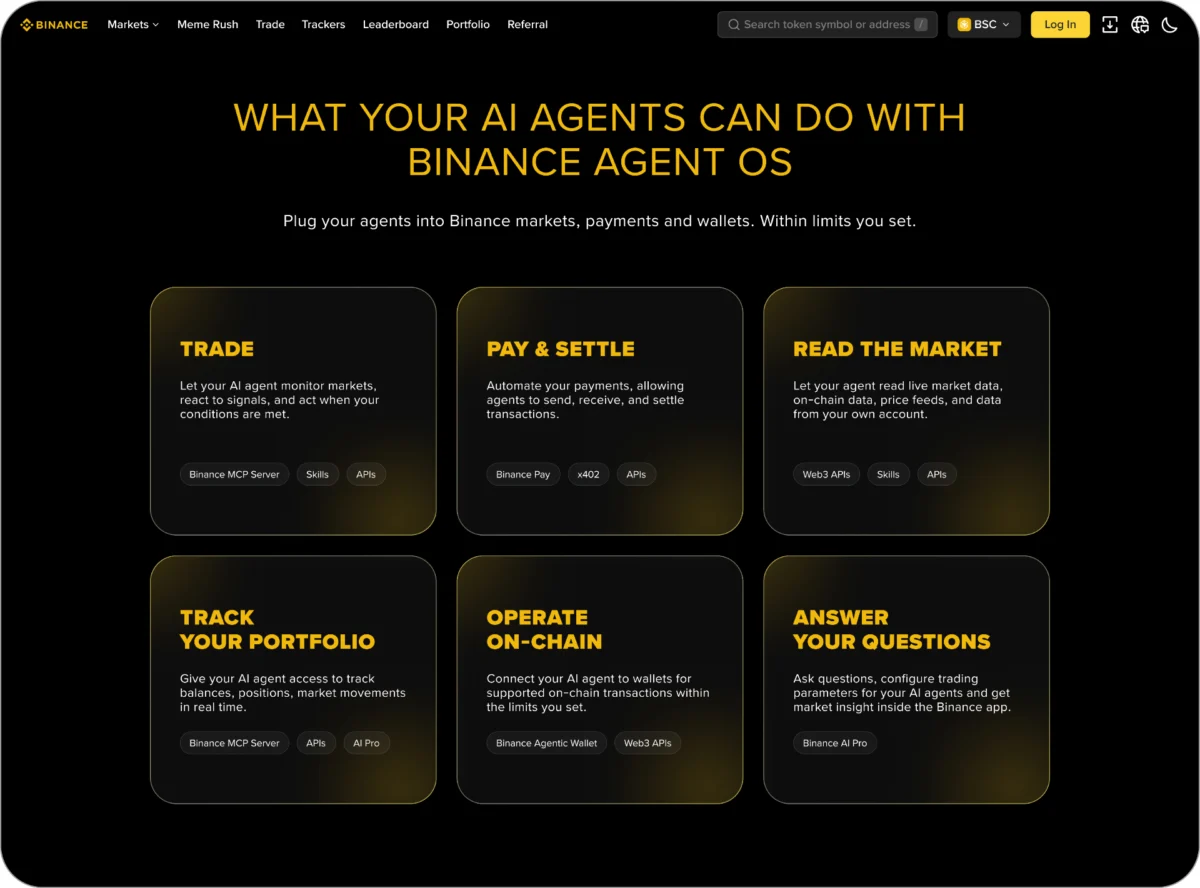
Binance, the world’s largest cryptocurrency exchange by trading volume, announced on Thursday the official launch of Agent OS, a specialized platform designed to allow artificial intelligence (AI) agents to analyze markets and execute financial transactions autonomously. The move signals a major shift in the digital asset landscape, moving beyond simple AI-assisted chatbots toward "agentic" systems capable of managing real capital and navigating complex financial ecosystems without constant human intervention. With a registered user base exceeding 300 million, Binance’s entry into the autonomous AI space provides a significant infrastructure boost to a nascent industry that seeks to merge large language models (LLMs) with high-frequency financial markets.
The Architecture of Agent OS: A Technical Overview
Agent OS is designed as a comprehensive development environment that allows software engineers to connect AI applications directly to Binance’s vast liquidity and financial tools. The platform is not a standalone AI model; rather, it serves as a sophisticated middleware layer. It integrates several of the exchange’s existing technological pillars, including Binance APIs and the Binance Wallet Agentic Hub, with newly developed protocols specifically tailored for autonomous agents.
A central component of the new platform is the integration of the Model Context Protocol (MCP). Developed as an open standard, MCP enables AI agents to maintain a consistent "context" when interacting with different data sources and tools. This allows an agent to seamlessly pull real-time market data from Binance, cross-reference it with external news feeds or proprietary datasets, and then act upon that information using the exchange’s execution engine.
Furthermore, Agent OS provides native support for several of the industry’s leading AI development tools. Developers can authorize agents built on OpenAI’s ChatGPT and Codex, Anthropic’s Claude Code, and the AI-powered code editor Cursor to access specific account permissions. Through these integrations, agents can perform a variety of tasks, including viewing account balances, monitoring order books, and executing buy or sell orders across various trading pairs.
Risk Management and the "Sandbox" Strategy
As AI moves from passive information retrieval to active financial management, the risks associated with autonomous trading have come to the forefront of industry discussions. Binance has addressed these concerns by placing the burden of oversight and granular control squarely on the user. The primary mechanism for this protection is the use of "subaccounts."
Jeff Li, Vice President of Product at Binance, emphasized in a recent interview that the platform was built with a "safety-first" philosophy. "Instead of total freedom, we put the power in users’ hands to give them granular access control of what they can do through the agent," Li stated. "We put [the control] at the account level to protect the users’ funds."
In practice, this means that an AI agent does not have access to a user’s primary Binance account. Instead, users create dedicated subaccounts that function as isolated sandboxes. These subaccounts can be restricted to specific activities, such as spot trading or futures contracts, while withdrawals are blocked by default. This ensures that even if an AI agent malfunctions or is compromised, the potential damage is limited to the funds specifically allocated to that subaccount.
Additionally, users can toggle between different levels of autonomy. An agent can be configured to require manual approval for every trade it proposes, or it can be granted full autonomy to execute strategies based on pre-set parameters. Notably, Binance does not impose its own loss-limit caps on these agents; the user-defined balance within the subaccount serves as the effective hard limit for any potential losses.
The Challenge of the "Reasoning Gap"
One of the most complex aspects of the AI-financial interface is the lack of transparency regarding an AI’s decision-making process. Because the "reasoning" behind a trade happens within the LLM—such as a model hosted by OpenAI or Anthropic—Binance cannot see why an agent chose a specific action.
"We really cannot see the reasoning of what the user’s action is," Li explained. This creates what some analysts call a "reasoning gap." While Binance can monitor the resulting trade activity for signs of market manipulation or violations of anti-money laundering (AML) policies, it has limited visibility into whether a decision was based on sound financial analysis, faulty data, or a "prompt injection" attack—a technique where an AI is tricked into following malicious instructions hidden within its input data.
To mitigate these risks, Binance has stated that its existing security and risk-control frameworks will be applied to all Agent OS activities. This includes real-time monitoring for suspicious patterns and the enforcement of global compliance standards. However, the company maintains that the ultimate responsibility for the agent’s logic and performance remains with the developer and the end-user.
A Growing Trend: The Chronology of Agentic Trading
Binance’s launch of Agent OS is the latest milestone in a rapidly accelerating trend across the cryptocurrency sector. Throughout 2024 and early 2025, several major exchanges have released tools aimed at empowering AI agents.
- March 2024: Kraken launched an open-source command-line interface (CLI) tool featuring a built-in MCP server. This allowed developers to script AI agents capable of executing spot and futures trades directly through Kraken’s infrastructure.
- June 2024: Coinbase introduced "Coinbase for Agents." This initiative focused on connecting AI to the "on-chain" economy, allowing agents to hold crypto wallets, make payments to other agents, and interact with decentralized finance (DeFi) protocols.
- Late 2024: OKX released its "Agent Trade Kit," an open-source toolkit designed to bridge the gap between LLMs and high-frequency trading APIs.
- Thursday, Current Week: Binance enters the fray with Agent OS, offering what is arguably the most comprehensive suite of integrated tools, leveraging its massive liquidity pool and global user base.
This chronology suggests a broader industry realization: the future of retail and institutional trading may not be human-led. As the speed of crypto markets continues to outpace human cognitive limits, the demand for autonomous systems that can operate 24/7 has become a competitive necessity for global exchanges.

Expanding Use Cases: Beyond Simple Trading
While market analysis and trade execution are the primary focus of Agent OS at launch, Binance envisions a much broader scope for the platform. The integration of the "x402" transaction verification and payment facilitator API allows agents to move beyond the exchange and into the realm of general commerce and payments.
The Agentic Wallet, a core feature of the platform, enables agents to interact with decentralized finance (DeFi) protocols. This opens the door for AI to manage complex yield-farming strategies, provide liquidity to decentralized exchanges, or manage collateral in lending protocols. To maintain safety in these less-regulated environments, Binance has implemented strict daily transaction limits for the Agentic Wallet:
- Regular Swaps: Capped at $50,000 per day.
- DeFi Transactions: Default limit of $100,000 per day.
- x402 Payments: Limited to $20 per day (intended for micro-payments and service fees).
These limits suggest that while Binance is encouraging innovation, it is taking a cautious approach to the "agent-to-agent" economy, where AI systems pay each other for data or processing power.
Implications for the Future of Finance
The launch of Agent OS carries significant implications for the structure of financial markets. First, it democratizes access to sophisticated algorithmic trading. Historically, high-frequency and autonomous trading were the exclusive domain of large hedge funds and institutional players with the resources to build proprietary execution engines. By providing the infrastructure and connecting it to accessible LLMs like ChatGPT, Binance is putting these tools into the hands of individual developers and retail traders.
Second, the move could lead to a surge in market volatility or "flash" events if large numbers of AI agents react simultaneously to the same data signals. The "reasoning gap" mentioned by Jeff Li suggests that if multiple agents are using the same underlying model (e.g., GPT-4o), they may exhibit herd behavior, magnifying market movements in ways that are difficult for humans to counteract in real-time.
Finally, the regulatory landscape remains a significant wildcard. Global regulators, including the SEC in the United States and ESMA in Europe, have expressed growing concern over the use of AI in finance. Issues regarding liability—who is responsible when an AI makes a trade that violates securities laws?—remain largely unsettled. By emphasizing user control and subaccount isolation, Binance appears to be positioning itself as a neutral infrastructure provider, shifting the legal and financial liability to the users who deploy the agents.
Conclusion
Binance’s Agent OS represents a pivotal moment in the convergence of artificial intelligence and blockchain technology. By providing a standardized platform for AI to interact with real-world capital, Binance is not just launching a new product; it is helping to define the parameters of "Agentic Finance." As the platform matures, the success of this initiative will likely depend on how well the industry balances the undeniable efficiency of autonomous agents with the critical need for security, transparency, and regulatory compliance. For now, the world’s largest exchange has sent a clear signal: the era of the human-only trader is drawing to a close.