Dwi Wanna
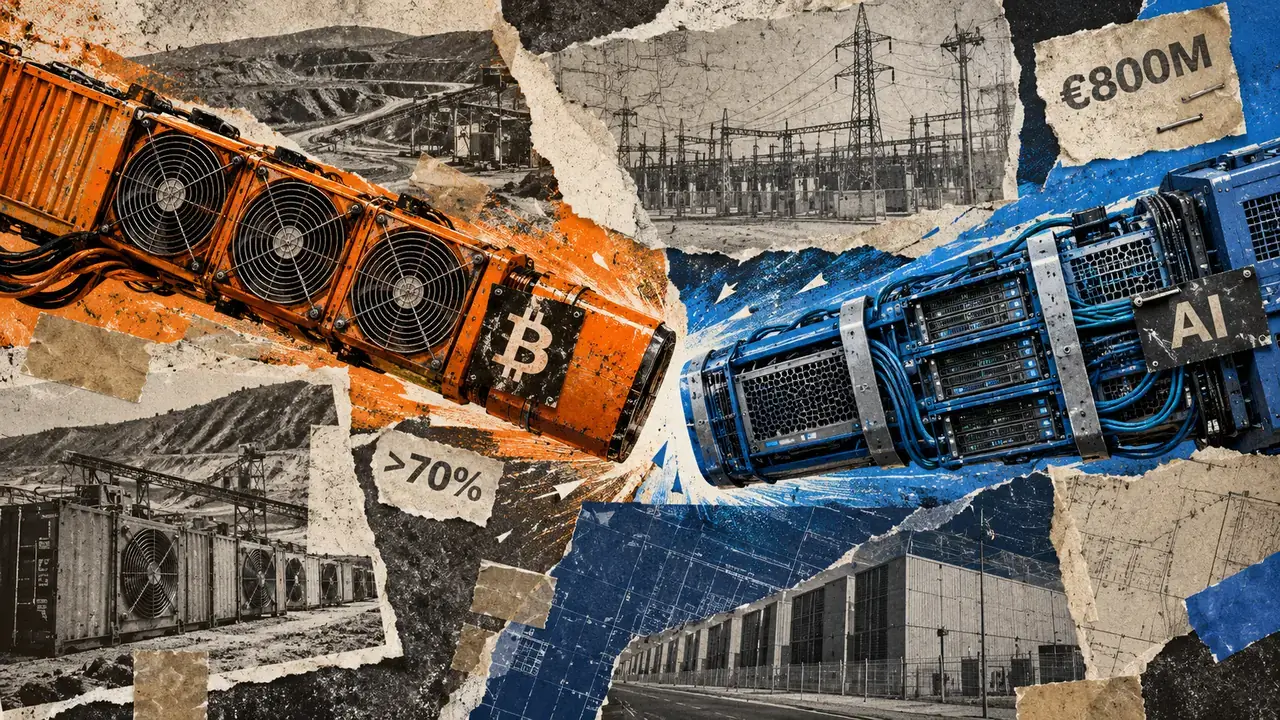
SWI Group, the Amsterdam-listed digital infrastructure conglomerate, has successfully closed an €800 million capital increase aimed at fueling its ambitious transition from cryptocurrency mining toward artificial intelligence (AI) and high-performance computing (HPC). Announced on Oct. 12, the financing round was heavily oversubscribed by institutional investors, a move that elevates the group’s total valuation to approximately €6.1 billion. This latest injection of capital brings the total equity raised by the firm since March to over €1 billion, signaling a robust appetite among institutional financiers for infrastructure assets that bridge the gap between traditional energy management and the burgeoning demand for generative AI processing power.
The primary objective of this massive capital deployment is the redevelopment of SWI’s global data center portfolio, with a specific focus on its operations in Europe and the United States. Central to this strategy is the total repurposing of Genesis Digital Assets (GDA), a former flagship investment of the now-defunct Alameda Research, the trading arm of the collapsed FTX exchange. SWI Group, which consolidated control of GDA earlier this year, intends to leverage the firm’s significant power-connected sites to build a foundation for specialized AI cloud services.
Strategic Consolidation and the Rebirth of Genesis Digital Assets
The transformation of Genesis Digital Assets represents one of the most significant pivots in the digital infrastructure sector following the 2022 crypto market contagion. Between 2021 and 2022, Alameda Research funneled approximately $1.15 billion into Genesis, at a time when the miner was valued at roughly $5.5 billion. Following the high-profile collapse of FTX in November 2022, these assets became the center of a protracted legal battle.
The FTX recovery trust initially filed a lawsuit seeking to reclaim the $1.15 billion, alleging that the funds were improperly transferred by Alameda leadership. However, after years of restructuring and negotiations, the trust dismissed the lawsuit in June 2026, clearing the path for SWI Group to finalize its takeover. By August, SWI had completed a series of share purchases and debt restructurings that granted it a stake exceeding 70% in the company.
Under the new roadmap, Genesis will be rebranded as SWI Digital. This new entity will move away from the volatile margins of Bitcoin mining to focus on the more stable and lucrative market for enterprise-grade computing. SWI’s leadership has confirmed that the rebranding is not merely cosmetic; it involves a fundamental overhaul of the physical infrastructure at these sites to meet the rigorous cooling and power redundancy requirements of modern AI workloads.
The Financial Logic of the AI Pivot: Profitability and Valuations
The decision to redirect capital from Bitcoin mining to AI infrastructure is driven by a stark divergence in financial performance metrics. According to data from the CoinShares second-quarter 2026 mining report, the revenue potential of AI computing infrastructure far outstrips that of traditional Proof-of-Work mining. Current estimates suggest that AI infrastructure can generate an annualized profit of approximately $1.5 million per megawatt (MW). In contrast, Bitcoin mining yields roughly $500,000 per MW—a threefold difference that has fundamentally altered the investment thesis for companies holding large-scale power interconnections.
This profitability gap has led to a massive revaluation of publicly traded companies in the space. Investors are increasingly valuing these firms as "power-play" real estate entities rather than mere crypto miners. During the second quarter of 2026, mining companies that successfully signaled a shift toward AI infrastructure—such as Hut 8, Cipher Mining, TeraWulf, and Core Scientific—saw their stock prices surge between 70% and 195%.
Market analysis shows that companies focused on AI infrastructure are currently trading at an average of 19.4 times forward sales. This is nearly triple the 6.6 times forward sales multiple assigned to companies that remain strictly focused on Bitcoin mining. For SWI Group, the €800 million raise is a calculated move to capture this valuation premium while securing the necessary hardware to service long-term enterprise contracts.
Infrastructure Scale and the 4-Gigawatt Portfolio
SWI Group’s competitive advantage lies in the sheer scale of its energy footprint. The company previously disclosed that its combined European and American portfolio exceeds 4 gigawatts (GW) of power capacity. To put this in perspective, 4 GW is enough to power millions of homes, or more pertinently, to host hundreds of thousands of high-end GPUs, such as the NVIDIA H100 and Blackwell series.
The group has already allocated more than 80% of its capital to the digital infrastructure sector, emphasizing its commitment to becoming a primary landlord for the AI era. Max-Hervé George, Chief Executive of SWI Group, noted that the fundraising would allow the company to expand in lockstep with the "insatiable" demand for computing capacity.
"We are no longer just an infrastructure owner; we are becoming a full-stack computing provider," George stated in a release following the capital increase. This shift includes the development of a proprietary AI cloud platform. By moving up the value chain—offering not just the space and power, but also the computing services for developers and enterprises—SWI aims to secure higher-margin recurring revenue.
The High Cost of Conversion: Engineering and Capital Requirements
While the transition from Bitcoin mining to AI sounds lucrative on paper, the physical execution is both capital-intensive and technically demanding. Converting a facility designed for mining to one capable of hosting AI workloads is not a simple "plug-and-play" process.
According to industry benchmarks, the development of AI-grade data centers from existing mining sites costs between $8 million and $15 million per megawatt. This is a massive increase compared to the $700,000 to $1 million per megawatt typically spent on basic Bitcoin mining infrastructure. The discrepancy arises from several critical factors:
- Cooling Systems: Bitcoin miners often use ambient air cooling, which is insufficient for the heat density generated by AI chips. AI facilities require advanced liquid cooling or specialized HVAC systems to maintain operational stability.
- Power Redundancy: Bitcoin mining is "interruptible" load, meaning miners can shut down during peak grid demand. AI clients, particularly enterprises and government agencies, require Tier III or Tier IV redundancy, ensuring 99.99% uptime.
- Connectivity: AI training and inference require ultra-low latency and massive fiber-optic bandwidth to move large datasets, a requirement rarely found in remote mining outposts.
SWI Group has not yet disclosed the specific timeline for the conversion of individual Genesis sites, nor has it detailed the exact allocation of the €800 million toward hardware procurement versus facility retrofitting. However, the scale of the capital raise suggests the company is preparing for a multi-year engineering phase.
Broader Market Implications and Execution Risks
The broader digital infrastructure market is currently witnessing a "land grab" for power. As the global energy grid faces constraints, companies like SWI that already possess multi-gigawatt interconnections hold a significant strategic advantage. However, the industry faces a looming "revenue gap."
CoinShares’ research indicates that while there are over $100 billion in disclosed AI computing contracts across the sector, these contracts have so far translated into only about $1.1 billion in annualized revenue. Currently, only about 550 megawatts of capacity are actively generating billings against more than 4 gigawatts of contracted capacity. This suggests that while the valuation of these companies has skyrocketed based on future potential, the actual delivery of services is still in its infancy.
For SWI Group, the challenge will be to bridge this execution gap. The company must navigate the global semiconductor supply chain to secure high-end GPUs and complete complex infrastructure upgrades while maintaining the confidence of its institutional investors.
Chronology of the SWI-Genesis Integration
The path to this €800 million milestone has been marked by several key events over the past four years:
- 2021-2022: Alameda Research invests $1.15 billion in Genesis Digital Assets, positioning it as a premier global miner.
- November 2022: FTX and Alameda Research file for bankruptcy; Genesis assets are frozen in legal limbo.
- March 2024: SWI Group begins its capital-raising cycle, securing the first tranche of what would become a €1 billion equity drive.
- June 2026: The FTX recovery trust officially drops its $1.15 billion lawsuit against Genesis, removing the primary legal hurdle for acquisition.
- August 2026: SWI Group completes the acquisition of a >70% stake in Genesis through a series of secondary market purchases and restructuring deals.
- October 12, 2026: SWI Group announces the €800 million capital increase to fund the "SWI Digital" rebranding and AI pivot.
Conclusion: A New Era for Digital Infrastructure
The €800 million capital raise by SWI Group marks a definitive chapter in the evolution of the digital asset industry. By successfully repurposing the remnants of a high-profile crypto investment into a pillar of AI infrastructure, SWI is setting a blueprint for how legacy mining assets can be salvaged and optimized for the next generation of computing.
As the demand for AI training and inference continues to grow, the ability to control both the energy source and the physical data center will be the primary differentiator in the market. SWI Group’s pivot reflects a broader institutional consensus: the future of high-value computing lies not in the speculative mining of digital tokens, but in the foundational infrastructure that will power the global artificial intelligence economy. Whether SWI can close the gap between its massive power capacity and actualized revenue remains to be seen, but with €1 billion in fresh equity and a €6.1 billion valuation, the market has clearly placed its bets on the success of the transition.