admin

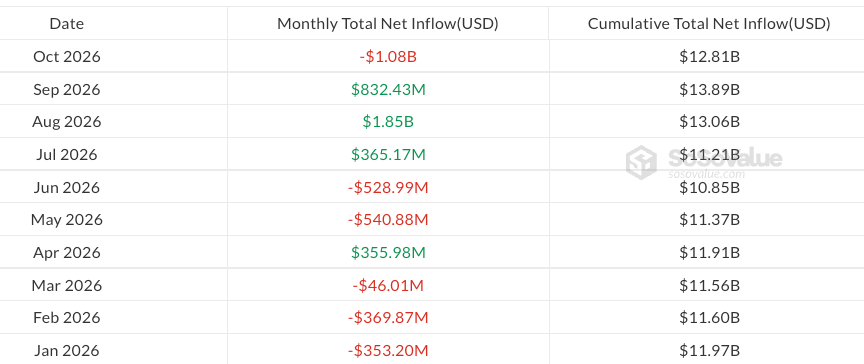
The digital asset market has witnessed a significant shift in investor sentiment, particularly impacting exchange-traded funds (ETFs) tracking the price of Ether (ETH). US spot Ether ETFs have collectively experienced substantial withdrawals throughout October, with net outflows surpassing $1.08 billion so far this month. This marks the largest monthly outflow recorded for these instruments in 2026, representing a stark reversal from previous periods of growth and accumulation. The pronounced cash drain from these Ether-backed products underscores a broader re-evaluation of risk and asset allocation among institutional and retail investors, coinciding with a notable decline in Ether’s market value.
Current Market Dynamics: Ether’s October Plunge
The current month has proven to be challenging for Ether ETFs, as the cumulative outflows have not only overshadowed recent gains but have also pushed the year-to-date net inflow figure down considerably. According to data compiled by SoSoValue, the $1.08 billion in net outflows recorded since the beginning of October has effectively erased the $832 million in net inflows observed during September. This reversal leaves the year-to-date net inflows for US spot Ether ETFs at approximately $485 million, a figure that reflects the volatile nature of investment in nascent asset classes and the rapid shifts in market sentiment. With eight trading sessions still remaining in October, the possibility of these outflows increasing further remains a pertinent concern for market participants.
This significant capital exodus from Ether ETFs has occurred in parallel with a notable depreciation in the price of Ether itself. Since October 1, Ether has experienced a decline of approximately 9.7%, falling from around $2,700 to $2,438 at the time of publication. This monthly slide contributes to an even more substantial year-to-date downturn, with ETH’s value plummeting nearly 18% throughout 2026, as reported by CoinGecko. The correlation between ETF outflows and underlying asset price movements highlights the increasing influence of these institutional investment vehicles on cryptocurrency markets, demonstrating their role as both barometers and drivers of market trends.
A Closer Look at the Data: Bitcoin ETFs Show Resilience
While Ether ETFs have faced considerable headwinds, their Bitcoin counterparts have demonstrated a more mixed but generally more resilient performance. US spot Bitcoin ETFs recorded modest net inflows of $23 million on Tuesday, building upon a more significant surge of $527 million in inflows observed on Monday. Despite these positive daily figures, the overall trend for Bitcoin ETFs in October has also been characterized by a net outflow, albeit on a much smaller scale compared to Ether. SoSoValue data indicates that US spot Bitcoin ETFs have experienced approximately $67 million in net outflows so far in October. However, these outflows are dwarfed by the year-to-date net inflows, which stand at roughly $809 million, underscoring a relatively stronger and more consistent demand for Bitcoin exposure through these regulated products over the longer term.
Bitcoin’s price trajectory during this period has mirrored the tempered activity in its ETF market. Trading at $82,954 at the time of publication, Bitcoin has seen a 2.2% decline since October 1. Its year-to-date performance shows a 5.3% decrease, indicating that while it has not been immune to market pressures, its decline has been less severe than Ether’s. This divergence in performance and ETF flow dynamics between the two largest cryptocurrencies suggests differing investor perceptions regarding their respective risk profiles, utility, and long-term potential in the current market environment.
The Genesis of Spot Crypto ETFs: A Brief History and Significance

To fully appreciate the current market movements, it is essential to understand the context and significance of spot cryptocurrency ETFs. The journey to bring spot Bitcoin and, subsequently, spot Ether ETFs to market in the United States was protracted and fraught with regulatory hurdles. For years, the U.S. Securities and Exchange Commission (SEC) expressed concerns regarding market manipulation, investor protection, and the nascent nature of the underlying crypto markets, leading to numerous rejections of proposed spot Bitcoin ETF applications.
The breakthrough arrived in January 2024 with the landmark approval of several spot Bitcoin ETFs. This decision, following a crucial court ruling against the SEC, was widely hailed as a watershed moment for the cryptocurrency industry. It legitimized Bitcoin as an institutional-grade asset and opened the floodgates for traditional finance investors to gain exposure to the cryptocurrency without directly owning it. These ETFs hold actual Bitcoin, offering a regulated, transparent, and accessible investment vehicle that can be traded on traditional stock exchanges. The immediate success of these products, attracting billions in inflows shortly after their launch, underscored the pent-up demand from institutional investors, wealth managers, and retail investors who previously faced barriers to direct crypto investment.
Following the success of spot Bitcoin ETFs, the market anticipated similar approvals for Ether. Ether, as the second-largest cryptocurrency by market capitalization and the backbone of the decentralized finance (DeFi) and non-fungible token (NFT) ecosystems, presented a compelling case for an ETF. The regulatory journey for spot Ether ETFs also faced scrutiny, but eventually, the SEC greenlit these products, albeit with slightly different structural considerations. The approval of spot Ether ETFs further cemented the institutionalization of the broader crypto market, offering diversified exposure to the two most dominant digital assets. These products allow investors to participate in the price movements of Ether through their existing brokerage accounts, simplifying access, enhancing liquidity, and potentially driving further adoption by mainstream financial players. The current outflows from Ether ETFs, therefore, represent not just a temporary dip but a critical test of this newly established bridge between traditional finance and the crypto economy.
Understanding the Flow: Factors Influencing Investor Behavior
The significant outflows from US spot Ether ETFs in October can be attributed to a confluence of factors influencing investor behavior. These often include macroeconomic conditions, specific cryptocurrency-related developments, broader market sentiment, and profit-taking strategies.
One primary driver could be macroeconomic uncertainty. Global economic indicators, such as persistent inflation concerns, fluctuating interest rates, and geopolitical tensions, often lead investors to de-risk their portfolios. In such environments, assets perceived as higher-risk or more volatile, like cryptocurrencies, tend to be among the first to see capital withdrawals. If investors anticipate a prolonged period of economic contraction or tighter monetary policy from central banks, they may rotate out of speculative assets into more stable or defensive investments.
Profit-taking is another plausible explanation. While the year-to-date performance of Ether has been negative, there might have been periods of localized rallies or entry points for investors earlier in the year or late last year that allowed for profitable exits, especially for those employing short-term trading strategies within the ETF wrapper. Given the $832 million in net inflows in September, some of these new positions might have been closed out in October if investors perceived a peak or an opportune moment to lock in gains or mitigate potential losses.
Specific Ether-related developments or lack thereof could also play a role. While Ether’s blockchain continues to evolve with significant upgrades (e.g., the transition to Proof-of-Stake with "The Merge" and subsequent enhancements), the market might be awaiting new, compelling catalysts to drive sustained upward price momentum. A perceived slowdown in innovation or adoption within the Ethereum ecosystem, relative to other emerging blockchains or competing narratives, could lead investors to reallocate capital.
Furthermore, a shift in market narratives and asset preference could be at play. The relatively stronger performance and more consistent inflows into Bitcoin ETFs, despite its own October outflows, suggest that investors might be rotating capital from Ether back into Bitcoin, viewing the latter as a more established "store of value" or a safer bet within the crypto space during uncertain times. Bitcoin often benefits from its first-mover advantage and its more defined role as "digital gold," which can attract capital during periods of heightened volatility when investors seek perceived stability.
Finally, regulatory clarity and developments can profoundly impact investor confidence. While the approval of spot Ether ETFs was a positive step, ongoing discussions surrounding regulatory frameworks for other digital assets, stablecoins, or even the evolving stance of various global regulators on Ether itself, could introduce an element of caution. Any perceived ambiguity or potential for stricter oversight could prompt withdrawals.
Expert Perspectives and Market Sentiment
While direct statements from specific fund managers or analysts regarding these particular outflows were not provided in the original text, a broader understanding of market sentiment allows for logical inference of expert perspectives. Market analysts would likely interpret the substantial Ether ETF outflows as a clear indicator of institutional de-risking and tactical allocation shifts.
"Observers point to a combination of factors, including broader macroeconomic headwinds and a potential rotation within the digital asset space," one might infer an analyst stating. "Investors are likely re-evaluating their exposure to assets perceived as higher beta or more sensitive to market downturns. For some, this might mean taking profits after periods of accumulation, while for others, it could signify a strategic move towards what they perceive as more stable assets within the crypto ecosystem, such as Bitcoin."
Furthermore, the significant volume of the outflows—surpassing $1 billion in less than a month—would be seen as a strong signal that traditional financial players are actively managing their crypto positions through these regulated products. This level of activity underscores the growing influence of ETFs in determining market direction and liquidity. It moves beyond the retail-driven market of previous cycles, indicating that sophisticated investors are utilizing these instruments for dynamic portfolio adjustments, hedging, and capital deployment strategies.
The muted reaction of Bitcoin ETFs, with relatively smaller outflows and even significant daily inflows, would likely be interpreted as a sign of Bitcoin’s enduring appeal as a foundational digital asset. "Bitcoin’s relative stability in terms of ETF flows compared to Ether suggests its continuing role as a primary gateway for institutional capital into crypto," an analyst might conclude. "While not immune to overall market sentiment, its established narrative and higher liquidity often make it a preferred choice during periods of uncertainty."
These inferred expert perspectives highlight the complex interplay of internal crypto market dynamics, external macroeconomic forces, and the strategic decisions of a diverse investor base that now has easier access to crypto exposure through ETFs.
Implications for Ether and the Broader Crypto Ecosystem
The sustained outflows from US spot Ether ETFs carry several significant implications for Ether’s price, market structure, and the broader cryptocurrency ecosystem.

Firstly, for Ether’s price, consistent selling pressure from ETFs can exacerbate downward trends. When large institutional investors redeem their ETF shares, the fund issuers typically sell underlying Ether to meet these redemptions. This direct selling pressure adds to the supply in the spot market, potentially driving prices lower. A prolonged period of such outflows could make it challenging for Ether to establish a strong price floor or initiate a significant recovery, especially if combined with weak demand from other market segments.
Secondly, the event underscores the increasing interconnectedness of traditional finance and crypto markets. The ease with which capital can flow in and out of crypto via ETFs means that crypto assets are now more susceptible to the same macroeconomic forces and investor sentiment shifts that impact traditional equities and commodities. This integration, while bringing legitimacy and liquidity, also introduces new layers of volatility and correlation with broader financial markets.
Thirdly, it highlights the evolving landscape of institutional investment in crypto. The fact that institutions are actively using these ETFs for significant capital movements, both inflows and outflows, demonstrates that these products are not merely passive holding vehicles but active trading and allocation tools. This implies a more mature, albeit still volatile, market where sophisticated strategies are being deployed.
For the broader crypto ecosystem, the divergence between Ether and Bitcoin ETF flows is particularly noteworthy. It reinforces the idea that not all cryptocurrencies are perceived equally by institutional investors. Bitcoin often serves as the entry point and a relatively "safer" bet, while Ether, despite its foundational role in Web3 and DeFi, might still be viewed as carrying higher risk or requiring more specific catalysts for sustained institutional conviction. This dynamic could lead to a ‘flight to quality’ within the crypto space during periods of uncertainty, benefiting Bitcoin at the expense of altcoins, including Ether.
Looking Ahead: Potential Catalysts and Challenges
Reversing the trend of outflows for Ether ETFs will likely depend on a combination of internal and external factors.
Potential catalysts for renewed interest in Ether and its ETFs include:
- Significant Ethereum network upgrades: Future upgrades that enhance scalability, security, or reduce transaction costs (e.g., proto-danksharding, further sharding implementations) could renew developer and user interest, boosting Ether’s utility and value proposition.
- Strong performance in the DeFi and NFT sectors: A resurgence in activity and innovation within decentralized finance and the non-fungible token markets, largely built on Ethereum, could drive demand for Ether as the underlying asset for gas fees and collateral.
- Favorable macroeconomic environment: A pivot by central banks towards more accommodative monetary policies, declining inflation, or a generally more optimistic global economic outlook could encourage investors to re-enter riskier assets, including cryptocurrencies.
- Increased institutional adoption of Ethereum-based solutions: Growing use of Ethereum’s blockchain for enterprise solutions, tokenized assets, or institutional DeFi could create new demand streams for Ether.
- Novel regulatory clarity: Any further positive regulatory developments, particularly concerning stablecoins or specific use cases of blockchain technology, could enhance overall market confidence.
However, challenges persist:
- Ongoing macroeconomic uncertainty: A prolonged period of high interest rates, inflation, or economic stagnation could continue to suppress appetite for speculative assets.
- Competition from alternative blockchains: The rise of other layer-1 blockchains offering competitive advantages in terms of speed, cost, or specific functionalities could fragment the market and divert attention away from Ethereum.
- Regulatory headwinds: Potential for new, restrictive regulations in major jurisdictions could dampen enthusiasm for crypto investments.
- Market saturation: As more ETF products come to market, competition for investor capital intensifies, requiring funds to differentiate themselves or offer superior performance.
In conclusion, the substantial outflows from US spot Ether ETFs in October 2026 represent a significant moment for the digital asset market. They highlight the growing integration of crypto into traditional finance, the impact of macroeconomic forces on this nascent asset class, and the evolving dynamics of investor preferences between different cryptocurrencies. While challenging, this period also serves as a crucial test of the resilience and maturity of the institutional infrastructure now supporting the crypto ecosystem, setting the stage for how these assets will navigate future market cycles. The focus will now turn to whether Ether can find new catalysts to reverse these trends and regain its institutional momentum, or if Bitcoin will continue to solidify its position as the preferred institutional crypto asset during periods of market uncertainty.