admin
admin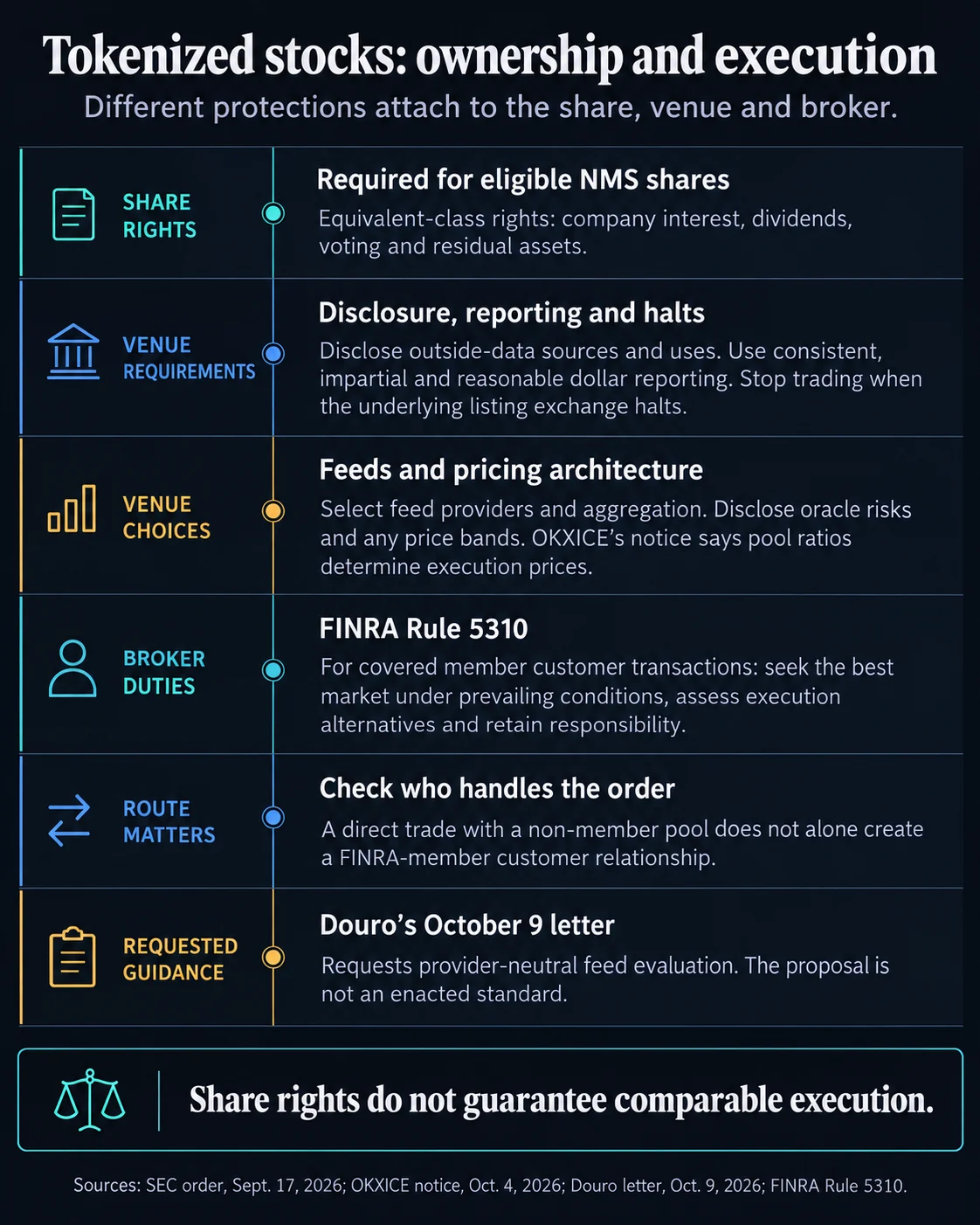
The U.S. Securities and Exchange Commission’s (SEC) September 17th order granting temporary, conditional relief to certain trading venues for tokenized National Market System (NMS) stocks introduces a complex landscape for investors. While these tokenized securities must mirror the shareholder rights of their traditional counterparts, the trading venues themselves can operate outside the stringent protections of Regulation NMS, particularly concerning price discovery and trade execution. This bifurcation necessitates a dual focus for investors: understanding the intrinsic value and rights represented by the tokenized share, and scrutinizing the mechanisms by which their orders are priced and executed. The nuances of external price data feeds, broker best execution obligations, and venue disclosures are paramount in this evolving market.
The regulatory environment surrounding tokenized securities has been in flux, with the SEC grappling to categorize and oversee digital assets that represent traditional financial instruments. The September 17th order represents a significant step in allowing regulated innovation within specific parameters. This relief, granted through an order under Section 36 of the Securities Exchange Act of 1934, carves out an exemption from the definition of an "exchange" for venues offering permissioned automated market maker (AMM) pools. These pools, powered by software, allow approved participants to trade against committed capital, effectively creating a regulated, yet distinct, trading environment for eligible tokenized NMS stocks. The order also provides a parallel exemption for certain liquidity providers who utilize their own capital, distinguishing them from traditional broker-dealers.
Crucially, the scope of this exemption is narrowly defined. It explicitly excludes third-party securities that offer synthetic exposure, such as tokenized linked securities and security-based swaps, as well as traditional rights and warrants. Eligibility for a tokenized stock to trade under this exemption hinges on both the defined nature of the underlying security and the venue’s adherence to the specific conditions laid out in the SEC’s order. For an investor holding an eligible tokenized share, the expectation is that it carries identical rights and privileges to its traditional equivalent. This includes a claim on the company’s assets, entitlement to dividends, voting rights, and a share in any residual assets upon liquidation. These ownership rights are fundamental to the investor’s stake in the underlying company.
However, the mechanics of acquiring or divesting these tokenized shares present a separate, though equally critical, consideration: the execution of the trade. Venues operating under this exemption find themselves outside the established framework of exchanges, alternative trading systems (ATSs), and traditional trading centers as defined by Regulation NMS. This means that protections like Rule 611, which safeguards against trades executed at prices inferior to protected quotations on other venues, may not directly apply. While the SEC emphasizes that anti-fraud and anti-manipulation laws, along with individual regulatory obligations for participants, remain in force, the absence of certain NMS protections elevates the importance of understanding how trading prices are determined and how orders are handled.
The Crucial Role of External Price Data in Tokenized Stock Trading
A significant aspect of the SEC’s September 17th order pertains to the use of external price data. Venues seeking exemption must provide transparent disclosures regarding their reliance on external data feeds, often referred to as "oracles" in the blockchain context. These oracles are essential for bridging the gap between the blockchain environment and real-world financial data. The order mandates that venues explain whether and how they utilize such external data, identify the specific providers and sources, articulate the purpose of the data, and detail their oracle usage. Furthermore, these disclosures must encompass known material risks, including the potential for oracle manipulation, and outline any reference-price bands or other risk controls implemented by the venue.
This emphasis on data transparency stems from the nascent nature of tokenized stock trading and the potential vulnerabilities associated with relying on off-chain data for on-chain transactions. The order also mandates concurrent trading halts when the underlying NMS stock experiences a halt on its primary listing exchange, ensuring a degree of market synchronization. Participant notifications, operational event remediation plans, accessible record-keeping, trading limits, and restrictions on venue credit are further requirements designed to foster a more controlled and accountable trading environment.
However, the SEC’s order does not mandate a prescriptive approach to data provision. It refrains from specifying a single data provider, a minimum number of contributors, a universal aggregation methodology, a definitive confidence threshold, or a uniform response mechanism for stale price data. This leaves a degree of flexibility that, while fostering innovation, also creates potential for divergence in market data quality and reliability.
It is within this context that market data provider Douro Labs submitted a letter to SEC staff on October 9th. Douro Labs, a contributor to the Pyth Network and developer of Pyth Pro, has a vested commercial interest in the standards being discussed. The submission requests the SEC staff to provide provider-neutral principles for assessing external price feeds and their subsequent use for dollar reporting. Douro’s proposed criteria highlight the importance of independent contributors involved in price formation, aggregation methodologies designed to resist manipulation, transparency regarding contributor identities and calculation methods, and robust comparison with external market benchmarks. The letter also advocates for disclosures concerning data confidence, staleness, and the procedures for handling situations where data becomes uncertain or unavailable.
The existing regulatory framework already imposes binding conditions around data reporting. Venues are required to publish free, machine-readable, dollar-denominated data covering transactions from the preceding 30 days, with updates occurring within ten minutes of each transaction. The conversion process for dollar reporting must employ consistent, impartial, and reasonable methods commonly utilized by market participants. Crucially, both trading interest and transaction records must clearly state dollar prices. This requirement for dollar-denominated reporting echoes language found in an existing SEC staff FAQ regarding pairs trading on exchanges and ATSs. Douro’s request, however, addresses a distinct and arguably more foundational issue: the methodology for evaluating the quality and reliability of the price feeds themselves.
Venue Notices Illuminate Diverse Data Feed Applications
The practical implementation of these data requirements is beginning to take shape through venue notices. OKXICE’s October 4th notice serves as a compelling illustration of how external price data can serve multiple, distinct functions within a tokenized stock trading venue. The notice delineates that while AMM execution prices are primarily determined by the ratios of assets within the liquidity pool, external price data plays a crucial role in other operational aspects. This includes displaying the real-time valuation of the stock, detecting trading halts in the underlying primary market, and facilitating the dollar reporting of stablecoin-paired transactions.
OKXICE’s notice identifies Massive.com as the source for stock prices and trading-halt data, while an affiliated entity, OKX INC, provides stablecoin price indices. Importantly, the notice states that OKXICE does not implement additional circuit breakers or reference-price bands beyond the trading halt notifications derived from the primary market. Among the payment assets listed by OKXICE is Circle’s USD-pegged USDC stablecoin. The conversion of trades into dollars for reporting purposes relies on a stablecoin-price input, distinct from the pool ratios that dictate the actual execution price. Furthermore, the notice describes the submission of external volume data to the venue’s smart contracts for the purpose of checking trading limits, demonstrating that price information and volume inputs serve different control functions within the trading process.
In contrast, TSV LLC’s September 23rd notice offers a different perspective. As of the date of its notice, operations had not yet commenced. TSV LLC outlined its intended uses for external data, including halt detection and monitoring for price divergence. Notably, a production market-data provider had not yet been selected, indicating that the disclosed functions were prospective and contingent on future data sourcing. This highlights the early-stage nature of some of these venues and the ongoing development of their data infrastructure.
Best Execution Remains a Broker’s Fundamental Duty
For FINRA member brokers handling covered customer transactions involving tokenized stocks, the obligation to seek best execution remains firmly in place. FINRA Rule 5310 mandates that member firms exercise reasonable diligence to ascertain the best market for a security and to obtain a price as favorable as possible for their customers under prevailing market conditions. This duty applies irrespective of whether the firm acts as an agent executing trades on behalf of clients or as a principal trading for its own account.
The assessment of best execution under Rule 5310 is a comprehensive process that considers a multitude of factors. These include the character of the market in which the transaction is executed, the size and type of the transaction, the markets that were checked, the accessibility of quotations, and the terms of the customer’s order. Beyond these core considerations, the rule also encompasses the speed of execution, the likelihood of executing limit orders, the overall costs associated with the trade, and the specific needs of the customer. This broad interpretation underscores that best execution is not merely about matching a price against a single external reference but involves a holistic evaluation of the entire execution process.
A critical aspect of Rule 5310 is that a member firm cannot delegate this best execution duty to another entity. Even when employing automated, non-discretionary order routing systems or internalizing trades, firms must conduct regular and rigorous reviews of their execution quality. These reviews, typically performed at least quarterly and segmented by security and order type, are essential for comparing current routing arrangements with those of competing markets. Any material differences in execution quality necessitate either a change in routing practices or a well-substantiated justification for maintaining the existing approach. In situations where pricing information is sparse or less transparent, the diligence requirements under Rule 5310 intensify, necessitating enhanced written procedures and documented compliance efforts.
The role of the customer’s instructions and the firm’s capacity in handling the order are also critical determinants. An unsolicited instruction from a customer to route an order to a specific market may limit the scope of the best execution determination, but the firm still retains the responsibility for prompt processing and adherence to the order’s terms. Similarly, if a FINRA member firm receives a customer order from another broker for handling and execution, the best execution duty extends to that routed order. However, simply filling a customer order from another broker against the member’s own quote, without active order handling, generally falls outside the purview of this routed-order duty.
Investors interacting directly with non-member pools offering tokenized stocks should proactively inquire whether a FINRA member is involved in handling their transaction. This clarification is vital to understanding the extent to which broker protections, including best execution, might apply. Regardless of the direct or indirect involvement of a FINRA member, the exemption conditions of the venue and the overarching anti-fraud and anti-manipulation protections remain pertinent.
FINRA’s ongoing efforts to modernize its guidance underscore the dynamic nature of market regulation. Regulatory Notice 26-15, which sought public comment on modernizing guidance under existing principles-based standards, highlights the ongoing dialogue about best execution principles. The distinction drawn in such notices between best execution and trade-through protection provides a useful lens through which to understand why venue relief under SEC exemptions and a broker’s customer duties operate as separate, albeit interconnected, regulatory spheres.
Investor Due Diligence in the Tokenized Stock Market
For investors navigating the burgeoning market for tokenized stocks, a proactive approach to due diligence is essential. A review of a trading venue’s notice goes beyond simply identifying a data provider; it requires a deeper understanding of how that data informs and governs trading activity. Investors should critically assess the specific roles attributed to external data: does it set the execution price, support a displayed valuation, facilitate transaction reporting in dollars, or trigger trading halts? Furthermore, the effectiveness of any disclosed price bands needs scrutiny – do they genuinely constrain trading, and what contingency plans are in place if their reference points become stale or unavailable?
When a broker is involved in handling the customer’s order, investors should also inquire about the broker’s internal processes for comparing the executed trade with alternative market opportunities. This proactive questioning can help ensure that the best execution duty is being diligently met.
Douro Labs’ October 9th request to the SEC staff for a concrete framework for evaluating external price feeds offers a potential pathway toward greater standardization and investor confidence. For investors comparing tokenized stocks, the ultimate practical test lies in whether the venue’s data infrastructure, pricing controls, and any broker’s execution review processes adequately support the expected outcomes of their trades. As this market matures, transparency and robust regulatory oversight will be paramount in fostering investor trust and ensuring the integrity of these innovative financial instruments. The ongoing evolution of regulations and industry practices will continue to shape the landscape for tokenized securities, requiring constant vigilance and informed decision-making from all market participants.