Dwi Wanna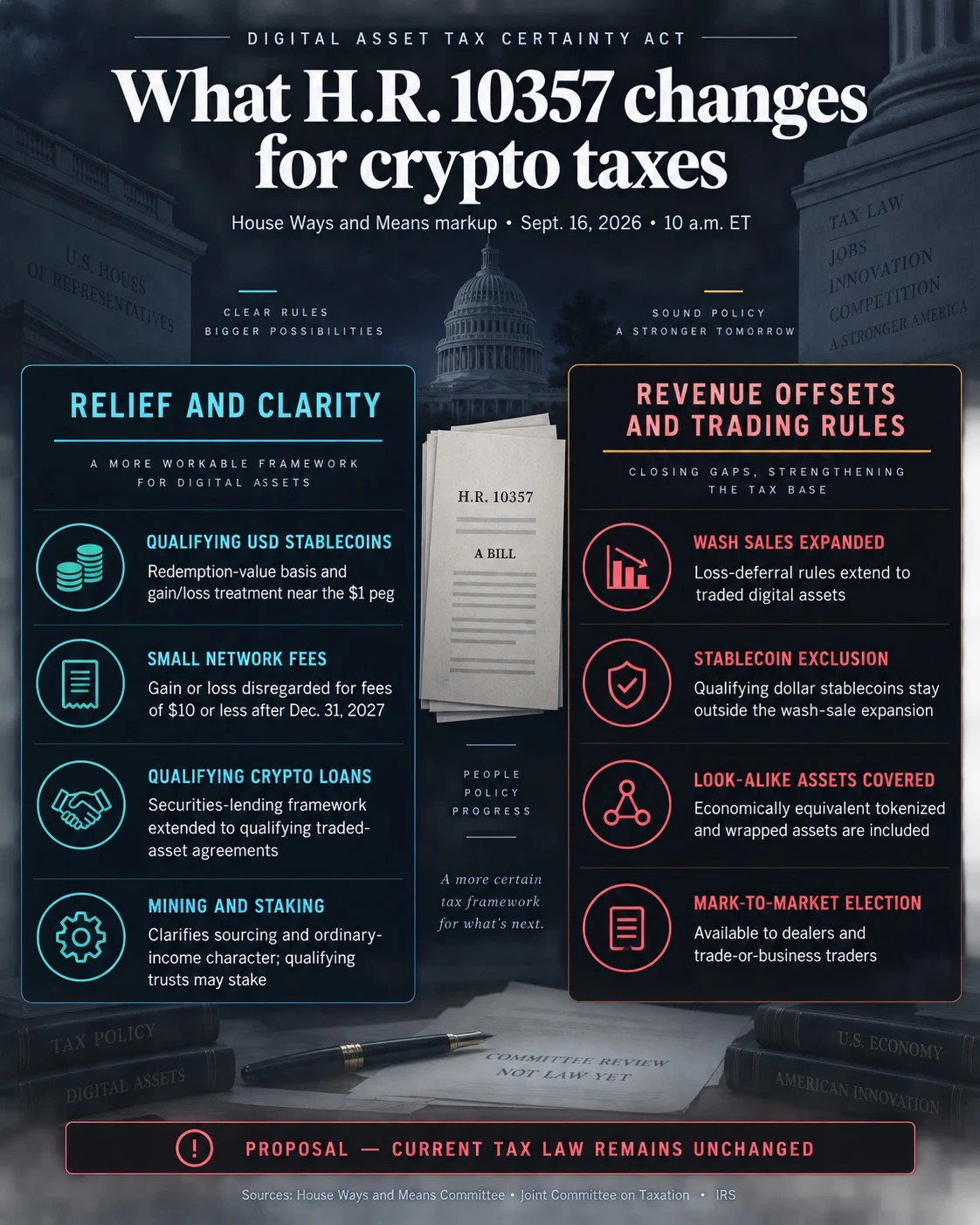
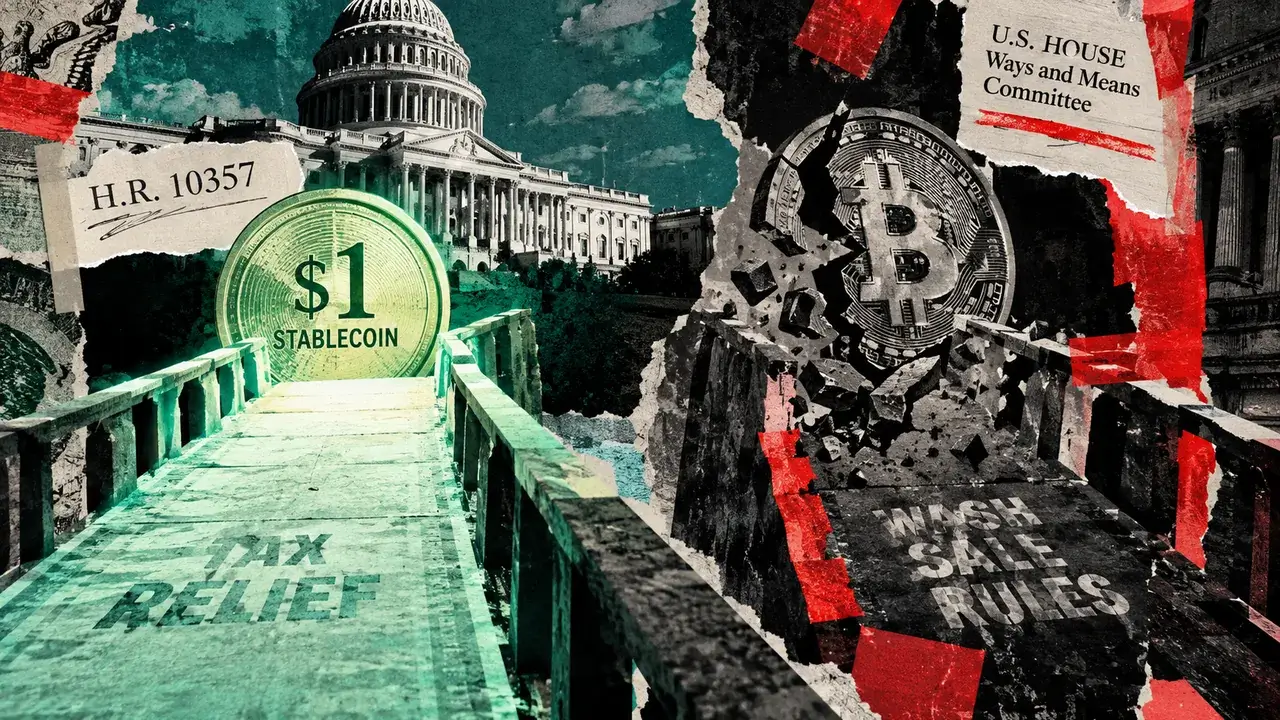
The House Ways and Means Committee is moving forward with H.R. 10357, known as the Digital Asset Tax Certainty Act, a comprehensive piece of legislation designed to modernize and clarify the United States’ tax code regarding cryptocurrencies. Scheduled for consideration on September 16, the bill represents the culmination of months of intense negotiations between lawmakers, industry stakeholders, and tax experts. The proposed overhaul aims to strike a delicate balance between easing the administrative burden on everyday crypto users and closing long-standing loopholes that have allowed traders to avoid billions in tax liabilities. According to estimates provided by the Joint Committee on Taxation (JCT), the legislation is projected to increase federal receipts by approximately $500 million net between fiscal years 2027 and 2036. This fiscal outcome is the result of a calculated trade-off: while certain provisions will reduce government revenue by providing relief for small transactions and stablecoin usage, other measures—specifically the application of securities-style rules to digital assets—are expected to generate significant new revenue.
The legislative push comes at a time when the Internal Revenue Service (IRS) and the Department of the Treasury have been struggling to apply mid-20th-century tax principles to a 21st-century asset class. For years, digital assets have been classified primarily as "property" under IRS Notice 2014-21, a designation that requires taxpayers to calculate capital gains or losses on every single transaction, regardless of size. H.R. 10357 seeks to move beyond this rigid framework, offering a more nuanced approach that recognizes the evolving utility of digital assets as both investment vehicles and mediums of exchange.
A New Framework for Stablecoins and Transaction Fees
One of the most significant components of the Digital Asset Tax Certainty Act is its treatment of qualifying U.S. dollar stablecoins. Under current law, because stablecoins are treated as property, a user who buys a coffee with a stablecoin must technically calculate the difference between the value of the token when they acquired it and its value at the time of the purchase. Even though stablecoins are designed to maintain a 1:1 peg with the dollar, minor fluctuations in market price (often fractions of a cent) can trigger a reportable tax event.
H.R. 10357 proposes to eliminate this "tax friction" by allowing redemption value to determine the basis and proceeds for qualifying transactions, provided they occur within prescribed bands around the $1.00 peg. This "de minimis" approach ensures that minor volatility does not create an administrative nightmare for consumers. However, this relief is targeted; it excludes professional traders, brokers, and dealers, as well as high-volume users who complete more than 5,000 transactions annually. Furthermore, the provision only applies to taxpayers whose functional currency is the U.S. dollar, ensuring the relief is focused on domestic commerce.
In addition to stablecoin relief, the bill introduces a $10 exemption for network or transaction fees. In the decentralized finance (DeFi) ecosystem, users frequently pay "gas fees" to validators to process transactions on a blockchain. Under current rules, paying a gas fee is technically a disposition of a digital asset, potentially triggering a capital gain. The new legislation would disregard gains or losses on digital assets used to pay these fees, provided the fee does not exceed $10. The JCT estimates that this small-fee relief alone will reduce federal receipts by $2.365 billion through 2036, making it one of the most expensive "taxpayer-friendly" provisions in the package. It is important to note, however, that this does not create a general $10 exemption for the purchase of goods or services with Bitcoin; it is strictly limited to the technical fees associated with moving assets on a network.
Closing the Wash Sale Loophole
To offset the revenue lost from small-fee and stablecoin relief, H.R. 10357 targets a controversial strategy long utilized by cryptocurrency investors: the wash sale. In the world of traditional stocks and securities, the "wash sale rule" prevents investors from claiming a tax loss on the sale of a security if they purchase a "substantially identical" security within 30 days before or after the sale. Because the IRS currently classifies most cryptocurrencies as property rather than securities, this rule has historically not applied to digital assets.
This has allowed crypto investors to engage in "tax-loss harvesting" with relative ease—selling Bitcoin during a market dip to lock in a capital loss for tax purposes and immediately rebuying the asset to maintain their market position. The Digital Asset Tax Certainty Act would end this practice by extending wash sale restrictions to all traded digital assets, excluding qualifying stablecoins. The bill also includes provisions to cover "economically equivalent" assets, such as wrapped or tokenized versions of the same underlying cryptocurrency. By bringing crypto trading in line with the rules governing the New York Stock Exchange and Nasdaq, the JCT expects the government to recoup $1.707 billion over the next decade.
Furthermore, the bill expands access to mark-to-market accounting for professional digital-asset dealers and traders. This accounting method requires taxpayers to report the fair market value of their holdings at the end of each year, treating any change in value as a gain or loss even if the asset hasn’t been sold. While this provides more flexibility for high-volume businesses, it is also expected to accelerate tax payments to the Treasury, contributing an estimated $2.332 billion in additional revenue through 2036.
Aligning Lending and Staking with Traditional Finance
Beyond trading and consumer use, H.R. 10357 addresses the complex plumbing of the digital asset economy, specifically lending and staking. Currently, the tax implications of crypto lending are murky. If an investor lends their Bitcoin to a platform to earn interest, the IRS could potentially view the transfer of that Bitcoin as a "taxable sale," even if the investor intends to get the asset back. The new legislation proposes to extend the tax treatment currently available for securities lending to qualifying digital-asset loans. This would allow these transactions to occur without triggering immediate capital gains, provided the agreement meets specific requirements regarding the return of equivalent assets.
The bill also tackles the burgeoning "staking" industry. Staking involves locking up digital assets to support the security and operations of a blockchain network in exchange for rewards. For institutional investors, the bill offers a significant win by preventing investment trusts from losing their tax status simply because a trustee stakes the assets held by the vehicle. This change could pave the way for more regulated investment products, such as exchange-traded funds (ETFs), to offer staking yields to their shareholders.
However, the legislation is more conservative regarding individual miners and stakers. While industry advocates have long argued that staking rewards should only be taxed when they are eventually sold (similar to how a farmer isn’t taxed on a crop until it is brought to market), H.R. 10357 maintains the status quo. It classifies validation income as ordinary income and confirms that rewards are generally recognized as taxable income the moment the taxpayer gains "dominion and control" over them.
Chronology of Crypto Tax Regulation
The introduction of H.R. 10357 is the latest chapter in a decade-long effort to define the tax landscape for digital assets.
- 2014: The IRS issues Notice 2014-21, declaring that virtual currency is treated as property for federal tax purposes.
- 2019: The IRS adds a question to Form 1040, asking every American taxpayer if they received, sold, or exchanged any financial interest in virtual currency.
- 2021: The Infrastructure Investment and Jobs Act introduces new reporting requirements for "brokers" of digital assets, sparking a massive lobbying effort from the crypto industry over the definition of a broker.
- 2023: The Treasury Department proposes expansive regulations regarding broker reporting, which are met with thousands of public comments and concerns over privacy and feasibility.
- 2024 (September): The House Ways and Means Committee introduces H.R. 10357 to provide the "tax certainty" that has been missing since the inception of Bitcoin.
Industry Reaction and Broader Implications
The reaction from the professional community has been largely positive, though tempered by the realization that increased clarity comes with a higher tax bill for some. Andrew Gordon, a prominent crypto tax lawyer, noted that the legislation is a "massive step forward" for investors who have been operating in a "gray area" for years. "We all pay taxes; the rules need to be clear," Gordon stated, echoing a sentiment shared by many compliance-focused firms.
However, some industry advocacy groups remain concerned about the sourcing rules and the refusal to defer staking taxes. The decision to treat validation rewards as immediate ordinary income remains a point of contention for the decentralized mining and staking community, who argue it creates a liquidity problem where stakers must sell a portion of their rewards immediately just to cover the tax liability.
The broader implications of H.R. 10357 extend beyond the balance sheets of individual traders. By integrating digital assets into the existing framework of securities laws and traditional finance (TradFi) accounting, the U.S. is signaling a move toward the institutionalization of the crypto market. The bill’s passage would likely encourage more traditional financial institutions to enter the space, knowing that the "tax friction" and regulatory uncertainty that once plagued the sector are being systematically addressed.
As the September 16 markup approaches, the eyes of the financial world will be on the House Ways and Means Committee. Any amendments made during this session could significantly shift the JCT’s revenue projections. If the bill successfully passes through the committee, it still faces the hurdle of a full House vote, the Senate, and ultimately, the President’s desk. Nevertheless, H.R. 10357 stands as the most comprehensive attempt yet to bring the American tax system into the digital age, proving that while crypto may be "decentralized," it is no longer beyond the reach of the taxman.