admin
admin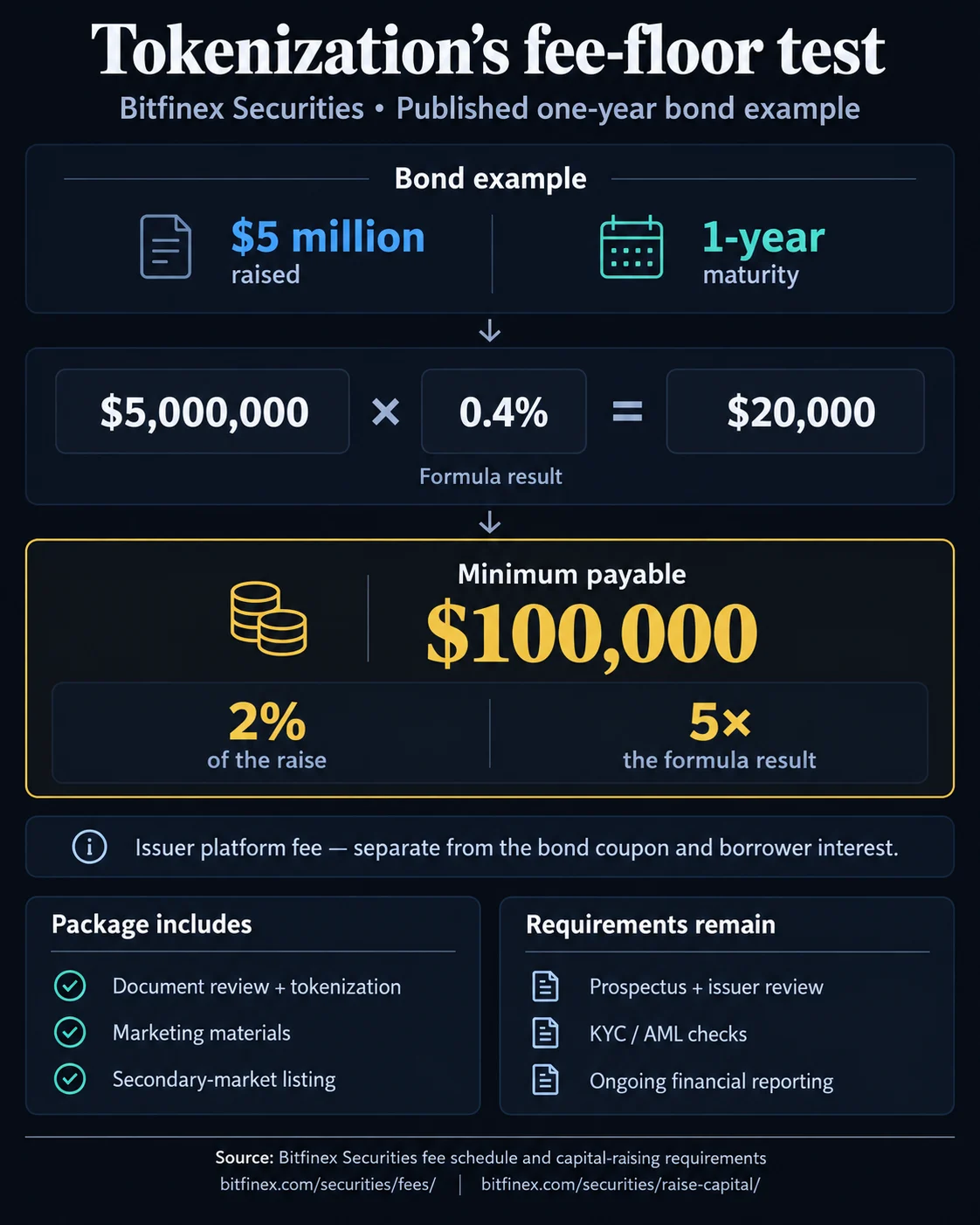
Paolo Ardoino, Chief Technology Officer of Bitfinex, has articulated an ambitious five-year vision for the tokenization industry: to slash companies’ capital-raising costs by a staggering 80%. This bold objective is now undergoing a rigorous practical evaluation through Bitfinex Securities, the platform designed to facilitate capital formation via tokenized securities. However, an early benchmark example—a $5 million, one-year bond offering—reveals a significant issuer fee of $100,000, equating to 2% of the total capital raised. This figure immediately raises questions about the accessibility of affordable financing for businesses, particularly those operating outside established financial hubs, when the fundamental act of issuing a security still entails a substantial minimum charge.
The core economic challenge lies in bridging the gap between Ardoino’s aspirational cost reductions and the tangible realities of regulatory compliance, listing processes, and the inherent overheads associated with debt or equity issuance. While Bitfinex Securities’ stated goal is to democratize capital markets and empower companies and entrepreneurs in underserved regions, the initial fee structure for a tokenized bond presents a considerable hurdle for smaller enterprises. The economics of such an endeavor appear to favor either businesses capable of raising substantial capital to absorb these fixed costs or the emergence of intermediaries that can pool financing for a cohort of smaller entities.
A potential model for this intermediary approach can be observed in ALTERNATIVE, a Luxembourg-based securitization fund. While ALTERNATIVE’s bond records demonstrate completed funding rounds and repayments, the precise impact of its structure on the loan prices for the ultimate borrowers remains an area requiring further clarification. Nevertheless, its operational framework offers a concrete illustration of how capital can be aggregated and channeled to businesses through a tokenized security issuance.
The Benchmark and the Reality of Fees
Bitfinex Securities’ published fee schedule provides a clear illustration of the pricing dynamics at play. For the aforementioned one-year bond example, a straightforward 0.4% formula would yield a fee of $20,000 based on the $5 million raise. However, the platform enforces a minimum issuer fee of $100,000. This means the actual payable charge is five times the calculated percentage, effectively establishing a floor price for capital raises. It is crucial to note that this issuer platform fee is distinct from the bond’s coupon rate or the annual interest rate borne by a small business borrower.
The fee structure for equity issuances differs, being progressive and commencing at 4%. Bond fees, on the other hand, are contingent upon the remaining time to maturity. Consequently, the fee calculations for permanent equity and a one-year bond are inherently dissimilar. The comprehensive package offered by Bitfinex Securities for capital raises includes essential services such as document review, the tokenization process itself, the creation of marketing materials, and secondary market listing, with no additional charges for the listing itself. Furthermore, issuers that successfully receive their proceeds are not subject to any withdrawal fees.
From an economic perspective, this fee floor significantly influences the consequential amount of capital that needs to be raised. While the minimum fee acts as a binding constraint, a larger capital raise allows for the wider distribution of this fixed charge. This dynamic explains how a low percentage-based fee formula can coexist with a substantial entry cost for smaller issuers. The underlying rationale is that the initial administrative and regulatory burdens are largely fixed, regardless of the precise amount raised.
Navigating the Regulatory Landscape
The capital-raising process on Bitfinex Securities is not merely a matter of tokenization. It necessitates rigorous issuer review and acceptance, the preparation of an offering prospectus, and the submission of supporting documentation. Robust Know Your Customer (KYC) and Anti-Money Laundering (AML) checks are mandatory, alongside ongoing financial reporting obligations. The platform’s main page stipulates the requirement for quarterly financial statements. For offerings within the Astana International Financial Centre (AIFC), a specific guide outlines the need for quarterly or annual statements or reports, depending on the prevailing market rules. The transition of ownership records to a blockchain does not absolve issuers of these continuing reporting responsibilities.
Investor participation guidelines vary depending on the jurisdiction and offering type. The investor guide for the AIFC details minimum investment thresholds and accreditation requirements for individuals. Offerings originating from El Salvador and corporate accounts are subject to different provisions. Notably, the platform explicitly excludes U.S. persons and participation in any jurisdiction where such an offer would be deemed unlawful.
For an enterprise seeking financing, the critical determinant of success for tokenization lies in whether the preparation of an eligible offer and the outreach to eligible investors become demonstrably simpler and less expensive. While advancements in technology can streamline settlement processes, this addresses only one facet of the overall capital-raising endeavor. A truly meaningful comparison with conventional financing methods would necessitate evaluating identical issuers, instruments, maturities, and financing objectives. This comparison must encompass the often-substantial effort involved in preparing documentation and maintaining ongoing reporting requirements.

ALTERNATIVE: A Model for Pooled Financing
The operational structure of ALTERNATIVE provides a working example of how capital markets can be accessed by businesses through an intermediary. Managed by MK Global Kapital, the fund solicits debt from investors, with the raised capital then being channeled to businesses through its investment portfolio. The fund’s stated objective is to support lending, leasing, and mobility initiatives. This model positions the fund as a crucial link between securities investors and the entrepreneurs seeking finance, thereby enabling smaller businesses to access capital without the burden of individual exchange issuances.
The primary advantage of this pooled approach lies in its potential for scale. A single issuance can effectively underwrite financing for a diverse portfolio of businesses. However, the ultimate benefit to an individual enterprise in terms of obtaining more favorable loan terms remains contingent upon the specific conditions negotiated within the fund’s portfolio.
Bitfinex reported in a December 20, 2023 announcement that ALTERNATIVE’s tokenized bond, ALT2612, had successfully raised over $5.2 million USDT and concluded its offering earlier that week. This particular bond had a 36-month tenor and offered a 10% coupon. Subsequent to this, the program introduced microfinance bond offerings in 2024, indicating an expansion of its scope.
A lifecycle report from MK Global Kapital in July 2025 detailed the Bitfinex program’s progress, indicating four completed issuances totaling the equivalent of $6.2 million. One matured issue, amounting to $630,000-equivalent, had been fully repaid, alongside more than $850,000-equivalent distributed in coupon payments. By March 2, 2026, the total reported issuance remained at four bonds, valued at $6.2 million-equivalent. Three matured bonds, totaling $1 million-equivalent, had been repaid, with 20 coupon payments exceeding $1.1 million-equivalent.
These announcements present varying scopes and indicate that the fund manager oversees a broader tokenized program that surpasses $10 million. A March announcement from Bitfinex further projected that future issuances from ALTERNATIVE were expected to exceed $10 million.
The pooled financing route offers the potential to distribute the administrative workload of issuance across financing for numerous businesses. Critically, it delegates the decisions regarding capital allocation and pricing to an intermediary. Consequently, the ultimate effectiveness of this model in delivering efficiency gains to entrepreneurs will be measured by the loan terms, underwriting standards, and overall accessibility of capital.
The Path Forward: Measuring True Cost Reduction
The ongoing evolution of tokenized securities platforms like Bitfinex Securities presents a compelling opportunity to re-evaluate traditional capital-raising paradigms. Paolo Ardoino’s benchmark of an 80% reduction in costs sets a high bar, and its achievement will depend on a nuanced understanding of the entire financial lifecycle for businesses. The immediate challenge for Bitfinex Securities lies in demonstrating how its initial fee structure, particularly the substantial minimum charge, can be reconciled with this ambitious cost-saving objective.
Future assessments of the tokenization industry’s success will require tangible evidence that links lower issuance and compliance costs to comparable financing offers available to businesses. This includes a comprehensive analysis of total charges, the amount of capital accessible, the maturity of the instruments, and the ongoing obligations imposed on issuers. For pooled lending structures, like that of ALTERNATIVE, a crucial metric will be the demonstrable impact on the terms and conditions offered to the end borrower.
Ultimately, Ardoino’s benchmark serves as a demanding economic standard for the promise of inclusivity that tokenization purports to offer. Meeting this standard necessitates a demonstrable reduction in the cost of capital access for businesses, whether they choose to issue directly or secure financing through an intermediary fund. The coming years will be critical in determining whether tokenized securities can truly deliver on their transformative potential and make capital markets more equitable and efficient for a broader spectrum of enterprises. The journey from aspirational goals to demonstrable cost savings remains a complex undertaking, requiring innovation, regulatory clarity, and a sustained focus on the needs of the businesses seeking to grow and expand.