admin
admin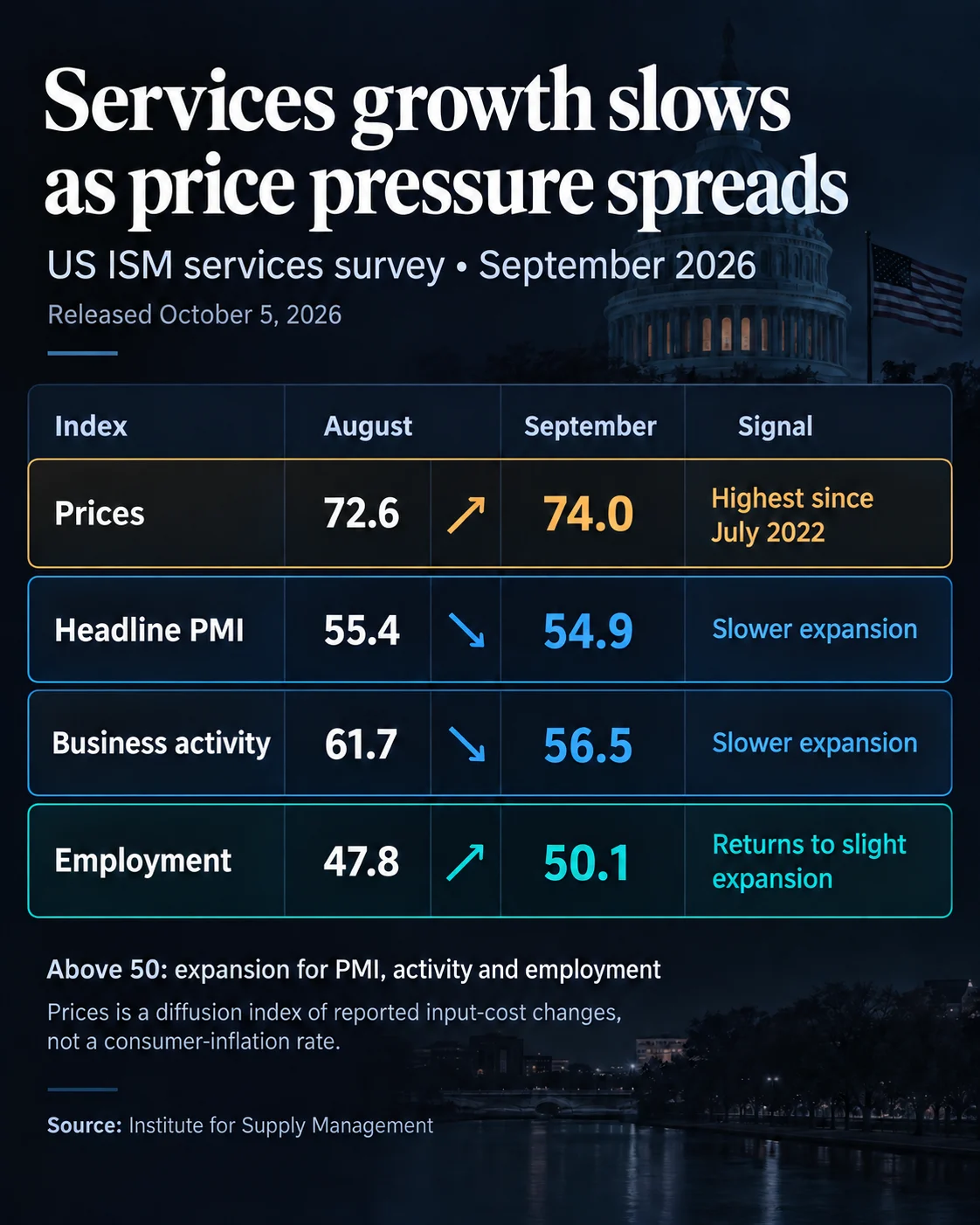
The US services prices index surged to a four-year peak in September, reaching 74.0, even as the broader services sector experienced a slowdown in growth. This mixed economic signal presents a complex scenario for the Federal Reserve and could cast a shadow over the prospects of interest rate relief for leveraged Bitcoin positions. The latest data from the Institute for Supply Management (ISM) paints a picture of persistent input cost pressures coexisting with moderating business activity, a combination that complicates the path toward potential rate cuts.
Key Economic Indicators Reveal Divergent Trends
The ISM’s report, released on October 5, highlighted a significant uptick in the prices paid by services businesses. The prices index climbed from 72.6 in August to 74.0 in September, marking its highest level since July 2022, when it registered 74.5. This indicator reflects the cost of inputs for businesses in the services sector, such as labor, materials, and energy. A reading above 50 generally signifies rising prices. The sustained elevated level of this index suggests that inflationary pressures within the services sector remain robust, despite broader economic deceleration.
Concurrently, the headline services Purchasing Managers’ Index (PMI), a key measure of overall economic health in the services sector, saw a slight dip. It moved from 55.4 in August to 54.9 in September. While still comfortably above the 50-point threshold that separates expansion from contraction, this marginal decline indicates a cooling of overall business activity. The business activity index itself experienced a more pronounced drop, falling from 61.7 to 56.5. This suggests that while the services sector is still expanding, its pace of growth has moderated.
In contrast, the employment component of the ISM services report showed a welcome uptick. The employment index rose from 47.8 in August to 50.1 in September, moving back into expansion territory after two consecutive months of contraction. This shift indicates a stabilization or slight increase in hiring within the services sector, potentially offering a silver lining amidst the mixed economic signals.
Understanding the ISM Prices Index
It is crucial to understand that the ISM’s prices index is a diffusion index that measures the breadth and direction of changes in input costs reported by survey respondents. It does not provide an exact quantification of price increases nor does it directly represent the consumer inflation rate, which is tracked by the Consumer Price Index (CPI). However, a consistently high reading in the ISM prices index is a strong forward-looking indicator, signaling potential inflationary pressures that could eventually filter through to consumer prices and influence monetary policy decisions.
Federal Reserve’s Stance and the Rate Relief Conundrum
The latest economic data arrives at a critical juncture for the Federal Reserve as it navigates its monetary policy path. Fed Vice Chair Philip Jefferson, in a speech on October 1, acknowledged that inflation risks remained tilted upward. He reiterated the Fed’s decision to raise the federal funds target range by a quarter percentage point to 3.75%-4.00% and emphasized that future adjustments would be data-dependent, considering the economic outlook and the balance of risks.
Jefferson’s remarks preceded the release of the ISM services report. The survey’s findings, particularly the elevated prices index, provide further evidence for policymakers concerned about sticky inflation. The juxtaposition of slowing economic growth and rising input costs creates a policy dilemma. On one hand, a cooling economy might suggest a need for monetary easing. On the other hand, persistent cost pressures could deter the Fed from prematurely signaling or implementing rate cuts, as this could risk reigniting inflation. This uncertainty surrounding the future trajectory of interest rates has significant implications for financial markets, including the cryptocurrency space.
Implications for Leveraged Bitcoin Exposure
The persistence of elevated input costs in the services sector, coupled with the Federal Reserve’s cautious stance on inflation, directly impacts the financing environment for leveraged positions in assets like Bitcoin. Leveraged trading involves borrowing funds to increase exposure to an asset, amplifying both potential gains and losses. When interest rates are high or expected to remain high, the cost of borrowing increases, making leveraged positions more expensive to maintain.
If the Federal Reserve continues to hold interest rates steady or even contemplates further hikes due to inflation concerns, the cost of capital for traders employing leverage will likely remain elevated. This can put pressure on leveraged Bitcoin positions, as traders may be forced to either inject more capital to meet margin requirements or liquidate their positions to cut losses if the market moves against them. The Commodity Futures Trading Commission (CFTC) has previously warned about the risks associated with margined virtual-currency futures trading, noting that traders can face margin calls and forced liquidations when markets experience adverse movements.
Understanding Bitcoin Perpetual Funding Rates
It is important to distinguish between the Federal Reserve’s policy rate and the funding rates observed in Bitcoin perpetual futures markets. While the Fed’s actions influence the broader financial landscape, Bitcoin perpetual futures funding rates are a separate market mechanism. Coinbase’s documentation explains that funding rates are payments exchanged between long and short positions in perpetual futures contracts. Their primary function is to incentivize traders to align the perpetual contract price with the spot market price of Bitcoin. These rates are determined by supply and demand dynamics within the perpetual futures market and cannot be directly inferred from the federal funds target rate. However, a higher overall cost of capital in the broader economy can indirectly influence risk appetite and, consequently, trading activity and funding rates in crypto markets.
Historical Context and Market Disconnects
While macroeconomic data and central bank policies are often seen as significant drivers of asset prices, historical evidence suggests that Bitcoin’s price movements can sometimes exhibit a degree of independence from traditional financial news. A February 2023 study by the New York Fed, utilizing intraday data, found that Bitcoin appeared largely disconnected from monetary and macroeconomic news within their sample period. This suggests that while broad economic trends can influence the cryptocurrency market, specific news events may not always trigger immediate or predictable reactions.
As of October 6, Bitcoin was trading around $85,580, showing a modest decline of 0.04% over the preceding 24 hours, according to CryptoSlate data. This small fluctuation does not offer conclusive evidence of a direct reaction to the ISM services report. The market’s response to the report will likely unfold over time as investors digest the implications of persistent inflation and the Fed’s potential policy responses.
Factors Weakening or Strengthening the Funding-Risk Case

The argument for increased funding risk for leveraged Bitcoin positions would be strengthened if a confluence of factors emerges. This includes adverse policy signals from the Federal Reserve, a significant repricing of interest rate expectations upwards, and a concurrent decline in demand for leveraged trading. Conversely, the funding-risk narrative would weaken if cost pressures ease, rate expectations stabilize, or if buying demand for Bitcoin increases without a reliance on leverage.
Ultimately, the slowing pace of services sector expansion alone does not provide sufficient assurance of relief for leveraged Bitcoin positions. The true impact on their financing costs and overall risk profile hinges on how these macroeconomic developments translate into observable market dynamics, particularly within the crypto financing markets themselves. Traders and investors will need to closely monitor both the Federal Reserve’s pronouncements and the behavior of Bitcoin’s funding rates and trading volumes to gauge the evolving risk landscape.
Broader Economic Landscape and Bitcoin’s Market Position
The ISM services report is a critical component of the broader economic puzzle that the Federal Reserve is trying to solve. The services sector constitutes a significant portion of the US economy, and its performance has a substantial impact on overall growth and inflation. The fact that input costs are rising even as business activity moderates suggests a potential for stagflationary pressures, where an economy experiences slow growth coupled with high inflation. This scenario is particularly challenging for central bankers, as traditional tools to combat inflation (raising rates) can exacerbate slow growth, and tools to stimulate growth (lowering rates) can fuel inflation.
Bitcoin, as a relatively new and volatile asset class, is often tested in such complex economic environments. Its performance is influenced by a multitude of factors, including macroeconomic conditions, regulatory developments, technological advancements, and investor sentiment. While historical studies suggest a degree of decoupling from traditional financial news, it is undeniable that significant shifts in interest rates and inflation expectations can impact risk appetite across all asset classes.
The current situation presents a scenario where the traditional playbook for monetary policy is being tested. The resilience of the services sector’s price pressures, as indicated by the ISM report, suggests that the fight against inflation may be more protracted than initially hoped. This, in turn, could lead to a prolonged period of higher interest rates, posing a persistent challenge for leveraged traders in Bitcoin and other risk-sensitive assets. The market will be closely watching for any further indicators of inflation’s persistence and the Federal Reserve’s unwavering commitment to price stability, which will ultimately shape the risk-reward calculus for investors in the digital asset space.
Conclusion
The September ISM services report, with its soaring prices index juxtaposed against moderating business activity, paints a complex economic picture. This data point reinforces concerns about persistent inflation and complicates the Federal Reserve’s path toward potential interest rate relief. For leveraged Bitcoin positions, this translates to a continued risk of elevated financing costs and potential pressure on margins. While Bitcoin’s price action may not always exhibit a direct correlation with macroeconomic news, the broader environment of higher-for-longer interest rates and ongoing inflation concerns creates a challenging backdrop for highly leveraged trading strategies. The market will remain sensitive to further economic data releases and Federal Reserve commentary as it navigates this intricate economic landscape.