admin
admin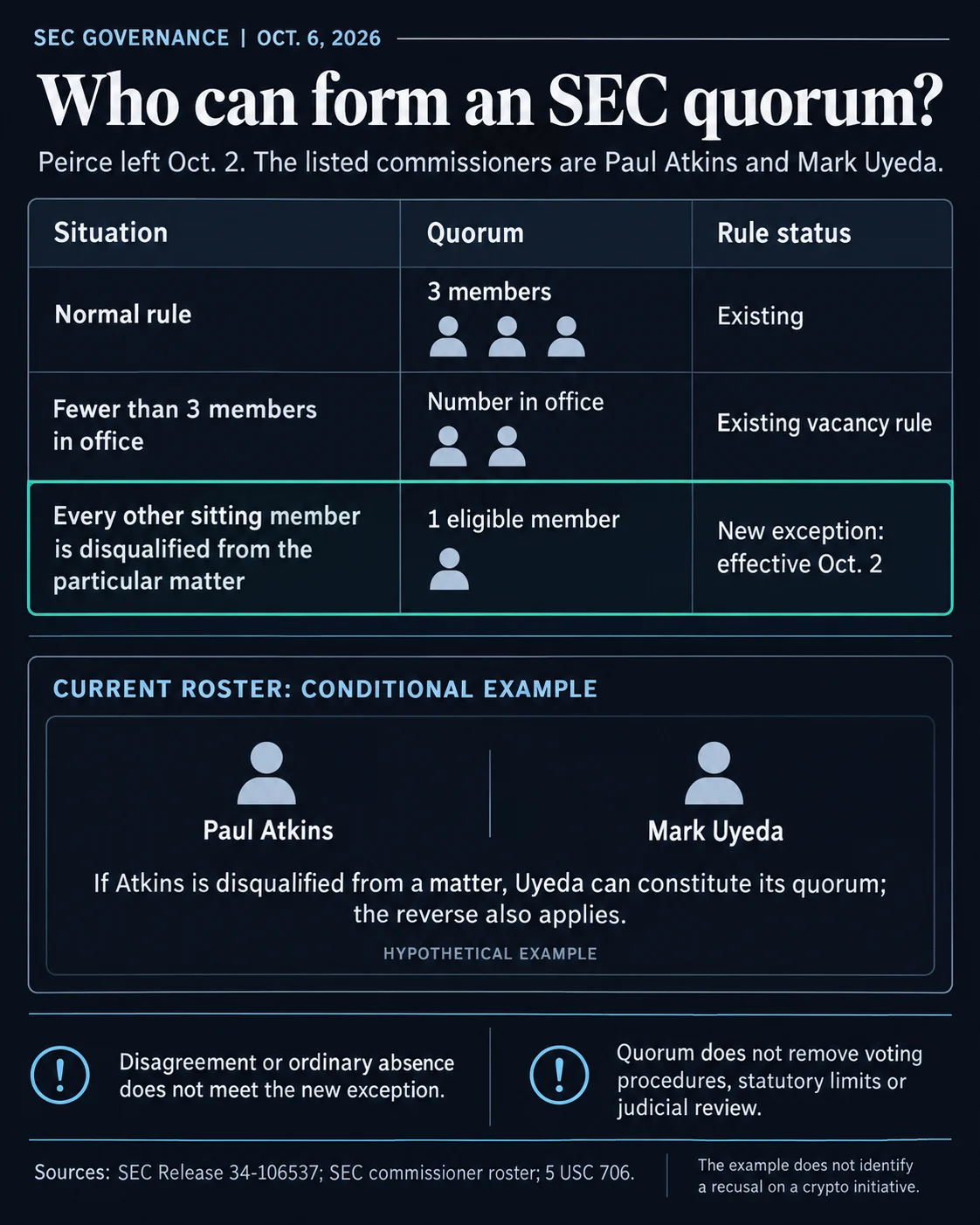
Hester Peirce’s Oct. 2 resignation has reduced the U.S. Securities and Exchange Commission (SEC) to two sitting commissioners, Paul Atkins and Mark Uyeda, a configuration that, coupled with a newly enacted rule, allows for a single commissioner to constitute a quorum under specific circumstances. This shift in operational capacity, particularly concerning the agency’s approach to cryptocurrency policy, introduces a new dynamic into decision-making processes that were already navigating complex regulatory landscapes. The amended quorum rule, effective concurrently with Peirce’s departure, addresses scenarios where all but one commissioner is disqualified from participating in a particular matter, a provision that could expedite or, conversely, concentrate decision-making power on pivotal issues affecting the digital asset industry.
The departure of Commissioner Peirce, a vocal proponent of the digital asset space and often characterized as a dissenter on certain regulatory approaches, leaves a void in the Commission’s deliberative process. Her resignation letter, dated September 21 and formally effective October 2, marks the end of her tenure. The SEC’s official roster, updated on October 3, now lists Chairman Atkins and Commissioner Uyeda as the sole commissioners. Historical records also confirm Peirce’s departure on the specified date. This reduction in the Commission’s membership to two active commissioners, coupled with the revised quorum rule, means that future Commission-level decisions, especially those pertaining to novel financial technologies and digital assets, will be made by a significantly smaller body, operating under stringent legal frameworks.
A Revised Framework for Commission Business
The crux of this operational adjustment lies in Amendment 17 CFR 200.41, a rule governing the quorum necessary to conduct SEC business. This amendment, published on September 30 and effective October 2, introduces a critical flexibility: in instances where every other sitting commissioner is disqualified from a specific matter, a single eligible commissioner can now form a quorum for that particular issue. This contrasts with previous regulations that might have required at least two eligible commissioners in such disqualification scenarios.
Historically, the SEC has had provisions to address situations with fewer than the full complement of five commissioners. An existing vacancy exception allowed the number of commissioners in office to constitute a quorum when fewer than three were serving. This meant that even with only one commissioner, the agency could theoretically continue to operate. However, the new amendment specifically targets situations of disqualification, a distinct scenario from mere vacancy or absence. Previously, separate provisions for disqualifications accommodated two eligible commissioners if others were recused. The recent amendment broadens this to empower a single commissioner to act when all other members are disqualified.
This distinction is crucial. Disqualifications typically arise from conflicts of interest, personal relationships, or prior involvement in a matter that might compromise impartiality. The rule explicitly states that a commissioner’s disagreement with a proposal does not constitute grounds for disqualification under this new provision. This means that a lone commissioner cannot simply recuse themselves to trigger the single-member quorum for a decision they oppose; genuine disqualifying circumstances are required.
Under the current roster of two commissioners, if Chairman Atkins were to be disqualified from a specific matter due to a conflict of interest, Commissioner Uyeda could legally constitute a quorum and render a decision on that particular issue. Conversely, the same would apply if Uyeda were disqualified. This mechanism is designed to ensure the agency’s ability to conduct business even when faced with individual commissioners being unable to participate.
Implications for Crypto Policy and Pending Regulations
The timing of this quorum amendment and Commissioner Peirce’s departure is significant, given the SEC’s ongoing work on cryptocurrency regulation. Several key proposals and initiatives are in various stages of development, and their progression through the Commission’s approval process could be affected by the reduced number of decision-makers and the enhanced quorum flexibility.
One such critical initiative is the SEC’s custody proposal, released on October 1. This proposal aims to clarify how regulated investment companies can custody crypto securities and similar digital assets, how registered investment advisers can safeguard client crypto funds and securities, and outlines necessary modernization and reporting requirements. Chairman Atkins, in a statement accompanying the proposal, contextualized custody reform alongside other significant actions, including an offering proposal, commission interpretations, and staff-level tokenization efforts. These initiatives represent a multi-faceted approach to integrating digital assets into the existing financial framework.
The custody proposal, currently classified as a proposed rule, has a public comment deadline of December 7. The existence of a smaller Commission, even with the new quorum exception, does not accelerate the rulemaking process itself. Proposed rules still require public comment and subsequent deliberation and voting by the Commission to become final. The October 1 vote to propose these rules saw approval from Chairman Atkins, Commissioner Peirce, and Commissioner Uyeda, underscoring a prior consensus on moving forward with public discourse on custody. This approval occurred before Peirce’s resignation and the quorum amendment took full effect, highlighting the progression of these initiatives under the previous Commission structure.

Another significant pending measure is the proposed "Regulation Crypto Assets," initially issued on August 18 and published on August 21. This regulation seeks to establish offering exemptions for certain investment contracts involving crypto assets, alongside stringent disclosure requirements and ongoing anti-fraud and anti-manipulation obligations. It also proposes a conditional safe harbor to assist in determining the investment-contract status of digital assets. The comment period for this regulation is set to close on October 20, marking another crucial juncture for industry input.
In contrast, the SEC has already taken action regarding tokenized-stock trading. On September 17, the agency issued an Innovation Exemption, a temporary conditional exemptive order that provides relief for specific tokenized National Market System (NMS) stock trading venues and certain liquidity providers. This order, detailed in a fact sheet, offers five-year conditional relief with defined limitations on stock symbols, trading volumes, and requirements for equivalent shareholder rights, publicly auditable smart contracts, and operational disclosures. For stocks tokenized by unaffiliated third parties, the order also mandates issuer notification and an opportunity to object. These conditions remain in place, and any future Commission decisions concerning this relief would operate under the existing quorum arrangements. The new quorum rule, however, does not inherently expand the scope of this exemption or remove its stipulated safeguards.
The Nuances of Quorum and Decision-Making Authority
It is vital to understand that the amended quorum rule, while providing a mechanism for action, does not alter the fundamental processes of Commission decision-making or grant additional substantive authority. The SEC operates under a seriatim rule (17 CFR 200.42), which stipulates that a matter is not considered final until each commissioner has formally reported their vote or indicated their intended non-participation to the secretary. Furthermore, any commissioner retains the right to request that a circulated matter be withdrawn for joint deliberation, a safeguard designed to encourage collaborative review.
The decision of whether a commissioner is qualified to participate in a matter rests with that individual commissioner, guided by principles outlined in 17 CFR 200.60, which emphasizes careful consideration of interests and relationships. The amended quorum clause extends the possibility of action to a single commissioner precisely when all others are deemed disqualified.
The SEC’s statutory framework also allows for the delegation of certain authorities through published orders or rules, as outlined in 15 U.S. Code § 78d-1. However, this delegation generally excludes general rulemaking authority, preserving the Commission’s ultimate oversight. Even in delegated matters, one member has the prerogative to bring a delegated action before the full Commission for review.
Furthermore, the agency’s organizational quorum amendment is an administrative procedural adjustment and does not represent a blanket exemption from established legal requirements for substantive rulemaking. The Administrative Procedure Act (APA), for instance, mandates notice-and-comment procedures for most rulemaking, with specific exceptions. The SEC’s internal justification for the quorum amendment, stating it concerns internal management and organization rather than substantive regulation, does not exempt future crypto-related rules from APA requirements.
Judicial review remains a significant constraint on agency action. Under 5 U.S. Code § 706, reviewing courts possess the authority to set aside agency actions found to be unlawful, exceeding statutory authority, or conducted without adherence to required procedures. The reduction in the number of eligible commissioners, or the utilization of the single-member quorum exception, does not inherently grant the SEC additional substantive authority nor does it insulate its decisions from legal scrutiny.
The SEC’s publicly available October voting record currently reflects the three-member approval for the custody proposal, with no subsequent single-member decisions on crypto matters yet posted. The agency generally publishes votes only when a matter has reached finality, suggesting that the absence of later entries may reflect the ongoing deliberative process rather than a definitive operational shift in crypto policy execution.
Looking Ahead: Milestones and Operational Dynamics
For businesses operating within the cryptocurrency ecosystem, the immediate future holds several critical regulatory milestones. These include the October 20 deadline for comments on the offering rules, the December 7 deadline for comments on the custody proposal, and any subsequent Commission decisions on these proposals or the existing conditional trading relief. The legal status of these initiatives, the recorded approvals, and the participating commissioners will offer tangible insights into how the reduced Commission navigates its responsibilities.
The new quorum exception serves as a mechanism to preserve the SEC’s ability to act in the face of disqualifications. However, its precise impact on the trajectory of crypto policy will ultimately depend on the nature of the specific matters that come before the Commission, the eligibility of each commissioner to participate in those deliberations, and the decisions they ultimately render. The departure of a prominent voice like Commissioner Peirce, combined with the operational adjustments, sets a precedent for a more streamlined, yet potentially more concentrated, approach to regulatory decision-making in the dynamic realm of digital assets.