Dwi Wanna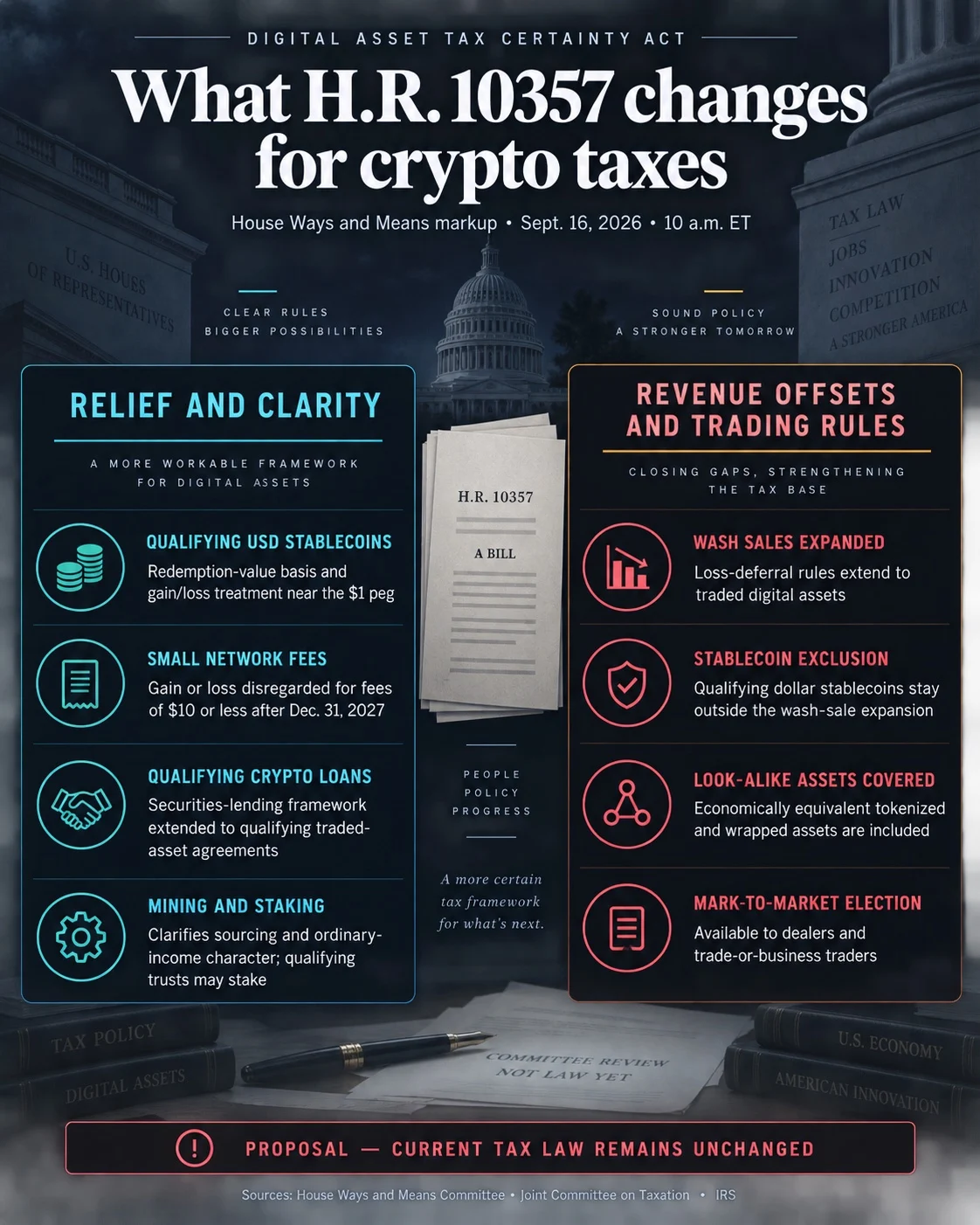
The House Ways and Means Committee is poised to reshape the landscape of American digital asset taxation through the introduction and consideration of H.R. 10357, formally known as the Digital Asset Tax Certainty Act. Scheduled for a critical markup session on September 16, the legislation represents the culmination of months of intensive negotiations among lawmakers, industry stakeholders, and fiscal experts. The bill seeks to resolve long-standing ambiguities in how the Internal Revenue Code treats cryptocurrencies, stablecoins, and decentralized finance (DeFi) activities, moving the sector closer to the regulatory framework governing traditional financial assets while providing targeted relief for everyday users.
According to a comprehensive analysis released by the Joint Committee on Taxation (JCT), the implementation of H.R. 10357 is projected to increase federal receipts by approximately $500 million on a net basis over the fiscal 2027 through 2036 window. This fiscal outcome is the result of a calculated "balancing act" that offsets significant tax reductions for retail users and stablecoin adopters with more stringent, securities-style reporting and trading requirements for high-volume traders and institutional participants. The legislation addresses several key pillars of the crypto economy, including the tax treatment of stablecoin redemptions, transaction fees, wash sales, digital asset lending, and the taxation of staking rewards.
Historical Context and the Drive for Regulatory Clarity
For over a decade, the United States tax framework for digital assets has been defined primarily by IRS Notice 2014-21, which classified cryptocurrencies as "property" rather than currency. While this classification provided an initial baseline, it created immense logistical hurdles for taxpayers. Under the current regime, every micro-transaction—from buying a cup of coffee with Bitcoin to paying a "gas fee" on the Ethereum network—is technically a realization event requiring the calculation of capital gains or losses.
The Digital Asset Tax Certainty Act arrives at a time when the crypto market has matured into a multi-trillion-dollar asset class, necessitating more sophisticated rules. Andrew Gordon, a prominent crypto tax lawyer, highlighted the industry’s desire for a formalized structure, stating that the bill represents a "massive step forward" for investors who have long struggled with opaque requirements. "We all pay taxes; the rules need to be clear," Gordon remarked, echoing a sentiment prevalent among both retail investors and institutional custodians who have faced mounting compliance costs due to regulatory uncertainty.
The Fiscal Trade-off: Relief vs. Revenue Generation
The JCT’s $500 million revenue estimate is derived from several high-impact provisions that shift how money flows into the Treasury. On one side of the ledger, the bill introduces "small-fee relief," which would disregard gains or losses when digital assets are used to pay network or transaction fees of $10 or less. This provision is designed to facilitate the use of blockchains for non-investment purposes, such as interacting with smart contracts or transferring assets between wallets. However, this convenience comes with a significant price tag for the federal government; the JCT estimates this relief alone will reduce federal receipts by $2.365 billion through 2036.
To recover this lost revenue and achieve a net surplus, lawmakers have targeted "tax advantages" that crypto investors have historically enjoyed over stock and bond traders. The most significant of these is the extension of "wash sale" restrictions to digital assets. Currently, Section 1091 of the Internal Revenue Code, which prevents taxpayers from claiming a loss on the sale of a security if they purchase a "substantially identical" security within 30 days, does not explicitly apply to digital assets because they are classified as property. H.R. 10357 would close this loophole, preventing investors from selling Bitcoin at a loss to lower their tax bill and immediately rebuying it. This change is expected to generate $1.707 billion in additional revenue over the next decade.
Furthermore, the bill expands access to "mark-to-market" accounting for digital asset dealers and professional traders. This accounting method requires taxpayers to report the fair market value of their holdings at the end of the year, treating any change in value as a realized gain or loss. By bringing crypto professionals under the same umbrella as commodities and securities dealers, the JCT anticipates a revenue increase of $2.332 billion through 2036.
Stablecoins and the Elimination of Payment Friction
One of the most anticipated sections of the Digital Asset Tax Certainty Act involves the treatment of qualifying U.S. dollar stablecoins. Under current law, because stablecoins are property, a user who buys $1,000 of a stablecoin and later spends it when the market price has fluctuated to $1,000.01 must technically report a $0.01 capital gain. This "friction" has been a primary barrier to the adoption of stablecoins for routine payments.
The proposed legislation would grant special treatment to "qualifying" stablecoins, ensuring that minor movements around their $1.00 peg do not trigger taxable events. The redemption value would generally determine the cost basis and proceeds for transactions occurring within prescribed price bands. To prevent this from becoming a vehicle for tax evasion, the bill excludes professional traders, brokers, and users who exceed 5,000 transactions annually. This ensures that the relief is targeted at consumers using stablecoins as a medium of exchange rather than institutional entities seeking to arbitrage small price fluctuations tax-free.
Bridging the Gap Between Crypto and Traditional Finance
H.R. 10357 also seeks to modernize the tax treatment of digital asset lending and investment trusts, moving them closer to the rules that govern the traditional securities market. Currently, the act of "lending" cryptocurrency—where a user temporarily transfers their tokens to a platform in exchange for interest—can sometimes be interpreted by the IRS as a taxable sale of the asset. The new bill would extend the tax-free treatment available for securities lending (under Section 1058) to qualifying digital asset loans. This would allow lenders to avoid immediate recognition of gains or losses, provided the borrower returns an equivalent asset and the economic terms of the deal meet specific requirements.
For institutional investors, the bill addresses a significant hurdle regarding investment trusts, such as those that hold Ethereum or Solana. Under current regulations, there is a risk that a trust could lose its tax-advantaged status if it engages in "staking"—the process of locking up tokens to secure a network in exchange for rewards. H.R. 10357 would clarify that a trust remains a "grantor trust" even if it stakes its digital assets, potentially clearing the way for a new wave of "staking-enabled" Exchange Traded Products (ETPs) in the U.S. market.
Staking, Mining, and the Voluntary Disclosure Program
While the bill offers many olive branches to the industry, it stops short of adopting the "deferral" model for staking and mining rewards that many advocacy groups have championed. Some industry leaders argued that rewards should only be taxed when they are eventually sold, similar to how a farmer is not taxed on a crop until it is brought to market. However, H.R. 10357 maintains the status quo for individuals, classifying validation income (staking and mining rewards) as ordinary income at the moment the taxpayer gains control of the assets.
Recognizing that many taxpayers may have inadvertently failed to report crypto transactions in previous years due to the lack of clear guidance, the bill directs the Treasury to establish a "Digital Asset Voluntary Disclosure Program." This initiative would allow eligible taxpayers to correct past filings and pay outstanding taxes and interest while receiving relief from certain civil penalties. This "amnesty-lite" approach is intended to bring thousands of taxpayers back into the system and provide the IRS with a clearer picture of historical market activity.
Timeline and Legislative Path Forward
The September 16 markup by the House Ways and Means Committee is only the first hurdle in a complex legislative journey. During the markup, committee members will have the opportunity to propose amendments that could significantly alter the JCT’s revenue projections. For instance, if the $10 fee exemption is increased to $50, the projected $2.365 billion cost would rise, potentially turning the bill into a "revenue loser" and making it a harder sell in a fiscally conscious Congress.
If the bill passes the committee, it must then navigate the full House of Representatives, where it will face scrutiny from both sides of the aisle. The Senate remains a significant challenge, as any tax-related legislation often becomes a magnet for broader political debates. Furthermore, the 2024 election cycle adds a layer of volatility; while digital asset policy has become increasingly bipartisan, the window for passing major tax overhauls narrows as the November elections approach.
Implications for the Future of the U.S. Crypto Industry
The Digital Asset Tax Certainty Act represents a pivot toward a "normalization" phase for the cryptocurrency industry. By integrating digital assets into established tax frameworks like wash sale rules and mark-to-market accounting, the U.S. government is effectively acknowledging that crypto is a permanent fixture of the financial system.
For the average user, the bill promises a future where using a blockchain is no longer a "tax nightmare." The combination of stablecoin peg relief and the $10 fee exemption would allow for a more seamless user experience in the burgeoning DeFi and Web3 sectors. For the government, the $500 million net gain serves as a pragmatic justification for providing this relief, ensuring that the modernization of the tax code does not come at the expense of the federal deficit.
As the Sept. 16 markup approaches, the industry remains focused on whether these provisions will survive the political process intact. If successful, H.R. 10357 could serve as the foundational blueprint for how the United States balances the need for innovation with the necessity of a robust and fair tax regime in the digital age.