admin
admin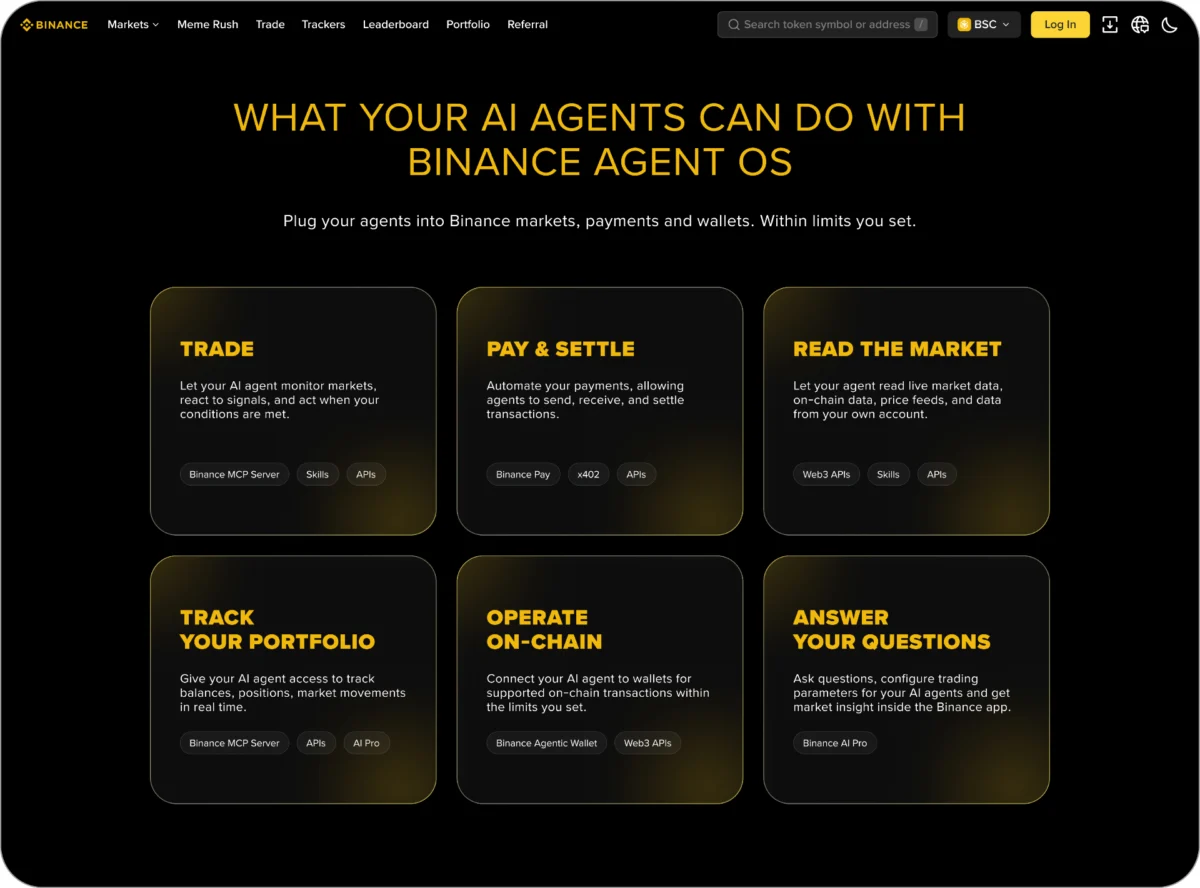
Binance, the world’s largest cryptocurrency exchange by trading volume and user base, officially announced on Thursday the launch of Agent OS, a specialized infrastructure designed to integrate autonomous artificial intelligence agents into the global financial ecosystem. This move marks a significant shift in the cryptocurrency industry, transitioning from AI-assisted data analysis to fully autonomous AI execution, where software agents can manage real capital, execute complex trading strategies, and interact with decentralized finance (DeFi) protocols on behalf of human users.
With more than 300 million registered users, Binance’s entry into the "agentic" AI space provides a massive testing ground for the intersection of large language models (LLMs) and high-frequency financial markets. Agent OS acts as a bridge, allowing developers to connect sophisticated AI applications—such as those powered by OpenAI’s ChatGPT, Anthropic’s Claude, or specialized coding environments like Cursor—to Binance’s deep liquidity and financial toolset.
The Technical Architecture of Agent OS
Agent OS is not a singular tool but an integrated ecosystem of application programming interfaces (APIs) and specialized "hubs" designed to facilitate secure, machine-led financial activity. At the core of the platform is the Model Context Protocol (MCP), an open standard that allows AI models to seamlessly access data and services across different platforms. By adopting MCP, Binance ensures that AI agents can "read" market conditions and "write" orders without the friction of custom-built connectors for every individual AI model.
The platform integrates several existing and new Binance services into a unified developer environment:
- Binance Wallet Agentic Hub: A secure interface for agents to manage digital assets.
- Binance Skill Hub: A repository of pre-defined functions that agents can use to perform specific tasks, such as technical analysis or portfolio rebalancing.
- Binance x402 Integration: A transaction verification and payment facilitator API that allows agents to handle settlement and payment workflows.
- Subaccount Infrastructure: A critical security layer that isolates agent activity from a user’s primary funds.
By providing these tools, Binance aims to lower the barrier to entry for developers who wish to build "AI-native" financial applications. This includes everything from automated arbitrage bots that scan multiple exchanges to personalized AI financial advisors that can execute trades based on a user’s risk tolerance and news sentiment analysis.
Governance and Risk Management: The "Sandbox" Approach
The delegation of financial decision-making to autonomous software raises significant concerns regarding security, market volatility, and the potential for catastrophic loss. Binance’s leadership has emphasized that while the agents are autonomous, the control remains strictly with the human user.
Jeff Li, Vice President of Product at Binance, noted in a recent interview that the company’s philosophy centers on "granular access control." Rather than giving an AI agent unrestricted access to a user’s entire portfolio, Agent OS utilizes a "subaccount" system. Users can create a dedicated subaccount, transfer a specific amount of capital into it, and assign an AI agent to that account only.
Crucially, withdrawals from these subaccounts are blocked by default. This creates a "sandbox" environment where an agent can trade, buy, and sell assets within the exchange, but cannot move those assets to external wallets without manual intervention from the account holder. This architecture is designed to mitigate the risks of "prompt injection" attacks—where a malicious actor might attempt to trick an AI agent into sending funds to a third-party address through deceptive instructions.
Furthermore, Binance allows users to choose between two execution modes:
- Approval Mode: The agent analyzes the market and proposes a trade, but the user must manually click "confirm" before the order is sent to the matching engine.
- Autonomous Mode: The agent is given permission to execute trades automatically based on pre-set parameters and its own internal logic.
Financial Guardrails and Transaction Limits
To prevent flash crashes or massive systemic errors, Binance has implemented a tiered system of transaction limits for activities involving the Agentic Wallet and on-chain protocols. While exchange-based trading (within a subaccount) is limited only by the balance provided by the user, activities that interact with the broader blockchain ecosystem are subject to strict daily caps:
- Token Swaps: Capped at $50,000 per day.
- DeFi Transactions: Limited to a default of $100,000 per day.
- x402 Payments: Strictly limited to $20 per day, primarily for small-scale automated settlements and service fees.
These limits reflect a cautious approach to the "AI-to-AI" economy, where agents may eventually pay each other for data or processing power. By capping these payments at a nominal amount, Binance reduces the risk of automated systems draining accounts through high-frequency micro-transactions.
The Evolution of Automated Trading: A Chronology
The launch of Agent OS is the latest milestone in a decades-long evolution of automated finance. To understand its significance, it is helpful to look at the timeline of how trading technology has progressed:
- 1980s-1990s: The rise of algorithmic trading in traditional markets. Traders began using "if-then" logic to automate orders based on price triggers.
- 2010-2017: The emergence of cryptocurrency trading bots. These were largely script-based and required significant coding knowledge to maintain.
- 2022-2023: The "ChatGPT Moment." Large Language Models demonstrated the ability to write code and analyze financial sentiment, but they remained "trapped" in chat windows, unable to take action.
- Early 2024: Rival exchanges like Kraken and OKX began introducing Model Context Protocol (MCP) toolkits and command-line interfaces for AI, moving toward "agentic" capabilities.
- June 2024: Coinbase launched "Coinbase for Agents," providing a dedicated SDK (Software Development Kit) for AI-driven financial workflows.
- August 2024: Binance launches Agent OS, leveraging its 300-million-user ecosystem to bring AI-native trading to the retail and institutional masses.
Competitive Landscape: The Race for the AI-Native Exchange
Binance is not operating in a vacuum. The race to become the primary infrastructure for AI agents is heating up among the "Big Three" of the crypto exchange world: Binance, Coinbase, and Kraken.

Kraken was among the first to embrace the open-source ethos of AI integration, launching a command-line tool with a built-in MCP server in March. This allowed technical users to pipe market data directly into LLMs. Coinbase followed shortly after with a more user-friendly approach, focusing on "on-chain" agents that can perform payments and DeFi interactions through the Base network.
Binance’s strategy appears to be one of "comprehensive integration." By combining its massive liquidity with a multi-layered security model and support for the industry’s most popular AI models (ChatGPT, Claude), Binance is positioning itself as the "operating system" for the future of automated wealth management.
Industry Implications and Future Outlook
The introduction of Agent OS has profound implications for the future of capital markets. On one hand, AI agents can process vast amounts of data—including news feeds, social media sentiment, and on-chain whale movements—far faster than any human trader. This could lead to more efficient markets and provide retail investors with tools previously reserved for elite quantitative hedge funds.
However, the "black box" nature of AI reasoning remains a point of concern. As Jeff Li admitted, Binance cannot see the internal "thought process" of an agent. If an agent makes a disastrous trade based on a hallucination or a misunderstood news headline, the exchange only sees the resulting order, not the faulty logic that led to it.
Market analysts suggest that this could lead to a new form of market volatility. If thousands of AI agents are trained on similar datasets, they may exhibit "herd behavior," all attempting to exit or enter positions simultaneously, potentially stressing exchange infrastructure or causing "flash" movements in specific tokens.
From a regulatory perspective, Agent OS will likely face scrutiny regarding Anti-Money Laundering (AML) and Know Your Customer (KYC) compliance. While Binance states that its existing risk-control policies apply to all Agent OS subaccounts, regulators may question how "intent" and "responsibility" are defined when an autonomous agent commits a trade that violates market manipulation rules.
Despite these challenges, the launch of Agent OS signals that the era of the "human-only" trader is drawing to a close. In the coming years, the primary users of financial exchanges may not be humans staring at screens, but sophisticated software agents negotiating with one another in millisecond timeframes. Binance’s new platform is a foundational step toward this AI-driven financial future, providing the rails upon which the next generation of automated wealth will be built.