admin
admin
Crypto exchange Bitget has initiated the phased resumption of withdrawal services following a significant security breach that saw nearly $388 million in digital assets compromised from its hot and warm wallet infrastructure. The incident, which unfolded in late September, has drawn sharp focus on the security vulnerabilities inherent in centralized exchanges and the challenges posed by decentralized protocols in preventing the laundering of stolen funds. As Bitget strives to restore full functionality and user confidence, on-chain analysis indicates that the perpetrator continues to move and obfuscate the stolen cryptocurrency, primarily utilizing the decentralized cross-chain swapping protocol THORChain.
Chronology of the Breach and Bitget’s Response
The security incident at Bitget was first detected on September 24, when the exchange identified unauthorized access to a portion of its digital asset holdings. In response to the breach, Bitget promptly suspended all withdrawal services across its platform to contain the damage and conduct a thorough security audit. This immediate halt is a standard industry protocol following such events, designed to protect remaining user funds and prevent further illicit transfers.
Initially, Bitget reported the stolen amount to be approximately $351.6 million. However, subsequent internal investigations and comprehensive on-chain analysis revealed a broader scope of the compromise. The exchange later revised this figure upwards to $387.5 million, after accounting for additional unauthorized transfers involving assets on the Zcash and Tron networks. This adjustment underscored the complexity of tracking and quantifying losses in multi-chain environments, especially when sophisticated attackers are involved. Throughout the incident, Bitget assured its users that its cold wallets, which typically hold the vast majority of an exchange’s assets offline and are considered the most secure storage method, remained uncompromised. This distinction between hot/warm and cold wallet security is crucial for user reassurance, as it suggests the core, long-term asset reserves were not directly impacted.
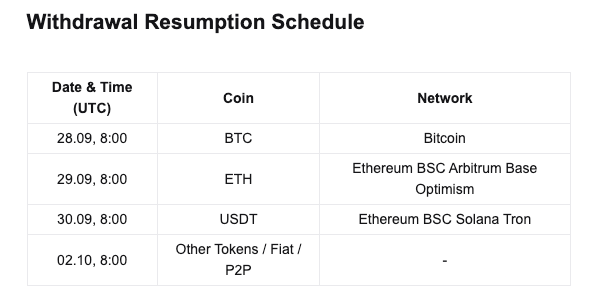
In a move to re-establish normalcy and rebuild user trust, Bitget announced the phased resumption of withdrawal services. On Monday, following the breach, Bitcoin (BTC) withdrawals were reactivated on both the Bitcoin network and the BNB Smart Chain. Gracy Chen, CEO of Bitget, addressed the community in an ask-me-anything (AMA) session, explaining the rationale behind prioritizing BTC withdrawals. "We restored BTC first because the withdrawal pipeline is the first to be completed," Chen stated, indicating a systematic approach to re-enabling services after rigorous security checks.
The exchange outlined a detailed schedule for the reintroduction of other major cryptocurrencies. Ether (ETH) withdrawals were slated to resume on Tuesday across multiple networks, including Ethereum, BNB Smart Chain, Arbitrum, Base, and Optimism. Tether’s USDt (USDT) withdrawals were scheduled for Wednesday, encompassing Ethereum, BNB Smart Chain, Solana, and Tron. All other remaining assets and peer-to-peer (P2P) services are expected to become fully operational by Friday. Chen emphasized that this schedule applies universally to all users, ensuring no preferential treatment for institutional clients, VIPs, or even Bitget employees, a measure likely aimed at fostering equitable service and transparency during a critical recovery phase.

The Attacker’s Tactics and THORChain’s Role
While Bitget focused on recovery, blockchain analytics firms and on-chain observers continued to monitor the movement of the stolen funds. Reports from Lookonchain and data from Arkham intelligence confirmed that the attacker was actively attempting to launder a significant portion of the pilfered assets, particularly by swapping Ether for Bitcoin through THORChain. Arkham data specifically highlighted ETH linked to the attacker flowing into THORChain vaults, indicating a clear strategy to convert traceable assets into more fungible and difficult-to-trace cryptocurrencies, such as Bitcoin, often considered a preferred asset for illicit transactions due to its widespread liquidity.
THORChain, a decentralized cross-chain liquidity protocol, facilitates direct swaps between different blockchain networks without the need for wrapped assets or centralized intermediaries. This functionality, while beneficial for legitimate users seeking seamless asset conversion, also presents an attractive avenue for attackers looking to obscure the origin of stolen funds. The protocol’s decentralized nature means it operates without a central authority, making it resistant to censorship and intervention by external parties, including law enforcement or affected exchanges.
Recognizing this, Bitget CEO Gracy Chen publicly appealed to THORChain to refuse services to the addresses identified as being linked to the attack. However, THORChain’s response underscored the inherent limitations of decentralized protocols in such scenarios. The protocol clarified that its network halt mechanism, an emergency security measure, affects the entire protocol broadly and "is not a selective freeze of specific funds or an individual swap." Crypto author Anndy Lian further elucidated this point, explaining that while THORChain can halt trading, stop outbound transactions, or pause a connected chain, these actions impact all users indiscriminately. Crucially, the protocol lacks a built-in address blacklist, which technically prevents it from selectively blocking specific wallet addresses or transactions associated with stolen funds. This operational reality highlights a fundamental tension between the ethos of decentralization and the practical demands of combating financial crime in the digital asset space.
Understanding Wallet Security and Decentralized Laundering
The Bitget breach offers a stark reminder of the tiered security approach adopted by most centralized crypto exchanges.
- Cold Wallets: These are offline storage solutions, typically hardware devices or paper wallets, that are completely disconnected from the internet. They offer the highest level of security against online hacking attempts but are less convenient for frequent transactions. Exchanges usually store the vast majority of their user funds in cold storage.
- Warm Wallets: These wallets have some degree of online connectivity, often for monitoring balances or preparing transactions, but are not constantly exposed to the internet. They serve as a buffer between hot and cold storage.
- Hot Wallets: These are online, internet-connected wallets used for daily operational needs, such as processing withdrawals and deposits. While essential for liquidity and user convenience, their constant connectivity makes them the most vulnerable to cyberattacks. The Bitget breach primarily impacted these hot and warm wallet infrastructures, which, while concerning, meant the majority of user assets held in cold storage remained secure.
The attacker’s choice of THORChain for laundering highlights a growing trend in post-breach fund movements. Decentralized exchanges (DEXs) and cross-chain bridges, by design, often operate without Know Your Customer (KYC) or Anti-Money Laundering (AML) checks, making them ideal tools for obfuscating the trail of illicit funds. Swapping assets across different blockchains, particularly through protocols that pool liquidity anonymously, makes it exceedingly difficult for investigators to trace the ultimate destination of the stolen cryptocurrencies. This poses a significant challenge for both exchanges seeking to recover funds and law enforcement agencies attempting to prosecute cybercriminals.
Broader Implications for the Crypto Industry
The Bitget breach, like numerous others before it, carries significant implications for the wider cryptocurrency ecosystem.
- Enhanced Security Scrutiny: The incident will undoubtedly prompt other centralized exchanges to review and bolster their security protocols, particularly concerning hot and warm wallet management, multi-signature requirements, and intrusion detection systems. The continuous arms race between exchanges and sophisticated attackers necessitates constant innovation in cybersecurity.
- Regulatory Pressure: Major breaches invariably attract the attention of financial regulators worldwide. Governments are increasingly grappling with how to regulate the nascent crypto industry, and incidents like this provide further impetus for stricter oversight, particularly regarding asset custody, cybersecurity standards, and AML compliance for both centralized and decentralized entities. The inability of decentralized protocols like THORChain to selectively block funds could intensify calls for regulatory frameworks that attempt to bridge the gap between decentralization and accountability.
- User Trust and Education: Each security incident erodes user trust, making it imperative for exchanges to demonstrate transparency, effective recovery plans, and robust security measures. Furthermore, these events underscore the importance of user education regarding the risks associated with leaving funds on exchanges and the advantages of self-custody for long-term holdings ("not your keys, not your crypto").
- Decentralization vs. Centralization Debate: The incident reignites the ongoing debate about the trade-offs between centralized and decentralized finance. While centralized exchanges offer convenience and often insurance funds, they present a single point of failure that can be exploited. Decentralized protocols offer censorship resistance and user autonomy but can inadvertently become tools for illicit activities due to their inherent lack of central control and selective intervention capabilities.
- Innovation in Security and Tracing: The constant threat of breaches also drives innovation in blockchain security and forensics. Companies specializing in on-chain analysis, such as Arkham and Chainalysis, play an increasingly vital role in tracking stolen funds, providing data to exchanges and law enforcement, and developing tools to identify illicit transaction patterns.
Bitget’s Path Forward
For Bitget, the immediate priority is to fully restore all services and demonstrate its resilience. The structured approach to re-enabling withdrawals, coupled with transparent communication from its CEO, is crucial for rebuilding confidence among its user base. The exchange will likely need to conduct a thorough post-mortem analysis of the breach, implement any necessary security upgrades, and potentially enhance its insurance fund to cover such eventualities. Many exchanges maintain emergency insurance funds, often funded by a percentage of trading fees, to protect users in the event of unforeseen security incidents. While the article doesn’t specify Bitget’s exact mechanism, such a fund would be critical for absorbing the $388 million loss without passing the burden directly to users.
The Bitget security breach serves as a stark reminder of the persistent challenges in securing digital assets in a rapidly evolving technological landscape. While exchanges continue to innovate and strengthen their defenses, the ingenuity of attackers and the unique characteristics of decentralized protocols ensure that the battle for cybersecurity in the crypto space remains a continuous and complex endeavor. The incident also highlights the intricate relationship between centralized entities, decentralized protocols, and the broader regulatory environment, all of which are striving to navigate the nascent but powerful world of digital finance.