admin
admin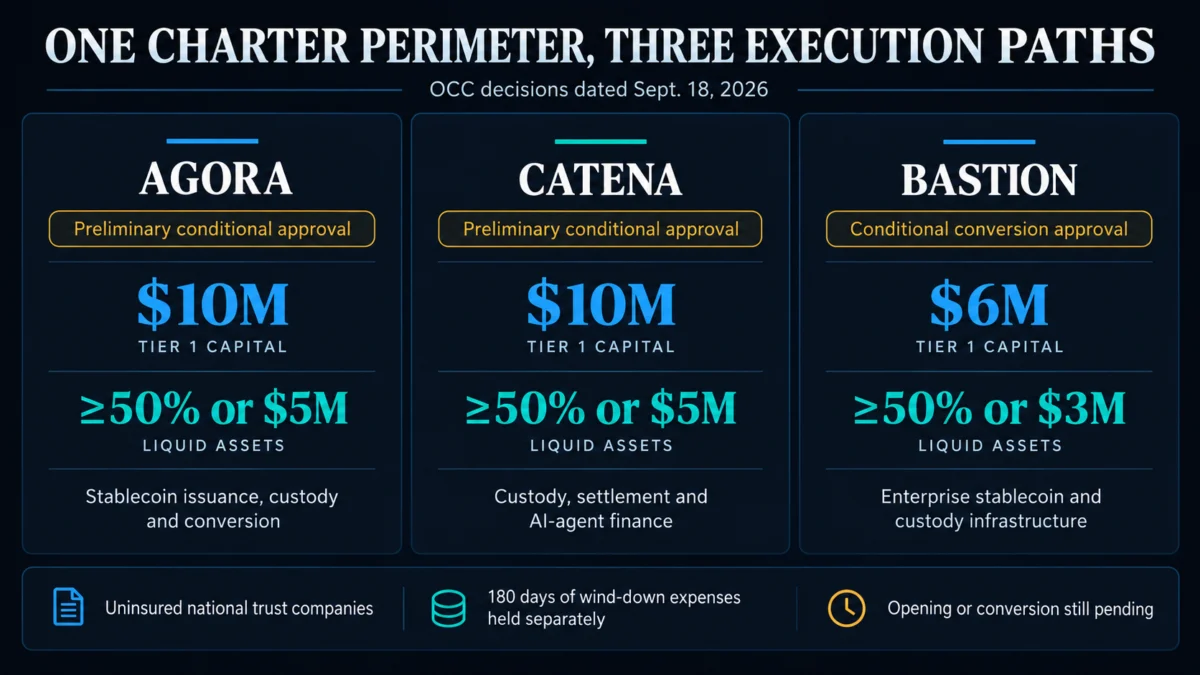
The Office of the Comptroller of the Currency (OCC) took a significant step on September 18th by advancing three firms focused on stablecoin operations – Agora, Catena, and Bastion – towards obtaining federal trust-bank status. These decisions, uniformly applied across the three applicants, underscore the OCC’s commitment to establishing a defined and repeatable regulatory framework for specialized, uninsured trust banks. While this development marks progress in bringing digital asset financial services under federal oversight, it also highlights the intricate path ahead, laden with execution, legal, and operational challenges that will ultimately determine the success of these nascent institutions.
The OCC’s recent approvals signal a deliberate strategy to streamline the process for companies seeking to operate as national trust banks, particularly those involved with stablecoins. This approach aims to reduce regulatory fragmentation by consolidating oversight under a single federal supervisor. However, the conditional nature of these approvals means that the charter itself is not yet a guaranteed competitive advantage. Final approval, securing adequate capital and robust reserve relationships, and demonstrating strong operating performance will be the true tests of viability for Agora, Catena, and Bastion.
OCC’s Regulatory Actions: A Detailed Breakdown
The OCC’s actions on September 18th were multifaceted, reflecting different stages of regulatory progression for each applicant.
Agora and Catena: Preliminary Approval for New National Trust Banks
Both Agora and Catena received preliminary conditional approval for de novo national trust banks. This means that while the OCC has signaled its intent to grant charters, both companies are still in the organizational phase. They must complete a series of pre-opening requirements before the OCC will grant final approval and grant them permission to commence business operations.
- Agora: The OCC’s decision regarding Agora (referenced in CD1393) grants initial conditional approval. Agora intends to focus on stablecoin issuance and reserve management, alongside digital asset custody, payments, and advisory services. A key aspect of their plan involves transitioning the issuance of their stablecoin, AUSD, from their Bermuda-based entity to the newly chartered national bank, contingent upon its establishment. This transition would involve transferring underlying assets and liabilities to the federal institution. As of late September, Agora’s public-facing materials still identified Agora Bermuda as the issuer of AUSD, indicating the prospective nature of this planned shift.
- Catena: Similarly, Catena (referenced in CD1392) received preliminary conditional approval. Their proposed business model encompasses fiduciary and non-fiduciary custody, investment management, and trust services. Notably, Catena aims to integrate conversion, clearing, and execution services linked to assets held within these relationships. The company has positioned its offerings with a particular emphasis on serving AI agents and the businesses that deploy them, a strategic focus that the OCC has acknowledged but not formally adopted as part of its regulatory characterization.
For both Agora and Catena, the clock began ticking on their approvals. They are required to submit a letter to OCC chartering staff at least 60 days prior to their anticipated opening date. Failure to raise the necessary capital within 12 months or to commence operations within 18 months will result in the expiration of their conditional approvals.
Bastion: Conversion of an Existing State Trust Company
Bastion Platforms Trust Company, already operating under a New York state trust charter, took a different regulatory route. The OCC conditionally approved its conversion into Bastion Platforms National Trust Company (referenced in CD1391). This process involves transitioning from state to federal chartering, requiring Bastion to complete its conversion and receive acknowledgement from the OCC before operating under the national charter.
- Bastion: Bastion’s operational focus is on enterprise infrastructure, including fiduciary custodial wallets, conversion services for custody clients, white-label stablecoin issuance, and technology and operational support for other authorized issuers. Their proposed national charter will consolidate capabilities currently delivered through their existing state charter, other licenses, and various partnerships. Bastion’s announcement highlights the ability for enterprise clients to leverage their custody, payments, and issuance tools, while third-party firms can maintain issuer status.
Bastion’s approval has a tighter timeline. The conversion must be completed within six months, unless the OCC grants an extension due to extenuating circumstances.
Defining the Perimeter: Trust Banks, Not Insured Commercial Banks
A crucial commonality across all three OCC decisions is the establishment of a clear perimeter for operations. Each institution must strictly limit its activities to those permissible for trust companies and closely related services. Importantly, these entities are explicitly designed to remain outside the definition of a "bank" as defined by the Bank Holding Company Act. This distinction is critical as it means they are not subject to the same regulatory regime as traditional insured commercial banks.
The OCC has made it clear that these are not ordinary insured depository institutions. Bastion’s decision explicitly states that it will not take deposits and will not be insured by the Federal Deposit Insurance Corporation (FDIC). Similarly, Agora’s application materials indicate that the proposed bank will not be an insured depository institution. Catena’s approval treats the institution as an uninsured national bank, with a specific clarification that payment stablecoins are not considered deposits and cannot be represented as FDIC-insured.
Capital and Liquidity Requirements: A Calibrated Approach
While adhering to a common regulatory architecture, the OCC has applied applicant-specific calibrations to capital and liquidity requirements.
- Agora and Catena: Both firms must maintain a minimum of $10 million in Tier 1 capital. Additionally, they are required to hold liquid assets equivalent to the greater of 50% of their Tier 1 capital or $5 million.
- Bastion: As part of its conversion, Bastion is subject to a slightly lower floor, requiring a minimum of $6 million in Tier 1 capital and liquid assets equivalent to the greater of 50% of Tier 1 capital or $3 million.
Beyond these initial floors, all three institutions are mandated to conduct quarterly reassessments of their capital and liquidity needs, with the obligation to hold additional amounts if their risk profiles warrant it.

A separate, overarching condition requires all three to maintain eligible liquid assets sufficient to cover 180 days of fixed and variable operating expenses, specifically earmarked for a distressed wind-down scenario. These assets are distinct from those used to meet capital liquidity requirements, preventing double-counting. This stringent liquidity requirement will be in place for the first three years of operation under their respective federal charters.
Furthermore, any significant changes to their business plans will necessitate advance notice to the OCC and a written determination of no objection. Essential functions such as compliance, audit, information security, and robust governance remain integral to the path toward full operational commencement or conversion completion.
A Repeatable Pathway: The OCC’s Evolving Digital Asset Strategy
The September 18th decisions are not isolated events but rather part of a broader, evolving strategy by the OCC to engage with the digital asset sector. The OCC’s publicly accessible decision index reveals a growing number of digital-asset-related trust bank applications and approvals involving firms such as Bridge, Foris DAX, Coinbase, Laser Digital, and Wise. The agency’s dedicated digital asset licensing applications page further indicates a robust pipeline of firms seeking similar charters.
In August of the current year, Comptroller Jonathan Gould highlighted that approximately 23 out of 40 new charter applications received over the preceding 18 months were related to digital assets. This substantial volume suggests that the trio of Agora, Catena, and Bastion represents a significant cohort within the OCC’s ongoing engagement, rather than an experimental anomaly.
The OCC’s Trust-Bank Rule, which became effective on April 1st, provided further clarity by affirming that national trust banks can engage in permissible non-fiduciary activities alongside their fiduciary services. While the OCC continues to assess the statutory authority for specific proposed activities on a case-by-case basis, this framework is contributing to a more predictable pathway for applicants.
Additionally, proposed rules implementing the GENIUS Act are signaling a move towards more standardized expectations for federal stablecoin issuers regarding reserves, capital, and liquidity. As of late September, these rules remained in their proposed state, outlining a potential federal layer of regulation rather than a finalized operational regime.
Contested Legal Foundations and Broader Implications
Despite the clear administrative process emerging, the legal foundation for the OCC’s approach remains a subject of contention. The Conference of State Bank Supervisors (CSBS) has publicly challenged the breadth of the OCC’s trust chartering authority and its preemption approach. While the CSBS has not yet filed litigation, its statements indicate a potential for future legal challenges if states perceive that the OCC’s actions exceed the limits established by the National Bank Act. This ongoing legal debate underscores that while the administrative process may appear repeatable, the ultimate legal standing of these charters is not yet settled.
The overarching implication of these three decisions is the increasing accessibility of a federal trust charter for qualified digital asset firms. The OCC appears to be creating a consistent framework, characterized by shared boundaries, capital principles, wind-down liquidity requirements, supervisory oversight, and pre-opening controls. The growing number of applications and the structured approach to approvals suggest that while obtaining a federal trust charter remains a demanding and costly endeavor, the permission set is becoming more standardized, allowing multiple qualified applicants to pursue it.
Differentiated Business Models Within a Common Framework
The OCC’s approach allows for significant differentiation in business models while operating within the established federal trust bank perimeter.
- Agora: Beyond stablecoin issuance and reserve management, Agora plans to offer digital asset custody, custody-linked payments and settlement, and fiduciary investment advice tailored for institutional and business custody clients. The planned transition of AUSD issuance to the federal bank, upon its establishment, signifies a core strategic objective.
- Catena: Catena’s strategy focuses on serving AI agents and their deploying businesses. Their approved plan includes custody, investment management, and trust services, alongside non-fiduciary conversion, clearing, and execution linked to assets under their management. This AI-centric positioning is Catena’s proprietary strategy, not an OCC-defined characteristic.
- Bastion: Bastion’s model is geared towards enterprise infrastructure, offering fiduciary custodial wallets, conversion services for custody clients, white-label stablecoin issuance, and operational support for other issuers. Their federal conversion aims to centralize capabilities currently dispersed across various state licenses and partnerships.
These distinct business models highlight that while a federal trust charter can provide national regulatory reach and unified supervision, it does not inherently guarantee success. The critical factors for competitive advantage will lie in customer acquisition, securing stable liquidity, establishing robust reserve partnerships, achieving seamless enterprise integrations, and executing a successful launch.
The Evolving Role of the Federal Trust Charter
Previous analyses had suggested that federal trust charters could be scarce strategic assets, offering both national reach and a defined structure for digital asset operations. However, the recent wave of decisions, particularly the synchronized approvals for Agora, Catena, and Bastion, suggests a narrowing of the "scarcity" argument. The shared regulatory perimeter, common supervisory architecture, and defined pathways toward operation indicate that the OCC is indeed establishing a more accessible infrastructure for a broader range of qualified applicants.
The emphasis has now shifted from the sheer availability of the charter to the execution capabilities of the firms. Agora and Catena must translate preliminary approval into the ability to open their doors, while Bastion must finalize its conversion. All three will be under pressure to maintain stringent capital and liquidity standards while convincing a competitive market that their specific blend of custody, issuance, settlement, and control services offers compelling value.
In this evolving landscape, the federal trust charter remains a valuable asset, increasingly serving as an entry requirement rather than a self-sustaining competitive moat. The true, durable advantage will be forged through effective distribution, sound liquidity management, and flawless operational execution. The OCC’s consistent application of its framework suggests a future where multiple firms can leverage this federal charter, with their ultimate success determined by their ability to navigate the complex operational and market realities that lie beyond regulatory approval.