admin
admin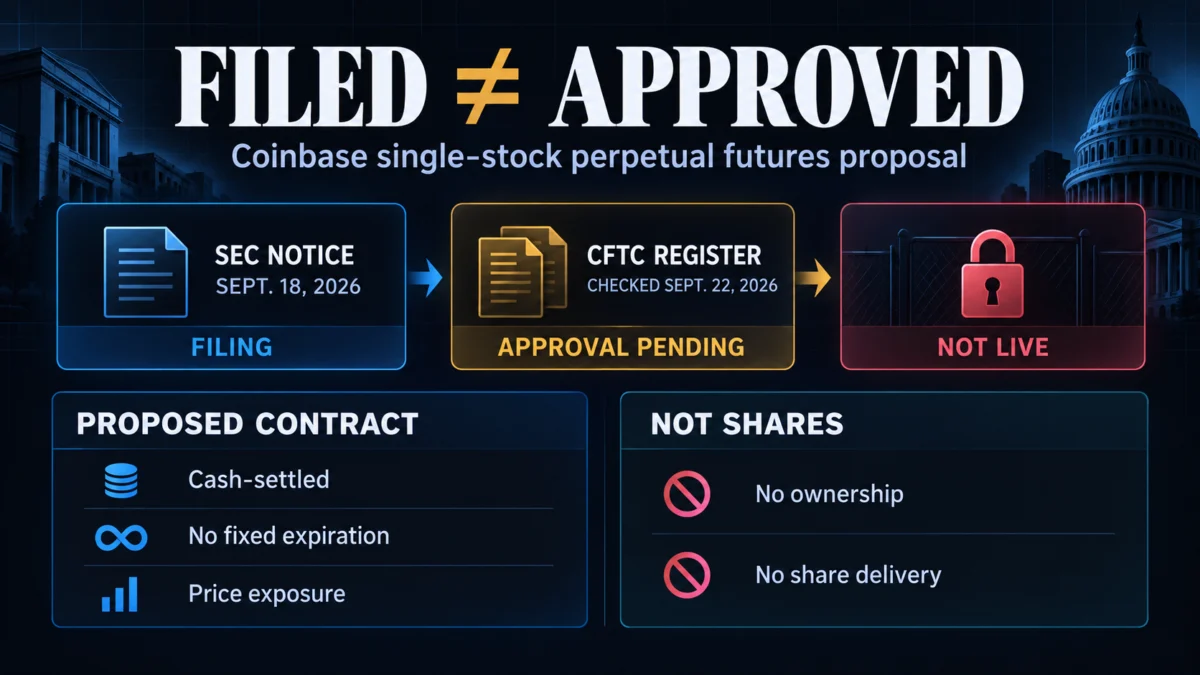
Coinbase Derivatives has submitted a proposed framework for perpetual futures contracts tied to individual U.S. stocks and exchange-traded funds (ETFs), signaling a significant expansion into traditional financial markets. However, these innovative products remain in regulatory limbo, awaiting crucial approval from the Commodity Futures Trading Commission (CFTC). The Securities and Exchange Commission (SEC) published a notice on September 18th, detailing Coinbase’s submission to the CFTC, which had not yet granted its approval as of September 22nd. This "Approval Pending" status, as indicated on the CFTC’s product register, means that while the proposal is publicly documented, the contracts are not yet accessible to traders.
The initiative represents Coinbase’s strategic move to bridge the gap between the burgeoning digital asset space and established financial instruments, offering U.S. investors novel ways to gain price exposure to equities without the complexities of direct ownership or physical settlement. The proposed contracts are designed as cash-settled perpetual futures, a structure that allows traders to speculate on price movements without the obligation to buy or sell the underlying asset. This approach mirrors the mechanics of popular cryptocurrency perpetual futures, which have seen substantial trading volumes globally.
The Mechanics of Cash-Settled Perpetual Futures
At the core of Coinbase’s proposal is the concept of cash settlement. Unlike traditional futures contracts that require the physical delivery of the underlying asset upon expiration, cash-settled contracts are resolved by a cash payment reflecting the difference between the contract’s entry price and its final settlement price. For Coinbase’s proposed stock and ETF futures, this means that traders would gain exposure to the price fluctuations of a particular stock or ETF. If the price of the underlying asset rises, holders of long positions would receive a cash payout equal to the increase, while short positions would incur a corresponding loss. Conversely, if the price falls, short positions would profit, and long positions would lose.
Crucially, these contracts would not confer any ownership rights associated with the underlying shares. Holders would not be shareholders, meaning they would not possess voting rights, be entitled to dividends, or have any claim on the company’s assets. This distinction is vital, as it allows for speculation on price movements independent of the rights and responsibilities of actual equity ownership. The value of the contract would be derived solely from its reference price, which is the market price of the underlying stock or ETF.
Perpetual futures, by definition, do not have a fixed expiration date. This allows traders to maintain positions indefinitely, provided they meet ongoing financial obligations. In the context of Coinbase’s proposal, these obligations would primarily involve funding payments. Funding payments are a mechanism used in perpetual futures markets to incentivize traders to keep contract prices aligned with the spot price of the underlying asset. Traders with long positions pay funding to traders with short positions if the perpetual future is trading at a premium to the spot price, and vice versa. The specific methodology, payment intervals, and publication practices for these funding payments would be detailed in product appendices or identified market reference materials for each individual contract. This suggests a flexible approach, allowing for tailored terms based on the characteristics of each underlying security.
A Proposed Trading Schedule and Regulatory Hurdles
Coinbase has proposed a trading week that would commence on Sunday at 8 p.m. Eastern Time and conclude on Friday at 5 p.m. Eastern Time. This schedule aims to provide nearly continuous trading, aligning with the 24/5-style exposure that has become a hallmark of cryptocurrency derivatives markets. Such extended trading hours would offer U.S. investors greater flexibility to react to global market news and price movements outside of traditional stock market operating hours. However, this proposed schedule is subject to interruptions, including holidays, scheduled maintenance windows, and other exchange-defined periods. Furthermore, trading activity would remain subject to pauses, suspensions, and regulatory halts, standard safeguards in any financial market.
The journey from proposal to live trading for these contracts has been protracted. Coinbase Derivatives initially filed its proposed rule change with the CFTC, a necessary step for any entity seeking to offer futures contracts in the United States. The SEC’s notice on September 18th served to make this filing public, initiating a period during which interested parties can review and comment on the proposal. The CFTC, as the primary regulator of futures markets in the U.S., is responsible for evaluating these proposals to ensure they meet regulatory requirements for market integrity, investor protection, and financial stability.
The fact that the CFTC’s product register still lists the Single Stock Perpetual Futures Contract as "Approval Pending" highlights the ongoing nature of the regulatory review process. This process can involve extensive due diligence, requests for additional information from the applicant, and consultations with other regulatory bodies. While Coinbase has provided a detailed framework, the CFTC’s final decision will hinge on its assessment of the proposed rules, Coinbase’s operational readiness, and the potential impact on market stability.
Background and Context: Coinbase’s Evolving Strategy
Coinbase’s ambition to offer stock and ETF futures is part of a broader trend of established cryptocurrency exchanges seeking to diversify their product offerings and capture a larger share of the global derivatives market. In recent years, platforms like Binance, FTX (prior to its collapse), and Bybit have become significant players in the crypto derivatives space, attracting millions of users with a wide array of futures and options products. Coinbase, as one of the largest and most reputable U.S.-based cryptocurrency exchanges, is looking to leverage its brand and regulatory compliance to enter this lucrative market.
The move into U.S. stock and ETF derivatives is also a strategic response to the evolving regulatory landscape for cryptocurrencies. As regulators worldwide grapple with how to classify and oversee digital assets, exchanges are exploring avenues that fall under existing financial regulatory frameworks. By proposing products that are familiar to traditional investors and fall under the purview of established regulators like the CFTC, Coinbase is attempting to navigate these complexities and build a more robust and diversified business model.
The current market for single-stock futures in the U.S. is relatively nascent compared to other global markets. While the CME Group offers futures on individual stocks, the market has not seen the explosive growth witnessed in other futures categories. Coinbase’s entry, if approved, could inject new dynamism into this segment, potentially attracting a new generation of traders familiar with the faster-paced, digitally native trading styles of cryptocurrency markets.
Potential Implications and Market Impact
The approval of Coinbase’s single-stock perpetual futures could have several significant implications for both the cryptocurrency and traditional financial markets.
For Coinbase, it represents a substantial expansion of its derivatives business. Currently, Coinbase Derivatives primarily offers futures contracts on cryptocurrencies, such as Bitcoin and Ether. Adding single-stock and ETF futures would diversify its revenue streams and appeal to a broader investor base, including hedge funds, proprietary trading firms, and retail traders interested in synthetic exposure to equities. This diversification could enhance Coinbase’s resilience against the volatility inherent in the cryptocurrency market.

For investors, the proposed contracts offer a new and potentially more accessible way to gain price exposure to U.S. equities. The cash-settled, perpetual nature of these contracts could appeal to traders looking for leveraged exposure or those who wish to hedge existing equity portfolios without the need for physical asset management. The extended trading hours would also provide greater flexibility.
From a market structure perspective, the introduction of these products by a prominent player like Coinbase could increase liquidity and competition in the single-stock futures market. It could also lead to greater integration between the crypto and traditional finance ecosystems, as investors become more comfortable trading a wider range of assets on a single platform.
However, the regulatory approval process remains the primary hurdle. The CFTC’s cautious approach underscores the importance of ensuring that new financial products are robust, transparent, and do not pose undue risks to market participants or the financial system. The "Approval Pending" status signifies that the review is ongoing and that the final outcome is not yet certain.
Awaiting the Green Light: The Path Forward
As of late September 2026, the proposed single-stock perpetual futures from Coinbase Derivatives are in a state of "Approval Pending" with the CFTC. This means that any claims of the product being already approved, launched, or open to traders are premature. The filing with the SEC and the subsequent publication of the notice provide transparency into Coinbase’s intentions and the structure of the proposed contracts. However, it is the CFTC’s formal approval that will ultimately determine when, and if, these products become available to the U.S. market.
The timeline for regulatory approvals can vary significantly, depending on the complexity of the proposal and the workload of the regulatory body. Given the novelty of combining perpetual futures mechanics with U.S. equities and ETFs, the CFTC is likely undertaking a thorough review. Industry observers will be closely watching for any further updates from the CFTC and Coinbase, as the outcome of this regulatory process will shed light on the future of derivatives trading at the intersection of digital assets and traditional finance.
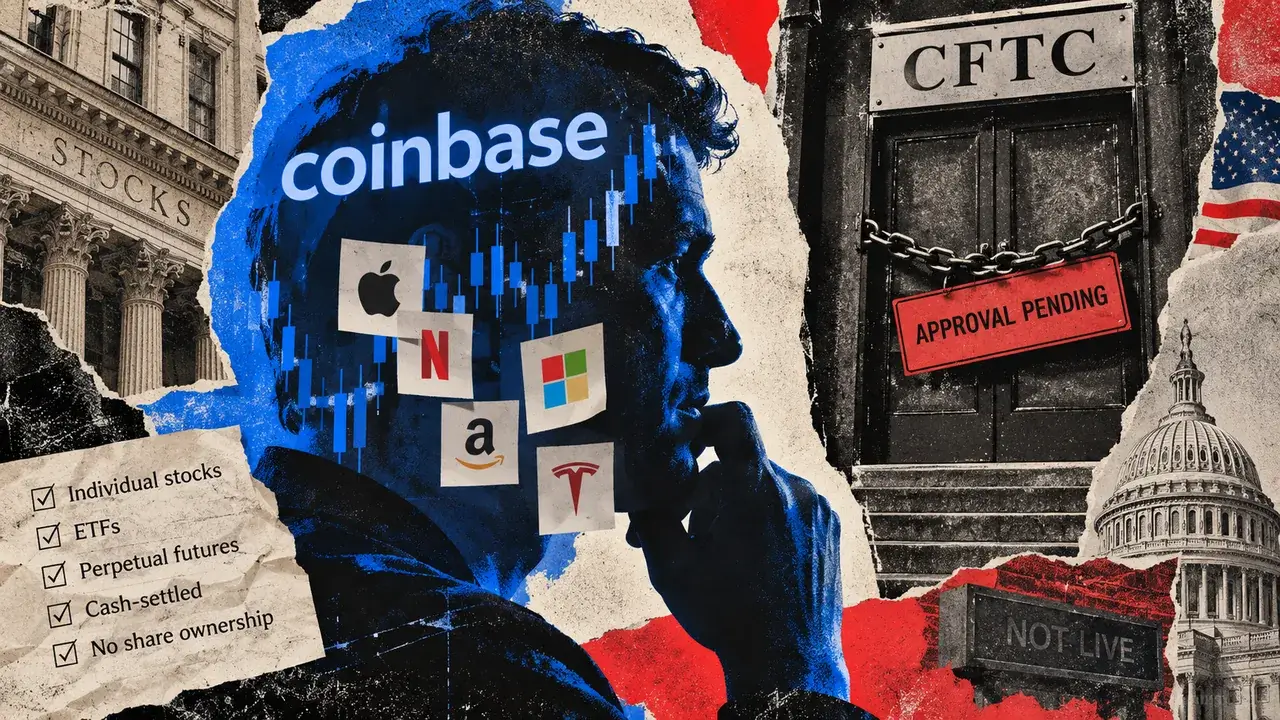
The image accompanying this report, depicting a chained CFTC doorway marked "approval pending" for Coinbase stock perpetuals, aptly illustrates the current situation. It signifies that while Coinbase has laid out its vision and prepared the groundwork, a critical regulatory gate remains to be passed. The details of stocks, ETFs, and cash-settled contracts are all outlined in Coinbase’s proposal, but their realization hinges on the CFTC’s final decision. The market eagerly awaits this decision, which could signal a new era for derivatives trading and further solidify Coinbase’s position as a leading player in both the crypto and broader financial landscape.