admin
admin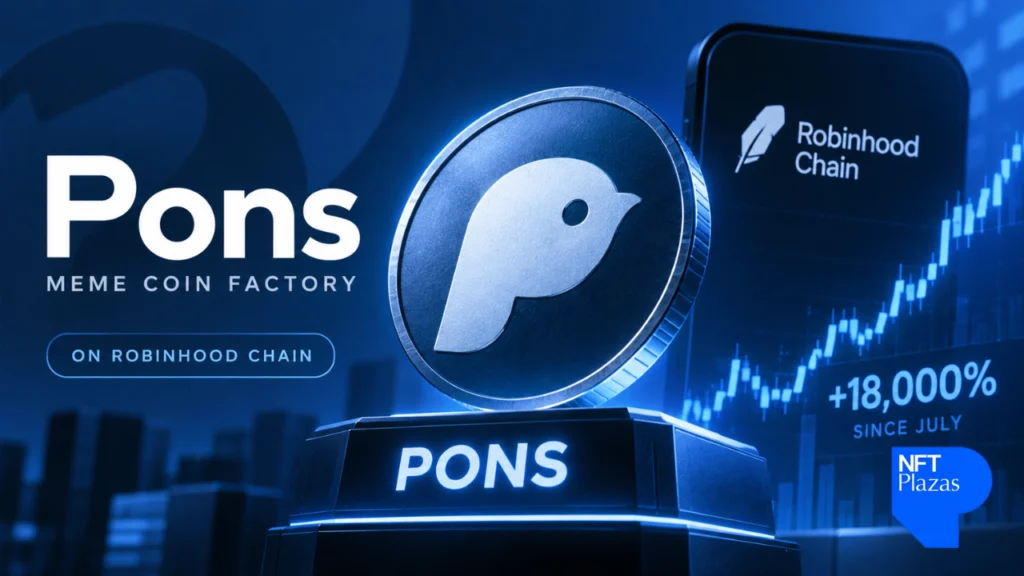
Pons, a decentralized token launchpad meticulously engineered on the nascent Robinhood Chain, has rapidly ascended to prominence, enabling users to effortlessly create and trade digital tokens directly on Robinhood’s recently unveiled layer-2 network. In a remarkable span of just two months since its inception, the platform has not only become one of the primary drivers of activity on the blockchain but has also seen its native PONS token skyrocket by an astounding 18,000% from its July low, attracting significant attention from the broader cryptocurrency market. This meteoric rise of Pons and its PONS token is largely attributable to a confluence of factors, including an explosive surge in meme-coin creation and trading, the generation of millions of dollars in daily protocol fees, and the implementation of a robust buyback-and-burn mechanism for its native token. However, this impressive growth trajectory remains intrinsically linked to highly speculative trading behavior, particularly within the burgeoning meme-coin ecosystem on Robinhood Chain, making it challenging to decouple Pons’s success from the broader, often volatile, market frenzy.
Understanding Pons: A Gateway to Decentralized Token Creation
At its core, Pons operates as a decentralized launchpad on Robinhood Chain, democratizing the process of token creation, launch, and trading. The platform eliminates the traditional barriers to entry, allowing virtually anyone to bring a token to life without the complex requirements of writing smart contracts or manually orchestrating liquidity pools. This innovative model significantly lowers the technical hurdle, making tokenization accessible to a wider audience. The operational framework of Pons bears a strong resemblance to established platforms like Pump.fun on Solana, effectively positioning Pons as a veritable "factory" for meme coins and other community-driven digital assets. Users are empowered to define key attributes for their tokens, such as a name, ticker symbol, visual identity (image), and other foundational information. Pons then seamlessly handles the underlying technical deployment and provides the necessary trading infrastructure, abstracting away the complexities of blockchain development.
Crucially, Pons is designed as a non-custodial platform, an essential security feature in the decentralized finance (DeFi) space. This means that Pons itself does not hold or control users’ funds. Instead, every token launch and every trade executed on the platform requires direct approval through the user’s personal cryptocurrency wallet, with all transactions meticulously recorded and executed on-chain. While this non-custodial design enhances security and user autonomy, Pons’s official documentation prudently cautions potential participants about the inherent risks associated with newly launched tokens, emphasizing their potential for extreme volatility, illiquidity, and even complete loss of value. This disclosure underscores the speculative nature of the assets created on the platform.
Robinhood Chain’s Genesis and the Unforeseen Meme Coin Boom
Robinhood Chain officially launched on July 1, 2026, entering the bustling blockchain landscape with an initial strategic focus on facilitating tokenized stocks and expanding the decentralized finance (DeFi) ecosystem. The vision was to leverage blockchain technology to enhance traditional financial assets and foster innovative financial applications. The introduction of a Layer-2 network by a mainstream financial entity like Robinhood was seen as a significant step towards bridging traditional finance with the burgeoning world of blockchain. Layer-2 solutions are designed to scale blockchain networks by handling transactions off the main chain (Layer-1), thereby increasing throughput and reducing fees, making them ideal for high-volume applications.

However, the early months of the chain’s operation witnessed an unexpected, yet powerful, shift in activity. Meme coins, driven by viral community engagement, internet culture, and speculative fervor, rapidly emerged as a dominant source of transaction volume and user interaction. This phenomenon, often characterized by rapid price swings and community-driven narratives rather than fundamental utility, quickly became a defining feature of the nascent chain. Within this dynamic environment, Pons quickly capitalized on the burgeoning demand, cementing its position as the network’s leading launchpad for these community-driven digital assets. This pivot highlights the unpredictable nature of blockchain adoption and how user-driven trends can reshape a network’s primary use cases, sometimes diverging significantly from initial strategic intentions.
Pons’s Astounding Growth Trajectory: Metrics and Milestones
The growth of Pons since its launch has been nothing short of explosive, demonstrating an unprecedented scaling velocity that has captured the attention of the crypto world. Its metrics provide a compelling narrative of rapid user adoption and significant economic impact within a very short timeframe.
Nearly 646,000 Tokens Created: A Testament to Accessibility
By early September 2026, a mere two months into its operation, Pons had facilitated the creation of approximately 646,000 unique tokens. This staggering figure was achieved by a diverse user base comprising more than 167,000 unique creator addresses, indicating widespread adoption and ease of use. The platform’s peak activity was observed on September 2, when nearly 25,000 new tokens were launched within a single 24-hour period. Concurrently, the 24-hour trading volume across these newly created assets reached an impressive $544 million, underscoring the liquidity and trading interest generated by the platform. To put this in perspective, this volume rivals that of some established centralized exchanges for specific trading pairs, highlighting the sheer scale of activity on Pons.
These remarkable statistics serve as a powerful testament to the appeal and effectiveness of Pons’s low-cost and user-friendly token launch model. The ability for an individual to transform a simple concept – a name and an image – into a fully tradable digital asset within minutes, with minimal technical expertise, has evidently resonated deeply with the broader crypto community, particularly those drawn to the cultural and financial phenomena of meme coins. This accessibility has democratized token creation, shifting power from developers to community members, which is a core tenet of decentralization, even if the end product is speculative.
Daily Fees Approaching $6 Million: Surpassing the Parent Chain
Beyond token creation, Pons has also distinguished itself as an unusually prolific fee generator, especially considering its nascent stage of development. On September 3, the platform generated approximately $5.95 million in fees over a 24-hour period. This monumental figure placed Pons fourth among all protocols tracked by DeFiLlama, a leading analytics platform that monitors decentralized finance activity, momentarily eclipsing even Robinhood Chain itself, which generated around $4 million in fees during the same timeframe.

This significant disparity in fee generation emphatically underscores the extent to which Pons and similar applications have driven the early activity and economic viability of Robinhood Chain. It highlights a critical dynamic where an application layer protocol can, in its initial growth phase, generate more revenue than the underlying blockchain it operates on, largely due to specific, high-demand use cases like meme coin trading. This scenario provides a compelling case study for new blockchain ecosystems, demonstrating that killer applications, even if driven by speculation, can rapidly bootstrap network value. In just a few months of operation, Pons had accumulated nearly $57 million in total fees, cementing its status as a financial powerhouse within the Robinhood Chain ecosystem. This rapid accumulation of fees provides substantial resources for the project’s ongoing development, marketing, and the implementation of its unique tokenomics.
Operational Mechanics: Pons V1 and the Evolution to V2
Pons has evolved its operational mechanics since its launch, introducing a second version to enhance the token launch experience and address some of the challenges inherent in new token distribution.
Pons V1: The Original Launch Mechanism
The initial iteration of Pons, referred to as V1, established a straightforward and accessible token creation process. Users could create tokens with a fixed supply of 1 billion units. The creator would define the token’s name, symbol, image, description, relevant links, and designate a wallet for fee collection. Pons would then take over, handling the technical deployment of the token and automatically establishing a corresponding Wrapped Ether (WETH) liquidity pool. WETH is a tokenized version of Ether (ETH) that makes ETH compatible with the ERC-20 standard, allowing it to be used in various DeFi protocols and paired with other tokens for trading. The automatic creation of this liquidity pool made the token instantly tradable upon launch.
Once launched, these V1 tokens could be directly traded against WETH on Robinhood Chain. Pons V1 implemented a 1% trading fee on all transactions. To mitigate potential market manipulation and excessive early concentration, the platform also incorporated temporary protections during the initial blocks following a token’s launch. During this critical period, individual wallets were subject to specific restrictions on purchase amounts and total holdings, designed to foster a more equitable distribution and prevent "whale" dominance immediately post-launch. This measure aimed to provide a fairer playing field for early participants. A key stage in the V1 model was "graduation," which a token reached once the WETH liquidity in its pool attained approximately 4.2 ETH. Unlike some competing launchpads that might migrate tokens to different pools at this stage, Pons V1 ensured that the token continued to trade within its original, established pool, maintaining continuity and reducing fragmentation.
Pons V2: Introducing the Bonding Curve for Enhanced Launches
Recognizing the need for further standardization and improved liquidity management, Pons introduced V2, which significantly altered the token launch mechanism. Under V2, a new token no longer begins with a conventional, immediately open liquidity pool. Instead, it starts its journey on a bonding curve, which holds its entire supply. A bonding curve is a mathematical function that defines the price of a token based on its supply. As more tokens are bought, the price algorithmically increases along the curve, and as tokens are sold, the price decreases. This mechanism aims to provide a more predictable price discovery process and ensure initial liquidity by creating a continuous market without needing a traditional order book.

Once the bonding curve stage is completed – typically after a predefined amount of capital has been raised or a certain time has elapsed – the token then "graduates" into a Uniswap v4 pool with permanently locked liquidity. Uniswap v4, representing the cutting edge of decentralized exchange technology, offers advanced features for liquidity providers, and the "permanently locked liquidity" aspect provides a strong assurance against rug pulls, a common scam in the meme coin space where developers withdraw liquidity, leaving investors with worthless tokens. This model is strategically designed to standardize the launch process, offer a more controlled initial price discovery, and crucially, alleviate the burden on creators to manually arrange and secure liquidity for their tokens, providing greater assurance of market stability and investor confidence.
PONS Tokenomics: Driven by a Powerful Buyback-and-Burn Mechanism
Central to the economic model of Pons is its native utility token, PONS, and its defining buyback-and-burn mechanism. This deflationary strategy is designed to create a direct link between the platform’s success and the value proposition of its token. The principle is straightforward: reduce supply in response to demand, potentially increasing the token’s scarcity and value.
Approximately 80% of all protocol fees generated by Pons are systematically allocated towards automated purchases of PONS tokens from the open market. These buybacks are executed via a Time-Weighted Average Price (TWAP) mechanism, which helps to minimize market impact by spreading purchases over time, preventing large price fluctuations from sudden demand. Once acquired, these PONS tokens are then immediately sent to a designated burn address, a non-recoverable wallet that effectively removes them from circulation permanently. The remaining 20% of the protocol fees are prudently channeled towards critical operational expenses, including infrastructure development, security audits, marketing, and the expansion of the Pons team, ensuring the long-term viability and growth of the platform.
This aggressive burning strategy has had a tangible impact on the token’s supply. By early September, approximately 288 million PONS tokens, representing about 28.8% of the original 1 billion supply, had been successfully burned. This leaves an approximate circulating supply of 712 million tokens. The direct implication of this structure is a strong positive feedback loop: increased platform activity, driven by more token launches and higher trading volumes, generates greater fees. These elevated fees, in turn, lead to more substantial PONS token buybacks and subsequent burns, theoretically driving scarcity and upward price pressure on the PONS token. This mechanism is a common strategy in crypto to incentivize holding and reward participation, but its effectiveness is ultimately tied to sustained platform activity.
PONS Token’s Unprecedented Rally: An 18,000% Surge
The PONS token has experienced an extraordinary price rally, transforming it into one of the standout performers on Robinhood Chain. Its journey has been characterized by sharp fluctuations, reflecting the highly speculative nature of the meme coin market.

Beginning its trading journey in July at a mere fraction of a cent, the token initially saw a dip, reaching its low point of approximately $0.0033 on July 17. This initial volatility is typical for newly launched tokens as early investors and speculators establish positions. However, this low proved to be a springboard for dramatic growth. PONS surged to approximately $0.066 by July 27, marking an early indication of robust investor interest and the beginning of its parabolic rise. This initial rally faced a temporary setback, with the token pulling back towards $0.016, partly influenced by the introduction of Uniswap’s competing Pools.trade launchpad on Robinhood Chain, which signaled increasing competition in the nascent ecosystem. The market reacted to the prospect of diluted attention and liquidity.
Undeterred, PONS staged a much more powerful and sustained recovery in the latter half of August, exhibiting resilience and renewed momentum. It climbed from roughly $0.03 to nearly $0.49 by early September. The ascent continued, and by September 5, PONS was trading around an impressive $0.6846, registering an astonishing 341.8% gain in just seven days and a staggering 18,000% from its July low. The token subsequently pushed above the $0.70 mark before experiencing a slight pullback, a natural occurrence as traders take profits. At this peak, its market capitalization reached approximately $475 million.
This remarkable rally propelled PONS to become one of Robinhood Chain’s largest native tokens by market capitalization. It even briefly surpassed CashCat, another prominent cryptocurrency on the chain, to claim the top spot, a clear indicator of the immense capital inflow and speculative interest it commanded. The performance of PONS vividly illustrates the explosive potential, albeit coupled with significant risk, inherent in tokens tied to successful decentralized applications on emerging blockchain networks. This kind of rapid appreciation often attracts further speculation, creating a self-reinforcing cycle that can be both exhilarating and perilous for investors.
PONS Tokenomics at a Glance
| Metric | Details |
|---|---|
| Project | Pons |
| Ticker | PONS |
| Blockchain | Robinhood Chain |
| Contract Address | 0x39dBED3a2bd333467115dE45665cC57F813C4571 |
| Initial Supply | 1,000,000,000 PONS |
| Burned (approx. by Sept.) | ~288 million PONS |
| Burned Supply % (approx. by Sept.) | ~28.8% |
| Circulating Supply (approx. by Sept.) | ~712 million PONS |
| Protocol Buyback Allocation | 80% of protocol fees |
| Trading Fee (V1) | 1% |
Transparency and Governance: The "Pons Family" Enigma
While Pons has achieved considerable operational and market success, the project currently maintains a relatively limited level of transparency regarding its founding team and investor base. Operating under the evocative brand of "pons family," the identities of its core founders and technical development team have not been officially disclosed to the public. Similarly, Pons has not made any public statements or provided detailed information concerning external fundraising rounds or strategic investors.
This degree of anonymity, while not uncommon in certain segments of the decentralized crypto space, particularly for projects aiming for true decentralization or those in the early, experimental stages, can present both opportunities and challenges. On one hand, it can foster a sense of community ownership and decentralization, allowing the project to evolve organically without a single point of failure or centralized control. On the other, it can raise questions about accountability, long-term commitment, and the potential for regulatory scrutiny, particularly as the project grows in scale and influence and interacts with