admin
admin
The United States economy demonstrated remarkable resilience in August, adding 162,000 nonfarm payroll jobs, a figure that dramatically exceeded economists’ consensus expectations of approximately 56,000. This robust labor market performance, announced on Friday, immediately sent ripples through financial markets, prompting a significant sell-off in Bitcoin (BTC) from $81,300 to local lows of $78,600 before partially recovering to $79,500 at the time of writing. The unexpected strength of the jobs report has intensified the already divided outlooks for the Federal Reserve’s upcoming Federal Open Market Committee (FOMC) meeting scheduled for September 15-16, adding a fresh layer of complexity to monetary policy discussions and drawing sharp criticism from US President Donald Trump regarding interest rates. Concurrently, the Bitcoin ecosystem witnessed its own significant development with the emergence of a new Blake2b version of Bitcoin, attracting its first liquidity following a contentious soft fork attempt and renewed debates over network decentralization.
Labor Market’s Unexpected Surge and Its Macroeconomic Implications
The nonfarm payrolls report is one of the most closely watched economic indicators, offering a snapshot of the health of the U.S. labor market outside of farm workers, private household employees, and non-profit organization employees. It serves as a critical barometer for economic growth, consumer spending, and inflationary pressures, directly influencing the Federal Reserve’s monetary policy decisions. The August data, showcasing 162,000 new jobs, represented a threefold beat on market expectations, which had largely anticipated a more modest recovery or even a slowdown. This consensus was likely shaped by a mix of recent economic data, including unemployment claims and business sentiment surveys, which had suggested a more tempered pace of hiring.
Such a strong jobs report typically signals a robust economy, potentially leading to increased consumer confidence and spending. However, in the current macroeconomic climate, where inflation remains a persistent concern for central bankers, "good news" on the employment front can often be interpreted as "bad news" for interest rate prospects. A tight labor market, characterized by low unemployment and strong wage growth, can fuel inflationary pressures as businesses compete for workers and pass increased labor costs onto consumers. This dynamic places the Federal Reserve in a delicate position as it strives to achieve its dual mandate of maximum employment and price stability.
Federal Reserve’s Crossroads: Divided Outlooks and Unconventional Guidance
The Federal Reserve’s path forward has been particularly fraught with uncertainty, especially concerning the trajectory of interest rates. The upcoming FOMC meeting on September 15-16 is anticipated with heightened scrutiny, largely due to the unconventional approach of current Federal Reserve Chair Kevin Warsh. Unlike previous Fed chairs who often provided clear "forward guidance" — communicating the central bank’s likely future policy actions to help anchor market expectations — Warsh has adopted a more opaque strategy. This lack of explicit guidance, coupled with the potential for dissenting votes within the FOMC, has introduced significant volatility and speculative trading into interest rate futures and prediction markets.
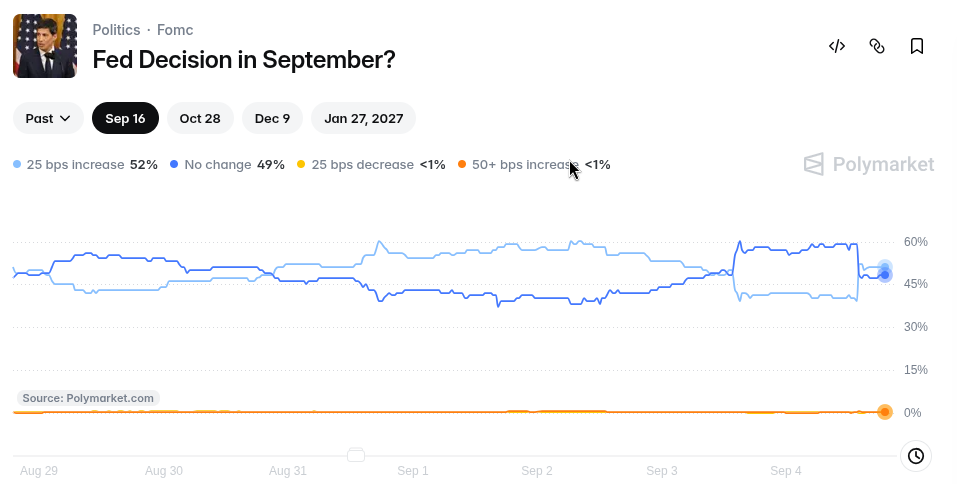
The division within the FOMC was highlighted by Fed Governor Christopher Waller’s statement on Thursday, prior to the jobs report. Waller indicated he would favor a rate pause, contingent upon upcoming inflation data. This dovish sentiment briefly shifted Polymarket probabilities, a prediction market platform, to a 60% likelihood of a pause in rate hikes and a 40% chance of a 25 basis-point interest rate increase. However, Friday’s surprisingly strong labor market data immediately recalibrated these expectations, driving the implied probabilities back to an even 50/50 split between a pause and a hike. This swift reversal underscores the market’s sensitivity to incoming economic indicators and the profound impact they have on the perceived likelihood of the Fed’s next move.
The accompanying image, titled "Implied Probabilities for the Sep. 16 FOMC rate decision. Source: Polymarket," visually captures this dramatic shift. Initially, the bar for a "pause" would have been significantly higher, reflecting Waller’s influence. Post-jobs report, the bars for "pause" and "25 bps hike" would appear nearly identical, illustrating the balanced uncertainty. This dynamic highlights the precarious tightrope the Fed walks, balancing economic growth with inflation control, while navigating market expectations that swing with every major data release.
Presidential Intervention: Trump’s Renewed Demands for Rate Cuts
The strong labor market data and the ensuing uncertainty over the Fed’s rate decision quickly drew a forceful reaction from US President Donald Trump. Leveraging his preferred platform, Truth Social, Trump publicly demanded rate cuts, stating, "The Fed Board, with its great new leader, must get smart – BE PATRIOTS for a change." He further asserted, "High interest rates put the U.S.A. at a very unfair disadvantage, and I won’t allow that to happen!"
This intervention marks a significant shift in President Trump’s public stance towards the Federal Reserve under Chair Warsh. While Trump was a frequent and vocal critic of former Chair Jerome Powell, often lambasting him for not cutting rates, he had largely refrained from similar public admonishments of Warsh until Friday. This renewed pressure underscores a recurring theme in modern American politics: the tension between presidential desires for economic stimulus and the Federal Reserve’s institutional independence. Historically, presidents have often preferred lower interest rates to stimulate economic growth, particularly during election cycles, while the Fed’s mandate requires it to act independently to maintain long-term economic stability, even if it means unpopular decisions. Trump’s rhetoric, urging the Fed to "BE PATRIOTS," frames the issue in nationalistic terms, suggesting that higher rates are detrimental to America’s global standing, thereby intensifying the political dimension of monetary policy.
Bitcoin’s Macro Sensitivity: A Risk Asset in Flux
The immediate and pronounced sell-off in Bitcoin following the jobs report underscores its increasing sensitivity to traditional macroeconomic indicators and Federal Reserve policy. As Bitcoin has matured and attracted significant institutional investment, its price movements have become more correlated with broader risk assets and liquidity conditions in the global financial system. Strong economic data, like the robust jobs report, can lead investors to anticipate a more hawkish stance from the Fed, implying higher interest rates and a tighter monetary policy. This environment typically reduces the appetite for riskier assets, including cryptocurrencies, as investors seek safer havens or higher yields in less volatile investments.
Conversely, a weaker economic outlook might prompt expectations of looser monetary policy, which could be seen as bullish for Bitcoin, as investors might seek alternatives to depreciating fiat currencies or assets with higher growth potential in a low-yield environment. The price action – dropping from $81,300 to $78,600 before settling around $79,500 – reflects this rapid market repricing. Traders and algorithmic systems likely reacted swiftly to the revised probabilities of a rate hike, leading to cascading sell orders. This volatility highlights Bitcoin’s dual nature: an innovative digital asset yet increasingly intertwined with the very traditional financial systems it often seeks to disrupt.
The Blake2b Bitcoin Fork: A Challenge to Centralization and a Bid for Decentralization
While the macroeconomic landscape dominated headlines, the Bitcoin network experienced its own internal upheaval, leading to the creation of a new, distinct version of the cryptocurrency. This saga began with the activation of BIP-110 (Bitcoin Improvement Proposal 110) on August 7. BIPs are formal proposals to introduce new features or changes to the Bitcoin protocol. BIP-110 was designed as a "soft fork," a backward-compatible change that allows nodes that haven’t upgraded to still interact with upgraded nodes. However, for a soft fork to be successfully activated and universally adopted, a significant majority of the network’s hashing power, typically controlled by mining pools, must signal support and begin enforcing the new rules.
Upon activation, the Bitcoin network briefly split into two competing chains: one adhering to BIP-110’s new rules and another continuing under the existing protocol. Crucially, the BIP-110 side largely stalled because miners did not devote sufficient computing power to extend that chain. This lack of miner support meant that blocks conforming to BIP-110’s rules were not being consistently found and added to the blockchain, effectively rendering the soft fork unsuccessful in its original form.
Mining Centralization Concerns and the UASF Movement
The failure of BIP-110 to gain miner traction reignited long-standing concerns among a segment of the Bitcoin community regarding the centralization of mining power. Supporters of BIP-110 viewed miners’ refusal to follow the user-activated soft fork (UASF) as compelling evidence that Bitcoin’s mining layer has become excessively concentrated. A UASF is a mechanism where full nodes enforce new rules without explicit miner signaling, relying on economic majority and social consensus to eventually compel miners to adopt the changes. The idea is that if enough users enforce new rules, miners will eventually follow to avoid mining invalid blocks.
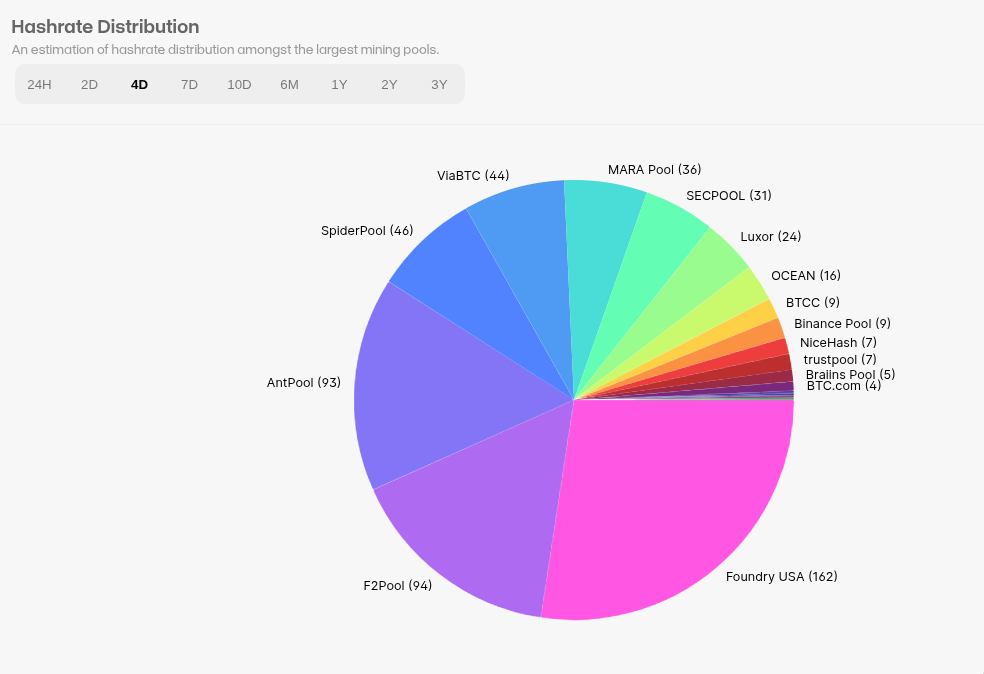
This criticism was further sharpened by the absence of an organized counter-effort from the "Bitcoin Core side" – the primary development team and wider community around the main Bitcoin protocol – such as a user-rejected soft fork (URSF). A URSF would have been a clear signal from users explicitly rejecting the BIP-110 changes. The perceived inaction reinforced the narrative that a handful of powerful entities wield disproportionate influence over the network’s future. Data, such as that depicted in the image "Bitcoin Network Hashrate Distribution. Source: Blockchain.com," often shows that a small number of mining pools (as few as five, according to the article) control the vast majority of Bitcoin’s hashrate. This concentration grants them significant power to dictate which chain is extended and which transactions are included in blocks, raising questions about the network’s censorship resistance and decentralized governance principles.
The Blake2b Hard Fork: A New Chapter in Decentralization
In response to the perceived failure of the BIP-110 soft fork and the enduring concerns about mining centralization, a subset of BIP-110 supporters, notably led by prominent Bitcoin developer LukeDashjr, decided to take a more radical step. They opted to continue the BIP-110 chain, but with a fundamental change: a hard fork that introduced a new proof-of-work (PoW) algorithm, Blake2b. This hard fork was initiated on August 30.
The rationale behind changing the PoW algorithm from SHA-256 (used by the original Bitcoin) to Blake2b is crucial for understanding the movement’s objectives. SHA-256 mining is dominated by highly specialized hardware known as ASICs (Application-Specific Integrated Circuits). These machines are expensive to develop and manufacture, leading to economies of scale that favor large, well-funded mining operations. By switching to Blake2b, the intention is to create a more "ASIC-resistant" mining environment, at least initially. This move aims to allow for a new, more decentralized set of miners to emerge, potentially utilizing more general-purpose hardware like CPUs or GPUs, thereby reducing the barrier to entry for individual miners.
Furthermore, the new chain aims to leverage "DATUM gateway technology," which, in the context of decentralization, likely refers to a system designed to facilitate more distributed and permissionless participation in the mining process. While specific details on this technology are not extensively provided in the original text, its mention strongly suggests an attempt to democratize mining and prevent the kind of concentration seen on the SHA-256 network.
Initial Liquidity and Future Prospects of Blake2b Bitcoin
A critical aspect of any new blockchain or cryptocurrency fork is its ability to establish market liquidity and gain acceptance within the broader ecosystem. The Blake2b version of Bitcoin (often referred to as BTCB2) initiated its journey by ensuring that every address that held SHA-256 Bitcoin before August 7 (and potentially after, depending on the exact snapshot timing) would hold an equivalent amount on the new Blake2b chain. This "airdrop" mechanism provides initial distribution to existing Bitcoin holders, encouraging them to explore and potentially support the new chain.
So far, the only exchange listing Blake2b Bitcoin is Neoxa. This initial listing marks a significant milestone, providing a venue for price discovery and trading. While liquidity "remains thin," which is typical for newly launched cryptocurrencies, Blake2b coins are currently trading at $350 against USDC with a 1.1% spread. The provided image, "BTCB2/USDC orderbook. Source: Neoxa Exchange," would show a relatively sparse order book, with noticeable gaps between bid and ask prices, illustrating this thin liquidity. A 1.1% spread indicates a moderately illiquid market where the difference between the highest price a buyer is willing to pay and the lowest price a seller is willing to accept is significant, potentially leading to larger price swings with smaller trades.
The emergence of Blake2b Bitcoin represents a tangible outcome of the ongoing debate within the Bitcoin community about governance, decentralization, and the role of miners. Its future success will depend on its ability to attract more miners, developers, users, and, critically, additional exchange listings to bolster its liquidity and market presence. This development is a stark reminder that even the most established cryptocurrencies like Bitcoin are not immune to internal ideological divisions that can lead to significant protocol changes and the birth of entirely new digital assets.
In conclusion, Friday’s economic data painted a picture of a robust US labor market, yet it simultaneously injected renewed uncertainty into the Federal Reserve’s monetary policy outlook, sparking presidential disapproval and causing immediate volatility in the Bitcoin market. Concurrently, the Bitcoin ecosystem itself is grappling with fundamental questions of decentralization, with the Blake2b hard fork representing a bold attempt to address perceived mining centralization and chart a new course for a segment of the community. These parallel narratives underscore a period of significant flux across both traditional finance and the nascent digital asset landscape.