Dwi Wanna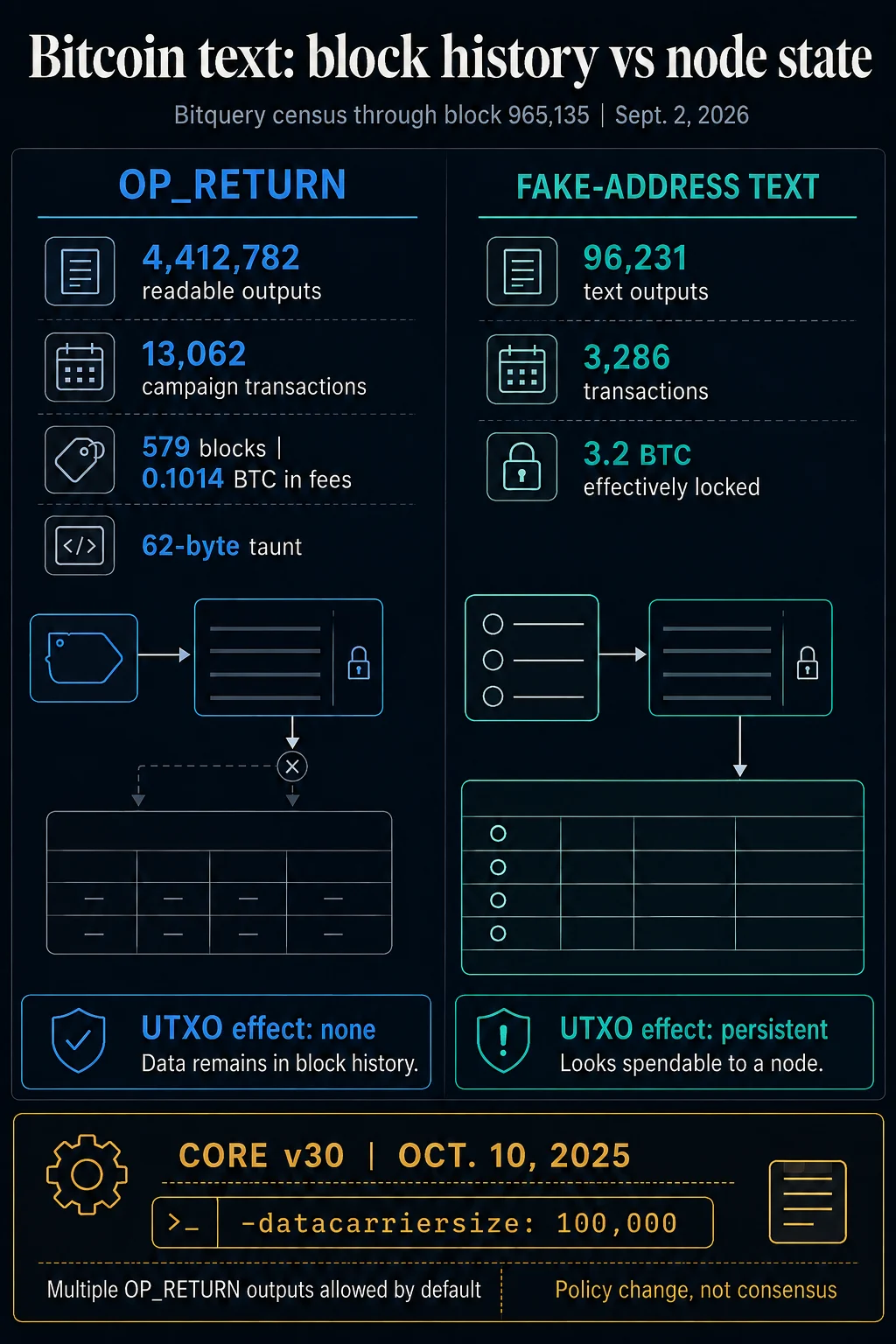
A comprehensive blockchain census published by Bitquery on September 2, 2026, has highlighted a significant disparity in how different methods of embedding text into the Bitcoin blockchain impact the network’s infrastructure. The study, which involved scanning 965,135 blocks, revealed that while modern protocols like OP_RETURN allow for data storage with minimal impact on node performance, older or more malicious "fake-address" techniques are placing a persistent and growing burden on the Unspent Transaction Output (UTXO) set. The findings provide a technical breakdown of how approximately 96,231 fake-address outputs have effectively "clogged" the database that every full node must maintain to validate transactions, contrasting sharply with the 4.4 million OP_RETURN outputs that remain outside this critical memory set.
The Bitquery report specifically focused on four primary ways text appears within the Bitcoin ledger. The data highlights a specific "taunt" campaign directed at Bitcoin Core developer Luke Dashjr in March 2026, which utilized both OP_RETURN and fake-address methods. While the OP_RETURN transactions added no permanent "spendable state" to the network, the 96,231 fake-address outputs identified in the broader scan represent a permanent bloat of the UTXO database, holding an estimated 3.2 BTC that is functionally unspendable.
The Technical Distinction: UTXO State vs. Block History
To understand the implications of the Bitquery study, it is necessary to distinguish between Bitcoin’s block history and its UTXO set. The block history is a chronological record of every transaction ever made; it is stored on disk and, while large, does not need to be entirely resident in a node’s high-speed memory (RAM) for the network to function. In contrast, the UTXO set is the database of all "unspent" coins. For a node to verify that a new transaction is valid, it must check the UTXO set to ensure the sender actually possesses the coins they are trying to spend.
Because the UTXO set must be accessed constantly, nodes typically keep as much of it as possible in RAM or on high-performance storage. When data is embedded into "fake addresses," it creates an entry in this UTXO set. Because these "addresses" (which are actually encoded text) do not have a known private key, the coins sent to them can never be spent. Consequently, these entries stay in the UTXO database forever, forcing every full node in the world to dedicate resources to tracking them.
Bitquery’s scan found that while there were over 4.4 million OP_RETURN outputs—a method specifically designed to hold data without affecting the UTXO set—the 96,231 fake-address outputs are far more damaging to the long-term scalability of the network. The OP_RETURN method, often referred to as "null-data," allows the data to be stored in the block history while signaling to nodes that the output is unspendable and can be safely ignored by the UTXO database.
Chronology of the March 2026 Taunt Campaign
The Bitquery study was prompted in part by a highly visible messaging campaign that occurred between March 21 and March 26, 2026. This campaign targeted Luke Dashjr, a prominent Bitcoin Core developer known for his strict stance on blockchain "spam" and his historical opposition to non-financial data embedding.

During this five-day window, Bitquery identified 13,062 OP_RETURN transactions. Each transaction originated from a unique sending address, totaling 13,062 distinct addresses across 579 blocks. The messages contained a two-sentence taunt naming Dashjr. Despite the volume of messages, the aggregate fees paid for this campaign were relatively low, totaling only 0.1014 BTC. Because the attackers used the OP_RETURN opcode, the text was recorded in the chain’s history, but it did not add to the UTXO set.
This campaign served as a stress test for the "standardness" policies updated in Bitcoin Core 30.0, which had been released in October 2025. The attackers demonstrated that under the new defaults, repeating short text strings across thousands of transactions had become economically trivial and technically seamless.
The Evolution of Data Embedding: From Genesis to Core 30.0
The practice of embedding text in Bitcoin is as old as the network itself. Satoshi Nakamoto famously included a newspaper headline in the Genesis Block. However, as the network grew, developers sought ways to prevent data storage from interfering with financial transactions.
- Early Methods (2009–2013): Users often used "fake addresses" or multisig outputs to hide data. This was inefficient and led to the first concerns regarding UTXO bloat.
- OP_RETURN Introduction (2014): Bitcoin Core 0.9.0 introduced the OP_RETURN script opcode, providing a "standard" way to embed data. Initially limited to 40 bytes (later 80 bytes), it was designed to be prunable, meaning nodes could discard the data while still maintaining the security of the financial ledger.
- The Ordinals and Inscriptions Era (2023–2025): The introduction of Taproot enabled much larger data sets to be stored in the "witness" section of a transaction. This led to a massive surge in blockchain usage for NFTs and tokens, sparking a heated debate within the developer community.
- Bitcoin Core 30.0 (October 2025): This version represented a significant shift in default policy. The release notes for v30.0 detailed an increase in the
-datacarriersizesetting to 100,000 bytes. It also allowed multiple OP_RETURN outputs within a single transaction, provided they stayed under an aggregate limit.
Bitquery’s data shows that before the release of v30.0, messages longer than the previous 80-byte ceiling were rare, appearing only a few dozen times per month. Following the update, by February 2026, the frequency of such messages rose into the thousands. This suggests that while the consensus rules remained the same, the change in relay policy (standardness) significantly lowered the barrier for data-heavy transactions to reach miners.
Quantitative Analysis of the Bitquery Findings
The Bitquery census provides a stark numerical comparison of how text is currently distributed across the Bitcoin network:
- Total Blocks Scanned: 965,135
- Total OP_RETURN Readable Text Outputs: 4,412,782
- Total Fake-Address Text Outputs: 96,231
- Total Transactions involving Fake-Address Text: 3,286
- Estimated "Burned" Bitcoin in Fake Addresses: 3.2 BTC
- Campaign-Specific OP_RETURN Transactions (March 2026): 13,062
The study noted that while the 4.4 million OP_RETURN entries represent a larger volume of data, they are "healthy" for the network because they do not require RAM-resident storage. Conversely, the 96,231 fake-address outputs are "toxic" state. Each of these 96,231 entries must be stored in the UTXO set indefinitely. At an estimated 3.2 BTC collectively, these funds are effectively removed from circulation, as the "addresses" are derived from ASCII text strings rather than cryptographic public keys, making the discovery of a corresponding private key statistically impossible.
Bitquery also acknowledged limitations in its scan. The study did not include "coinbase" fields (data added by miners) for 191,427 historical blocks and excluded witness inscriptions (the method used by the Ordinals protocol). Therefore, the total amount of text on the Bitcoin blockchain is likely significantly higher than the 4.4 million outputs cited, though the state impact remains concentrated in the fake-address category.

Community Reactions and Developer Implications
The Bitquery report has reignited the long-standing debate over "spam" on the Bitcoin network. While the March 2026 taunt campaign was a direct provocation of Luke Dashjr, the technical data underscores the validity of his long-held concerns regarding UTXO bloat.
Dashjr and other "small block" advocates have historically argued that any data that increases the cost of running a full node is an attack on Bitcoin’s decentralization. If the hardware requirements for a node—specifically RAM and high-speed SSD storage—become too high, only large data centers will be able to validate the network, leading to centralization.
Conversely, proponents of higher data limits argue that as long as users are paying market-rate fees for their transactions, the "use case" of the data is irrelevant. They point to the 0.1014 BTC in fees paid during the March campaign as evidence that the "attackers" are still contributing to the security budget of the network. However, the Bitquery study highlights a flaw in this argument: a one-time fee payment for a fake-address transaction imposes a permanent cost on every future node operator, a cost that is not covered by the initial fee.
Broader Impact and Future Outlook
The revelation that nearly 100,000 outputs are "clogging" the UTXO set may lead to renewed calls for more aggressive pruning techniques or changes to how Bitcoin handles unspendable outputs. One potential solution often discussed in technical circles is "Utreexo," a permanent research project aimed at making the UTXO set more compact using cryptographic proofs.
Furthermore, the Bitquery study serves as a warning to developers of second-layer protocols and meta-protocols. Using the Bitcoin blockchain as a data layer via fake addresses is increasingly viewed as socially and technically unacceptable within the core developer community. The preference for OP_RETURN is now clearly established by both policy (as seen in Core 30.0) and empirical data (as shown by Bitquery).
As Bitcoin continues to evolve from a simple peer-to-peer electronic cash system into a multi-layered computational and settlement network, the management of its "state" remains the most critical hurdle. The Bitquery scan proves that while Bitcoin can handle millions of messages, the way those messages are written matters deeply. The 96,231 fake addresses identified are not just artifacts of the past; they are a persistent weight on the network’s future, serving as a reminder of the permanent nature of blockchain decisions.