admin
admin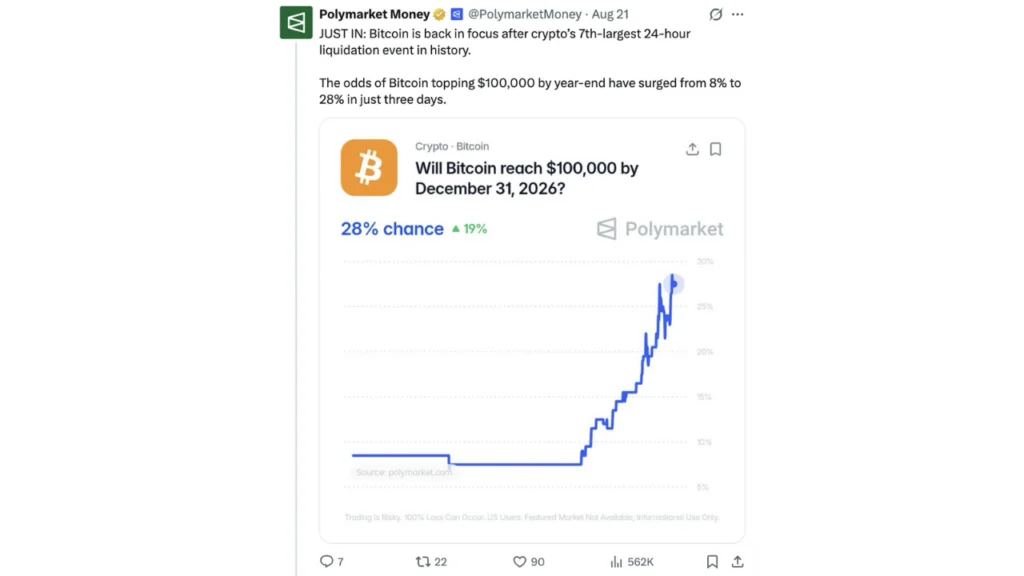
Bitcoin is once again positioned within striking distance of the $80,000 threshold, captivating the cryptocurrency market and fueling heightened bullish sentiment. Traders on prediction markets like Polymarket are increasingly staking their positions on the flagship cryptocurrency reaching this significant milestone before the close of August. The shift reflects a dramatic recalibration of market expectations, propelled by a potent combination of technical catalysts, robust institutional inflows, and supportive macroeconomic tailwinds.
According to Polymarket, a decentralized prediction market, the probability of Bitcoin (BTC) touching $80,000 this month has surged to 59%. This figure represents a sharp increase from earlier in the month, underscoring the rapid transformation in investor confidence. The cryptocurrency’s latest rally has seen its value climb decisively past $77,000, briefly touching highs near $79,500, igniting speculation about its immediate trajectory. The market’s newfound optimism contrasts sharply with the sentiment prevalent at the start of August, when Bitcoin hovered around the mid-$60,000s. This latest surge has delivered impressive gains exceeding 20% within a mere few weeks, positioning BTC near its highest levels since early summer and firmly placing $80,000 back at the forefront of market discourse. Beyond the immediate target, Polymarket traders are also assigning a 35% probability to Bitcoin reaching $82,500 and an 18% chance of hitting $85,000 before the month concludes. A more ambitious move to $100,000, however, remains a distant prospect, with odds currently standing at a modest 2%.
Chronology of a Rapid Rebound: From Consolidation to Conviction
The current rally’s genesis can be traced back to early August, a period characterized by Bitcoin consolidating around the mid-$60,000 range. This phase followed a period of fluctuating prices and a degree of market uncertainty, leading some analysts to anticipate prolonged sideways movement or even further downside. However, the market narrative began to shift dramatically.
A pivotal moment occurred over a concentrated three-day period, during which Bitcoin experienced an accelerated ascent from approximately $64,000 to nearly $79,500. This rapid appreciation not only shattered key resistance levels but also triggered a massive wave of liquidations among bearish positions, a phenomenon commonly known as a "short squeeze." This swift recovery underscored the inherent volatility and rapid reversal potential within the cryptocurrency markets, catching many by surprise and forcing a re-evaluation of Bitcoin’s short-term prospects.
The momentum generated by this initial surge was then sustained and amplified by a renewed influx of institutional capital, primarily channeled through U.S. spot Bitcoin Exchange-Traded Funds (ETFs). These funds, which offer regulated exposure to Bitcoin, recorded significant inflows throughout the week, signaling a broadening base of demand beyond speculative derivatives trading. This sustained buying pressure, coupled with a more favorable macroeconomic environment, has cultivated a robust bullish backdrop, pushing Bitcoin closer to the coveted $80,000 mark and setting the stage for the current high-stakes battle between bulls and bears.
The Mechanics of a Short Squeeze: Fueling the Price Surge

One of the most defining characteristics of Bitcoin’s recent recovery has been its remarkable speed and intensity. The explosive climb from roughly $64,000 to nearly $79,500 in just three days was largely catalyzed by a significant short squeeze. This market dynamic occurs when a cryptocurrency’s price suddenly rises, forcing traders who had placed "short" bets (betting on a price decline) to close their positions. To close a short position, traders must buy back the underlying asset, in this case, Bitcoin. This forced buying creates additional demand, further pushing up the price, which in turn triggers more short liquidations, creating a powerful feedback loop.
Market data, as cited in recent reports, indicates that more than $4 billion in bearish crypto positions were liquidated during this rally. This massive unwinding of short positions acted as a potent accelerant, transforming what might have been a gradual recovery into a vertical surge. As Bitcoin breached critical psychological and technical resistance levels, notably $70,000 and then $75,000, momentum traders—those who buy assets based on their recent price trends—also began to enter the market, adding further buying pressure. The confluence of short covering, fresh speculative buying, and an overall improvement in market sentiment collectively propelled Bitcoin’s price with unprecedented force.
However, this same dynamic introduces a degree of fragility. As Bitcoin approached the $80,000 mark, traders who had entered leveraged long positions (betting on a price increase with borrowed funds) began to face increased risks. A subsequent pullback towards $77,000, for instance, has already triggered hundreds of millions of dollars in crypto liquidations, shifting some of the market pressure from short sellers to overextended buyers. This dynamic highlights the critical importance of the $79,000-$80,000 range. A decisive breakout above this level could attract another wave of momentum buying, potentially establishing $80,000 as a new support. Conversely, another rejection could encourage profit-taking, leading to a period of consolidation or even a deeper correction as traders lock in gains.
Institutional Endorsement: The Resurgence of Spot Bitcoin ETF Demand
Unlike some previous rallies that were predominantly driven by derivatives trading and speculative fervor, Bitcoin’s latest advance has been significantly bolstered by robust demand for U.S. spot Bitcoin ETFs. These regulated investment vehicles, which began trading in January, offer traditional investors and institutions a more accessible and compliant pathway to gain exposure to Bitcoin without directly owning the cryptocurrency.
The data unequivocally points to a resurgence in institutional interest. On Thursday, these funds collectively attracted a remarkable $606 million in net inflows, marking their largest single-day inflow since May. Over the four-day period from Monday through Thursday, U.S. spot Bitcoin ETFs recorded approximately $1.6 billion in combined net inflows. This substantial capital injection signals a renewed appetite from institutional players, who often represent a more stable and sustained source of demand compared to individual retail traders.
This positive momentum extended into Friday, August 21, with U.S. spot Bitcoin ETFs recording an additional $307.5 million in net inflows, stretching their positive streak to five consecutive trading sessions. BlackRock’s IBIT, one of the leading spot Bitcoin ETFs, spearheaded this demand with roughly $239.3 million of inflows, while Fidelity’s FBTC added about $30.2 million. The sustained inflows into these ETFs are profoundly significant because they provide a direct, transparent indication of demand from investors operating within regulated financial frameworks. If Bitcoin’s price were surging while ETF investors were simultaneously withdrawing funds, the rally’s credibility would be severely undermined. Instead, the parallel strengthening of institutional flows alongside price appreciation provides a powerful argument for bulls, lending legitimacy and a stronger fundamental underpinning to the current move above $80,000. This trend suggests a deepening integration of Bitcoin into mainstream finance, indicating a maturation of the asset class.
Macroeconomic Tailwinds and Regulatory Clarity: Adding to the Bullish Narrative

Beyond market-specific dynamics, broader macroeconomic developments have also played a supportive role in Bitcoin’s recent performance. The U.S. Treasury’s recent announcement regarding plans to increase its buybacks of longer-dated government bonds has been interpreted by many as a potentially bullish signal for scarce assets like Bitcoin and gold. Bond buybacks inject liquidity into the financial system and can, under certain conditions, exert downward pressure on bond yields and weaken the U.S. dollar. A weaker dollar often makes dollar-denominated assets, including Bitcoin, more attractive to international investors. This move by the Treasury was initially seen as easing pressure in the broader Treasury market, thereby creating a more accommodative environment for risk assets.
Furthermore, renewed optimism surrounding U.S. cryptocurrency regulation has added another layer of support to market sentiment. President Donald Trump has actively encouraged Congress to advance the CLARITY Act, a legislative proposal designed to establish a clearer and more predictable regulatory framework for digital assets. The lack of clear regulations has long been cited as a significant impediment to broader institutional adoption and innovation within the crypto space. Any progress toward regulatory clarity is generally viewed positively by the market, as it reduces uncertainty and could pave the way for more mainstream financial products and services involving cryptocurrencies. These recent political and regulatory developments have contributed to a more favorable macro backdrop, reinforcing the bullish outlook for Bitcoin.
However, the macroeconomic picture is not entirely devoid of risks. Long-term Treasury yields remain elevated, reflecting ongoing concerns about inflation and the potential for continued fiscal expansion. Investors continue to monitor the Federal Reserve closely for any clues regarding its future interest rate policy and broader financial conditions. The upcoming Jackson Hole economic symposium, a gathering of central bankers and economists, could therefore become an important test for risk assets globally. Any signals indicating that monetary policy may remain restrictive for a longer period than anticipated could temper Bitcoin’s upside momentum, particularly after such a rapid and substantial rally.
Navigating the $80,000 Threshold: Challenges and Opportunities
While the prevailing market sentiment currently leans bullish, the challenge of not only reaching $80,000 but also sustaining a price above this psychological barrier presents two distinct hurdles. Bitcoin’s recent powerful ascent has undeniably restored momentum, yet it has also created conditions ripe for profit-taking. Traders who entered positions near $64,000 or $70,000 now hold substantial unrealized gains, making them potential sellers should the price falter. Concurrently, leveraged buyers, though benefiting from the rally, are increasingly vulnerable to sharp reversals, as evidenced by recent liquidations on pullbacks.
The weekend trading period introduces an additional layer of volatility and uncertainty. Unlike traditional markets, Bitcoin trades 24 hours a day, seven days a week. However, U.S. spot Bitcoin ETFs, a major source of institutional demand, do not operate when traditional markets are closed. This temporary absence of a significant institutional bid can lead to thinner liquidity over weekends, meaning that relatively modest buy or sell orders can have a disproportionately larger impact on price. This dynamic often results in increased volatility, making the weekend a critical period for price discovery and potential swings.
Consequently, the first full U.S. trading sessions of the upcoming week are anticipated to be particularly revealing. Should ETF inflows remain robust and Bitcoin manage to reclaim and hold above $80,000 with sustained trading volume, it could signal a decisive breakout. In such a scenario, traders and analysts may then begin to target the $82,500-$85,000 range as the next significant resistance zone. Conversely, a failure to consolidate above $80,000, coupled with diminishing ETF inflows, could prompt a wave of profit-taking and a re-evaluation of the immediate bullish thesis.
For now, Polymarket’s 59% probability suggests that a test of $80,000 is considered more likely than not by a significant portion of the market. However, given Bitcoin’s more than 20% gain in a relatively short period, the path higher is unlikely to be linear or without significant resistance. The immediate battleground has shifted from whether Bitcoin can recover from its mid-$60,000 levels to whether bulls possess the conviction and sustained buying power to transform $80,000 from a psychological ceiling into a robust new support level. The coming days will be crucial in determining the sustainability of this rally and Bitcoin’s ability to cement its position at these elevated price points.