admin
admin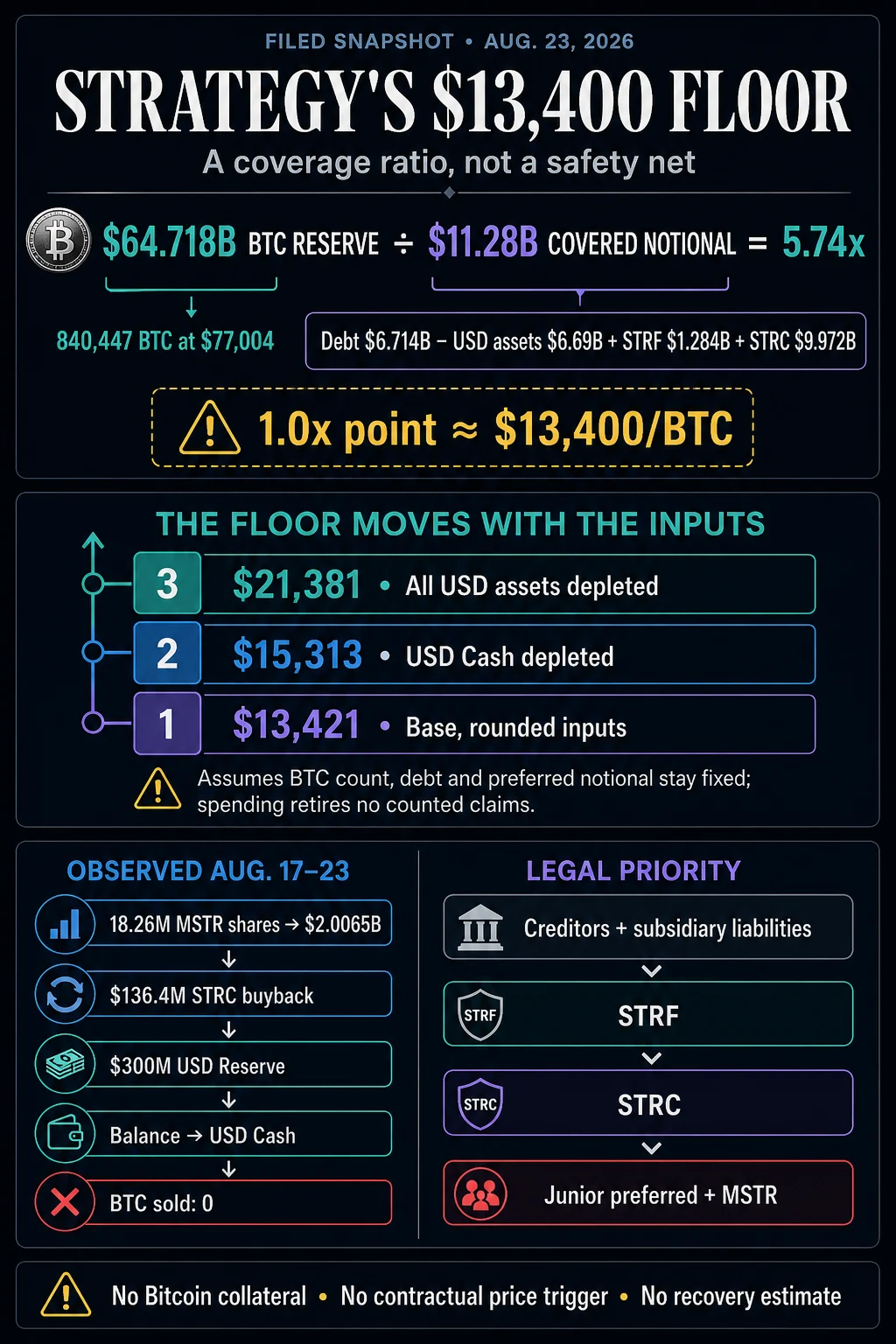
Strategy, the prominent Bitcoin treasury company, has recently brought to market a designated "BTC Floor" of approximately $13,400 for its STRC, a variable-rate cumulative perpetual preferred stock. This figure, presented against the backdrop of Bitcoin’s current price hovering around $78,000, might initially suggest a substantial safety net for investors. However, a closer examination of the Securities and Exchange Commission (SEC)-filed briefing reveals a more nuanced definition. The $13,400 figure does not represent a direct claim on Strategy’s Bitcoin holdings nor does it carry any inherent solvency or recovery guarantee for STRC shareholders. Instead, it denotes the specific Bitcoin price at which Strategy’s illustrative STRC coverage ratio is projected to reach 1.0x. This metric is a calculated point, derived from a complex interplay of the company’s assets, liabilities, and its Bitcoin reserves, rather than an absolute protection against depreciation.
The current market valuation of STRC, which closed at $97.33 on August 28th, translates to an effective yield of 12.33% based on the company’s annualized dividend of $12 per share. This yield calculation is based on the current stock price and the declared dividend, offering a clear income stream for preferred stockholders. The SEC filing, which utilized data from August 21st with STRC at $96.18, indicated a slightly higher yield of 12.48%. This filing also provided a snapshot of the company’s financial architecture, listing a notional value of $9.972 billion for STRC, 59 basis points of BTC Credit, 4.68% BTC Risk, and the aforementioned -14.61% BTC Floor Annualized Rate of Return (ARR). These figures collectively paint a picture of Strategy’s intricate financial engineering, designed to leverage its Bitcoin holdings while managing its capital structure.
The Mechanics of the BTC Floor: A Deeper Dive
The "BTC Floor" calculation is intrinsically linked to Strategy’s broader "BTC Rating," a metric that quantifies the relationship between the dollar value of the company’s Bitcoin reserves and a specific "covered-notional" denominator. The BTC Floor essentially reverses this calculation, defining the Bitcoin price at which the covered notional is precisely equal to the value of the company’s Bitcoin holdings. It’s crucial to understand that this floor is a theoretical construct, derived from a snapshot of financial data at a particular moment. While changes in the spot price of Bitcoin will dynamically alter the company’s displayed BTC Rating, the $13,400 floor price remains static for a given set of company inputs. This means that as Bitcoin’s price fluctuates, the coverage ratio shifts, but the underlying calculation for the floor remains fixed until other financial variables within the company are adjusted.
To illustrate the calculation of Strategy’s BTC Rating, we can examine the components of its denominator. This denominator begins with $6.714 billion in debt. From this, $6.69 billion in USD assets are subtracted. Subsequently, $1.284 billion in senior STRF (another class of preferred stock) and $9.972 billion in STRC are added. This results in a total denominator of approximately $11.28 billion. At the time of the dashboard’s creation, Strategy held 840,447 Bitcoin, valued at $64.718 billion based on a Bitcoin price of $77,004. Dividing the Bitcoin value by the denominator yields a coverage ratio of approximately 5.74x, which is then displayed as 5.7x.
The unrounded BTC Floor figure, as reported by Strategy, stands at $13,415. When using the rounded denominator and Bitcoin count, the calculation results in approximately $13,421. Both figures are commonly presented to the public as roughly $13,400. For context, during a research assessment on August 30th, when Bitcoin was trading at $78,440.50, and assuming all other company inputs remained fixed, the BTC Rating would have increased to approximately 5.84x, while the BTC Floor would have remained remarkably stable, hovering near $13,421. This stability of the floor price, despite fluctuations in Bitcoin’s spot price, underscores its nature as a technical benchmark rather than a dynamic market protection.
Sensitivity Analysis: Unpacking Potential Floor Movements
The "BTC Floor" is not an immutable figure; its sensitivity to changes in the company’s USD asset holdings is particularly noteworthy. A significant depletion of the company’s $1.59 billion USD Cash pool, without a corresponding reduction in debt or preferred notional, would lead to an upward revision of the modeled floor price to approximately $15,313. This scenario highlights how a decrease in readily available cash, if not offset by a reduction in liabilities, would necessitate a higher Bitcoin price to maintain the same coverage ratio.

Further illustrating this sensitivity, if the company were to deplete its entire $6.69 billion in USD assets, and these assets were utilized in ways that did not retire any of the claims counted in the denominator, the modeled BTC Floor could ascend towards $21,381. This extreme scenario demonstrates the profound impact that the management of USD liquidity can have on the calculated floor. It is important to reiterate that these sensitivity analyses are based on the assumption that all other inputs into the calculation remain constant. This isolation of variables allows for a clear understanding of the impact of specific financial levers on the STRC coverage ratio and the associated BTC Floor.
The Strategic Financial Management of Strategy
Strategy’s approach to managing its financial position, particularly in relation to its Bitcoin holdings and preferred stock obligations, involves a multi-faceted strategy that extends beyond the theoretical BTC Floor. Stress management, for instance, is a proactive endeavor that begins well before any potential need for legal recovery. In the most recently disclosed week, Strategy executed a significant transaction by selling 18,261,118 shares of MSTR (MicroStrategy) for $2.0065 billion. These proceeds were strategically allocated: $136.4 million was used to repurchase 1,431,212 shares of STRC, demonstrating a commitment to managing its preferred stock liabilities. Additionally, $300 million was added to the USD Reserve, a crucial buffer for future obligations, with the remaining balance being placed into USD Cash. Notably, Strategy did not sell any of its Bitcoin holdings during this period. The funding for these activities primarily stemmed from the issuance of common stock, which, from the perspective of MSTR holders, represented a dilution of their equity stake in the company.
Looking ahead, Strategy retains considerable discretion in its future financial maneuvers. The company has an available authorization for preferred stock repurchases amounting to $516.6 million and a remaining authorization of $1 billion for MSTR share repurchases. However, there is no mandatory requirement for the company to engage in these buyback programs. The $5.10 billion USD Reserve is earmarked by board policy specifically for servicing preferred dividends and debt interest payments. Furthermore, USD Cash can be flexibly deployed for various purposes, including Bitcoin acquisitions, share repurchases, note repayments, or bolstering the reserve. It is significant to note that neither the USD Reserve nor the USD Cash pools are pledged as collateral to STRC holders. This means that in scenarios of financial distress, these cash assets are not directly secured for STRC investors.
Understanding STRC Holder Protections and Capital Stack Realities
The cash dividends payable to STRC holders are contingent upon their formal declaration by the company and the existence of legally available funds. However, any missed dividend installments are legally accumulated and compounded, meaning that unpaid dividends accrue and continue to earn their stated rate. This feature provides a measure of protection for STRC holders by ensuring that unpaid dividends do not simply disappear. Nevertheless, the market price of STRC and the timing of cash distributions can deteriorate even before the modeled coverage ratio reaches the 1.0x threshold. This implies that market sentiment and the company’s cash flow management can impact STRC holders’ returns independently of the technical BTC Floor calculation.
In the event of an actual restructuring scenario, the hierarchy of claims is critically important. Creditors, along with subsidiary liabilities, are positioned ahead of STRC holders in the capital stack. Similarly, holders of STRF, another class of preferred stock, also rank senior to STRC. Conversely, junior preferred stock and MSTR common stockholders are subordinate to STRC holders. This established pecking order dictates the priority of repayment and the distribution of assets in a distressed situation, with senior claims being satisfied before junior claims.
The $13,400 figure, therefore, represents a specific valuation point derived from a dated set of assets and counted claims. It serves as a reference, but it does not encompass all potential pressures or protections. Earlier points of pressure that can influence the financial well-being of STRC holders include the company’s access to capital markets, the availability of liquid cash reserves, and the discretionary allocation decisions made by management. Each of these factors has the potential to shift the financial burden and the distribution of value among MSTR holders, STRC holders, and the company’s Bitcoin reserve. The interplay of these elements underscores the complex financial ecosystem that Strategy operates within and the multiple layers of risk and reward for its various stakeholders.