Dwi Wanna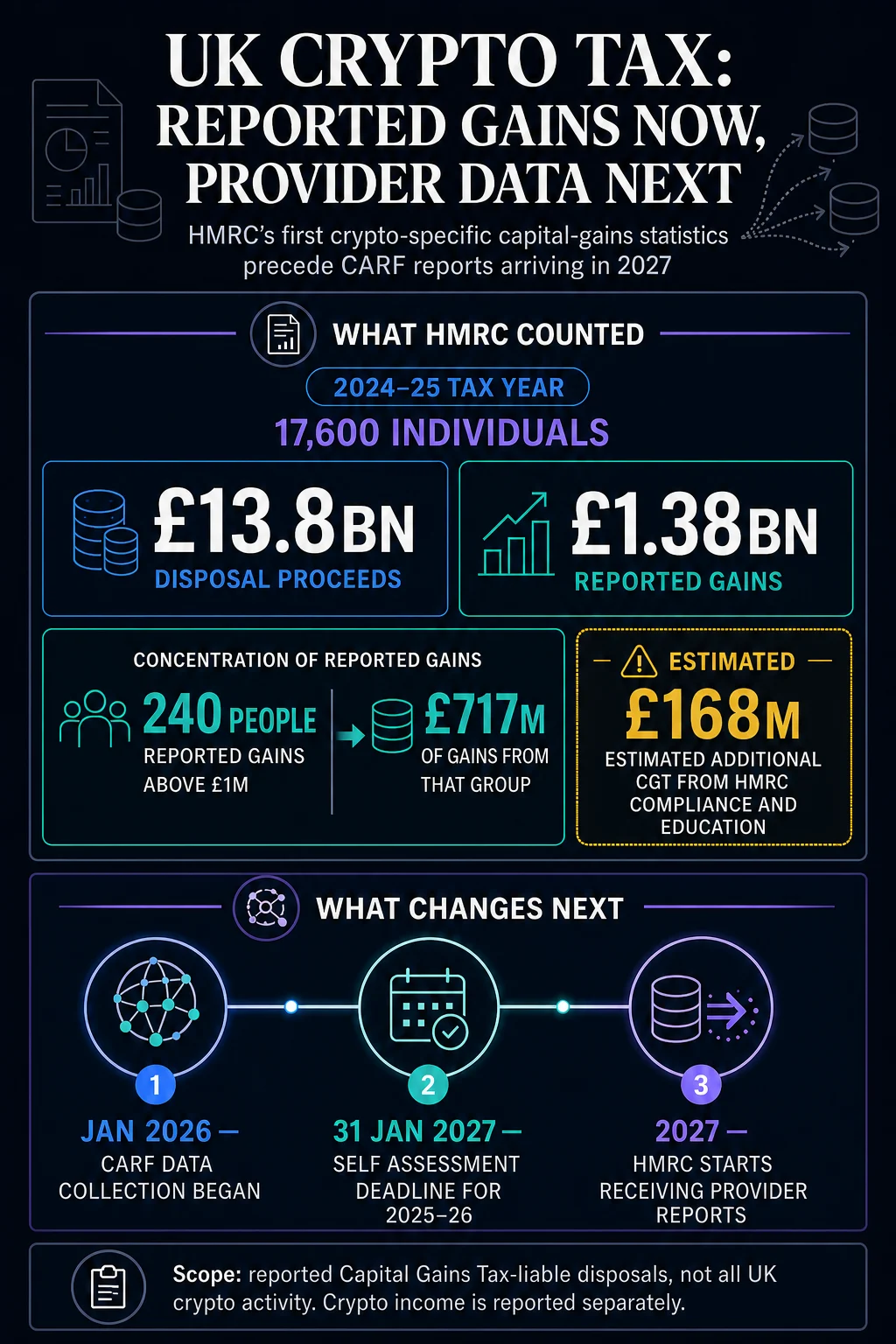
The data underscores a "Pareto principle" within the UK crypto market, where a tiny fraction of participants—approximately 1.3% of those reporting—accounted for more than 50% of the total capital gains. According to the government report, these 240 high-net-worth investors each realized gains exceeding £1 million, collectively contributing £717 million to the total declared gain pool of £1.38 billion. This statistical snapshot serves as a formal baseline for the UK government as it prepares to transition from a reliance on voluntary taxpayer disclosures to a more rigorous, automated reporting regime.
The Scale of Crypto Disposals and Realized Gains
The HMRC report provides a comprehensive overview of the sheer volume of activity within the UK’s crypto-investor base. For the 2024 to 2025 fiscal period, the 17,600 reporting individuals declared a total of £13.8 billion in disposal proceeds. In tax terminology, a "disposal" occurs when an individual sells cryptoassets for fiat currency, exchanges one cryptoasset for another, uses crypto to pay for goods or services, or gives away crypto to someone other than a spouse or civil partner.
While the £13.8 billion in disposals represents the total value of assets moved or sold, the £1.38 billion in gains represents the taxable profit after deducting the original acquisition costs and allowable expenses. The disparity between the disposal volume and the realized gains suggests that while many investors are active in the market, a significant portion of the activity may involve high-frequency trading with thin margins or the movement of assets that have not appreciated substantially since their purchase.
However, the concentration of gains among the top 240 individuals suggests that "early adopters" or institutional-grade individual investors continue to reap the lion’s share of the market’s upside. This group’s ability to generate nearly £3 million in average gains per person stands in stark contrast to the remaining 17,360 taxpayers, who shared the remaining £663 million in gains—averaging roughly £38,000 per person.
The Implementation of the Cryptoasset Reporting Framework (CARF)
The timing of this data release is strategic, as the UK is currently in the midst of implementing the Organization for Economic Co-operation and Development’s (OECD) Cryptoasset Reporting Framework (CARF). This international standard is designed to ensure that tax authorities have visibility into the crypto transactions of their residents, similar to the visibility they currently have into traditional banking and brokerage accounts.

The transition to CARF marks a fundamental shift in how HMRC monitors the sector:
- Data Collection (January 2026): Cryptoasset service providers, including exchanges and custodial wallet providers operating in or serving the UK, were mandated to begin collecting detailed customer and transaction information starting in January 2026.
- Information Exchange (2027): HMRC expects to receive its first batch of automated reports from these providers in 2027. This data will include transaction volumes, wallet addresses, and the identities of the beneficial owners.
- Cross-Border Cooperation: CARF is not limited to the UK. It involves a multilateral agreement where dozens of countries will share information on each other’s residents, making it increasingly difficult for investors to hide assets in offshore exchanges.
The current statistics gathered from Self Assessment returns will serve as a "control group." Once the CARF data begins flowing in 2027, HMRC will be able to cross-reference what taxpayers have declared against what the exchanges have reported. Any discrepancies will likely trigger automated inquiries or full-scale audits.
Chronology of UK Crypto Taxation and Regulation
The journey toward the current reporting standards has been a decade-long process of evolving policy.
- 2014: HMRC issued its first brief guidance on the tax treatment of "Bitcoin and other cryptocurrencies," primarily focusing on VAT and general principles.
- 2018-2019: The agency published comprehensive "Cryptoassets Manuals" for both individuals and businesses, clarifying that most crypto holdings are treated as capital assets subject to Capital Gains Tax (CGT).
- 2021-2022: HMRC began sending "nudge letters" to thousands of suspected crypto holders, reminding them of their tax obligations and encouraging voluntary disclosure.
- 2024: The introduction of a dedicated cryptoasset section in the Self Assessment tax return form, leading to the data released today.
- 2026: Mandatory data collection by exchanges under CARF begins.
- January 31, 2027: The deadline for taxpayers to file returns for the 2025-2026 tax year, which will be the last year before HMRC has full access to third-party exchange data.
Compliance Success and Enforcement Revenue
Beyond the voluntary declarations, HMRC has been proactive in its enforcement efforts. The agency estimated that its dedicated crypto compliance and education initiatives generated an additional £168 million in Capital Gains Tax during the 2024 to 2025 period. This revenue was derived from targeted investigations, the aforementioned nudge letters, and the use of data analytics to identify high-risk individuals who had failed to report disposals.
This "compliance yield" demonstrates that even without the full automation of CARF, HMRC possesses the tools to track on-chain and off-chain activity. The agency has increasingly collaborated with blockchain analysis firms to de-anonymize transactions and link digital wallets to UK-based bank accounts.
Nuances of Taxation: Capital Gains vs. Income Tax
It is important to note that the £1.38 billion figure only covers Capital Gains Tax. In the UK, crypto-related activities can also fall under the Income Tax regime, which often carries higher rates. The current data release does not include:

- Mining and Staking: Rewards earned from validating blockchain transactions are generally treated as miscellaneous income, subject to Income Tax.
- Airdrops: Depending on the circumstances, receiving free tokens can be classified as income.
- Employment Income: An increasing number of tech workers receive part of their salary in digital assets, which is taxed as PAYE (Pay As You Earn) income.
- Trading as a Business: If an individual’s frequency and sophistication of trading reach the level of a financial trade, they may be taxed on profits as income rather than capital gains.
Because these categories are reported in different sections of the tax return, the total tax contribution of the crypto sector to the UK Treasury is likely significantly higher than the £1.38 billion gain figure suggests.
Broader Implications for the UK Economy and Policy
The concentration of crypto wealth among 240 individuals raises questions about the long-term impact of digital assets on wealth inequality and tax policy. For the UK government, these "crypto millionaires" represent a vital tax base. However, the volatility of the asset class means that tax receipts can fluctuate wildly from year to year. A market crash could lead to a surge in reported capital losses, which investors can use to offset gains in other areas, such as property or stocks, potentially reducing the overall tax take.
Industry experts suggest that the clarity provided by HMRC’s reporting and the upcoming CARF implementation may actually benefit the sector in the long run. Professionalization and clear "rules of the road" tend to attract institutional capital and more risk-averse retail investors who were previously deterred by the "gray area" status of crypto taxation.
The Global Context: A Tightening Net
The UK’s move mirrors a global trend toward transparency. In the United States, the IRS has added a prominent crypto question to the front page of Form 1040, and the Infrastructure Investment and Jobs Act has introduced new reporting requirements for brokers. Similarly, the European Union’s DAC8 directive will bring cryptoassets under the umbrella of automatic exchange of information across all member states.
For the UK investor, the message from HMRC is clear: the window for "accidental" non-compliance is closing. The Jan. 31, 2027, deadline for the 2025-2026 tax year represents a critical juncture. Investors who have not yet reconciled their past transactions are being encouraged to use HMRC’s voluntary disclosure service before the automated data-matching systems of 2027 make such disclosures less of an "option" and more of a requirement.
As HMRC continues to refine its baseline data, the focus will likely shift from broad education to targeted enforcement. With £717 million in gains coming from just 240 people, the agency knows exactly where to look to maximize its investigative resources. The era of the "untraceable" digital fortune in the UK appears to be coming to a definitive end.