Dwi Wanna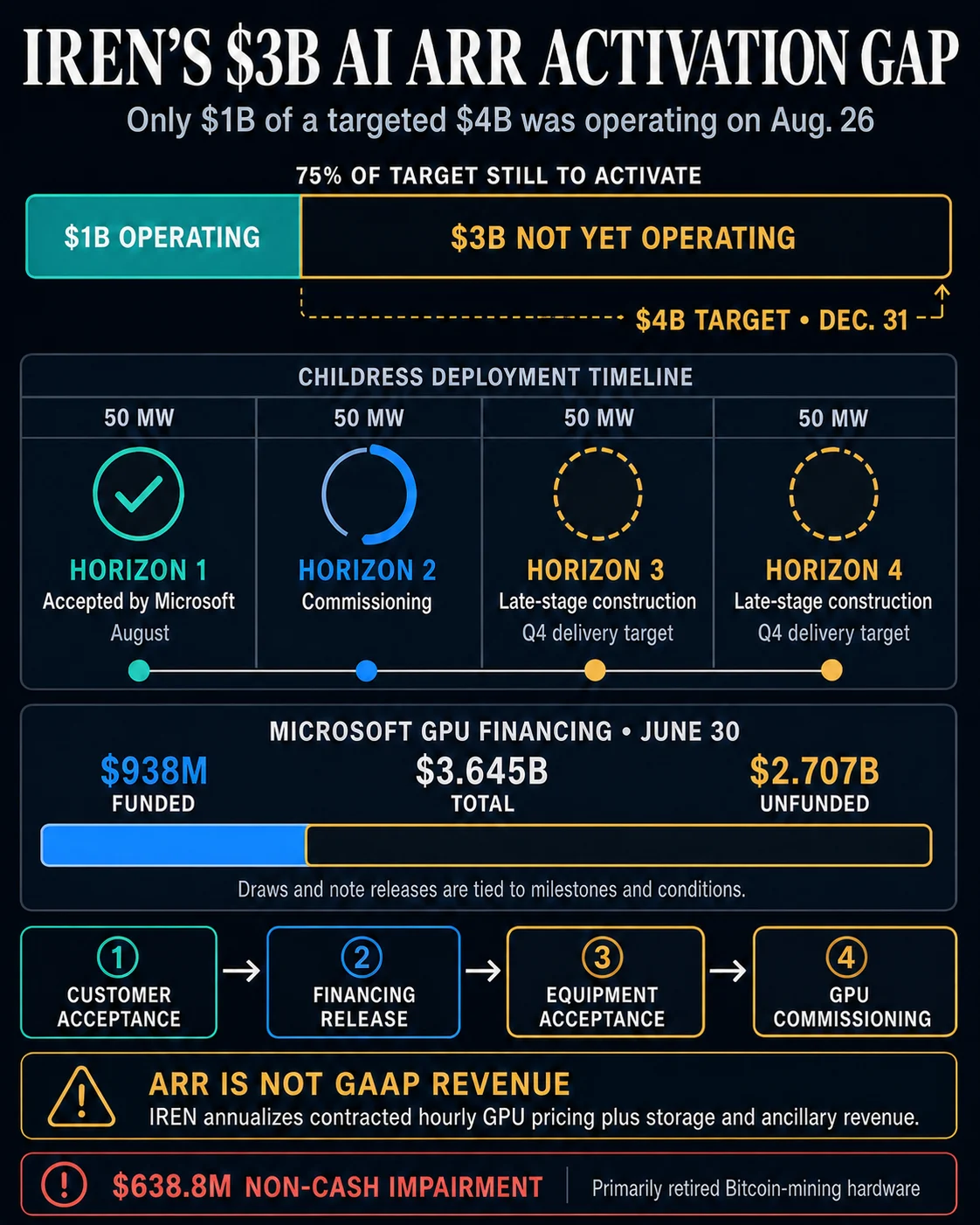
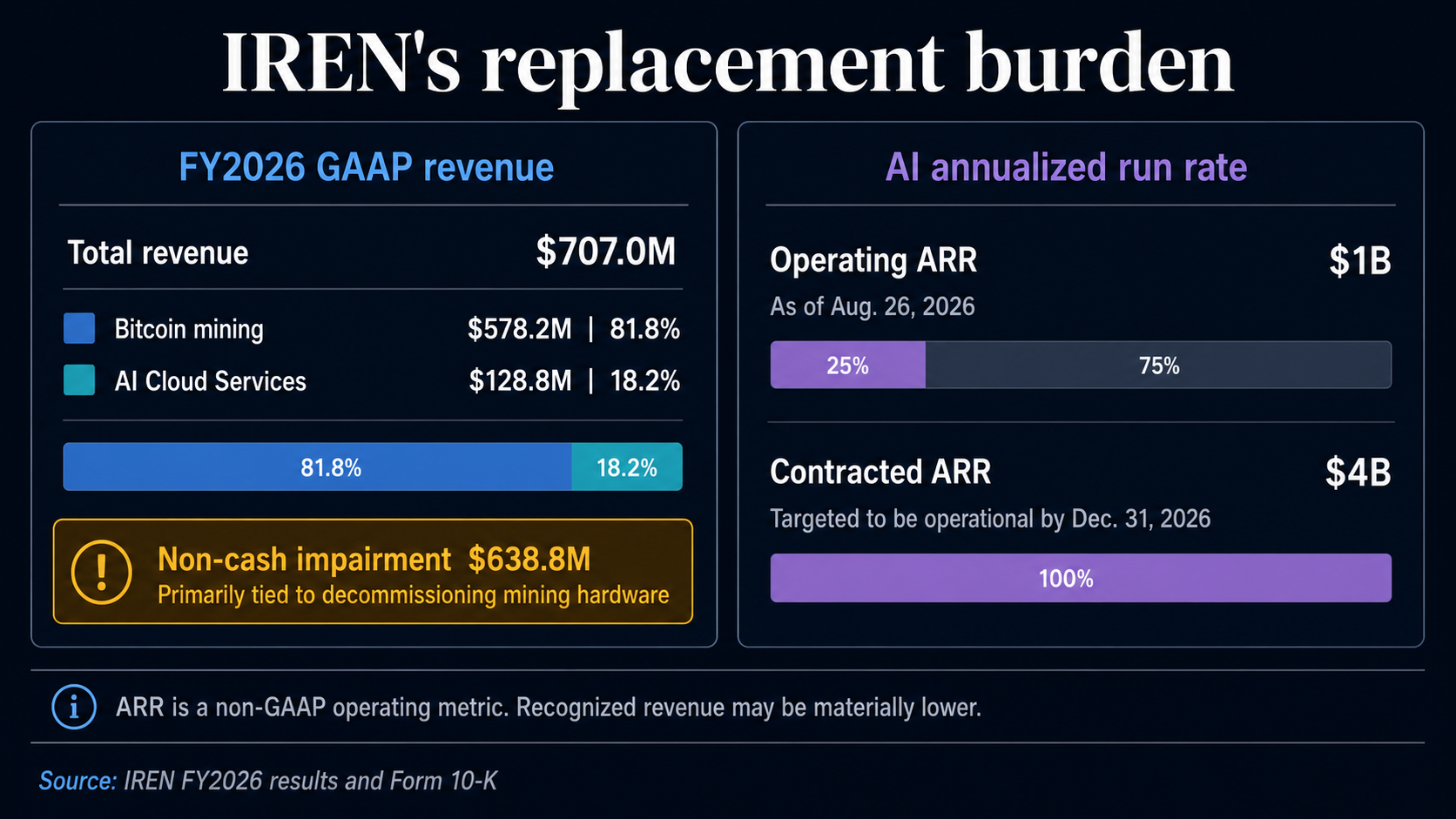
IREN, the high-performance data center operator formerly known as Iris Energy, continues to derive the vast majority of its revenue from Bitcoin mining despite an aggressive and costly strategic pivot toward artificial intelligence (AI) infrastructure. According to the company’s fiscal 2026 results, filed on August 27, Bitcoin mining generated $578.2 million of IREN’s $707 million in total annual revenue, representing approximately 81.8% of the company’s top-line performance. While the company has been vocal about its transition into a diversified cloud service provider, its AI Cloud Services division contributed a more modest $128.8 million during the same period.
This transition, characterized by the retirement of legacy Bitcoin mining hardware to make physical and electrical room for AI-capable servers, has come at a significant accounting cost. IREN reported a $638.8 million non-cash impairment charge, primarily tied to the decommissioning of miners as data center sites were converted for AI workloads. This impairment was a primary driver behind the company’s reported $702.6 million net loss for the fiscal year. While the charge does not represent a direct cash outflow, it reflects the accelerated depreciation and loss of accounting value for assets retired before their replacement business—AI cloud infrastructure—had fully entered service and reached operational maturity.
Bridging the $3 Billion Operating Gap
The central challenge for IREN as it moves into the 2027 calendar year is closing the substantial gap between its current operational capacity and its lofty contractual targets. As of August 26, IREN reported $1 billion in operating annualized run-rate revenue (ARR). However, the company has set a target of $4 billion in contracted ARR for its 2026 capacity, leaving a $3 billion delta that must be bridged by the end of the calendar year.
IREN calculates its ARR based on contracted GPU (Graphics Processing Unit) pricing multiplied by a full year of operating hours, including ancillary services such as data storage. It is important to note that ARR is an internal operating measure rather than a figure recognized under Generally Accepted Accounting Principles (GAAP). In its filings, IREN cautioned investors that recognized GAAP revenue might be materially lower than the ARR projections. The successful conversion of contracted ARR into recognized revenue is contingent upon several external and internal factors, including the timely delivery of physical infrastructure, hardware installation, and, most critically, customer acceptance.

The company’s Form 10-K outlines a rigorous process for revenue recognition. Revenue generally begins to accrue only after data centers are fully built and energized, equipment is installed and commissioned, and performance testing is completed to the satisfaction of the client. Any delays in this pipeline can postpone revenue generation while IREN continues to incur financing and operating costs. Furthermore, contracts often include clauses for delay credits or service credits, which could further impact the final revenue figures if milestones are missed.
Strategic Infrastructure Conversion and the Microsoft Partnership
IREN’s pivot is anchored by a significant relationship with Microsoft and a reliance on high-end NVIDIA hardware. The company’s deployment strategy is organized into "Horizons," representing different phases of data center capacity and GPU integration.
The timeline for these deployments is staged to manage the technical complexity of the transition. In August, Microsoft officially accepted "Horizon 1," marking a critical milestone for IREN’s AI ambitions. The subsequent phases, Horizons 2 through 4, are targeted for phased delivery throughout the fourth quarter of the 2026 calendar year. However, the company has built-in contractual grace periods that extend into the beginning of the second quarter of 2027, providing some buffer against potential supply chain or technical bottlenecks.
As of June 30, IREN maintained an installed Bitcoin mining capacity of approximately 23.2 exahashes per second (EH/s) distributed across roughly 380 megawatts (MW) of power capacity. The company’s stated goal is to substantially complete the transition of this existing data center capacity toward AI Cloud Services by the end of the year. This involves a massive logistical undertaking: removing thousands of Application-Specific Integrated Circuits (ASICs) used for mining and replacing them with high-density GPU racks that require different cooling, power distribution, and networking configurations.
Financing the High-CapEx AI Pivot
The capital expenditures required to compete in the AI cloud space are significantly higher than those for Bitcoin mining. To fund the purchase of NVIDIA GPUs and the necessary infrastructure upgrades for the Microsoft contract, IREN has utilized a variety of financing instruments.

The company secured GPU-specific financing through a delayed-draw loan priced at the one-month Secured Overnight Financing Rate (SOFR) plus 2.25%. Additionally, IREN issued senior notes at a 5.96% interest rate, with various tranches subject to specific closing conditions. Beyond these instruments, a separate financing agreement with Mackenzie provides up to $2.4 billion in capital. This facility carries a 9% fixed interest rate and matures 30 months after each relevant staged funding date.
These financing costs represent a significant ongoing obligation. While IREN’s Bitcoin mining revenue provides a cash flow cushion, the interest payments on the debt used to acquire AI hardware create a high "hurdle rate" for the new business line. The company must ensure that its AI capacity is not only operational but highly utilized to cover these costs and eventually move toward profitability.
Counterparty Risk and Market Concentration
A notable risk factor highlighted in IREN’s recent filings is the concentration of its customer and supplier base. Microsoft and NVIDIA together represent a substantial majority of the company’s contracted revenue and hardware supply, respectively. While partnering with two of the world’s most valuable technology companies provides a level of prestige and perceived stability, it also exposes IREN to significant counterparty risk.
If Microsoft were to alter its cloud strategy or if NVIDIA were to face further supply chain disruptions, IREN’s projected $4 billion ARR could be jeopardized. The company has stated that it is actively seeking to diversify its client roster to mitigate these risks. However, the specialized nature of the data center environments required for high-end AI workloads means that the pool of potential large-scale tenants remains relatively small compared to the broader enterprise market.
Chronology of Key Events
The following timeline illustrates IREN’s transition over the fiscal 2026 period and into the future:
- June 30, 2026: IREN reports 23.2 EH/s of mining capacity across 380MW of power.
- August 2026: Microsoft officially accepts Horizon 1, allowing for the commencement of revenue recognition for that specific capacity.
- August 26, 2026: IREN reaches a $1 billion operating ARR milestone.
- August 27, 2026: Fiscal 2026 results are filed, revealing the $638.8 million impairment and the 81.8% revenue reliance on Bitcoin.
- Q4 2026 (Targeted): Phased delivery of Horizons 2, 3, and 4.
- December 31, 2026: Target date for achieving the $4 billion operational ARR.
- Q2 2027: Expiration of contractual grace periods for the current phase of AI infrastructure deployment.
Broader Industry Implications and Analysis
IREN’s situation is reflective of a broader trend within the Bitcoin mining industry. Following the 2024 Bitcoin halving, which reduced block rewards by 50%, many miners found their profit margins squeezed. This led to a wave of "HPC-pivoting," where mining firms attempt to leverage their access to large-scale power interconnection and cooling infrastructure to serve the booming AI market.
However, IREN’s results highlight the "valuation gap" that many of these companies face. While the market often rewards AI-related announcements with higher stock valuations, the underlying GAAP financials often remain tethered to the volatile Bitcoin mining sector for years. The transition is not merely a matter of swapping machines; it requires a fundamental overhaul of the business model—moving from a commodity-based "self-mining" operation to a service-based "infrastructure-as-a-service" (IaaS) provider.
The success of IREN’s pivot will ultimately be judged by its ability to translate "contracted ARR" into "recognized GAAP revenue." Until the AI Cloud Services division can eclipse the Bitcoin mining revenue, IREN remains, for all intents and purposes, a Bitcoin miner with an expensive and ambitious side-hustle in AI. The next several months will be a "proof of concept" period for the company as it seeks to meet its end-of-year targets and satisfy the performance requirements of its high-profile partners.
As the global demand for AI compute continues to outpace supply, IREN is well-positioned in terms of raw power capacity. However, the $702.6 million net loss serves as a stark reminder of the financial friction involved in reinventing a publicly traded company in real-time. Investors and industry analysts will be watching the Q4 2026 and Q1 2027 results closely to see if the "Horizon" deployments stay on track and if the company can finally reduce its 82% dependence on the world’s largest cryptocurrency.