admin
admin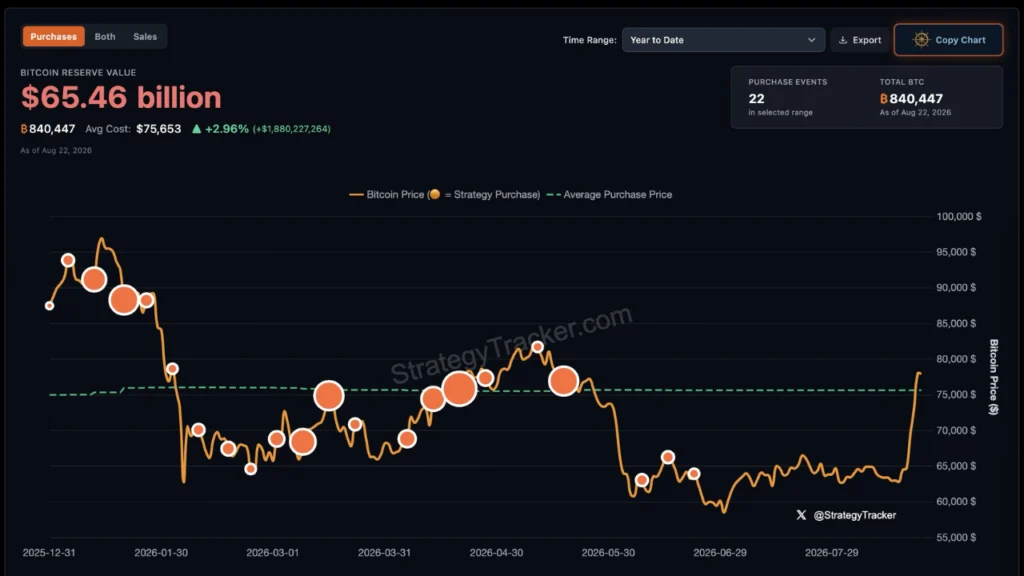
Strategy, the corporate entity renowned for its aggressive Bitcoin accumulation strategy, has successfully navigated a tumultuous period, emerging from substantial unrealized losses to once again report significant paper gains on its massive Bitcoin treasury. A powerful five-day rally saw Bitcoin (BTC) surge past the company’s average acquisition price, marking a pivotal turnaround for an investment strategy that has been closely watched by institutional investors and the broader cryptocurrency market alike. This shift underscores both the inherent volatility of digital assets and the strategic adjustments undertaken by companies heavily invested in them.
Bitcoin’s price climbed to approximately $77,300 on August 21, 2026, representing a robust increase of roughly 23% from its position at the start of the week, when it hovered around $62,800. This upward momentum was sufficient to erase months of unrealized losses for Strategy, transforming its substantial holdings of 840,447 BTC into an estimated paper gain of approximately $1.4 billion. This translates to an unrealized profit margin of about 2.4% above its aggregate cost basis, a testament to the digital asset’s capacity for rapid recovery. The company’s total cost basis for its Bitcoin holdings stands at roughly $63.36 billion, acquired at an average price of $75,385 per BTC. At the peak of this rally, Strategy’s Bitcoin treasury was valued at nearly $65 billion, a stark contrast to its valuation just months prior.
A Volatile Journey: From Peak to Trough and Back
Strategy’s journey with Bitcoin has been characterized by both conviction and dramatic market fluctuations. The company first began accumulating Bitcoin in August 2020, pioneering the concept of a publicly traded company holding a significant portion of its treasury reserves in the volatile cryptocurrency. Under the leadership of its then-CEO, Michael Saylor, Strategy positioned Bitcoin as a superior store of value, an inflation hedge, and a long-term strategic asset. This bold move inspired other corporations to explore similar treasury strategies, fundamentally altering the perception of Bitcoin within traditional finance.
The initial years saw Strategy’s Bitcoin bet pay off handsomely, with the company often sitting on billions in unrealized gains as Bitcoin surged through successive bull markets. The apex of this period came in October 2025, when Bitcoin reached an all-time high of over $126,000. At this point, Strategy’s unrealized profits would have been at their zenith, validating its pioneering approach and solidifying its reputation as a leading institutional proponent of Bitcoin.
However, the cryptocurrency market is notoriously cyclical, and the euphoria of late 2025 gave way to a prolonged and challenging bear market throughout much of 2026. Bitcoin experienced a significant correction, falling well below its previous record highs. By the end of June 2026, the digital asset had plummeted to as low as $58,000. This severe downturn pushed Strategy’s massive Bitcoin position deep into unrealized losses. At the $58,000 level, analysts estimated the company’s Bitcoin treasury was approximately $13 billion underwater, representing more than 20% of its total cost basis. This period of sustained losses exerted considerable pressure on Strategy’s balance sheet and investor sentiment.

Strategic Adjustments Amidst Market Headwinds
The financial pressure during the downturn was not merely theoretical; it necessitated pragmatic adjustments to Strategy’s long-standing Bitcoin-centric model. The company, which had historically adopted a "hodl" (hold on for dear life) philosophy, began to make strategic sales of Bitcoin to strengthen its liquidity position and meet various financial obligations, particularly those tied to its preferred securities.
A significant development occurred in June 2026, when Strategy executed its first Bitcoin sale in nearly four years. While the initial transaction involved a modest 32 BTC, it signaled a notable departure from the company’s deeply entrenched strategy of continuous accumulation. This initial sale was followed by further strategic divestments in early August, with Strategy selling another 1,690 BTC for approximately $108.6 million. These sales, while relatively small compared to its enormous treasury, brought its total holdings to the current 840,447 BTC and underscored the company’s commitment to managing its liquidity and balance sheet prudently during challenging market conditions.
Despite these sales, Strategy’s overarching Bitcoin strategy remained fundamentally intact. Management reiterated its long-term conviction in Bitcoin while simultaneously working to fortify the company’s financial resilience. This involved a multi-pronged approach to liquidity management, ensuring that the company could absorb market volatility without being forced into larger, more detrimental sales of its core Bitcoin assets.
Fortifying the Cash Buffer and Diversifying Funding
Beyond selective Bitcoin sales, Strategy has also proactively focused on building a more robust U.S. dollar reserve to navigate the inherent volatility of its primary asset. By August 17, 2026, the company’s U.S. dollar reserve had reached an impressive $4.8 billion. Strategy publicly stated that this substantial reserve provided approximately 2.8 years of coverage for its preferred dividends and other financial obligations, offering a significant buffer against future market downturns or unexpected expenditures.
A key component of this liquidity enhancement strategy involved leveraging its equity markets. During the week ending August 16, Strategy successfully raised $333.7 million through the sale of 3.46 million Class A shares. This move demonstrated the company’s ability to access capital through traditional financing channels, reducing its sole reliance on Bitcoin sales for liquidity. The proceeds from these share sales were strategically allocated: $52.4 million was directed towards preferred dividends, $132.2 million was utilized for the repurchase of STRC preferred shares, and a substantial $149.1 million was added to the burgeoning dollar reserve. Importantly, Strategy did not engage in any Bitcoin transactions during that specific week, highlighting its preference for alternative funding mechanisms when available.

This distinction is crucial for understanding Strategy’s evolving financial posture. While its financial health remains inextricably linked to Bitcoin’s price performance, the establishment of a larger cash reserve and the diversification of funding sources provide the company with greater operational flexibility. This enhanced liquidity position allows Strategy more room to absorb market fluctuations without immediately resorting to selling its core Bitcoin position, thereby protecting its long-term accumulation thesis.
The Rising Importance of STRC: Preferred Stock Management
Alongside its primary focus on Bitcoin, Strategy has increasingly directed attention towards managing its preferred stock, particularly the STRC series. Preferred stock, a hybrid security, typically offers fixed dividend payments and has preference over common stock in claims on assets and earnings. Strategy has embarked on an aggressive buyback program for its STRC shares, aiming to restore the security’s value closer to its $100 par value. Over the past four weeks, the company repurchased approximately $347 million worth of STRC, making significant progress towards a larger $1 billion buyback authorization. This proactive management has seen STRC shares recover substantially, trading around $95.62, a considerable improvement from its June low near $71.
The recent recovery in Bitcoin’s price is expected to indirectly bolster these efforts. An improved Bitcoin valuation positively impacts investor sentiment regarding Strategy’s overall balance sheet, reducing concerns about the company’s financial stability and its capacity to support its preferred securities. As the perceived risk associated with Strategy’s Bitcoin holdings diminishes, investor confidence in its ability to meet all its financial commitments, including preferred dividends and buybacks, naturally increases.
It is vital to underscore that the reported $1.4 billion gain is an unrealized mark-to-market increase. This means the profit has not been "locked in" through sales. The value can fluctuate rapidly, disappearing just as quickly if Bitcoin’s price declines back below Strategy’s average acquisition price of $75,385. This inherent characteristic of unrealized gains and losses is a central feature of Strategy’s Bitcoin-centric model, highlighting the continuous exposure to market movements.
What Comes Next: Renewed Accumulation or Prudent Consolidation?
The immediate question following this significant turnaround is whether Strategy will revert to its aggressive Bitcoin accumulation strategy now that BTC has moved comfortably above its cost basis. Historically, the company has viewed periods of market weakness as prime opportunities to increase its holdings, adhering to a "buy the dip" philosophy. However, the recent liquidity pressures forced management to balance its desire for accumulation against other critical financial imperatives, including preferred dividends, preferred-stock obligations, and the imperative to maintain a sizable cash reserve.

Strategy’s CEO, Phong Le, has previously indicated the company’s expectation to resume Bitcoin accumulation. Furthermore, available data suggests that Strategy’s Bitcoin purchases for the current year still substantially exceed its sales, indicating that the recent divestments were tactical adjustments rather than a fundamental shift away from its long-term Bitcoin strategy. The strengthened cash buffer provides the necessary operational latitude for such a resumption, should market conditions and internal financial planning align.
The recent Bitcoin rally has undoubtedly provided Strategy with crucial breathing room. Its colossal Bitcoin treasury has transformed from a staggering $13 billion paper loss during the summer downturn to approximately $1.4 billion in unrealized profit within a matter of weeks. This dramatic reversal is a powerful illustration of the high-stakes, high-reward nature of Strategy’s investment approach.
However, this turnaround also serves as a stark reminder of the central risk inherent in Strategy’s business model: its financial position remains profoundly and inextricably tied to the volatile price movements of Bitcoin. At approximately $77,000, the company’s holdings are comfortably above its average acquisition price. Nevertheless, a renewed decline below the $75,385 threshold would swiftly plunge the treasury back into an underwater position, reigniting concerns about its balance sheet and liquidity.
For shareholders of Strategy, the latest rally represents more than just a headline-grabbing profit figure. It is a potent affirmation of the power and potential of the company’s Bitcoin-centered balance sheet, demonstrating its capacity for significant value creation. Simultaneously, it is a sober reminder of the persistent and substantial risk associated with such an undiversified and highly correlated financial strategy. As Strategy moves forward, its ability to prudently manage both its Bitcoin holdings and its overall financial structure will be paramount to sustaining its long-term vision within the ever-evolving digital asset landscape.