admin
admin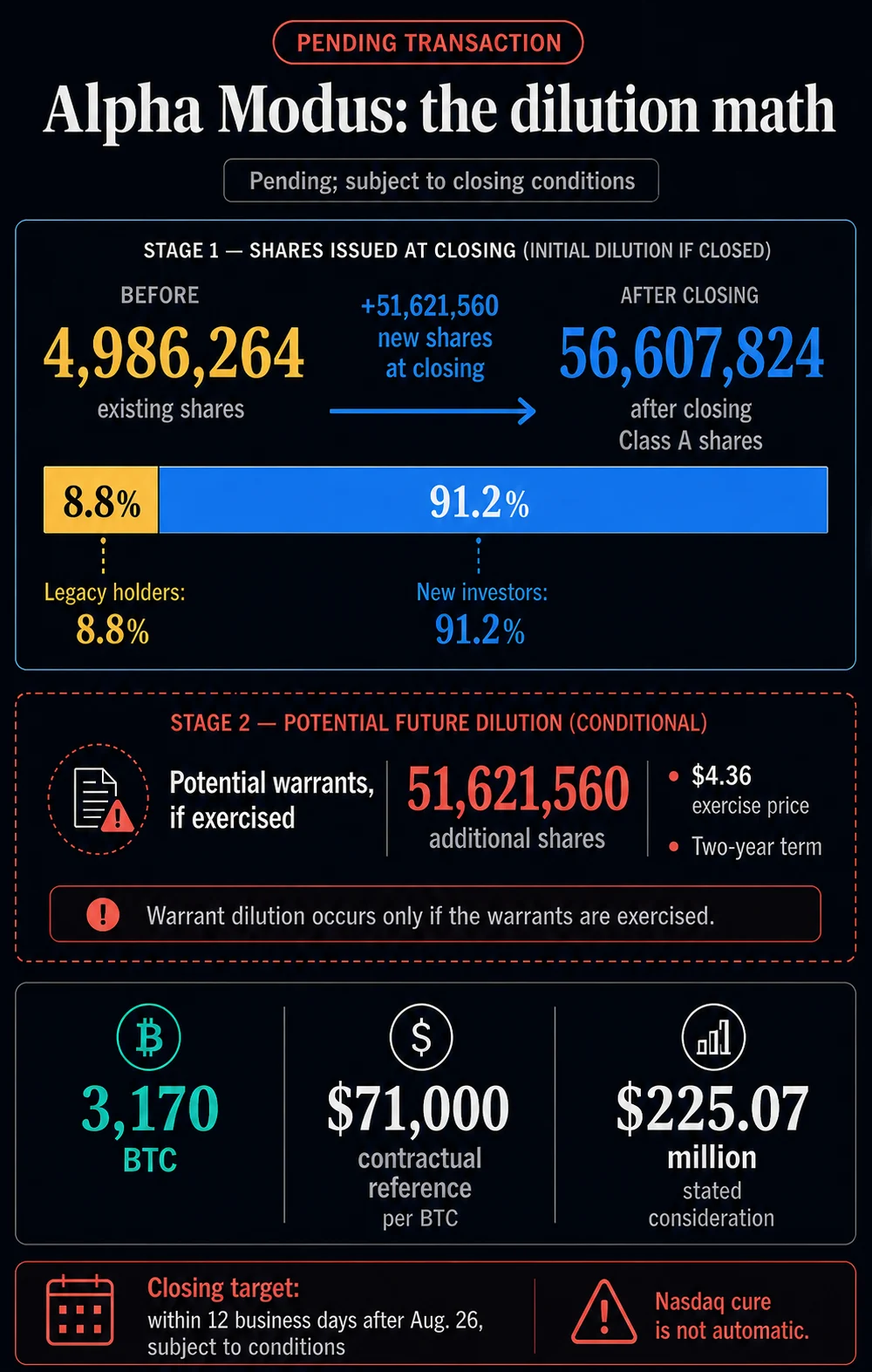
Alpha Modus shares experienced a dramatic 25% plunge following the company’s announcement of a groundbreaking agreement to acquire over 3,170 Bitcoin by issuing new shares and warrants, significantly expanding its existing share count. This strategic move, detailed in a filing with the Securities and Exchange Commission (SEC) on August 27th, involves a complex transaction with ten non-U.S. investors, aiming to bolster the company’s balance sheet and potentially secure its listing on the Nasdaq stock exchange.
The core of the agreement centers on the exchange of 3,170 Bitcoin for 51.62 million newly issued Class A shares, with an additional 51.62 million shares reserved under warrants. This transaction values each Bitcoin at $71,000, representing a total consideration of approximately $225.1 million. While the agreement has been formally signed, it is still pending closure, meaning the Bitcoin has not yet been transferred, and the new securities have not been formally issued to the investors.
This substantial share issuance is poised to drastically alter Alpha Modus’s capitalization structure. As of August 24th, the company reported approximately 4.99 million Class A shares outstanding. The immediate issuance of 51.62 million shares would elevate the total to around 56.61 million, reducing the stake of pre-deal shareholders to a mere 8.8% of the enlarged shareholder base. This translates to an approximate issuance of 10.35 new shares for every existing Class A share held by current investors, a ratio that has evidently alarmed the market. Furthermore, the warrants, exercisable at $4.36 over a two-year period, introduce a secondary layer of potential dilution, with the possibility of an additional 51.62 million shares entering circulation. The company has indicated that these issuances will be subject to standard regulatory requirements, including beneficial ownership limits, Nasdaq listing rules, and necessary shareholder approvals.
The market’s immediate reaction underscores investor apprehension regarding the scale of dilution. Alpha Modus’s stock price plummeted by approximately 25%, settling at $2.84 per share in the wake of the announcement, reflecting concerns about the significant impact on existing shareholder value.
A Strategic Gambit to Preserve Nasdaq Listing
Beyond its ambitious Bitcoin acquisition, the transaction serves a critical, more immediate purpose for Alpha Modus: a desperate attempt to shore up its precarious financial position and avert potential delisting from the Nasdaq stock exchange. In April, the company received a notification from Nasdaq indicating its failure to meet any of the three alternative Capital Market standards. These standards are designed to ensure that listed companies maintain a minimum level of financial health, typically assessed through metrics like net income, market value of listed securities, or stockholders’ equity. Alpha Modus subsequently submitted a compliance plan to the exchange in an effort to rectify its standing.
The company’s latest quarterly filing painted a stark picture of its financial health. It revealed a meager cash reserve of $2 million, a significant stockholders’ deficit of $6.1 million, and a working-capital deficit of $6.3 million. Compounding these issues, Alpha Modus reported no revenue for the most recent quarter or the first half of 2026, and posted a substantial loss of $6.2 million during the six-month period. This financial disclosure also raised serious doubts about the company’s ability to continue operating as a going concern, with management estimating a need for at least an additional $2.5 million to sustain its growth initiatives.
Management’s expectation is that the influx of Bitcoin will significantly strengthen stockholders’ equity, thereby addressing the deficiencies that have jeopardized its Nasdaq listing. However, the nature of the consideration is noteworthy; by accepting Bitcoin rather than cash, Alpha Modus has not automatically solved its immediate operational liquidity challenges. While the value of the Bitcoin may improve its balance sheet metrics, it does not directly inject the liquid capital required for day-to-day operations.

Navigating a Shifting Corporate Treasury Landscape
The timing of Alpha Modus’s bold Bitcoin acquisition is particularly striking, as it enters the cryptocurrency market during a period of waning enthusiasm for the corporate treasury Bitcoin strategy among investors. This trend is evidenced by a notable decline in the market capitalization of the largest publicly traded Bitcoin holders. According to a report by the Financial Times, the combined market capitalization of the fifty largest publicly traded Bitcoin holders fell from approximately $150 billion in July 2025 to about $67 billion in August 2026.
The corporate treasury Bitcoin strategy gained significant traction, largely popularized by Michael Saylor’s MicroStrategy. This model encouraged other public companies to leverage debt and equity financing to accumulate Bitcoin as a reserve asset. However, the volatile nature of Bitcoin, which has experienced a roughly 30% decline over the past 12 months despite a recent rebound towards the $80,000 mark, has led to significant underperformance for many companies that adopted this strategy. In many cases, the stock prices of these companies have fallen much more sharply than Bitcoin itself.
This market shift has prompted some companies to reassess their positions. Several firms have begun divesting their Bitcoin holdings or pivoting back to their core business operations, as leveraged treasury strategies amplified downside risk during market downturns. This trend has created a challenging environment for companies looking to emulate the early successes of the Bitcoin treasury model.
Alpha Modus’s Counter-Trend Strategy
In contrast to the prevailing market sentiment, Alpha Modus is adopting an inverse strategy, venturing deeper into Bitcoin at a time when other companies are retreating. Chief Executive Officer William Alessi addressed the company’s strategic rationale, revealing that Alpha Modus had previously considered a Bitcoin acquisition strategy when prices were near their all-time highs but had opted against it due to unfavorable timing.
"We considered pursuing this strategy when Bitcoin was near record highs, and decided that timing was not optimal," Alessi stated. He is now effectively betting that the recent 30% retreat in Bitcoin’s price has created a more opportune entry point compared to the peaks observed in the previous year. This decision represents a contrarian approach, positioning Alpha Modus against the prevailing tide of investor caution regarding Bitcoin treasury holdings.
However, the immediate market reaction suggests that investors are far from convinced by this strategy. The steep decline in Alpha Modus’s stock price following the announcement serves as a clear indicator of their skepticism and concern over the potential ramifications of the massive share dilution. The company faces the dual challenge of navigating a volatile cryptocurrency market and assuaging the concerns of its existing shareholders, who now face a significantly diminished ownership stake.
The success of this ambitious plan will hinge on several factors. Firstly, the company must navigate the complex regulatory landscape and secure all necessary approvals for the share issuance and warrant exercise. Secondly, it needs to demonstrate a clear path to profitability and financial stability, not only to satisfy Nasdaq’s listing requirements but also to regain investor confidence. The significant influx of Bitcoin, while potentially bolstering its balance sheet, must be managed effectively to mitigate its inherent price volatility. The coming months will be crucial for Alpha Modus as it attempts to execute this high-stakes maneuver and chart a new course in a challenging market environment. The company’s ability to communicate its long-term vision and demonstrate tangible progress towards financial recovery will be paramount in overcoming the current investor skepticism and securing its future on the Nasdaq exchange.