Dwi Wanna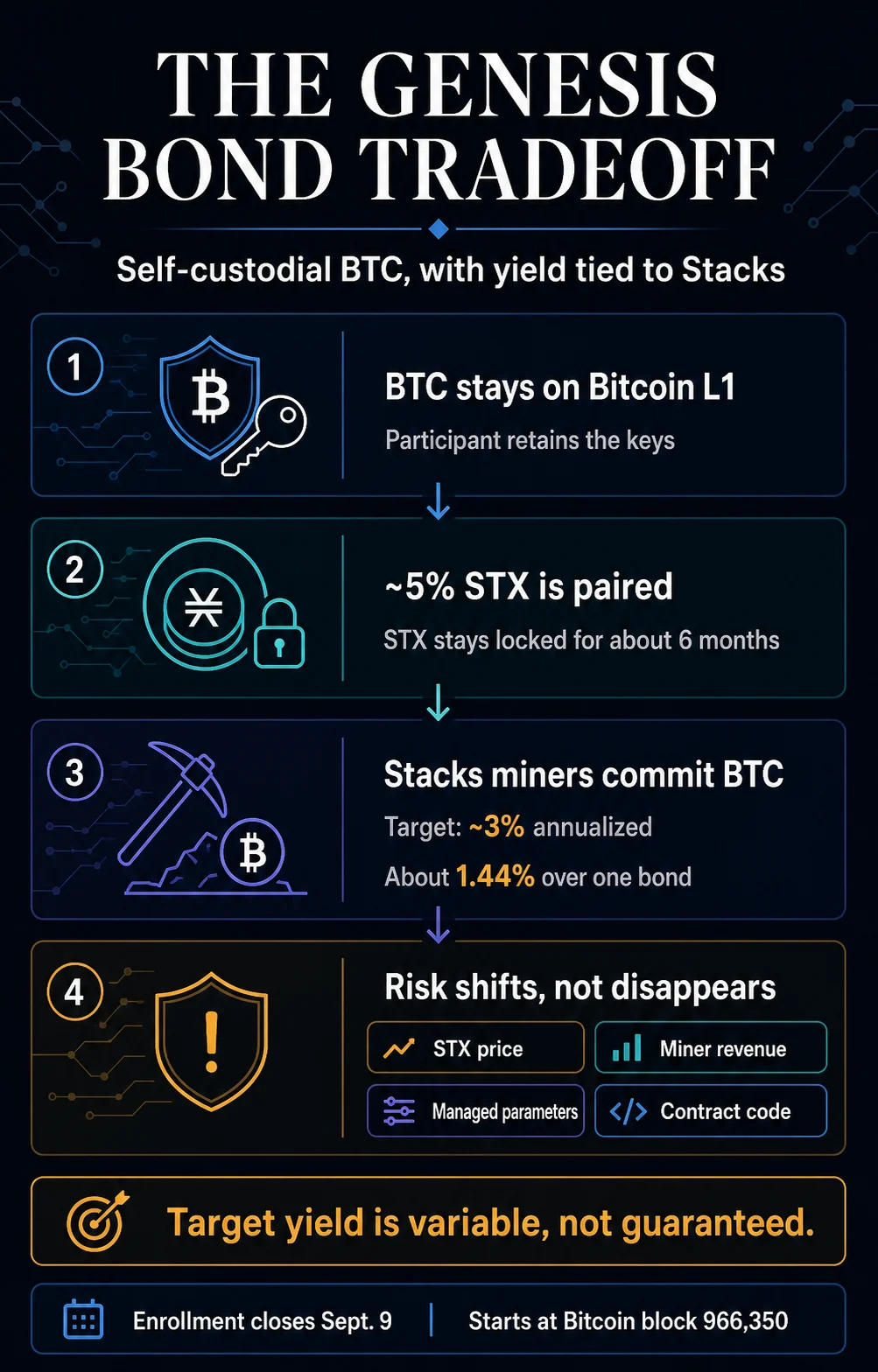
Stacks founder Muneeb Ali confirmed on August 27 that HashKey Cloud, the infrastructure arm of the prominent Asian digital asset group HashKey, will deploy Bitcoin into the Stacks network’s Genesis Bond pilot. This move positions the Hong Kong-based infrastructure provider as the second major institution to participate in the pilot program, marking a significant milestone in the integration of institutional-grade capital with Bitcoin-native decentralized finance (DeFi) protocols. The partnership underscores a growing trend where large-scale digital asset managers seek to generate yield on Bitcoin holdings without relinquishing custody of the underlying asset.
Under the terms of the agreement, HashKey Cloud will utilize a "native-BTC protocol bond" structure. This involves time-locking Bitcoin on the Bitcoin base layer, where HashKey retains full control of the private keys. To participate, the institution must pair its Bitcoin position with Stacks (STX) tokens worth approximately 5% of the committed Bitcoin value. This dual-asset requirement serves as a collateralization and participation mechanism, aligning the interests of Bitcoin holders with the economic health of the Stacks ecosystem.
The Mechanics of the Stacks Genesis Bond
The Genesis Bond represents a novel approach to Bitcoin yield generation. Unlike traditional lending platforms where assets are transferred to a third party or wrapped into a secondary token (such as WBTC), the Stacks protocol bond allows the principal to remain immobile on the Bitcoin blockchain. The Bitcoin is placed in a time-locked output, ensuring it stays outside of any third-party custody or lending agreement during the duration of the bond.
The yield itself is derived from the Stacks network’s Proof of Transfer (PoX) consensus mechanism. In this system, Stacks miners commit Bitcoin to compete for the right to produce blocks and earn STX block rewards. A portion of the Bitcoin committed by these miners is then distributed to participants in the protocol bond. Stacks has set a target of approximately 3% annualized yield from the committed Bitcoin. However, because the payouts are inextricably linked to the economics of Stacks mining—including STX block rewards, transaction fees, and overall network activity—the actual returns remain variable.
The 5% STX requirement is a critical component of the bond’s architecture. This amount determines the participant’s total Bitcoin capacity. By requiring a STX position, the protocol ensures that bondholders have "skin in the game" regarding the Stacks ecosystem. This also means that while the Bitcoin principal is protected from price volatility relative to other assets, the total position is exposed to STX price movements for the duration of the bond, which typically lasts around six months or 24 reward cycles.
Timeline and Chronology of the Pilot Launch
The path to the Genesis Bond has been paved by several technical upgrades to the Stacks network throughout 2024. The foundation was laid with the activation of PoX-5 at Bitcoin block 960,230 on July 30. This update introduced the necessary smart contract logic to support the native-BTC protocol bond.
The current schedule for the Genesis Bond pilot is as follows:
- July 30, 2024: Activation of PoX-5, enabling the technical framework for the bond.
- August 27, 2024: Announcement of HashKey Cloud as the second institutional participant.
- September 10, 2024 (Approximate): The Genesis Bond is expected to begin, at which point on-chain commitments of the total Bitcoin involved will become visible to the public.
- September 2024 – March 2025: The initial six-month bonding period, during which yield distributions will be monitored to see if they meet the 3% target.
- Future Transition: The eventual proposal and activation of PoX-6, which aims to transition the bond from a managed bootstrap phase to a permissionless, algorithmic auction.
Currently, the program operates within a "managed bootstrap" environment. During this phase, the Stacks Endowment—a foundation-led entity—sets the parameters for each bonding period, including total capacity, target yield, and the specific BTC-to-STX ratio. This controlled environment allows the developers to monitor the system’s stability before moving to a fully decentralized model.
Economic Implications for Stacks Miners and Bondholders
The success of the Genesis Bond is heavily dependent on the profitability of Stacks mining. Miners are the primary source of the Bitcoin that funds the yield for bondholders. When a miner wins a block, they receive STX tokens. If the value of those STX tokens, combined with transaction fees, exceeds the cost of the Bitcoin they committed, the miner is profitable.
The protocol bondholders are prioritized in the distribution of this Bitcoin pool. If the target yield of 3% is realized over 24 reward cycles, a six-month bond would deliver approximately 1.44% of the locked Bitcoin. However, if network activity slows or the price of STX drops significantly, miner revenue may fall short. To mitigate this, Stacks has designed a reserve system where excess miner revenue can be stored during high-activity periods.

In the event of a sustained shortfall that exhausts the reserve, the protocol dictates a specific hierarchy for yield compression. Returns would first be reduced for "STX-only" stakers—those who lock STX to secure the network without a BTC pairing. Protocol-bond holders, who provide the Bitcoin liquidity, would see their returns compressed only after the STX-only stakers’ yields have been impacted. This tiered system is designed to protect institutional participants and encourage the locking of "hard" Bitcoin assets.
Institutional Context and the Role of HashKey Cloud
HashKey Cloud’s participation is a significant endorsement of the Stacks "Nakamoto" upgrade and the broader vision of Bitcoin layers. As a leading provider of node validation and infrastructure services in Asia, HashKey brings a level of reputational weight that is essential for attracting further institutional capital. While the specific size of HashKey’s Bitcoin allocation has not been disclosed, its presence in the pilot serves as a bellwether for institutional demand for non-custodial Bitcoin yield.
The demand for such products is driven by a desire to move beyond "lazy" Bitcoin holding. While many institutions are content to hold Bitcoin in cold storage, there is an increasing appetite for "productive" Bitcoin. However, the high-profile failures of centralized lending platforms in 2022 (such as Celsius and BlockFi) have made institutions wary of custodial risk. The Stacks Genesis Bond addresses this specific pain point by ensuring the participant retains their keys.
Technical Audits and Identified Risks
Despite the structural advantages of self-custody, the Genesis Bond is not without risk. The program introduces exposure to new smart contract code and the market volatility of the STX token.
Stacks has emphasized that the PoX-5 codebase underwent rigorous security reviews. Audits were conducted by Trail of Bits and the Clarity Alliance, with additional specialized review provided by Asymmetric Research. These audits are intended to ensure that the logic governing the locking of BTC and the distribution of rewards is sound.
However, an open issue remains in the official stacks-core repository. A medium-severity flaw has been identified regarding the "rollover" path of the bond. The issue suggests that near the end of a bonding term, a participant transitioning into a subsequent bond could theoretically remain credited with reward shares from the old bond even after withdrawing the underlying collateral. This could potentially dilute the rewards for other participants in the final cycle.
While this flaw does not put the Bitcoin principal at risk—as the BTC remains under the participant’s private keys—it highlights the complexities of managing decentralized reward distributions. The Stacks development community has noted that a public fix or mitigation strategy will be necessary before the first rollover window occurs in early 2025.
Broader Impact on the Bitcoin DeFi (BTCFi) Landscape
The entry of HashKey Cloud into the Stacks ecosystem is part of a larger shift toward what is frequently termed "BTCFi." For years, Bitcoin was viewed primarily as a store of value, while Ethereum and other smart contract platforms handled decentralized finance. Stacks, acting as a Layer 2 (or a "Sidecar" layer) for Bitcoin, aims to change this by enabling smart contracts that settle on the Bitcoin blockchain.
The Genesis Bond pilot serves as a test case for whether Bitcoin can support a complex financial ecosystem without compromising its core security principles. If the pilot successfully delivers stable yields to institutions like HashKey, it could lead to a massive influx of Bitcoin into Layer 2 protocols. This would increase the utility of Bitcoin and provide a sustainable source of demand for the network’s block space.
Furthermore, the transition from PoX-5 to PoX-6 will be a critical juncture. Moving from a managed system to an algorithmic auction will test the protocol’s ability to self-regulate based on market demand. If successful, the Stacks protocol could provide a template for other Bitcoin-centric protocols, such as Babylon (which focuses on Bitcoin restaking) or various Discreet Log Contract (DLC) implementations.
In conclusion, the partnership between Stacks and HashKey Cloud represents a strategic attempt to bridge the gap between institutional finance and Bitcoin-native technology. By separating principal custody from yield generation, the Genesis Bond offers a unique risk-reward profile that prioritizes asset safety while acknowledging the inherent volatility of the emerging Stacks economy. As the bond begins its on-chain operations in September, the industry will be watching closely to see if the "3% target" can be maintained in the face of fluctuating market conditions and evolving network economics.