Dwi Wanna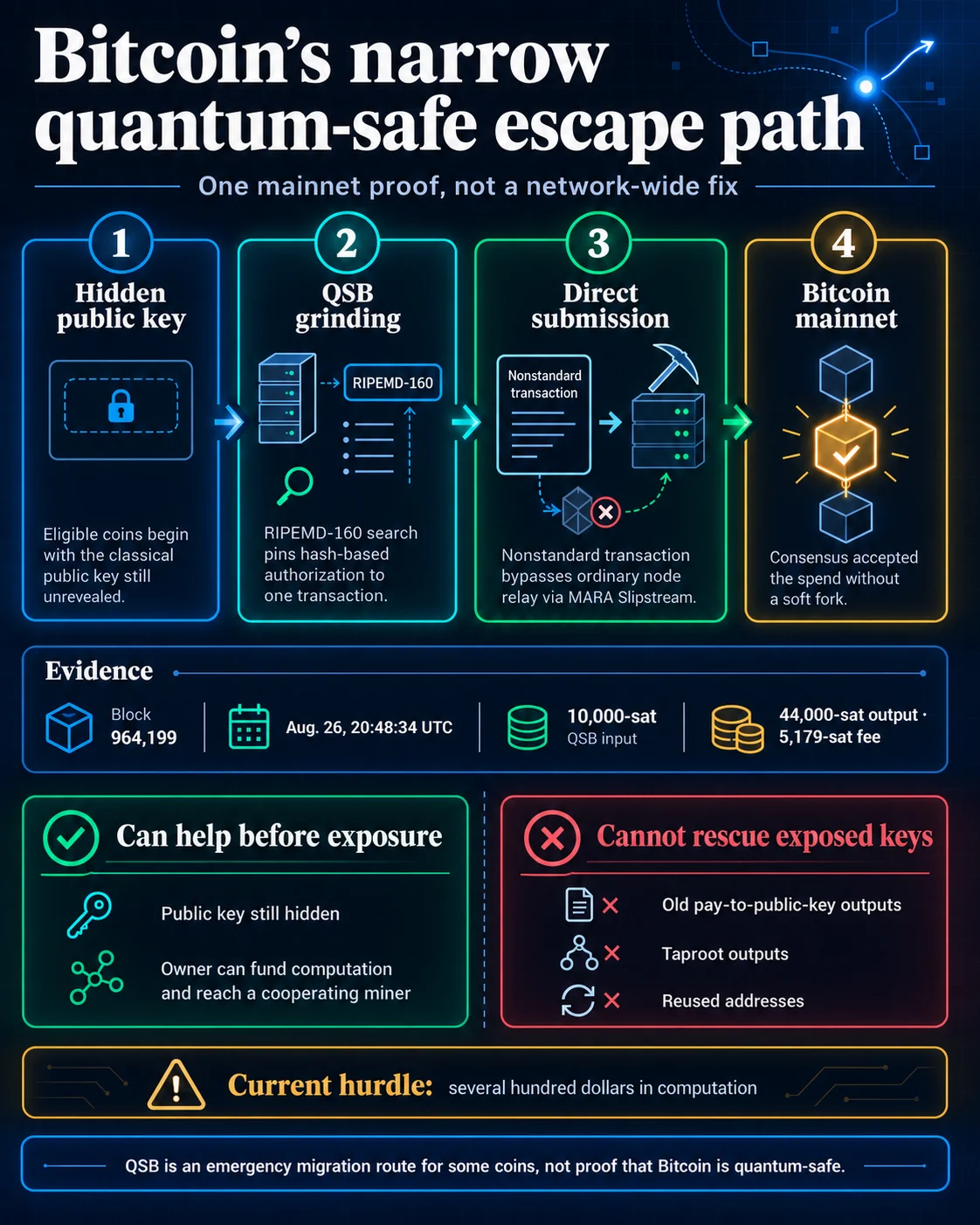
The Bitcoin network reached a significant milestone in cryptographic evolution on August 26, when researchers successfully confirmed the first quantum-resistant transaction on the mainnet using existing consensus rules. This proof-of-concept, developed by StarkWare researcher Avihu Levy, demonstrates that a subset of Bitcoin holders may have a viable path to migrate their assets to safety before the arrival of functionally capable quantum computers, all without requiring an immediate and contentious protocol upgrade. The transaction, which was included in block 964,199, marks a pivotal moment in the ongoing debate regarding the long-term viability of the world’s largest cryptocurrency in a post-quantum world.
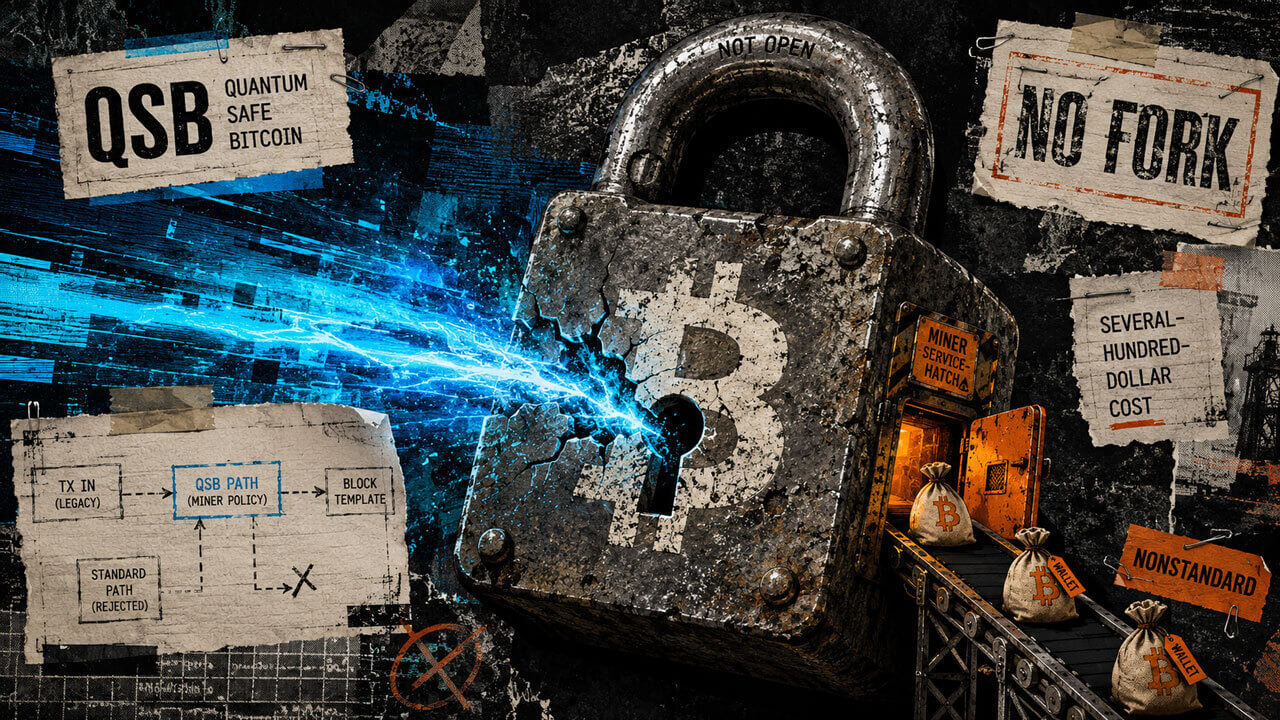
By utilizing a specialized construction known as Quantum-Safe Bitcoin (QSB), the transaction successfully shifted the security requirements of the spend from traditional elliptic-curve signatures to hash-based security. This was achieved by submitting the transaction directly to the Bitcoin mining firm MARA (formerly Marathon Digital) through its Slipstream service, bypassing the standard public mempool. While the experiment proves that the Bitcoin protocol is flexible enough to support hash-based spending paths in its current state, experts warn that the discovery is a "specialized escape route" rather than a comprehensive solution for the network’s broader exposure to quantum threats.
The Genesis of Quantum-Safe Bitcoin Transactions
The technical breakthrough originated from the research laboratories of StarkWare, a firm primarily known for its work on Ethereum scaling and Zero-Knowledge (ZK) proofs. The lead researcher, Avihu Levy, sought to address a long-standing theoretical vulnerability in Bitcoin’s architecture: the reliance on the Elliptic Curve Digital Signature Algorithm (ECDSA). While ECDSA is currently robust against classical computing attacks, it is mathematically susceptible to Shor’s algorithm, which a sufficiently powerful quantum computer could use to derive a private key from a public key in a matter of hours or even minutes.
The August 26 transaction was not merely a simulation but a live execution on the Bitcoin mainnet. It utilized a unique spending condition that does not rely on a digital signature in the traditional sense. Instead, it leverages Bitcoin’s scripting language to require the revelation of a "pre-image"—a piece of data that, when hashed, matches a specific value. Because hash functions are significantly more resistant to quantum acceleration than elliptic curve mathematics, this shift effectively "quantum-proofs" the specific output being spent.
StarkWare Chief Executive Eli Ben-Sasson emphasized that while the success of this transaction is a "historic first," it should not lead to complacency. He noted that the test serves as a proof of concept that workable approaches exist, but the primary task for the global developer community remains the establishment of a standardized migration path before quantum hardware reaches the "cryptographically relevant" stage.
Technical Architecture: Shifting from Elliptic Curves to Hash-Based Security
To understand the significance of the QSB construction, one must look at how Bitcoin currently secures funds. Most modern Bitcoin addresses (such as P2PKH, P2SH, or SegWit) do not reveal the owner’s public key on the blockchain until the moment a transaction is initiated. Instead, the blockchain stores a hash of the public key. This provides a layer of "hash-based" protection; an attacker cannot attempt to break the elliptic curve signature because they do not yet know the public key they need to target.
The vulnerability window opens when a user broadcasts a transaction. At that moment, the public key is revealed to the network so that miners can verify the signature. In a future where quantum computers exist, an attacker could monitor the mempool, see the revealed public key, calculate the private key using Shor’s algorithm, and broadcast a competing transaction with a higher fee to steal the funds before the original transaction is confirmed.
Levy’s QSB method exploits the fact that the public key remains hidden until the spend. By creating a transaction where the "signature" is actually the result of an intensive computational search for a specific hash, the user can move their coins into a new, quantum-secure state without ever exposing their classical public key to the threat of a quantum intercept. The process involves repeatedly varying the candidate transaction data until it produces a hash that the Bitcoin protocol accepts as a validly formatted signature. This computation is performed entirely offline or in a private environment before the transaction hits the network.
The Role of MARA and the Slipstream Protocol
A critical component of this successful test was the collaboration with MARA, one of the world’s largest publicly traded Bitcoin mining companies. Although the QSB transaction is valid under Bitcoin’s consensus rules—meaning it follows the "laws" of the protocol—it is considered "non-standard" under default node policy. Most Bitcoin nodes are programmed to only propagate a specific set of common transaction types to prevent spam and potential denial-of-service attacks.
Because the QSB transaction used a highly unconventional structure, it would likely have been rejected by the standard public mempool. To circumvent this, StarkWare utilized MARA’s Slipstream service. Slipstream allows users to submit non-standard but valid transactions directly to the mining pool’s internal mempool. This ensures that the transaction is included in a block as soon as the pool finds one, without needing to be "voted on" or passed around by thousands of individual nodes across the globe.
This highlights a potential future for Bitcoin security where miners play an active role in "rescuing" funds. However, it also raises questions about censorship resistance and the centralization of security services, as users would have to rely on the altruism or paid services of large-scale mining operations to secure their assets.
Quantifying the Quantum Threat: Shor’s Algorithm and Bitcoin’s Vulnerability
The urgency behind the QSB experiment is driven by the rapid advancement of quantum computing. While current quantum processors, such as those developed by IBM, Google, and IonQ, do not yet have the "qubit" count or error-correction capabilities to break 256-bit ECDSA encryption, the timeline for such a machine is shrinking.
Shor’s algorithm provides a polynomial-time solution to the discrete logarithm problem, which is the mathematical foundation of Bitcoin’s security. In contrast, hash functions like SHA-256 (used in Bitcoin mining and address generation) are only susceptible to Grover’s algorithm. Grover’s algorithm provides a "quadratic speedup," meaning that to break a 256-bit hash, a quantum computer would still need to perform the equivalent of $2^128$ operations. This remains computationally infeasible for the foreseeable future, making hash-based security the preferred "safe harbor" for cryptographic assets.
The StarkWare team’s use of hash-based conditions aligns with the broader cryptographic industry’s move toward Post-Quantum Cryptography (PQC) standards, such as those recently finalized by the National Institute of Standards and Technology (NIST) in the United States.
The Seven Million Bitcoin Risk: Why Current Protections are Insufficient
Despite the success of the August 26 transaction, a massive portion of the Bitcoin supply remains "in the line of fire." Approximately 7 million BTC—worth hundreds of billions of dollars—are stored in "quantum-vulnerable" formats.
These include:
- Pay-to-Public-Key (P2PK) Outputs: Used in the earliest days of Bitcoin (including the "Satoshi era" coins), where the public key is recorded directly on the blockchain without being hashed.
- Reused Addresses: If a user receives Bitcoin to an address they have previously spent from, their public key is already visible in the historical record of the blockchain.
- Taproot (P2TR) Outputs: While Taproot offers privacy and efficiency benefits, its default spending path reveals a public key, making it potentially vulnerable to quantum analysis if not properly migrated.
The QSB method developed by Levy cannot save these coins. Because the public keys for these 7 million BTC are already known, a quantum attacker does not need to wait for a transaction to be broadcast; they can begin the "cracking" process at any time once they possess a sufficiently powerful machine. For these assets, only a network-wide soft fork that introduces new cryptographic primitives—and potentially a mandatory migration period—can provide protection.
Economic Barriers and Operational Constraints of QSB
While technically successful, the QSB method is currently impractical for the average user. The computational requirements to "brute force" a validly formatted signature through hashing are immense. StarkWare reported that the mainnet test cost "several hundred dollars" in administrative and processing fees. Furthermore, the project’s open-source repository estimates that a single migration could cost between $75 and $150 in cloud-GPU rental costs just to perform the necessary search phases.
Beyond the cost, the process is time-consuming and requires significant technical expertise. It is not a "one-click" solution that can be integrated into popular hardware wallets like Ledger or Trezor in its current form. As it stands, QSB is a "break glass in case of emergency" tool for high-net-worth individuals or institutional custodians rather than a scalable solution for the millions of retail Bitcoin users.
Institutional Mobilization: The Bitcoin Security Consortium and Global Policy
The realization that Bitcoin’s cryptographic foundations may have an expiration date has prompted a surge in institutional involvement. In July 2024, a group of industry giants including BlackRock, Coinbase, and MicroStrategy (referred to in some circles as the "Bitcoin Security Consortium") pledged $15 million over the next three years to fund research into Bitcoin’s security. A primary focus of this funding is the development of post-quantum signatures that could be implemented via a soft fork.
The involvement of BlackRock, the world’s largest asset manager and a major sponsor of a Bitcoin Spot ETF, signals that quantum risk is no longer viewed as a fringe "cyberpunk" concern but as a systemic risk to global financial stability. If Bitcoin is to function as "digital gold" for institutional balance sheets, its long-term resistance to any form of computational attack must be guaranteed.
Simultaneously, the US Treasury Department has begun including digital assets in its broader "Quantum Readiness" planning. In recent reports, the Treasury highlighted the need for financial institutions to transition to quantum-resistant algorithms to protect the integrity of the US financial system, explicitly mentioning the potential impact on decentralized ledgers.
The Path Forward: Soft Forks and the Future of Post-Quantum Cryptography
The successful mining of the QSB transaction provides a crucial data point for the Bitcoin Core developer community. It proves that the "hash-based fallback" is a reality, providing a safety net for those who have followed best practices (i.e., not reusing addresses and using modern hashed address formats).
However, the consensus among developers is that a more elegant solution is required. Proposals for "STARK-based" or "Lamport-based" signatures are being discussed as potential candidates for a future soft fork. These would allow Bitcoin to natively support quantum-resistant addresses that are as easy to use as current ones, without the need for expensive GPU searches or direct-to-miner submission services like Slipstream.
The August 26 transaction serves as both a beacon of hope and a warning. It demonstrates that Bitcoin’s programmable nature allows for creative survival strategies, but it also underscores the vast amount of work remaining to secure the network’s 7 million vulnerable coins. As the race between quantum hardware and cryptographic defense intensifies, the QSB experiment will likely be remembered as the first shot fired in Bitcoin’s battle for survival in the quantum age. For now, the message to holders is clear: the technology to protect your assets is being built, but the window for a safe and orderly migration is slowly but surely closing.