admin
admin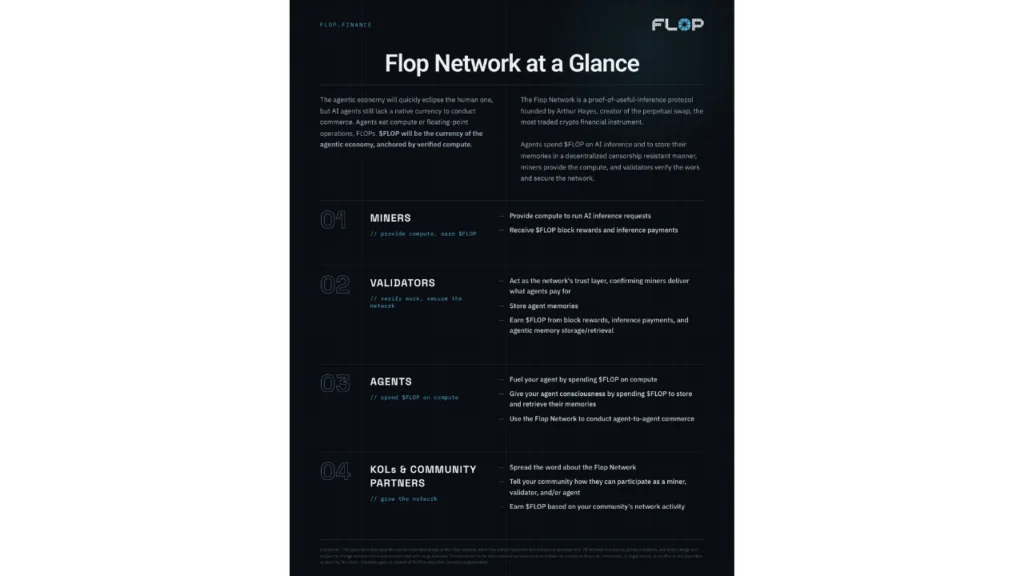
The unexpected announcement, made by Hayes on August 18, signals a definitive departure from his previous "retirement" from day-to-day project management, as he publicly updated his X (formerly Twitter) profile to reflect his new executive position. This move positions Hayes at the forefront of a project aiming to develop the Flop Network, a proposed decentralized ledger specifically engineered to empower AI agents to conduct transactions independently. On this network, AI agents would leverage the native FLOP token to procure essential resources such as computing power, AI inference capabilities, and decentralized memory services, fundamentally shifting their role from mere tools to autonomous economic participants.
The ambitious roadmap laid out by Flop Labs includes a "massive airdrop" of FLOP tokens slated for the fourth quarter of 2026, intended to precede the network’s targeted genesis block launch in the first quarter of 2027. Both dates, it is important to note, are presented as targets and not yet firm launch commitments. This venture marks a significant pivot for Hayes, who has remained a prominent voice and investor in the crypto space since stepping down from BitMEX leadership, now choosing to directly engage in building foundational technology at the critical intersection of AI and blockchain.
Arthur Hayes’ Resurgence: From BitMEX Pioneer to AI Visionary
Arthur Hayes’ return to an operating role carries considerable weight within the cryptocurrency community. He co-founded BitMEX in 2014, guiding it to become one of the industry’s most dominant and innovative derivatives exchanges. Under his leadership, BitMEX popularized high-leverage perpetual swaps, fundamentally altering the landscape of crypto trading and attracting a massive global user base. However, his tenure at BitMEX concluded in October 2020 when he stepped down as CEO amidst a U.S. regulatory crackdown, which ultimately led to charges of violating the Bank Secrecy Act and operating an unregistered trading platform. Hayes later pleaded guilty to one count of violating the Bank Secrecy Act and received a two-year probation sentence in 2022, effectively closing a challenging chapter in his career.
Despite these legal tribulations, Hayes never truly left the crypto ecosystem. He transitioned into an influential role as an investor and astute market commentator, often sharing his macroeconomic insights and crypto analyses through his widely followed "Maelstrom" blog posts. His role as Chief Investment Officer of Maelstrom Fund further solidified his ongoing presence and influence. His commentary is frequently characterized by a blend of sharp market observations, contrarian views, and a deep understanding of global financial systems, making him a respected, if sometimes controversial, voice.
His decision to lead Flop Labs thus represents a significant shift from an advisory and investment capacity back to the demanding day-to-day responsibilities of building and scaling a startup. This move comes at a coincidental, yet perhaps symbolically resonant, time for his former enterprise, as BitMEX is scheduled to cease its exchange operations on September 23, following an announcement made in July. While the direct connection between these two events is not explicitly stated, it marks a definitive end to one chapter and the emphatic beginning of another for Hayes. The precise details of his compensation, ownership stake, and the full scope of his responsibilities at Flop Labs have not yet been publicly disclosed, nor is it clear how this new role will impact his existing commitments at Maelstrom Fund.
Flop Network: Enabling Autonomous Economic Agents
At its core, Flop Labs is built upon a profound and increasingly relevant thesis: that as AI capabilities advance, autonomous AI agents will inevitably require the ability to conduct transactions and manage resources independently, without constant human oversight. The Flop Network is envisioned as the foundational infrastructure to facilitate this shift. Rather than relying on humans to authorize every single payment or resource allocation, these AI agents would utilize the FLOP token to acquire necessary computing resources, execute AI inference tasks, and secure decentralized memory services from a network of providers.

This paradigm aims to create a self-sustaining economy for AI agents, where they can autonomously pay for the digital resources crucial for their operation and evolution. Providers, in turn, would be incentivized and rewarded for supplying these resources. The project describes its innovative consensus mechanism as "proof of useful inference." Under this proposed model, network participants acting as "miners" would perform specific AI inference requests, while "validators" would be tasked with verifying the accurate and complete execution of these requested computations.
The concept of "proof of useful inference" stands in contrast to traditional blockchain consensus mechanisms like Proof of Work (PoW) or Proof of Stake (PoS). While PoW consumes computational power for arbitrary puzzle-solving and PoS relies on capital commitment, Flop’s proposed mechanism aims to harness computational power for directly valuable AI tasks. This represents a significant technical challenge. Verifying the correctness and utility of complex AI inferences in a decentralized, trustless, and deterministic manner is an open research problem. Issues such as handling inconsistent or subjective AI outputs, preventing fraudulent computations, and ensuring the integrity of the verification process are critical hurdles that Flop Labs will need to transparently address through its technical documentation.
Currently, Flop Labs has yet to release sufficient technical documentation to allow for a comprehensive assessment of how this ambitious system would function in practice. Key questions remain unanswered regarding the specifics of validator verification for AI inference, mechanisms for addressing potential inconsistencies in AI outputs, and robust methods for identifying and penalizing fraudulent or incorrect computations. Furthermore, the project has not yet launched a public testnet, which is a crucial step for demonstrating the practical viability and resilience of its proposed architecture.
The Promise of a "100% Fair Launch" and Unfolding Tokenomics
A central tenet of Arthur Hayes’ re-entry into the operational crypto landscape with Flop Labs is the promise of a "100% fair launch" for the FLOP token. Hayes has explicitly stated that FLOP will be distributed without any presale or allocations to venture capital (VC) firms, a move that aims to distinguish it from a vast majority of crypto projects that typically involve significant pre-mine or early investor allocations before a public launch. This approach resonates with a segment of the crypto community that advocates for more equitable and decentralized token distribution, minimizing the potential for early investor dominance or "pump-and-dump" schemes.
Historically, "fair launches" like Bitcoin’s genesis have been celebrated for their egalitarian distribution, allowing anyone to participate from the outset without preferential access. In recent years, as institutional money poured into crypto, many projects adopted private sales and venture rounds, leading to concerns about centralization of ownership and unequal playing fields. Hayes’ commitment to a "100% fair launch" could generate significant community goodwill and interest, particularly among retail participants who often feel disadvantaged in VC-heavy launches.
However, the complete details necessary to fully assess the token’s distribution and economic model are still forthcoming. Flop Labs has not yet published comprehensive tokenomics, which typically include crucial information such as the total supply, specific allocations for contributors, treasury holdings, emission schedules, and vesting periods for any team or foundation tokens. A full whitepaper, which would outline the technical architecture, economic model, and governance structure, along with an official token contract, are also pending release.
Consequently, there is currently no reliable market price for FLOP, and any tokens or trading pairs purporting to be the official FLOP asset should be approached with extreme caution until officially confirmed by Flop Labs. The absence of these foundational documents leaves many critical questions open regarding the long-term sustainability, incentive structures, and true decentralization of the network.

Upcoming Milestones: The Q4 2026 Airdrop
The planned "massive airdrop" in Q4 2026 stands as the most immediate and anticipated milestone for Flop Labs, likely serving as the primary mechanism for initial token distribution and community engagement. Airdrops are a common strategy in the crypto space to bootstrap network participation, reward early adopters, and decentralize token ownership. However, the specifics of this "massive airdrop" remain largely undefined.
Hayes has not yet disclosed the precise size of the distribution, the eligibility criteria users will need to meet, or any specific wallet requirements. Furthermore, details regarding anti-bot measures, which are crucial to prevent Sybil attacks and ensure equitable distribution, have not been announced. It is unclear whether potential recipients will need to interact with a testnet, contribute computing resources, actively use AI agents, or participate in the community to qualify. These details will be paramount for interested parties to understand how they can participate.
An intriguing aspect of the announced timeline is the planned distribution of FLOP tokens before the network’s targeted genesis block in Q1 2027. This raises logistical questions regarding where these initial tokens will reside and how they will seamlessly transition to the native Flop Network once it officially launches. Projects typically launch a token on an existing blockchain (e.g., Ethereum or Solana) before their own mainnet is ready, and then offer a "swap" mechanism for users to migrate their tokens to the native chain. Clarity on this process will be essential to ensure a smooth and secure transition. These crucial details are expected to emerge as Flop Labs progresses in its development and releases its comprehensive technical documentation and official airdrop rules.
The Broader Implications: A Bet on the AI-Agent Economy
Flop Labs is strategically positioning itself at the rapidly expanding intersection of cryptocurrency and artificial intelligence – two of the most transformative technologies of our era. The central thesis undergirding the project is a profound one: that increasingly sophisticated and autonomous AI agents will inevitably evolve into independent economic participants. These agents, freed from constant human intervention, would require the ability to autonomously acquire data, computing power, access APIs, and utilize various other digital services. Blockchain-based payment systems and decentralized networks could provide the ideal settlement infrastructure and resource pools for these AI-driven interactions.
Arthur Hayes has been a vocal proponent of the idea that the enormous capital investment currently flowing into AI infrastructure development could eventually lead to an oversupply of computing capacity. Flop Network appears designed to capitalize on this potential scenario by creating a marketplace where computing providers can directly sell their excess resources to autonomous AI agents, fostering a dynamic and efficient digital economy. This vision aligns with a growing movement towards decentralized AI, which seeks to mitigate the risks of centralized AI control by distributing power, data, and computational resources across a network. Projects like Fetch.ai, Render Network, Akash Network, and Arweave are also exploring various facets of decentralized AI infrastructure, highlighting the burgeoning interest and potential in this sector.
However, despite the compelling narrative and the significant attention garnered through Hayes’ involvement, Flop Labs remains at a very early stage of development. The project has announced an ambitious roadmap, but many critical components are yet to be disclosed. These include the detailed technical architecture, comprehensive tokenomics, the full development team behind the project, and the precise mechanics of the anticipated airdrop. The success of Flop Labs will ultimately hinge on its ability to translate this compelling vision into robust, functional, and scalable infrastructure.
For the immediate future, the Q4 2026 airdrop and the Q1 2027 genesis block represent the two most pivotal milestones for Flop Labs. The crypto and AI communities will be closely watching whether Arthur Hayes and his team can navigate the considerable technical and economic challenges to deliver on their promise, transforming a powerful narrative of AI-crypto convergence into a tangible, operational reality. The coming months will be crucial for the project to build trust, transparency, and a solid foundation for its groundbreaking aspirations.