Dwi Wanna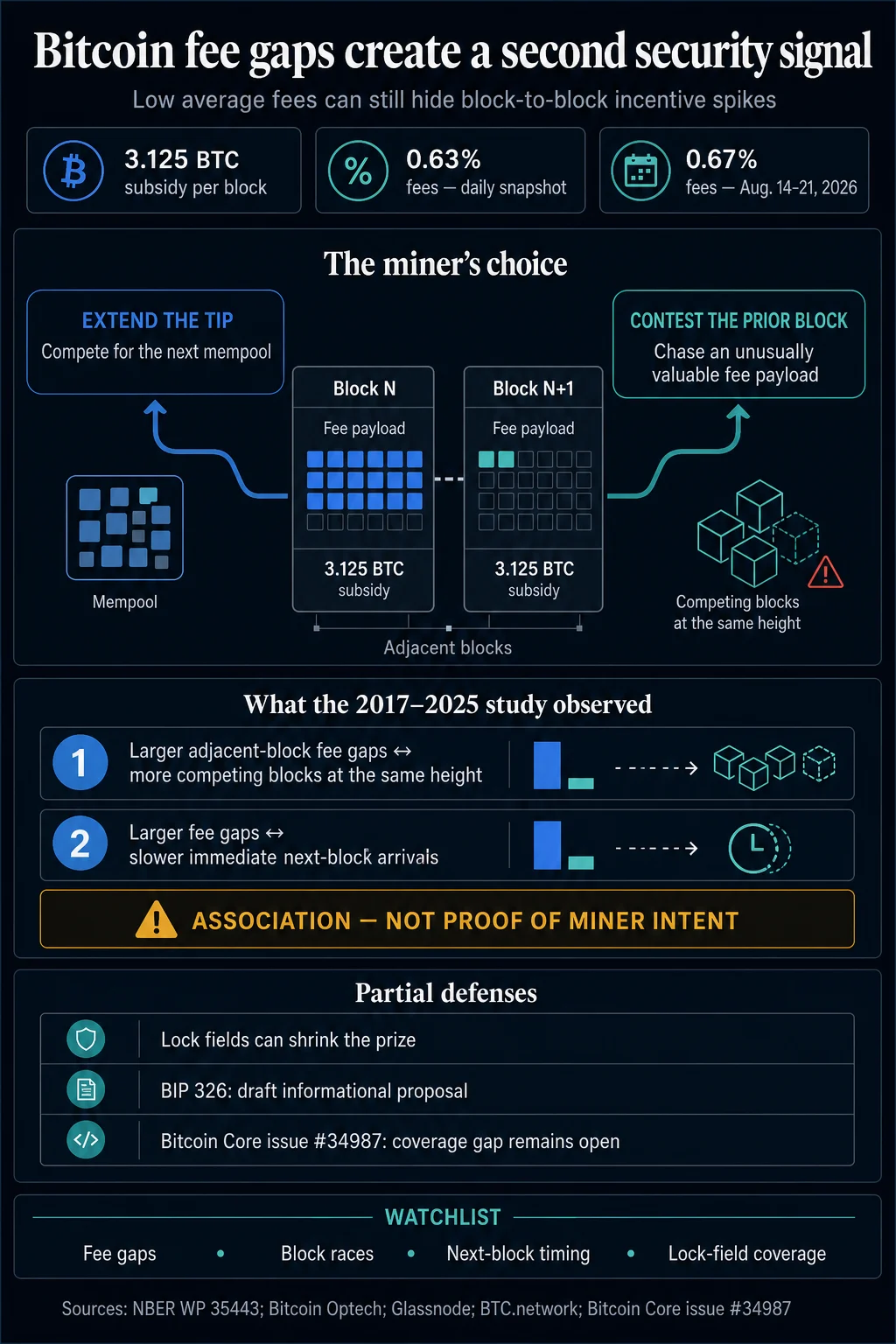
The long-standing debate regarding the sustainability of Bitcoin’s security budget typically centers on a singular metric: the total aggregate of transaction fees collected by miners as the fixed block subsidy continues its quadrennial decline. However, a July 2026 working paper published by the National Bureau of Economic Research (NBER) suggests that the total volume of fees may be less significant for short-term network stability than the variance of fees between individual blocks. Authors Fabian Schär, Dario Thürkauf, and David Yermack, utilizing a comprehensive dataset spanning from 2017 through 2025, have identified a critical second variable in the security equation. Their research demonstrates that larger fee discrepancies between adjacent Bitcoin blocks are statistically associated with an increase in competing blocks at the same height—commonly referred to as "block races"—and a measurable delay in the propagation of the subsequent block.
This discovery introduces a new layer of complexity to the understanding of Proof-of-Work (PoW) incentives. While the evidence presented is observational and identifies a network-level relationship, it highlights a signal that wallets, miners, and users can use to gauge the immediate health and security of the network. The findings suggest that Bitcoin’s security incentives are not merely a product of how much the network pays over a month or a year, but are highly sensitive to the arrival rate and distribution of fees from one ten-minute interval to the next.
The Economic Shift from Subsidy to Transaction Fees
To understand the implications of the NBER study, one must first look at the current structure of Bitcoin mining rewards. As of mid-2026, the Bitcoin network pays miners a fixed block subsidy of 3.125 BTC for each successfully mined block. This subsidy, which is halved approximately every four years, is designed to eventually reach zero, leaving transaction fees as the sole incentive for miners to secure the blockchain.
As the network progresses toward this fee-only model, the consistency of those fees becomes paramount. Recent data from August 2026 illustrates the current state of this transition. A Glassnode measure recorded on August 26 indicated that transaction fees accounted for approximately 0.70% of total miner revenue. Similarly, a report from BTC.network covering the period of August 14 through August 21 calculated the fee share at roughly 0.67%. While these aggregate snapshots suggest that fees currently play a minor role in the total revenue pie, they mask the extreme volatility that occurs at the individual block level.
For instance, a snapshot from Blockchain.com on August 26 revealed a stark contrast between adjacent blocks. Block 964,120 contained only 0.0077 BTC in fees, while the very next block, 964,121, contained 0.0536 BTC. This represents an almost seven-fold increase in fee value between blocks produced minutes apart. While the aggregate fee revenue remains below 1% of the total reward, these sharp "fee gaps" create localized incentives that can temporarily override the standard protocol of extending the most recent block.
The Mechanics of Fee Sniping and Strategic Mining
The primary concern raised by significant fee gaps is a phenomenon known as "fee sniping." In a standard scenario, a miner’s most profitable path is to extend the current tip of the blockchain, competing for the new transaction fees waiting in the "mempool" (the pool of unconfirmed transactions). However, the economic calculation changes if a previously mined block contains an exceptionally high amount of fees.
When a miner observes a prior block with a fee reward that significantly exceeds the expected fees in the current mempool, they may be tempted to "snipe" that block. This involves the miner ignoring the current tip of the chain and instead attempting to recreate the high-value prior block, claiming its fees, and then mining a subsequent block to overtake the existing chain. This is a probabilistic gamble; the miner starts from a position of being one block behind, and their success depends on their share of the total network hash rate, the speed of block propagation, and the reactions of other miners.
The NBER working paper confirms that this theoretical risk manifests in actual network behavior. Dario Thürkauf, a co-author of the study, explains that a "block race"—where two or more blocks are found at the same height—is more likely to occur following a large fee gap. Furthermore, the researchers found a lower probability of the next block appearing in the immediate seconds following a large fee gap. This timing pattern is consistent with a portion of the network’s hash rate being diverted to contest the prior block height rather than extending the current one.

Chronology of Security Budget Research and Development
The evolution of the "security budget" discussion has moved from theoretical warnings in early academic papers to empirical observations in the mid-2020s.
- 2016-2020: Early theoretical papers, such as those by Carlsten et al., warned that a fee-only reward system could lead to instability and frequent reorganizations.
- 2021-2024: The rise of various protocol layers and increased on-chain activity led to the first significant spikes in fee volatility, providing the data necessary for deeper analysis.
- April 2026: An open issue in the Bitcoin Core GitHub repository (Issue #34987) identified a critical inconsistency in how different transaction-creation paths handle anti-fee-sniping protections. The issue noted that while the standard "send" RPC and GUI wallet flows set
nLockTimeto the current block height, other paths likecreaterawtransactiondefaulted to zero. - July 2026: The NBER working paper by Schär, Thürkauf, and Yermack is released, providing empirical evidence that fee gaps correlate with network-level instability.
- August 2026: Real-time data from Glassnode and Blockchain.com confirms that even in a low-fee environment, block-by-block variance remains high, maintaining the relevance of the NBER findings.
Technical Mitigations and the Role of BIP 326
The Bitcoin developer community has not been idle in the face of these risks. Several technical "lock fields" exist to reduce the profitability of fee sniping. By using fields like nLockTime or nSequence, a wallet can ensure that a transaction is only valid if it is included in a block at a specific height or after a certain time.
A widely adopted strategy is for wallets to set the nLockTime of a transaction to the height of the most recent block. This means the transaction cannot be included in any "re-mined" version of the current block; it can only be included in the next block or later. This effectively "locks" the fees to the future tip of the chain, making them unavailable to a miner attempting to rewrite the previous block.
BIP 326 (Bitcoin Improvement Proposal 326) further refines these protections, specifically addressing anti-fee-sniping for Taproot transactions. However, as of late 2026, BIP 326 remains a draft informational proposal. Its effectiveness is limited by the fact that its adoption is voluntary and depends on individual wallet implementations. The inconsistency identified in Bitcoin Core in April 2026 highlights the difficulty of achieving universal protection. If a significant portion of transaction volume is created via paths that do not apply nLockTime correctly, the "prize" for fee sniping remains large enough to potentially influence miner behavior.
Broader Impact and Implications for Network Stability
The implications of the NBER study extend beyond technical mining debates; they touch upon the fundamental security assumptions of the Bitcoin network. If fee volatility leads to frequent block races and chain reorganizations (even "micro-reorgs" of one block), it could undermine the finality of transactions. For exchanges and high-value users, this might necessitate increasing the number of confirmations required before a transaction is considered settled, thereby slowing down the network’s effective throughput.
Moreover, the study suggests that the "security budget" cannot be evaluated solely by looking at the total USD or BTC value paid to miners. A network that pays $10 million in fees spread evenly across 144 blocks a day may be more stable than a network that pays $20 million in fees concentrated in just five outlier blocks.
Miners also face a coordination dilemma. If one large mining pool decides to attempt a fee snipe, other miners must decide whether to help extend the "honest" tip or join the "attacker" to ensure they are on the winning chain. This game-theoretical tension becomes more acute as the block subsidy—the "guaranteed" portion of the reward—shrinks further in future halving cycles.
Signals to Watch Before the Next Subsidy Cut
As the network approaches the next subsidy halving, the NBER research provides a roadmap for what analysts and stakeholders should monitor. Four primary signals have been identified as essential for assessing the impact of fee-based incentives:
- Adjacent-Block Fee Gaps: This serves as a proxy for the potential "extra prize" available in a prior block. Monitoring the frequency and magnitude of these gaps can highlight periods of increased risk.
- Competing Blocks at the Same Height: While routine network latency can cause occasional block races, a sustained increase in competing blocks—especially following high-fee blocks—suggests strategic mining behavior.
- Propagation Delays: A delay in the first few seconds of a new block’s lifecycle may indicate that hash power is being temporarily diverted to contest the previous height.
- Lock-Field Adoption Rates: The percentage of transactions using
nLockTimeand other anti-fee-sniping measures is the network’s primary defense. Increased consistency across all wallet software would reduce the economic viability of reorganization attempts.
Ultimately, Bitcoin’s fee market is a dynamic system that is still in its early stages of evolution. While the total security budget remains a valid concern for the long-term future, the NBER paper highlights that the distribution of those fees is a much more immediate factor in network stability. As the block subsidy continues to fade, the ability of the network to manage fee volatility through both technical mitigations and market behavior will be the true test of Bitcoin’s resilient design. Professional miners and developers must now look past the monthly revenue charts and focus on the granular, block-by-block incentives that govern the chain’s tip.