Dwi Wanna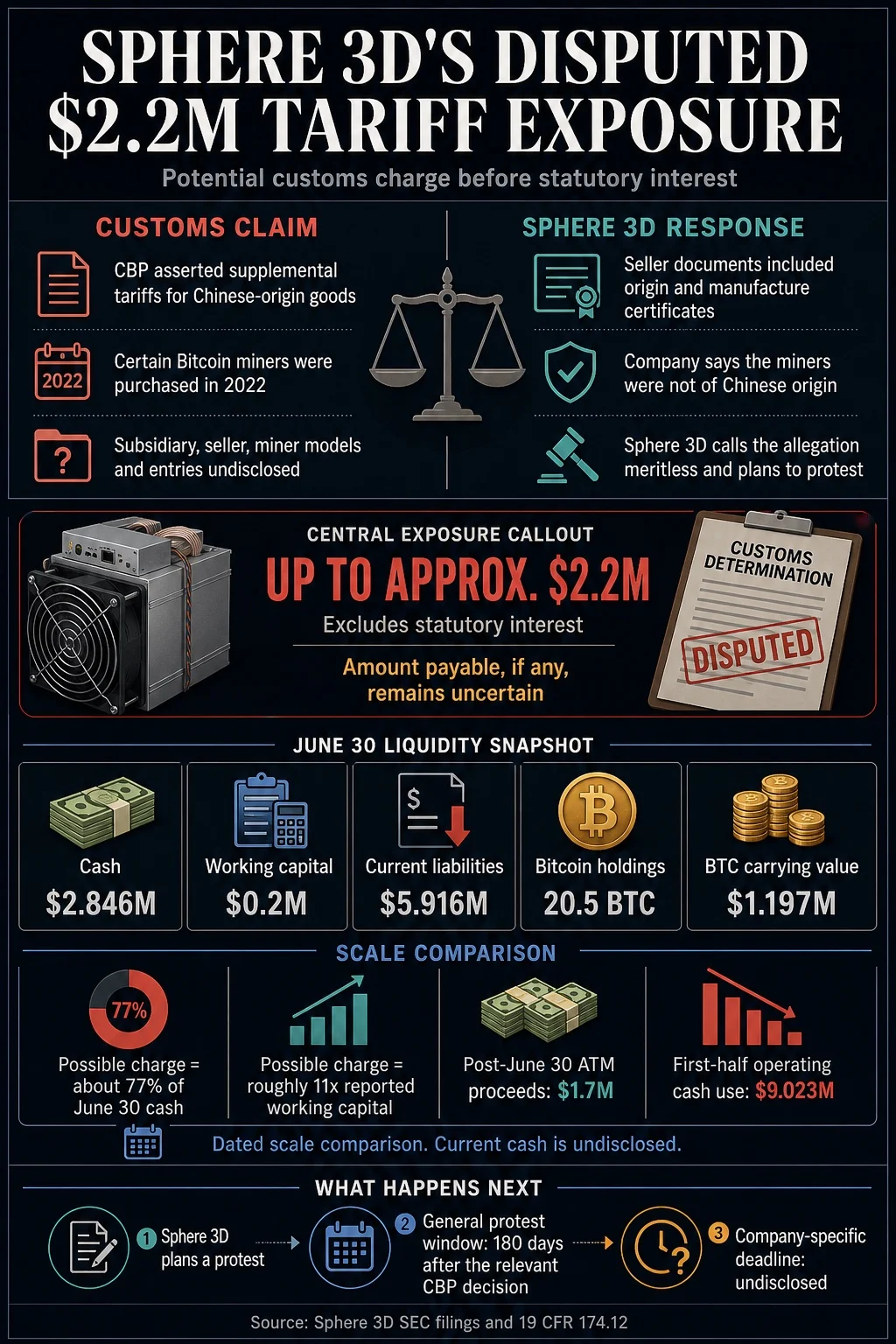
The digital asset mining sector, already grappling with the economic aftermath of the Bitcoin halving and fluctuating energy costs, has encountered a new regulatory hurdle as Sphere 3D Corp. (NASDAQ: ANY) disclosed a significant financial challenge involving international trade compliance. According to a recent filing with the U.S. Securities and Exchange Commission (SEC), the company is facing a supplemental tariff claim from U.S. Customs and Border Protection (CBP) totaling approximately $2.2 million. This figure, which notably excludes statutory interest, stems from a dispute regarding the country of origin for Bitcoin mining hardware purchased in 2022.
The core of the dispute centers on the classification of equipment imported by a subsidiary that Sphere 3D now owns. While the company maintains that the hardware was manufactured outside of China, specifically citing documentation that points to Thailand as the point of origin, CBP officials have countered this assertion. The federal agency has categorized the equipment as Chinese-origin goods, a distinction that carries heavy financial penalties under current U.S. trade policies, specifically the Section 301 tariffs targeting Chinese-made electronics and industrial machinery.
Financial Vulnerability and Liquidity Concerns
The timing of this tariff claim is particularly precarious for Sphere 3D. A detailed analysis of the company’s June 30 balance sheet—the first since the completion of its strategic combination with Cathedra Bitcoin—reveals a fragile liquidity position. As of the end of the second quarter, Sphere 3D reported cash reserves of just over $2.8 million. The potential $2.2 million tariff liability represents approximately 77% of the company’s total cash on hand, leaving a minimal buffer for ongoing operations.
Furthermore, the company’s working capital was reported at a lean $0.2 million, with current liabilities hovering around $5.9 million. When measured against these figures, the $2.2 million claim is roughly 11 times the company’s reported working capital. While Sphere 3D holds 20.5 Bitcoin, valued at approximately $1.2 million based on current market rates, the combined liquidity of cash and digital assets barely covers the potential tariff hit and existing short-term obligations.
Management has been transparent about these financial headwinds. In recent filings, the company acknowledged that recurring losses and negative operating cash flow have created "substantial doubt" regarding its ability to continue as a going concern without securing additional funding. To mitigate these risks, Sphere 3D has utilized an at-the-market (ATM) equity program, which recently generated $1.7 million in additional proceeds. An updated ATM prospectus suggests the company has the capacity to sell up to $10.3 million in shares, though the actual realization of these funds depends entirely on market demand and share price stability.
The Origin of the Dispute: A 2022 Legacy
The equipment at the center of the CBP investigation was purchased during the height of the previous mining bull cycle in 2022. During this period, many North American miners were aggressively expanding their fleets, often sourcing hardware through complex international supply chains to bypass supply bottlenecks.
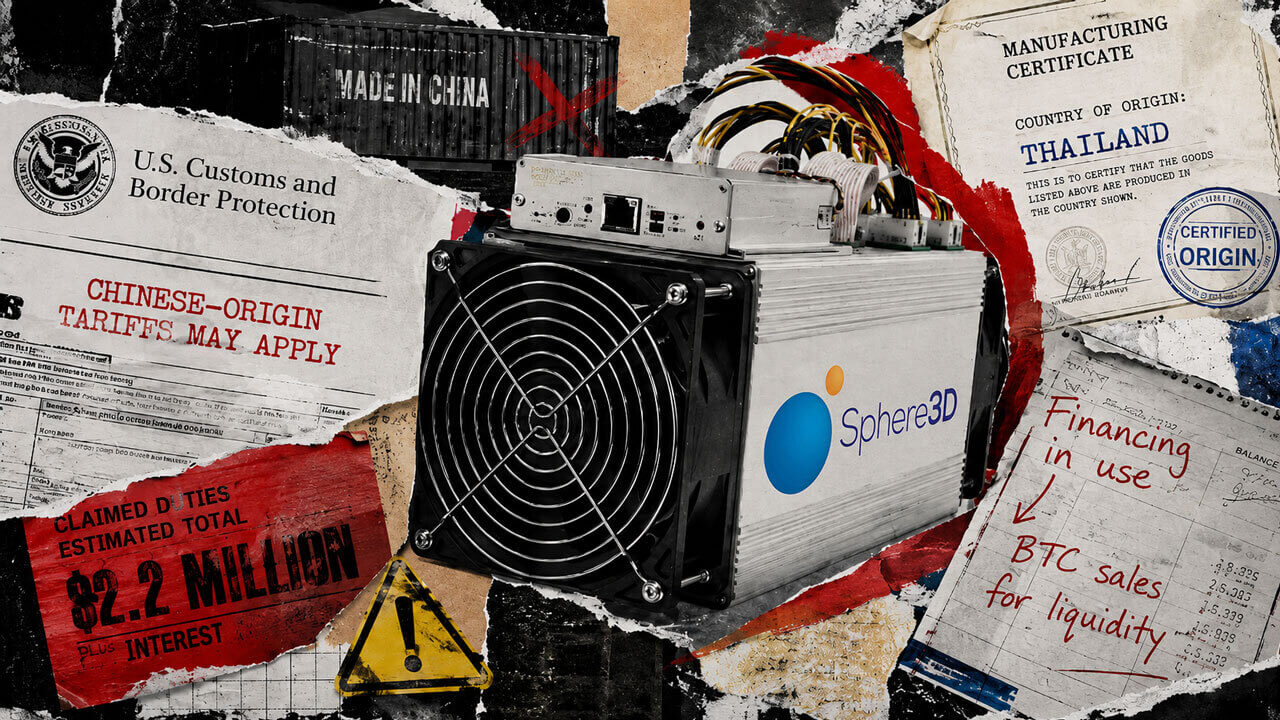
Sphere 3D’s filing on August 24 stated that the seller-provided import documents for the 2022 transaction included both a certificate of origin and a certificate of manufacture. These documents were intended to certify that the miners were not produced in China. The company has labeled the CBP’s allegations as "meritless" and expressed its intention to vigorously protest the claim.
While the current filing does not explicitly name the vendor or the specific miner models involved in this specific $2.2 million claim, historical disclosures provide some context. In 2022, Sphere 3D reported that 4,000 Bitmain S19j Pro miners had arrived in July but were held pending the receipt of proper supplier documentation. At the time, roughly 540 units were released after initial review. Those transactions involved FuFu Technologies (BitFuFu) within the context of a purchase agreement. While there is no definitive public evidence linking those specific shipments to the current $2.2 million dispute, the timeline and the nature of the documentation delays in 2022 align with the procedural triggers often seen in CBP audits.
Understanding Section 301 Tariffs and the Mining Industry
The dispute highlights a broader challenge facing the U.S. Bitcoin mining industry: the "Section 301" tariffs. Originally implemented during the Trump administration and largely maintained by the Biden administration, these tariffs impose a 25% duty on a wide array of Chinese imports, including the specialized integrated circuits and hardware used in cryptocurrency mining.
To avoid these steep costs, many hardware manufacturers, including industry giants like Bitmain and MicroBT, shifted portions of their assembly and manufacturing lines to Southeast Asian nations such as Thailand, Malaysia, and Vietnam. However, CBP utilizes a "substantial transformation" test to determine the country of origin. If CBP determines that the critical components (such as the ASIC chips) are manufactured in China and that the assembly in a third country does not constitute a "substantial transformation" into a new and different article of commerce, the goods may still be treated as Chinese-origin for tariff purposes.
Sphere 3D’s protest will likely hinge on proving that the manufacturing process in Thailand was significant enough to meet the legal threshold for a change in origin. The burden of proof in these cases rests heavily on the importer, requiring granular data on labor costs, factory processes, and the sourcing of individual components.
Legal Recourse and the Protest Process
Under federal customs rules, Sphere 3D has a specific window to contest the CBP’s decision. Generally, importers are granted 180 days after the liquidation or reliquidation of an entry to file a formal protest. The company has not yet disclosed the specific deadline for its protest, nor has it quantified the potential statutory interest that could be added to the $2.2 million principal.
The protest process involves a formal administrative review where the importer presents evidence to rebut the CBP’s findings. If the administrative protest is denied, Sphere 3D would have the option to take the matter to the U.S. Court of International Trade. However, such litigation is often costly and time-consuming, a factor that complicates the company’s efforts to stabilize its balance sheet.

It remains unclear whether Sphere 3D has already paid the amount under protest, bonded the debt, or simply accrued the liability on its books. The uncertainty regarding the final amount payable adds another layer of risk for investors monitoring the company’s "ANY" ticker.
Strategic Rebranding Amidst Turbulence
The tariff dispute arrives as Sphere 3D is attempting to execute a major corporate pivot. Following its combination with Cathedra Bitcoin, the company is in the process of rebranding as DarkHorse Technologies. While the name change to DarkHorse Technologies has been approved, the proposed transition to the "DRK" ticker remains pending.
This rebranding is intended to signal a fresh start and a more diversified approach to the digital infrastructure space. However, the legacy issues from 2022—represented by this $2.2 million claim—continue to weigh on the company’s financial narrative. For DarkHorse Technologies to succeed, management must resolve these inherited liabilities while navigating a market where mining margins are under constant pressure.
Broader Implications for the Crypto Mining Sector
Sphere 3D’s struggle with the CBP serves as a cautionary tale for the broader Bitcoin mining industry. During the 2021-2022 expansion phase, many companies prioritized rapid deployment over rigorous supply chain auditing. As CBP ramps up its post-entry audits, other mining firms may find themselves facing similar "look-back" tariff claims.
The situation underscores the importance of "Trade Compliance" as a critical risk factor for publicly traded mining companies. For an industry that prides itself on decentralization and global mobility, the physical reality of international trade law and the geopolitical tensions between the U.S. and China present very centralized and localized risks.
Industry analysts suggest that the outcome of Sphere 3D’s protest will be closely watched by other miners who sourced equipment from Southeast Asian facilities between 2021 and 2023. A win for Sphere 3D could provide a roadmap for defending against origin-based tariff claims, while a loss could signal a wave of similar enforcement actions across the sector, potentially straining the liquidity of other small-to-mid-sized mining operations.
As of the latest reports, Sphere 3D continues its operations while preparing its legal defense. The company’s ability to navigate this $2.2 million hurdle will likely determine its viability as it transitions into its new identity as DarkHorse Technologies. With cash reserves dwindling and a "substantial doubt" warning already on the books, the stakes for this customs protest could not be higher.