Dwi Wanna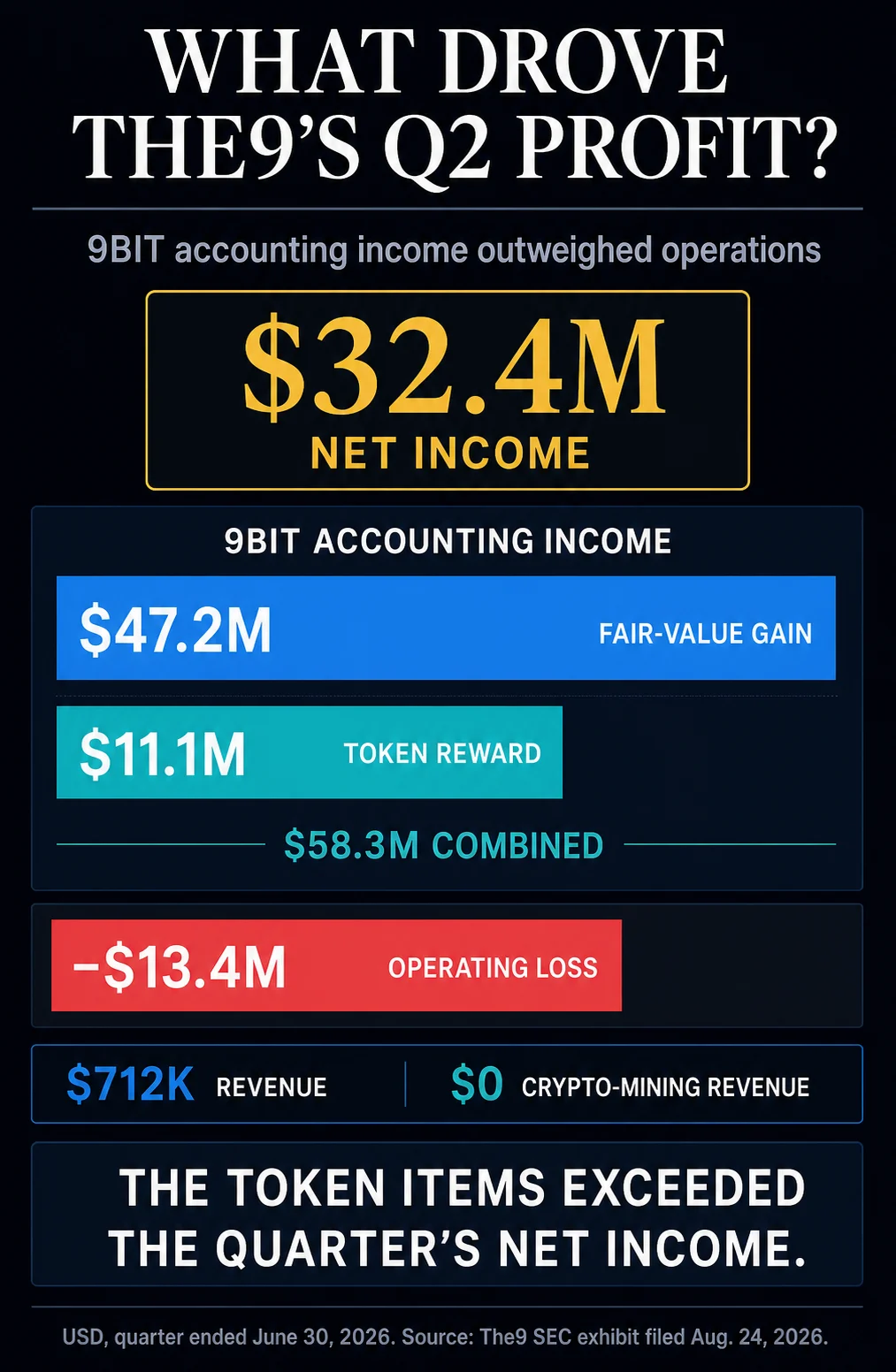
The9 Limited, a long-standing player in the digital entertainment and blockchain sectors, has released a second-quarter 2026 financial report that highlights a growing divergence between traditional business operations and cryptocurrency-based accounting. Despite a deepening operating loss and nearly non-existent revenue from its core business activities, the Nasdaq-listed firm reported a substantial surge in net income. This financial performance was almost entirely buoyed by the appreciation of its proprietary 9BIT token, a dynamic that has now satisfied key conditions for a lucrative management incentive program.
According to the company’s latest filing with the U.S. Securities and Exchange Commission (SEC), The9 recorded a net income of $32.4 million for the quarter ended June 30, 2026. This represents a significant increase from the $22.6 million reported in the first quarter of the year. However, a closer inspection of the balance sheet reveals a precarious operational foundation: the company generated just $712,000 in total revenue during the three-month period and reported zero revenue from its cryptocurrency mining operations. The resulting operating loss stood at $13.4 million, underscoring the company’s total reliance on "below-the-line" accounting adjustments to maintain profitability.
The Role of 9BIT Token Appreciation in Corporate Earnings
The primary driver behind The9’s reported profitability was the fair-value adjustment of its 9BIT token holdings. During the second quarter, the company recognized a $47.2 million fair-value gain on these tokens, supplemented by an $11.1 million cryptocurrency reward. Combined, these two items contributed $58.3 million to the company’s bottom line—an amount that far exceeds the total net income for the period.
This accounting treatment separates the token-related income from the company’s actual business operations. Under standard accounting practices, these gains are recorded after the operating income or loss has been calculated. While they flow through to the final net income figure, they do not represent cash flow generated by the company’s services or products. In the case of The9, these non-cash gains served as a "profit shield," masking the fact that the company’s operating expenses continue to outpace its ability to generate revenue from gaming or mining.
The disparity between operations and token gains has widened since the start of the year. In the first quarter, 9BIT-related income totaled $37.6 million. The jump to $58.3 million in the second quarter provided the necessary lift to exceed the first-quarter net income baseline, a crucial metric for the company’s leadership. Meanwhile, the operating loss narrowed by less than $1 million quarter-over-quarter, suggesting that the core business remains in a state of stagnation or transition.
Management Incentive Plans and Equity Awards
The achievement of these net income figures carries significant implications for the leadership at The9. The company’s long-term management incentive plan includes a growth condition that requires net income in each subsequent quarter of 2026 to exceed the $22.6 million benchmark set in the first quarter. By reaching $32.4 million in Q2, the company has fulfilled the second-quarter requirement of this plan.

If the trend continues through the remainder of the fiscal year, senior management may become eligible for equity awards representing up to 12% of the company’s total outstanding shares. While the company emphasized that these awards are subject to a multi-year vesting schedule and a three-year lock-up period, the potential for such a significant payout based on "paper gains" has drawn attention from market analysts.
The structure of the incentive plan effectively ties executive compensation to the market price of the 9BIT token rather than the operational success of the company’s mining or gaming divisions. This creates a unique corporate governance scenario where the management’s primary path to wealth is the appreciation of a digital asset they helped create and issue, rather than the traditional metrics of revenue growth or operational efficiency.
A Historical Pivot: From Gaming Giant to Crypto Enterprise
To understand The9’s current financial state, one must look at its historical trajectory. Founded in 1999 and listed on the Nasdaq in 2004, The9 was once the premier operator of online games in China, most notably holding the exclusive license for Blizzard Entertainment’s World of Warcraft (WoW). At its peak, the company was a titan of the industry, but the loss of the WoW contract in 2009 triggered a decade of searching for a new identity.
After several attempts to regain its footing in the mobile and PC gaming markets, The9 pivoted toward the blockchain industry in late 2020 and early 2021. The company began aggressively purchasing Bitcoin mining rigs and rebranded itself as a high-tech enterprise focused on the "metaverse" and cryptocurrency. The 9BIT token was launched as part of this transition, intended to serve as a utility token within a decentralized ecosystem the company is attempting to build.
However, the transition has been fraught with volatility. The company’s mining revenue, which was supposed to be a primary pillar of its new strategy, fell to zero in the most recent quarter. This suggests either a strategic pause in mining operations due to energy costs and hardware depreciation or a complete shift in focus toward token appreciation and ecosystem development.
Liquidity Concerns and Market Depth for 9BIT
While The9’s balance sheet looks robust on paper—valuing its total crypto holdings at approximately $120 million as of late August 2026—there are significant questions regarding the realizable value of these assets. The company’s holdings include 347 Bitcoin and a staggering 1.9 billion 9BIT tokens.
The 9BIT token currently trades on secondary spot markets including BingX, MEXC, and KuCoin. Data from market aggregators like CoinGecko shows that the 24-hour trading volume for 9BIT across these platforms is approximately $5.7 million. This volume is relatively low when compared to the size of The9’s holdings. If the company were to attempt to liquidate even a fraction of its 1.9 billion tokens to cover its $13.4 million operating loss, it would likely face extreme "slippage," where the act of selling drives the price down precipitously.

In its SEC filing, The9 acknowledged this risk, warning investors that the quoted market prices for its tokens might not reflect their actual realizable value. This creates a circular logic in the company’s financial reporting: the company is "profitable" because its tokens have a high theoretical value, but that value may only remain high as long as the company does not try to sell them to fund its money-losing operations.
Comparative Analysis and Industry Implications
The9’s strategy mirrors that of other "crypto-first" public companies like MicroStrategy, which holds massive amounts of Bitcoin on its balance sheet. However, a key difference exists: MicroStrategy holds a decentralized, globally liquid asset (Bitcoin) that it did not create. The9, conversely, is heavily reliant on a token of its own making.
This "in-house" token model is more reminiscent of the strategies used by various crypto exchanges and DeFi platforms that use their native tokens to bolster their treasuries. When the market for those tokens is bullish, the company appears exceptionally healthy. When the market turns bearish, the lack of operational revenue can lead to a rapid erosion of the balance sheet.
For investors, the primary concern is whether The9 can eventually convert its token-based wealth into a sustainable, revenue-generating business. With only $712,000 in quarterly revenue, the company is currently functioning more as a crypto-holding vehicle than an operating business. The management incentive plan adds another layer of complexity, as it rewards executives for a net income figure that is highly sensitive to the price fluctuations of a single, relatively illiquid altcoin.
Future Outlook for 2026
As The9 moves into the second half of 2026, the company faces a high bar for maintaining its current momentum. To satisfy the remaining conditions of the management incentive plan, the net income in Q3 and Q4 must continue to exceed the $22.6 million Q1 baseline. This puts immense pressure on the market performance of 9BIT.
Should the price of 9BIT decline, the company would be forced to record fair-value losses, which could swing the net income from a surplus to a massive deficit, given the lack of offsetting operational revenue. The company has not yet provided a clear roadmap for how it intends to restart its mining operations or revitalize its gaming revenue to provide a more stable financial floor.
The9’s Q2 report serves as a case study in the modern intersection of corporate accounting and digital assets. It highlights how "paper gains" can be used to meet performance targets and trigger executive bonuses, even as the core business struggles to find its footing. For the time being, the "9BIT umbrella" remains the only thing shielding the company’s bottom line from the reality of its $13.4 million operating deficit. Whether this shield can withstand a potential downturn in the volatile crypto market remains the most critical question for the company’s shareholders.