Dwi Wanna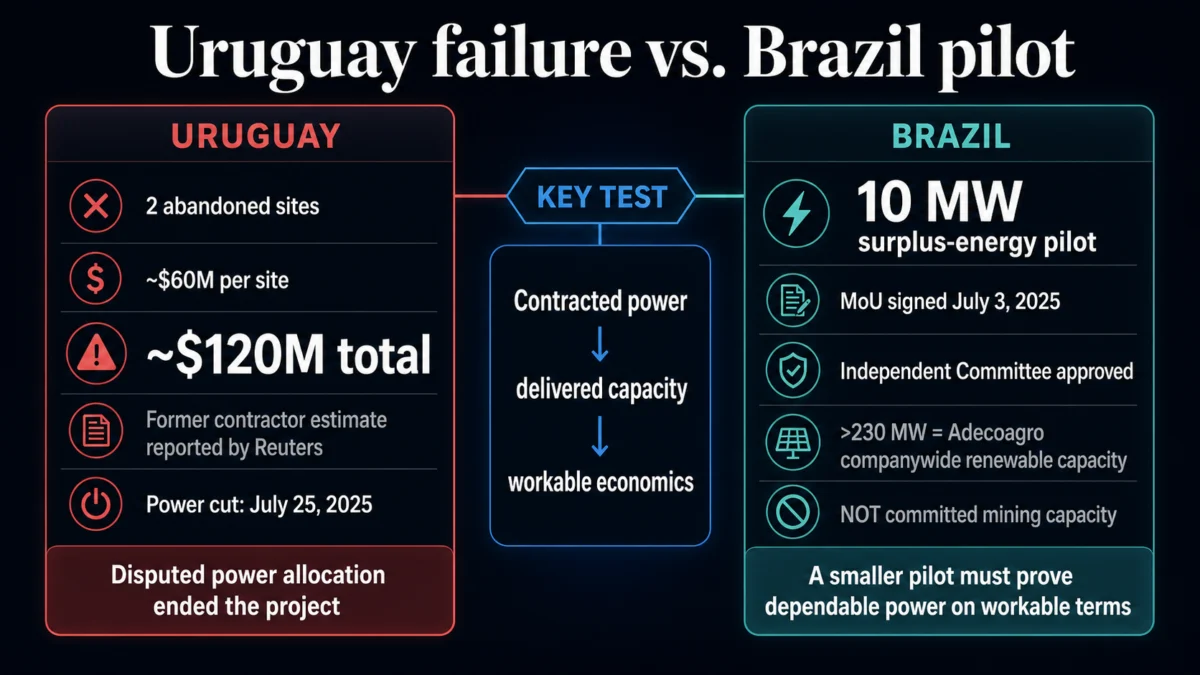
The failure of the Uruguay project underscores the immense logistical and regulatory hurdles that even the most well-capitalized firms face when integrating large-scale Bitcoin mining operations into national power grids. While the availability of renewable energy was the primary draw for Tether in 2023, the reality of managing industrial-scale loads proved to be far more complex than initially anticipated. The breakdown of the project was not due to a lack of capital or a decline in Bitcoin’s value, but rather a fundamental disagreement over the terms of energy consumption between Microfin and the Uruguayan state-owned power utility, Administración Nacional de Usinas y Trasmisiones Eléctricas (UTE).
The $120 Million Disconnect: Anatomy of the Uruguay Failure
The scale of Tether’s investment in Uruguay was significant. According to reports from former contractors and local sources, the company spent approximately $60 million on each of its two primary sites located in the Florida department of the country. This $120 million figure represents a massive commitment to physical infrastructure, including high-performance computing hardware, specialized cooling systems, and electrical substations designed to handle the rigorous demands of 24/7 Bitcoin mining.
The core of the dispute centered on the interpretation of Power Purchase Agreements (PPAs). Tether’s local entity, Microfin, operated under the assumption that the electricity allocation stipulated in their contracts represented a minimum baseline that could be flexibly expanded as the operation scaled. Conversely, UTE viewed these figures as a hard maximum. In a grid environment where load balancing is critical to national energy security, such a discrepancy in contractual interpretation is more than a legal nuance; it is a structural barrier to operations.
By late 2024, the relationship between Microfin and UTE began to fray. The inability to reach a consensus on power scaling led to a stalemate. In May 2025, Microfin reportedly ceased payments on its power bills, a move that signaled the beginning of the end for the venture. By June, the company formally notified UTE of its intention to terminate its contracts. Despite attempts to negotiate revised terms, the two parties could not reach an agreement, leading UTE to officially disconnect the sites on July 25, 2025. By the end of the year, Tether had notified labor authorities that it would be laying off the majority of its local staff and shuttering the operation entirely. While Microfin eventually settled its outstanding debts with UTE in December 2025, the damage to Tether’s regional mining ambitions was already done.
Chronology of the Tether-Uruguay Collapse
The timeline of Tether’s venture in Uruguay reveals a rapid transition from optimistic expansion to a complete withdrawal:
- May 2023: Tether announces its expansion into Bitcoin mining, choosing Uruguay as its primary hub due to the country’s high percentage of renewable energy generation (over 90%) and stable grid infrastructure.
- Late 2023 – Early 2024: Construction and deployment of hardware at two major sites in the Florida department. Investment reaches an estimated $120 million.
- Late 2024: Internal tensions arise between Microfin and UTE regarding electricity usage limits and the ability to scale power consumption beyond initial contract figures.
- February 2025: Representatives from Adecoagro visit the Uruguay facilities to observe the operations as part of early-stage discussions for a potential partnership.
- May 2025: Microfin stops paying its electricity bills to UTE amid escalating disputes over contract terms.
- June 2025: Microfin issues a formal notice to UTE of its intent to terminate power contracts.
- July 25, 2025: UTE officially cuts power to the mining sites, effectively ending the operation.
- November 2025: Tether notifies the Uruguayan Ministry of Labor of mass layoffs and the total cessation of operations in the country.
- December 2025: Microfin settles all outstanding debts with UTE, clearing the legal path for a full exit.
Shifting Focus: The Brazil Pilot with Adecoagro
As the dust settled on the Uruguay failure, Tether moved quickly to announce its next move in the South American market. In July 2025—coincidentally the same month the Uruguay sites were disconnected—Tether and Adecoagro announced a memorandum of understanding (MOU) for a Bitcoin mining pilot in Brazil. Adecoagro is a formidable partner; as a leading producer of sustainable agricultural products and renewable energy in the region, they offer a different value proposition than the state-owned utility model Tether encountered in Uruguay.
The Brazil project, however, is notably different in scope and strategy. Unlike the $120 million massive build-out in Uruguay, the Brazil venture is starting as a 10-megawatt (MW) pilot. This pilot is designed to utilize surplus renewable energy that Adecoagro would otherwise be forced to sell into the spot market at potentially lower prices. This "energy arbitrage" model is a common strategy in the Bitcoin mining industry, where miners act as a "buyer of last resort" for stranded or excess energy, helping to stabilize the revenue of renewable energy producers.
While the MOU mentions a broader renewable generation capacity of over 230 MW across Adecoagro’s portfolio, it is crucial to note that this figure represents the company’s total energy footprint, not the power committed to Bitcoin mining. The decision to start with a 10 MW pilot suggests a more cautious, modular approach—perhaps a direct response to the "all-in" strategy that proved so costly in Uruguay.
Comparative Analysis: Uruguay vs. Brazil
The transition from Uruguay to Brazil represents a strategic pivot for Tether. In Uruguay, the company attempted to operate as a traditional industrial consumer on a state-managed grid. This required navigating the rigid regulatory frameworks of a state utility (UTE) that may not have been equipped or willing to accommodate the highly variable and rapidly scaling nature of a crypto-mining operation.
In Brazil, by partnering with a private energy producer like Adecoagro, Tether may find more flexibility. The use of "surplus" energy suggests a more symbiotic relationship where the mining operation helps the energy producer manage its supply-demand balance. If the grid is oversupplied, the miners turn on; if the grid needs power for traditional consumers, the miners can be powered down. This flexibility is the cornerstone of modern, sustainable Bitcoin mining and was notably absent in the rigid contractual environment of the Uruguay project.
However, the shadow of the $120 million loss in Uruguay remains. The Brazil project must prove that Tether can successfully manage the operational complexities of mining without falling into the same contractual traps. The fact that Adecoagro officials visited the Uruguay site just months before it collapsed suggests they were aware of the challenges Tether faced, and the smaller scale of the Brazil pilot likely reflects a desire to mitigate those risks.

Broader Implications for Tether and the Mining Industry
Tether’s struggles in Uruguay highlight a broader trend in the Bitcoin mining sector: the move toward "energy-first" partnerships. As the mining industry matures, the most successful operations are those that are deeply integrated with energy producers rather than those that simply buy power from the grid as a third party.
For Tether, the stakes are high. As the issuer of USDT, the world’s largest stablecoin with a market capitalization exceeding $100 billion, Tether is under constant pressure to diversify its reserves and prove the utility of its massive profits. Its expansion into "Tether Energy" is a key part of this diversification strategy. However, the failure in Uruguay demonstrates that having billions of dollars in capital does not automatically translate to success in the highly technical and politically sensitive world of energy infrastructure.
The Uruguay experience also serves as a reminder to South American governments and utilities. While Bitcoin mining offers a lucrative way to monetize excess renewable energy, it requires clear, transparent, and flexible regulatory frameworks. The dispute between Microfin and UTE suggests a lack of alignment on how crypto-mining fits into the national energy strategy.
Conclusion: A Test of Strategy and Resilience
The move into Brazil is more than just a new project for Tether; it is a test of the company’s ability to learn from its mistakes. The $120 million spent in Uruguay represents a significant loss of capital and time, but more importantly, it represents a loss of momentum in Tether’s quest to become a dominant player in the global Bitcoin mining landscape.
As the 10 MW pilot in Brazil begins, the industry will be watching closely to see if Tether can successfully navigate the Brazilian energy market. The partnership with Adecoagro provides a strong foundation, but as the Uruguay failure proved, renewable energy availability is only one piece of the puzzle. Success in Bitcoin mining requires a perfect alignment of technology, capital, and—most importantly—dependable, well-negotiated power agreements. Whether Brazil becomes the success story Tether needs or another costly footnote in its history remains to be seen.