Dwi Wanna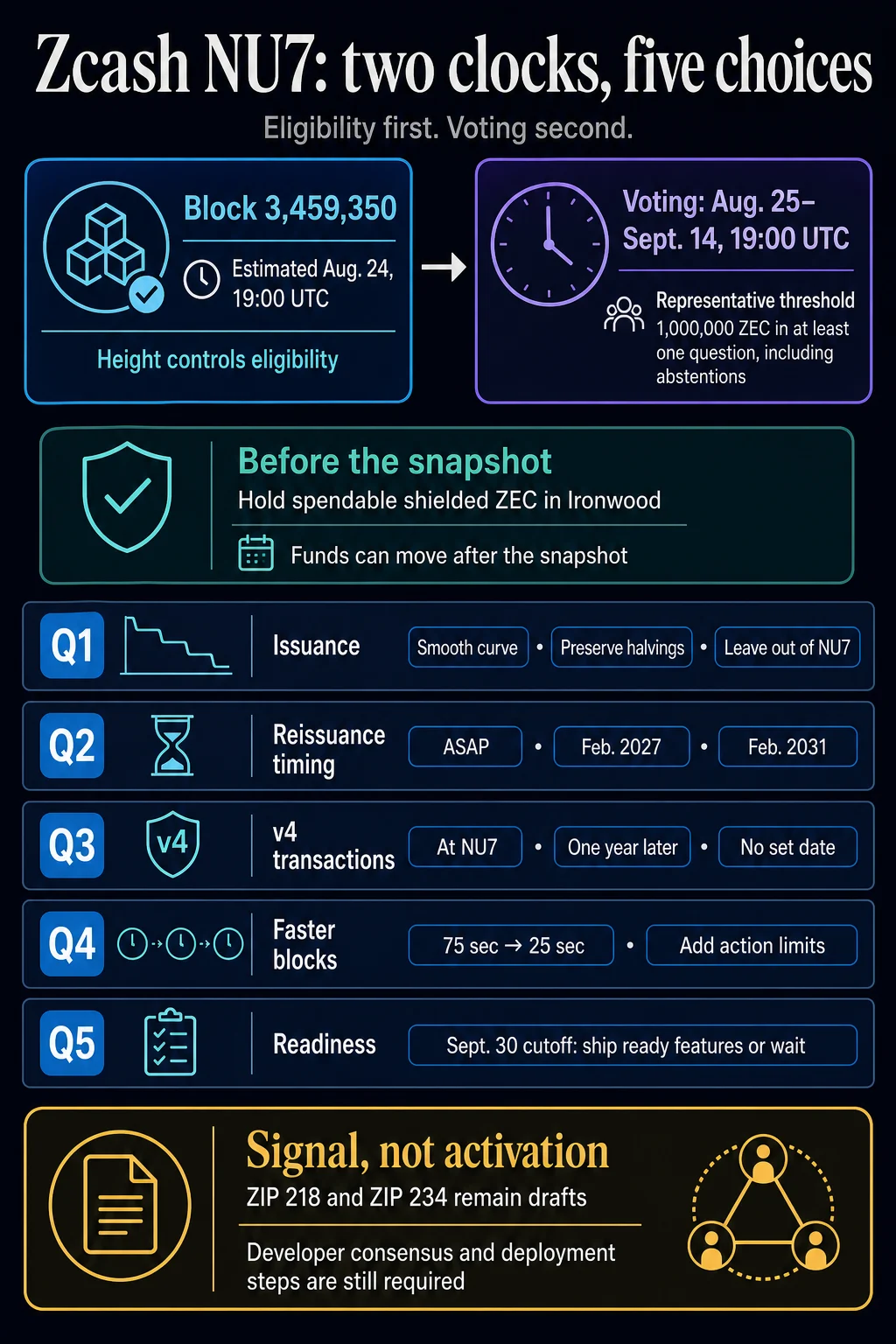
The Zcash (ZEC) ecosystem is currently navigating one of its most pivotal moments since its inception in 2016, characterized by a dual surge in both market valuation and governance activity. As of August 24, 2024, Zcash holders are facing a critical snapshot deadline that will determine eligibility for a comprehensive vote on the network’s future. This governance process, which could fundamentally alter the protocol’s issuance model and block production speed, coincides with a dramatic market rally that has seen ZEC climb approximately 62% over the past week. Reaching a peak of $880—a level not witnessed since the height of the 2018 bull market—the privacy-centric asset has retraced slightly to approximately $830, maintaining a robust market capitalization of $13.9 billion and a 24-hour trading volume of $1.46 billion.
The Snapshot and Governance Framework
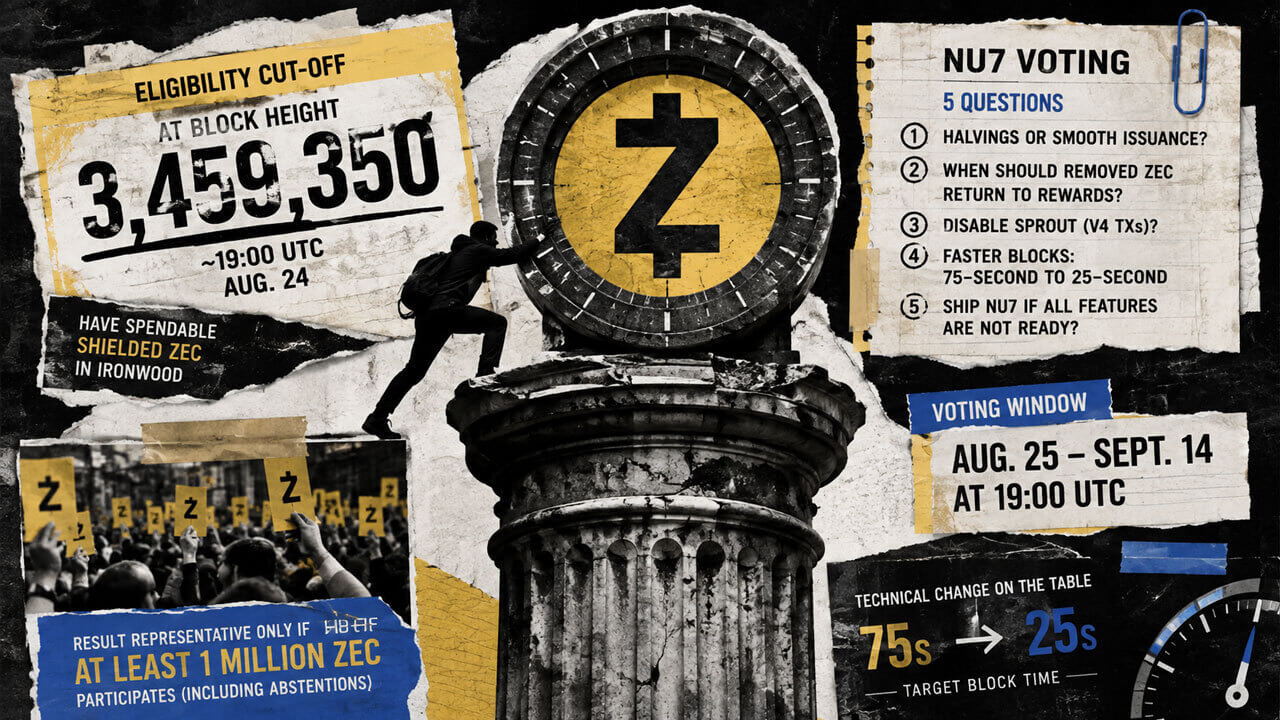
The immediate focus for the Zcash community is the eligibility snapshot, which is tethered to the blockchain’s progress rather than a strictly fixed timestamp. To participate in the upcoming governance poll, holders must possess spendable shielded ZEC within the "Ironwood" upgrade framework at the moment the blockchain reaches block height 3,459,350. While organizers Valar Group and Project Tachyon estimate this will occur around 19:00 UTC on August 24, the decentralized nature of block production means the exact second is variable.
The voting period is scheduled to commence on August 25 and will remain open until September 14, 2024. This poll is categorized as a "signaling vote," meaning it serves to gauge the consensus of the community rather than triggering an automated, hard-coded protocol change. However, the results will carry significant weight for developers and the Electric Coin Company (ECC) as they finalize the scope of Network Upgrade 7 (NU7). To ensure the results are viewed as a legitimate mandate from the community, organizers have set a quorum threshold of 1 million ZEC. This participation requirement ensures that any proposed changes to the monetary policy or technical architecture have the backing of a substantial portion of the circulating supply, which currently stands at 16.84 million ZEC.
Reimagining Monetary Policy: The Issuance Curve vs. Halving
The most contentious and consequential proposal on the ballot concerns the "Smoothing of ZEC Issuance." Historically, Zcash has followed a four-year halving cycle modeled after Bitcoin. These events abruptly reduce the amount of new ZEC entering the market, which can lead to significant price volatility and shifts in miner or staker incentives.
A new proposal, documented as ZIP 234, suggests replacing these periodic "cliff" halvings with a gradual issuance curve. This transition aims to provide a more predictable and stable supply expansion, potentially mitigating the market shocks associated with halvings. Crucially, proponents emphasize that this change would not alter the hard cap of 21 million ZEC. Instead, it would smooth out the distribution over time.
Complementing this is the proposed Network Sustainability Mechanism (NSM). This mechanism would allow ZEC that has been removed from circulation—such as through certain transaction fees or other protocol-level burns—to be recycled back into future block rewards. This "circular economy" approach is designed to ensure the long-term security of the network as the initial issuance subsidy eventually tapers off. Voters are also being asked to decide when this recycled ZEC should begin returning to the reward pool, with options ranging from "as soon as possible" to deferred dates in February 2027 or 2031.
Enhancing Network Performance: The Shift to 25-Second Blocks
Beyond the economic implications, the governance vote addresses the technical performance of the Zcash network. Under ZIP 218, the community is weighing a proposal to reduce the target block time from the current 75 seconds to 25 seconds.
Tripling the block production speed would have immediate benefits for user experience, primarily by reducing transaction confirmation times. In the increasingly competitive landscape of decentralized finance (DeFi) and instant payments, a 75-second wait is often viewed as a bottleneck. By moving to 25-second blocks, Zcash would align more closely with faster modern protocols while maintaining its rigorous privacy guarantees.
To prevent this change from accelerating the total supply issuance, the proposal includes a proportional adjustment to block rewards. Under this "faster block" regime, each individual block would yield one-third of the current reward, ensuring that the daily and annual issuance of ZEC remains consistent with the established monetary schedule. This technical refinement is seen by many as a necessary step for Zcash to remain viable as a medium of exchange in an era where "near-instant" finality is becoming the industry standard.
Chronology of Zcash Development and the Road to NU7
To understand the weight of the current vote, one must look at the trajectory of Zcash’s technical evolution. Since its launch, the protocol has undergone several major upgrades:
- Overwinter (June 2018): Prepared the network for future upgrades and introduced transaction expiry.
- Sapling (October 2018): Significantly improved the performance of shielded transactions, reducing memory requirements and time for zk-SNARK proofs.
- Blossom (December 2019): Reduced block times from 150 seconds to the current 75 seconds, doubling the network’s capacity.
- Canopy (November 2020): Established a new development fund and enhanced network security.
- NU5 (May 2022): Introduced the Orchard shielded pool and the Halo proving system, eliminating the need for "trusted setups."
The upcoming NU7 (Network Upgrade 7) is viewed as the next logical leap. However, the current vote also addresses legacy debt. One ballot question asks whether to disable transactions tied to the "Sprout" pool, the original but now deprecated shielded pool. Disabling Sprout would simplify the codebase and reduce the "attack surface" of the protocol, though it requires careful coordination to ensure users have migrated their funds to the modern Sapling or Orchard pools.
Market Context and the Privacy Coin Landscape
The 62% price surge of ZEC to $880 occurs against a backdrop of complex regulatory and market dynamics. For several years, "privacy coins" like Zcash and Monero have faced headwinds from centralized exchanges and regulators who express concerns regarding the potential for illicit use of anonymous transactions. However, the narrative has shifted recently as the broader blockchain industry embraces Zero-Knowledge Proofs (ZKPs)—the core technology pioneered by Zcash—for scalability and enterprise privacy.
The current rally suggests that investors may be re-evaluating Zcash not just as a "privacy coin," but as a fundamental piece of ZK-infrastructure. Furthermore, the high trading volume of $1.46 billion indicates that the price action is supported by significant liquidity, rather than being a low-volume anomaly. Some analysts suggest that the "yield" potential of the Network Sustainability Mechanism and the prospect of a more "modern" block time are attracting institutional interest that had previously sat on the sidelines.

The fact that ZEC is trading near its highest levels since 2018 is also a psychological milestone. For long-term holders, the move toward $880 represents a recovery from years of underperformance relative to Bitcoin and Ethereum. This renewed market strength provides a potent backdrop for the governance vote, as a high valuation often encourages higher participation rates in community signaling.
Broader Implications and Future Outlook
The outcome of the September vote will serve as a roadmap for the Electric Coin Company and the Zcash Foundation. If the community overwhelmingly supports the issuance smoothing and the 25-second block time, it will signal a shift toward a more aggressive, performance-oriented development phase.
However, the path to implementation is not instantaneous. Following the signaling vote, the proposed changes must undergo rigorous security audits and testing. The ballot even includes a question regarding the launch strategy for NU7: whether it should proceed only when all features are ready, or if it should launch on schedule even if certain complex features (like the issuance curve) require more time.
The stakes are high. By moving away from the "Bitcoin-clone" halving model and toward a customized sustainability mechanism, Zcash is attempting to forge an independent economic identity. If successful, it could provide a blueprint for other Proof-of-Work or transitionary protocols struggling with the long-term decline of block subsidies.
As the snapshot at block 3,459,350 approaches, the eyes of the crypto-community are on Zcash. The convergence of a massive price breakout with a fundamental redesign of the protocol’s economics marks this as a defining chapter for the world’s most prominent privacy-preserving blockchain. Whether the rally continues or stabilizes, the decisions made by ZEC holders over the coming weeks will echo through the protocol’s architecture for years to come.