Dwi Wanna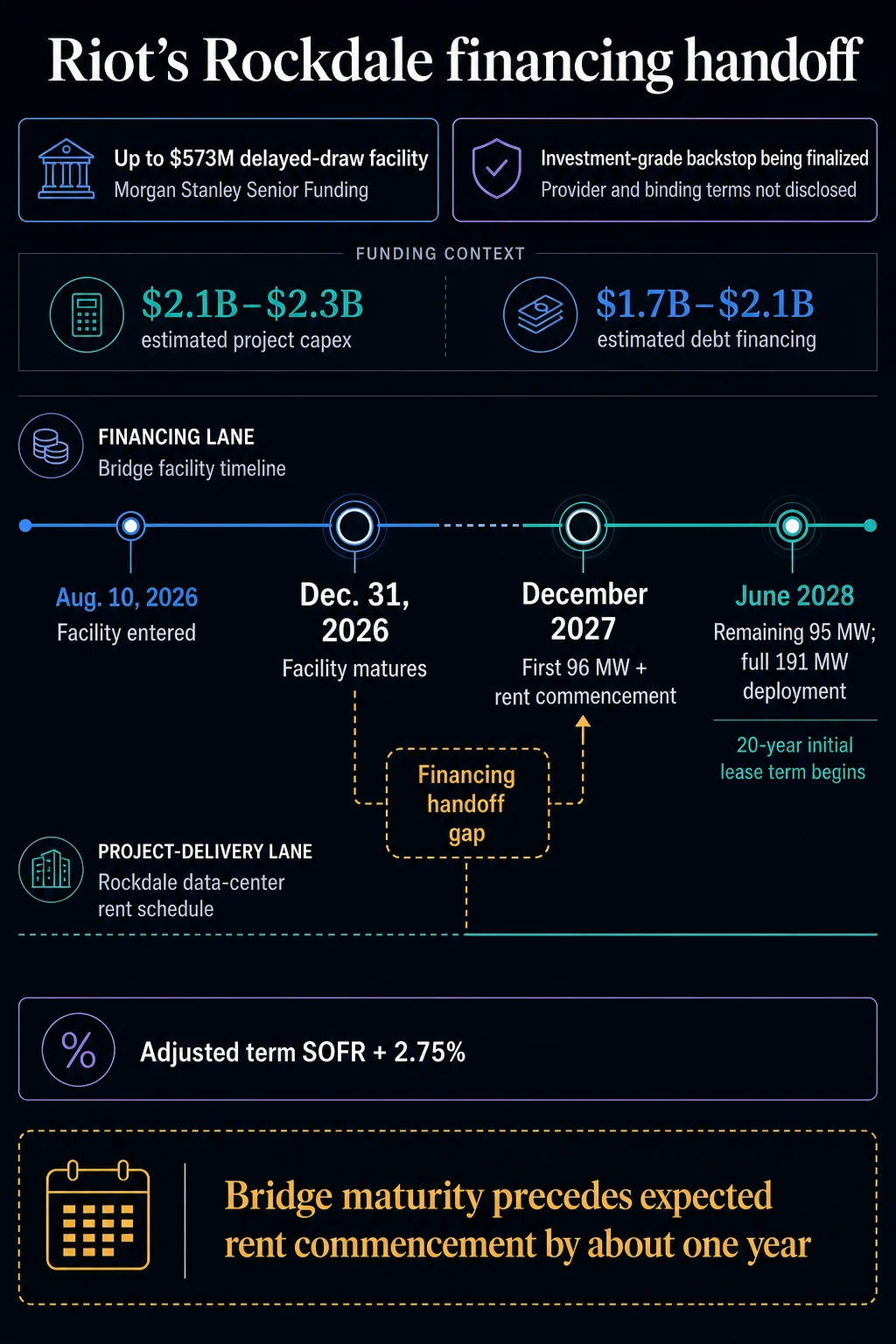
The Scope of the Anthropic Agreement
In early August 2026, Riot Platforms disclosed the details of a massive 20-year lease agreement for 191 megawatts (MW) of critical IT capacity at its flagship Rockdale, Texas, facility. The tenant, described in official filings as a “leading frontier AI lab,” is tasked with utilizing the massive power capacity for large-scale AI model training and inference. Industry reports from CNBC and other financial outlets have confirmed the tenant is Anthropic, the San Francisco-based AI startup responsible for the Claude series of large language models.
The financial scale of the deal is unprecedented for a former crypto-mining entity. Riot estimates that the initial 20-year term will generate approximately $9.1 billion in total revenue through June 2048. The contract also includes provisions for two five-year extensions, which, if exercised, could elevate the total contract value to a staggering $16.1 billion. Under the terms of the agreement, the capacity will be delivered in two distinct phases: the first 96 MW is scheduled to go online in December 2027, with the remaining 95 MW following in June 2028.
The Financing Bridge and the Maturity Mismatch
To facilitate the massive capital expenditure required to build out this AI-ready infrastructure, Riot’s subsidiary, Riot HPC LLC, entered into a senior secured delayed-draw facility administered by Morgan Stanley Senior Funding. This facility provides the company with access to $573 million, intended to cover long-lead equipment orders—such as transformers, cooling systems, and specialized electrical switchgear—as well as initial development costs at the Rockdale site.
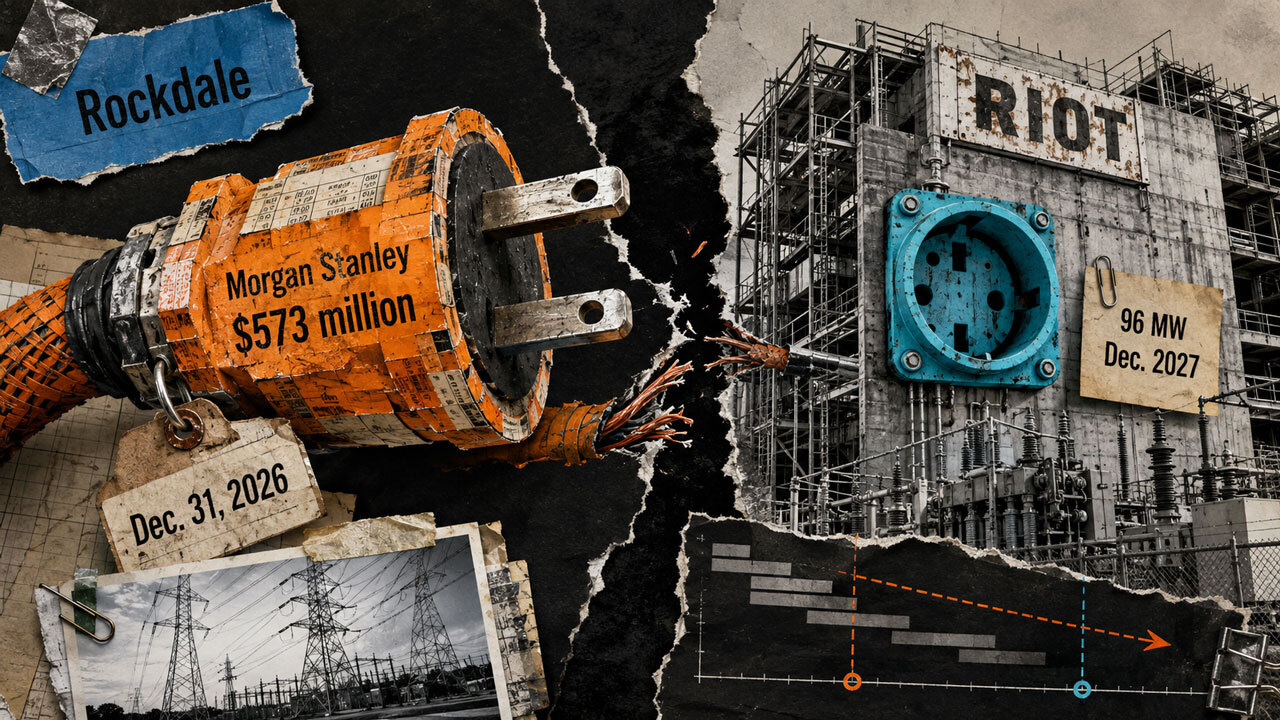
However, a closer look at the filing reveals a precarious timeline. The Morgan Stanley facility is set to mature on December 31, 2026. This creates a one-year "liquidity gap" where the initial bridge financing must be repaid or refinanced before the Anthropic lease payments begin in December 2027.
Riot has characterized this $573 million facility as "interim financing." The company’s long-term strategy involves finalizing an investment-grade credit backstop to replace the bridge loan. This secondary financing layer is expected to provide the stability needed to carry the project through the construction phase and into the operational phase. As of the latest disclosures, Riot has not publicly named the provider of this credit backstop or the specific binding terms, leaving market analysts to monitor the transition from bridge debt to permanent capital closely.
Project Costs and Capital Structure
The conversion of a Bitcoin mining site into a Tier 3 or Tier 4 equivalent data center capable of hosting AI workloads is an expensive endeavor. Riot estimates the total development cost for the 191 MW Rockdale project to be between $2.1 billion and $2.3 billion. This reflects the high cost of the liquid cooling systems and high-density power distribution required by AI chips like NVIDIA’s H100 and Blackwell series, which consume significantly more power per rack than traditional Bitcoin mining ASICs.
To fund this $2.3 billion buildout, Riot is targeting a debt-heavy capital structure. The company expects to secure debt financing covering 80% to 90% of the total cost, amounting to roughly $1.7 billion to $2.1 billion in total leverage. The current Morgan Stanley facility carries an interest rate based on the adjusted term SOFR (Secured Overnight Financing Rate) plus 2.75%, or a defined base rate plus 1.75%.
Importantly, the debt is structured as non-recourse to the parent company, Riot Platforms, Inc. The collateral is primarily tied to the assets of the specific project borrower and credit parties involved in the Rockdale expansion. This structure protects Riot’s broader balance sheet—including its substantial Bitcoin holdings—from the direct risks associated with the project’s debt, though the parent company remains responsible for the strategic execution of the buildout.
Strategic Pivot: From Bitcoin to AI Infrastructure
Riot’s move into AI infrastructure is part of a broader trend within the Bitcoin mining industry. Following the April 2024 Bitcoin halving, which reduced block rewards by 50%, miners have faced compressed margins and increased competition. Companies like Core Scientific, Northern Data, and Terawulf have all begun pivoting toward HPC and AI to diversify their revenue streams.
The appeal of the AI sector for miners lies in the long-term nature of the contracts. While Bitcoin mining revenue is volatile and dependent on the daily price of the cryptocurrency and network difficulty, AI data center leases are typically 10- to 20-year agreements with fixed escalators. For Riot, the $9.1 billion Anthropic deal provides a predictable "infrastructure-style" cash flow that balances the cyclicality of its crypto-mining operations.
Timeline of Development and Key Milestones
The path to 2048 is marked by several critical milestones that Riot must hit to ensure the success of the project:
- August 2026: Secured $573 million interim facility and finalized lease agreement.
- Late 2026: Deadline to finalize the investment-grade credit backstop to replace the Morgan Stanley loan.
- December 31, 2026: Maturity date of the $573 million bridge loan.
- Throughout 2027: Construction and commissioning of the first 96 MW of capacity.
- December 2027: Target date for the first phase to go online and rent payments to commence.
- June 2028: Target date for the second 95 MW phase to go online.
- 2028–2048: Primary lease term with Anthropic.
Asset Backing and the Role of Bitcoin
While the project debt is non-recourse, Riot Platforms enters this high-stakes expansion from a position of relative strength regarding its balance sheet. According to data from BitcoinTreasuries.net, Riot currently holds approximately 11,380 BTC. At current market valuations, this "digital gold" reserve acts as a massive liquidity cushion for the parent company.
Although the Bitcoin is not identified as collateral for the Morgan Stanley facility, it provides Riot with the ability to raise additional capital if needed through equity offerings or Bitcoin-backed loans. In the past, Riot has successfully leveraged its Bitcoin trove for facilities such as its $100 million Coinbase loan, demonstrating a sophisticated approach to managing its crypto assets alongside its physical infrastructure investments.

Industry Implications and Market Reaction
The "financing gap" identified in Riot’s filings has drawn mixed reactions from the financial community. On one hand, securing a tenant like Anthropic is a massive validation of Riot’s power assets in Texas. In the current AI arms race, access to hundreds of megawatts of power is the primary bottleneck for AI labs. By controlling a large, shovel-ready site with existing power interconnections, Riot holds a "scarcity" premium.
On the other hand, the execution risk is substantial. Building out $2.3 billion of specialized data center infrastructure on a tight timeline is a complex engineering feat. Any delays in construction could push the start of rent payments beyond the capacity of Riot’s bridge financing, necessitating further high-interest debt or dilutive equity raises.
Market analysts suggest that the gap between the loan maturity and the rent start date is likely a tactical move to allow Riot to reach "de-risking" milestones. Lenders are often more willing to provide lower-cost, long-term financing once a project is partially built and equipment is on-site. By using a bridge loan for the first 12–15 months, Riot may be betting that it can secure much more favorable terms for its $2 billion long-term debt once the project is further along the development curve.
Conclusion: A High-Stakes Financial Tightrope
Riot Platforms is walking a financial tightrope, balancing the massive potential of the AI revolution against the immediate pressures of capital intensive infrastructure development. The $9.1 billion deal with Anthropic represents a "generational" contract that could redefine the company’s identity for the next two decades. However, the 12-month gap between the expiration of its $573 million bridge loan and the commencement of revenue remains a critical hurdle.
The success of this transition will depend on Riot’s ability to seamlessly transition from interim financing to a permanent, investment-grade capital structure. If successful, Riot will have transformed itself from a volatile cryptocurrency miner into a foundational pillar of the global AI economy. If the financing handoff falters, the company may find itself owning a multi-billion dollar "shell" in Rockdale with a pressing need for emergency capital. For now, the eyes of both the crypto and AI sectors remain fixed on Texas, watching to see if Riot can bridge the gap to its $16 billion future.