admin
admin
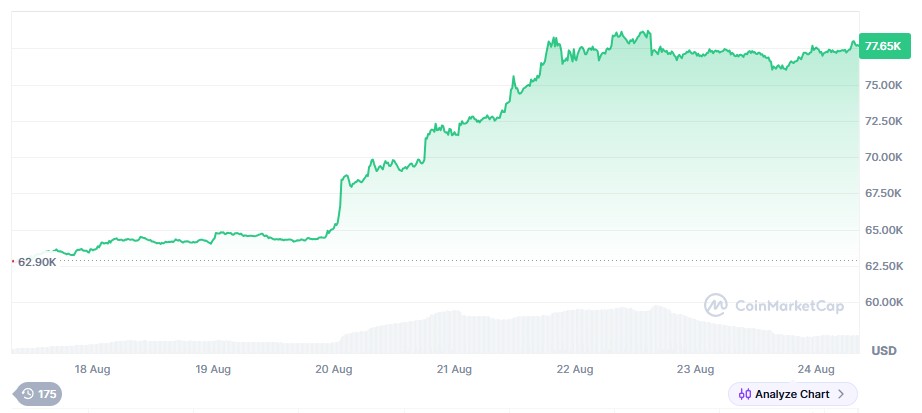
Confidence has demonstrably returned to cryptocurrency markets this week, marked by a significant surge in Bitcoin’s price, prompting widespread speculation about the potential end of the protracted bear market. The flagship cryptocurrency experienced a sudden and robust rally, gaining more than 23% to trade around $77,559 at the time of writing, having briefly touched highs above $79,000 on Friday. This upward movement has reverberated across the broader digital asset ecosystem, reigniting investor optimism and drawing renewed attention from both institutional and retail participants.
Bitcoin’s Resurgent Momentum: A Deep Dive into Market Indicators
The recent price action for Bitcoin (BTC) is particularly noteworthy due to its breach of a critical technical threshold. Charting platform Barchart highlighted on Thursday that Bitcoin’s price had successfully crossed above its 200-day moving average for the first time since November 2025. This indicator is widely regarded by technical analysts as a crucial barometer for assessing longer-term market trends. A sustained move above the 200-day moving average is typically interpreted as a strong signal of bullish momentum, suggesting a potential shift from a downtrend to an uptrend. The last time Bitcoin successfully maintained a position above this key average for an extended period, it presaged a significant upward trajectory, fueling hopes that the current cycle has finally flipped positive after a challenging period for crypto investors.
The enthusiasm extended far beyond Bitcoin, with several major altcoins registering even more impressive gains. Ethereum (ETH), the second-largest cryptocurrency by market capitalization, climbed an impressive 31%. Solana (SOL), a high-performance blockchain, saw its value increase by 28%, while XRP experienced an astonishing 53% surge, indicating a broad-based recovery across the market. These simultaneous rallies suggest a collective return of risk appetite among investors, potentially signaling a broader market turnaround rather than an isolated Bitcoin phenomenon.
Fueling this renewed confidence are robust inflows into institutional investment vehicles. Bitcoin and Ether Exchange-Traded Funds (ETFs) collectively attracted over $2.61 billion in inflows last week alone. This substantial capital injection underscores growing institutional adoption and validates the increasing mainstream acceptance of cryptocurrencies as legitimate asset classes. Furthermore, the strategic Bitcoin investments made by Michael Saylor’s firm, Strategy, have officially crossed their breakeven point of $75,385. This milestone not only vindicates Saylor’s long-term conviction in Bitcoin but also re-establishes his reputation as a far-sighted Bitcoin visionary, shifting perceptions from that of a risk-taker to a prudent investor. The market’s renewed optimism is also reflected in prediction markets, with Polymarket odds of Bitcoin reaching $90,000 before 2027 hitting a significant 48%, indicating a growing belief in its near-term appreciation potential.

The positive sentiment in the crypto markets also had a ripple effect on publicly listed companies with significant exposure to the digital asset space. Firms such as Canaan, a leading manufacturer of Bitcoin mining equipment; Metaplanet, a Japanese company adopting a Bitcoin-centric treasury strategy; and prominent crypto platforms like Coinbase and Robinhood, all registered double-digit gains in their share prices. This correlation highlights the interconnectedness of the crypto market with traditional finance and the broader investment landscape.
Macroeconomic Headwinds: US Debt Policy and the Flight to Alternative Assets
Beyond the internal dynamics of the crypto market, a significant macroeconomic factor contributing to the recent surge is the escalating concern surrounding US national debt. This week, the US debt pile officially crossed an unprecedented $40 trillion, a figure that continues to grow without a clear, comprehensive plan for balancing the budget or paying it down, beyond a vague aspiration for economic growth. The implications of this ballooning debt are profound. The annual cost of servicing this debt, primarily through interest payments, has now surpassed the cost of Medicare and is second only to social Security as the US government’s largest annual expense. This unsustainable fiscal trajectory raises alarms about future inflation, currency devaluation, and the long-term stability of traditional financial assets.
The Kobeissi Letter, a respected financial commentary, attributed the rapid gains observed in both precious metals and cryptocurrencies to a confluence of these macroeconomic pressures: persistent inflation, unchecked deficit spending, and specific US Treasury policy actions. Record government deficit spending, coupled with the Treasury Department’s pledge to at least double the size of certain debt buyback operations to $4 billion, has effectively injected more liquidity into the financial system, devaluing fiat currency and pushing investors towards alternative stores of value. Kobeissi argued that these factors are directly fueling the rally in both asset classes, as investors seek refuge from potential economic instability.
Prominent financial figures are also voicing concerns and offering strategies. Ray Dalio, the founder of the world’s largest hedge fund, Bridgewater Associates, has long advocated for diversification into alternative assets. He believes investors should allocate approximately 15% of their portfolios to gold and "a bit of Bitcoin" to strategically position themselves for the impending fallout from the US’s mounting debt problems. Dalio offered a stark warning: "My guess, which I suppose will be a bad one, is that [a US debt crisis] will come in three years, give or take two, if the course we’re on is not changed." His advice underscores the growing perception of Bitcoin, alongside gold, as a potential hedge against systemic financial risks and currency debasement.
Regulatory Crossroads: White House, SEC, and CFTC Vie for Clarity
Amidst the market’s resurgence, the US regulatory landscape for cryptocurrencies continues to evolve, with key players pushing for greater clarity and frameworks. US President Donald Trump recently reiterated his call for the passage of the CLARITY Act, following a high-profile meeting with prominent crypto industry executives. Attendees included Coinbase CEO Brian Armstrong and Gemini co-founders Cameron and Tyler Winklevoss, signaling the industry’s direct engagement with the highest levels of government.
President Trump explicitly urged members of Congress to pass "a fair version" of the bill, emphasizing the need to keep the US "ahead of China" in the rapidly developing digital asset space. The CLARITY Act, a market structure bill designed to provide a clearer regulatory framework for digital assets, was passed by the House of Representatives in July 2025. It now faces a crucial procedural vote on September 15, which will require 60 votes in favor to advance in the Senate. Trump expressed confidence in the bill’s bipartisan support, stating, "It’s very bipartisan, I would say. Lot of Democrats support."
However, the path to passage is not without political hurdles. Democrat Senators appear hesitant to support the bill without further concessions from the President on ethics provisions. Senator Ruben Gallego articulated this concern, remarking, "I think, unfortunately, what the President means is fair to him. The president doesn’t just get to decide what level of regulation he gets." This political tug-of-war highlights the complex interplay between industry needs, legislative priorities, and political dynamics in shaping the future of crypto regulation in the US.
In a curious turn during the meeting, President Trump also inadvertently influenced the market price of Hyperliquid, causing its value to jump by 20%. This occurred when he revealed, "I understand that Mike [Selig, CFTC chair] is also working to bring Hyperliquid into the United States in a fully compliant and legal fashion." This comment, whether intentional or not, demonstrates the significant impact that high-profile endorsements or mentions can have on specific crypto assets.
Concurrently, the US Securities and Exchange Commission (SEC) has unveiled its own set of proposed rules for the cryptocurrency industry. These proposals, currently open for a 60-day public comment period, could either exert pressure on lawmakers to pass the CLARITY Act or, if enacted independently, potentially spark a new boom in Initial Cryptocurrency Offerings (ICOs). The proposed rules offer exemptions to crypto projects, allowing them to issue up to $5 million in tokens over a four-year period, and up to $75 million within a 12-month period, albeit with stricter reporting and structural requirements. Crucially, the SEC has also put forward a "safe harbor" proposal, which would exempt certain cryptocurrencies from being treated as "investment contracts" under existing securities laws, providing much-needed relief and clarity for developers and issuers.
Commissioner Hester M. Peirce, often referred to as "Crypto Mom" for her progressive stance on digital assets, has been a vocal critic of the SEC’s previous regulatory approach. She stated that "a whole generation has struggled" with the SEC’s application of "a set of inapt rules to crypto." Peirce added that the SEC’s new crypto guidelines, despite their limitations, mark an important step toward "putting clear, sensible, enforceable rules in place for crypto offerings." These proposals reflect a growing recognition within the SEC that a tailored regulatory approach is necessary for the unique characteristics of digital assets.

Adding another layer to the regulatory puzzle, Michael Selig, who chairs the US Commodity Futures Trading Commission (CFTC), has asserted his agency’s readiness to establish its own crypto regulations if the CLARITY Act fails to pass the Senate. Selig indicated that he has already directed staff to facilitate "crypto asset trading on a leveraged or margined basis" for both registered and non-registered entities and to explore protections for developers. This proactive stance from the CFTC highlights the jurisdictional complexities and potential for overlapping or conflicting regulations among different US financial watchdogs.
Selig issued a clear warning regarding the legislative process: "We’re going to give CLARITY its breathing room for a vote, but if the Democrats cannot support a bipartisan work product, which reflects compromises from both sides of the aisle, and ultimately send a fair version of the bill to the President’s desk, then rest assured, I will direct CFTC staff to move swiftly to propose these new rules for the industry." This statement underscores the urgency and determination of regulatory bodies to establish frameworks for the burgeoning crypto sector, regardless of congressional gridlock.
Weekly Market Performance: Winners and Losers
As the week concluded, the overall cryptocurrency market capitalization surged to $2.63 trillion, according to CoinMarketCap, reflecting the broad-based gains. Bitcoin (BTC) closed up 23.5% at $77,559. Ethereum (ETH) saw a 31.1% increase, trading at $2,456. XRP (XRP) led the charge among major altcoins with a remarkable 53.3% surge, reaching $1.52.
Among the top 100 cryptocurrencies by market capitalization, several altcoins posted extraordinary weekly gains:
- Pump.fun (PUMP): Soared by 98.9%
- Ethena (ENA): Rose by 98.3%
- Stacks (STX): Increased by 94.8%
Conversely, a few cryptocurrencies experienced minor pullbacks against the backdrop of the market rally:

- JUST (JST): Down 4.3%
- MemeCore (M): Declined by 2.9%
- Sun (SUN): Dropped by 1%
Expert Predictions and Market Outlook
The significant market movements have prompted updated predictions from financial analysts. Geoff Kendrick, global head of digital asset research at Standard Chartered, revised his outlook for Bitcoin. He suggested in a Friday note that Bitcoin could potentially reach its all-time high of $126,000 before the end of the year, with recovery possibly accelerating after October 6. Kendrick attributed the latest rally largely to short liquidations, combined with a recovery in inflows into spot Bitcoin exchange-traded funds. He also noted that low open interest in the market could create room for more investors to enter as prices continue to climb. "For the first time this year there is now a risk my end year forecast (of USD100k) is too low," Kendrick wrote, indicating a heightened bullish sentiment from a major institutional player.
However, not all market participants share such an aggressively bullish short-term view. Gracy Chen, CEO of Bitget, offered a more tempered perspective, expecting Bitcoin to remain broadly around current levels through the end of the year despite its recent surge. Chen cited prevailing interest rates and broader macroeconomic conditions as key factors that could temper Bitcoin’s trajectory. She pointed to the possibility of higher interest rates as a potential pressure point on prices. "If any of that happens, the price should go down, at least theoretically," Chen explained, highlighting Bitcoin’s increasing integration with traditional finance and its sensitivity to macroeconomic shifts. She predicted that BTC could finish the year within a range of $10,000 to $20,000 above or below current levels, suggesting continued volatility and a nuanced outlook for the coming months.
Challenges and Concerns: Ethical Debates and Technical Glitches
Despite the prevailing market optimism, the week also brought forth its share of "Fear, Uncertainty, and Doubt" (FUD). A new Reuters/Ipsos poll revealed that a majority of American respondents deemed it "not appropriate" for US President Donald Trump and his family to accrue substantial wealth through cryptocurrency investments while in office. Conducted between August 14-17, the poll of 1,166 people found that 63% believed this practice was inappropriate. The results highlighted a significant partisan divide, with 69% of Republicans polled finding it appropriate, while an overwhelming 92% of Democrats responded negatively. This ethical debate underscores the ongoing scrutiny of political figures’ involvement in the crypto space and its potential implications for public trust and policy-making.
In other news that injected a degree of FUD, the MANTRA network experienced a significant technical issue. MANTRA’s native token sank to an all-time low of $0.004126 around 11:00 pm UTC on Thursday, shortly before MANTRA Chain ceased producing blocks. The team subsequently announced a precautionary halt over an unexplained incident. On Friday, MANTRA confirmed it was "aware of an incident affecting MANTRA Chain" and had halted the network as a precaution during investigation. The project initially stated, "We don’t have a root cause or timeline to share yet," adding that all endpoints and transactions were frozen. This halt prevented asset movement on the MANTRA Chain and led affected exchanges to pause deposits and withdrawals. However, by August 22, MANTRA announced that "the vulnerability in the Cosmos-EVM module has been fixed, the network has resumed, and no user funds were affected," bringing relief to its community. This incident serves as a stark reminder of the inherent technical risks and vulnerabilities that can affect even established blockchain networks, impacting token prices and user confidence.
In summary, the cryptocurrency market has experienced a powerful resurgence, driven by significant price rallies, strong institutional inflows, and growing macroeconomic concerns. While regulatory clarity remains an ongoing challenge, both legislative and executive branches are actively engaging with the industry. Divergent expert predictions indicate a complex outlook, but the overall sentiment suggests a potentially pivotal moment for digital assets.