admin
admin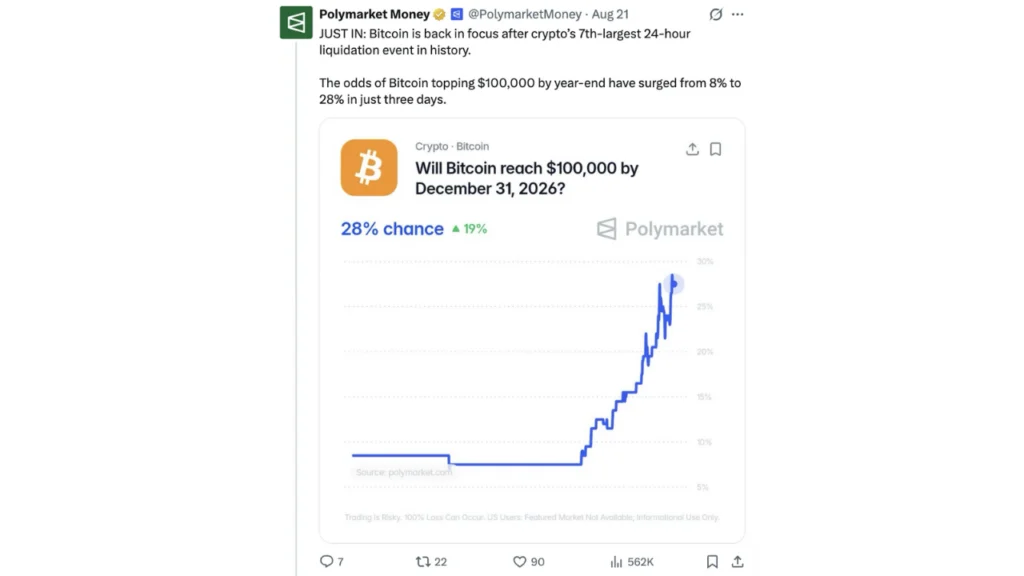
Bitcoin is currently positioned within striking distance of the coveted $80,000 milestone, a price point that has ignited significant bullish sentiment across the cryptocurrency market. Prediction markets, particularly Polymarket, reflect this heightened optimism, with traders increasingly wagering on the digital asset achieving this benchmark before the conclusion of August. The current odds on Polymarket’s Bitcoin market assign a 59% probability to BTC touching $80,000 this month. This surge in confidence follows a powerful rally that propelled Bitcoin past the $77,000 mark and briefly brought it tantalizingly close to $79,500. This dramatic shift in market sentiment is particularly noteworthy given Bitcoin’s position at the beginning of August, when it was trading around the mid-$60,000s, meaning the latest upward trajectory has delivered gains exceeding 20% in a mere matter of weeks. The cryptocurrency now trades near its highest level since early summer, firmly re-centering market attention on the $80,000 psychological barrier.
Beyond the immediate $80,000 target, Polymarket traders are also projecting further upside potential, albeit with diminishing probabilities. The market assigns a 35% chance of Bitcoin reaching $82,500 and an 18% chance of touching $85,000 before the month’s end. A more ambitious move to $100,000, however, remains a distant prospect, with the odds currently standing at only 2%, underscoring the near-term focus on the immediate resistance levels. The confluence of factors driving this rally suggests a multi-faceted push, drawing strength from both technical market dynamics and broader macroeconomic currents.
The Anatomy of a Rapid Ascent: Short Squeeze Dynamics
One of the most defining characteristics of Bitcoin’s recent upward trajectory has been the sheer speed and intensity of its recovery. The digital asset climbed from approximately $64,000 to nearly $79,500 in a remarkably short span of just three days. This aggressive upward movement acted as a catalyst, triggering a substantial wave of short liquidations across the cryptocurrency derivatives market. According to market data cited in recent reports, more than $4 billion in bearish crypto positions were wiped out during this concentrated rally. This figure represents a significant deleveraging event, forcing traders who had bet against Bitcoin to cover their positions.
The mechanics of a short squeeze played a crucial role in accelerating the price appreciation. When traders "short" an asset, they borrow and sell it, hoping to buy it back at a lower price for a profit. If the price moves against them, they are compelled to buy back the asset to limit their losses, thereby creating additional buying pressure. This forced buying, in turn, pushes prices even higher, creating a feedback loop that liquidates more short positions and further fuels the rally. As Bitcoin breached key psychological and technical resistance levels—first $70,000 and then $75,000—a new cohort of market participants, known as momentum traders, began to enter the market. These traders aim to profit from continuing trends, adding another layer of buying interest. The powerful combination of short covering, fresh capital from momentum traders, and a rapidly improving market sentiment transformed what might have initially appeared as a modest recovery into a much stronger and more sustained rally.
However, this very dynamic that propelled Bitcoin upwards also carries inherent risks, as the market can reverse course with similar velocity. Following Bitcoin’s approach to the $80,000 mark, traders who had entered highly leveraged long positions began to face increased vulnerabilities. A recent pullback toward $77,000, for instance, has already resulted in hundreds of millions of dollars in crypto liquidations. This shift indicates that some of the pressure has transferred from short sellers to overextended buyers, highlighting the volatile nature of highly leveraged trading. Consequently, the price area between $79,000 and $80,000 holds particular significance. A decisive breakout above this range, accompanied by sustained volume, could attract another wave of momentum buying, potentially propelling Bitcoin towards higher targets. Conversely, another rejection at this level could encourage profit-taking among early entrants, leading to a period of consolidation or a minor correction.

Institutional Momentum: The Role of Spot Bitcoin ETFs
Unlike previous Bitcoin rallies that were often primarily driven by speculative derivatives activity, the current advance is underpinned by a robust and verifiable source of demand: U.S. spot Bitcoin Exchange-Traded Funds (ETFs). These regulated investment vehicles have demonstrated consistent and substantial inflows, signaling renewed institutional interest and capital allocation towards Bitcoin.
Thursday, August 21, 2026, marked a particularly strong day for these funds, as they collectively attracted an impressive $606 million in net inflows. This figure represents their largest single-day inflow since May, underscoring a significant resurgence in demand. Over the four trading days from Monday through Thursday, U.S. spot Bitcoin ETFs recorded an approximate combined inflow of $1.6 billion. This consistent capital injection provides a clear indication of a growing appetite among institutional investors and traditional financial players seeking regulated exposure to the leading cryptocurrency.
This positive momentum continued into Friday, August 22, 2026, with U.S. spot Bitcoin ETFs recording an additional $307.5 million in net inflows, extending their positive streak to five consecutive trading sessions. BlackRock’s IBIT, a prominent player in the spot ETF landscape, led the charge with roughly $239.3 million of inflows on Friday alone, demonstrating its continued appeal to a broad investor base. Fidelity’s FBTC also contributed significantly, adding about $30.2 million to the total.
The importance of these ETF flows cannot be overstated. They provide a more direct and transparent indication of demand from institutional investors and retail participants operating within regulated financial frameworks, as opposed to the often opaque and highly leveraged derivatives markets. If Bitcoin’s price were to surge while ETF investors were simultaneously withdrawing funds, the rally’s sustainability would be considerably less convincing. Instead, the parallel strengthening of institutional flows alongside price appreciation provides bulls with a powerful argument for a sustained move above the $80,000 threshold and suggests a deeper, more fundamental support for Bitcoin’s valuation. This trend highlights Bitcoin’s increasing integration into mainstream finance and its growing acceptance as a legitimate asset class for diversification and long-term investment.
Macroeconomic Tailwinds and Regulatory Clarity
Beyond market-specific dynamics, broader macroeconomic developments are also contributing to Bitcoin’s bullish backdrop. The U.S. Treasury recently announced strategic plans to increase its buybacks of longer-dated government bonds. This policy decision has had several implications for financial markets. Initially, it helped to ease pressure within the Treasury market, leading to a softening of bond yields. Concurrently, it contributed to a weakening of the U.S. dollar against other major currencies. Investors typically interpret such moves as potentially supportive for scarce assets that are perceived as stores of value, such as Bitcoin and gold, as they often benefit from a depreciating dollar and an environment of increased liquidity.

Adding to the positive sentiment is renewed optimism surrounding U.S. cryptocurrency regulation. Political figures, notably President Donald Trump, have actively pushed Congress to advance the CLARITY Act. This legislative initiative is specifically designed to establish a clearer and more comprehensive regulatory framework for digital assets within the United States. The current patchwork of regulations has long been a source of uncertainty and a barrier to broader institutional adoption. The prospect of a clearer, more predictable regulatory environment is highly attractive to major financial institutions and corporations, as it reduces compliance risks and provides a more stable foundation for integrating digital assets into their operations. Recent political and regulatory developments, therefore, have added another layer of fundamental support to the overall crypto market sentiment, making it easier for large players to justify their involvement.
However, the macroeconomic picture is not entirely devoid of risks. Long-term Treasury yields, despite recent movements, remain elevated by historical standards, reflecting ongoing concerns about inflation and government debt. Investors continue to monitor the Federal Reserve closely for any clues regarding its future stance on interest rates and broader financial conditions. The upcoming Jackson Hole gathering, an annual symposium of central bankers and economists, is therefore poised to become an important test for risk assets like Bitcoin. Any signals from the Federal Reserve that monetary policy may remain restrictive for a longer duration than anticipated could potentially limit Bitcoin’s upside momentum, especially after such a rapid and substantial rally. The delicate balance between supportive macro factors and potential tightening policies will be a key determinant of Bitcoin’s short-to-medium term trajectory.
Navigating the Path to $80,000 and Beyond
For the immediate future, the market sentiment unequivocally leans bullish, with significant capital flows and technical indicators pointing upwards. However, reaching the $80,000 mark and, crucially, holding above it, represent two distinct challenges. Bitcoin’s recent ascent has been powerful enough to unequivocally restore positive momentum, but it has also created conditions ripe for profit-taking. Traders who entered positions near the $64,000 or $70,000 levels are now sitting on substantial unrealized gains, making them potential sellers should the price falter. Furthermore, the increasing number of leveraged buyers are inherently more vulnerable to sharp reversals, as even minor price corrections can trigger forced liquidations, creating downward pressure.
The upcoming weekend could introduce another layer of volatility into the market. While Bitcoin trades 24 hours a day, seven days a week, U.S. spot Bitcoin ETFs adhere to traditional market hours and do not trade when these markets are closed. With this significant source of institutional demand temporarily offline, the market’s liquidity can thin out considerably. In such an environment, relatively modest buy or sell orders can have a disproportionately larger impact on price movements, potentially leading to increased volatility and unpredictable swings.
Consequently, the first full U.S. trading sessions of the following week are expected to be particularly revealing. If ETF inflows remain robust and Bitcoin can definitively reclaim and sustain its position above $80,000 with consistently strong trading volume, then traders may begin to confidently target the subsequent resistance levels in the $82,500 to $85,000 range. This would signify a successful conversion of a psychological ceiling into a new, formidable support level.
For now, Polymarket’s 59% probability for Bitcoin to reach $80,000 by the end of the month suggests that the collective wisdom of the crowd believes a test of this critical level is more likely than not. However, given that Bitcoin has already appreciated by more than 20% in a relatively short period, the path higher is unlikely to be smooth or without intermittent corrections. The immediate battleground for market participants is no longer centered on whether Bitcoin can recover from its mid-$60,000s slump. Instead, the focus has firmly shifted to whether the bulls can successfully transform $80,000 from a formidable psychological ceiling into a new, enduring support level, paving the way for further exploration of uncharted price territories. This transition would be a critical validation of the current rally’s underlying strength and the broader acceptance of Bitcoin’s value proposition in the global financial landscape.