admin
admin
A groundbreaking working paper from the Federal Reserve Bank of Cleveland has unveiled a compelling explanation for the distinct behavior of cryptocurrency compared to conventional financial assets. The study posits that the primary driver behind individuals’ decisions to invest in digital assets is not merely differing demographics or risk tolerance, but rather fundamentally divergent beliefs regarding the future returns of these volatile instruments. This significant finding offers crucial insights into both the persistent volatility of the crypto market and the self-reinforcing cycles where price rallies attract new participants, potentially creating speculative bubbles.
The research, titled "Do You Even Crypto, Bro? Cryptocurrencies in Household Finance," was authored by Michael Weber, Bernardo Candia, Olivier Coibion, and Yuriy Gorodnichenko. Their extensive methodology involved repeated surveys of up to 25,000 U.S. households per wave, meticulously examining the factors influencing cryptocurrency ownership and investment decisions. The overarching conclusion is that expectations about future crypto returns account for a far greater proportion of the variation in ownership than a wide array of traditional demographic characteristics typically considered paramount in financial decision-making.
Unpacking the Divergence in Investor Expectations
One of the most striking findings of the paper concerns the stark contrast in return expectations between crypto owners and non-owners. For those willing to venture a forecast, the gap was substantial. Cryptocurrency owners anticipated an average return of 22% over the subsequent year, a figure more than three times higher than the mere 7% expected by non-owners. This pronounced difference underscores a fundamental disconnect in market perception, with current participants exhibiting significantly more bullish outlooks. Furthermore, the study revealed that crypto owners tended to perceive digital assets as inherently less risky than their non-owning counterparts, suggesting a potential cognitive bias or an information asymmetry at play.
The researchers quantified the explanatory power of these expectations, finding them unusually potent in determining ownership. Specifically, a one-percentage-point increase in an individual’s expected crypto return was statistically associated with a 0.8-percentage-point increase in the probability of owning cryptocurrency. This relationship proved more robust than the influence of observable characteristics such as age, income, and gender, which typically hold considerable sway in explaining ownership of traditional assets like stocks, bonds, or gold. For conventional investments, demographic and financial profiles generally offer much greater explanatory power than variations in expected returns. Crypto, the study concludes, dramatically reverses this established relationship, marking it as a unique anomaly in household finance.
This distinct pattern highlights why cryptocurrency markets often appear to defy conventional economic models. While factors like income, wealth, and age certainly play a role in shaping overall financial capacity and risk appetite, the decision to enter the crypto space appears to be primarily driven by a conviction about its future price appreciation. This conviction, rather than a deep understanding of underlying technology or market fundamentals, seems to be the critical determinant.
The Role of Information and the Speculative Feedback Loop
A crucial aspect of the study involved a randomized information experiment designed to test how exposure to past performance data influences investment behavior. As part of their research, which contributed to the 2026 working paper, researchers assigned households to receive information about various assets, including Bitcoin (BTC), stocks, GameStop, or inflation. Participants who were shown Bitcoin’s previous 12-month return subsequently increased their desired crypto portfolio allocation by approximately 2 percentage points. This represented a substantial 47% increase relative to the 4.3% desired allocation observed in the control group, which received no specific information. More critically, actual subsequent crypto purchases also rose by about 2.5 percentage points among the informed group.

The authors emphatically state that this result provides direct evidence that "providing information about recent Bitcoin returns induces some households to start buying cryptocurrency." This effect was not universal, however. It was predominantly concentrated among individuals who had previously cited a lack of sufficient information as their reason for not owning crypto. Conversely, those who already held a negative view of crypto as a "bad investment" generally remained unaffected by the information treatment, underscoring the persistence of pre-existing beliefs.
This finding carries profound implications for understanding market dynamics and the formation of speculative bubbles. The mechanism suggested by the researchers is one where past gains act as a powerful magnet, attracting new investors. These new purchases, in turn, push prices higher, creating a positive feedback loop that can draw in even more buyers. The authors explicitly state, "Positive returns attract new participants, which raises the price further." This cycle, driven by an almost herd-like response to upward price movements, can decouple asset valuations from underlying fundamentals, a hallmark of speculative episodes throughout financial history.
Understanding Crypto: A Persistent Knowledge Gap
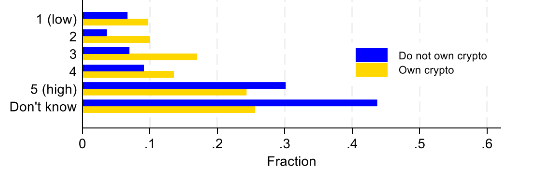
Despite its growing prominence and market capitalization, cryptocurrency remains a poorly understood asset class for a significant portion of the population. The researchers’ 2021 survey data revealed a striking knowledge gap: a staggering 87% of individuals who did not own crypto admitted they had no idea what return to expect from it over the following year. While this figure was lower among crypto owners, it remained substantial, with 54% of them also unable to forecast future returns.
This widespread lack of understanding provides fertile ground for divergent beliefs and the powerful influence of readily available information, such as recent price performance. In the absence of established valuation models, transparent financial statements, or long-standing historical benchmarks that characterize traditional assets, investors may rely more heavily on immediate past performance and anecdotal evidence. This environment can amplify the impact of positive news or price surges, leading to rapid inflows of capital driven by optimistic expectations rather than fundamental analysis.
The lack of common information and shared belief structures among investors, as highlighted by the study, is posited as a fundamental reason why price volatility will continue to be a defining characteristic of this new asset class for the foreseeable future. This suggests that the crypto market’s inherent instability is not merely a transient phase but an intrinsic feature stemming from the nascent stage of its understanding and adoption.
Demographic Nuances and "Gambling Income" Effects
While expected returns proved to be the dominant explanatory factor, the demographic profile of crypto investors still exhibits distinctive patterns. The study confirmed that younger individuals are significantly more likely to engage with digital assets. People under 40 were found to be 13 percentage points more likely to own cryptocurrency than those over 60, even after controlling for other characteristics. Gender also played a role, with men approximately 4 percentage points more likely than women to own crypto. Furthermore, households with higher incomes and greater wealth demonstrated a higher propensity for participation in the crypto market. These demographic trends, while secondary to return expectations in explaining ownership, still paint a picture of the typical early adopter: younger, predominantly male, and financially more affluent.
Beyond investment decisions, the paper also delved into the broader economic implications of crypto wealth, specifically its impact on household consumption. The findings suggest a unique pattern: a doubling in Bitcoin’s price made a household whose entire financial portfolio was concentrated in crypto 1.4 percentage points more likely to purchase a durable good. This is equivalent to roughly a 7% increase relative to the unconditional probability of such a purchase. However, this effect did not extend to ordinary, day-to-day spending.
This distinction led the researchers to a stark comparison: crypto gains appear to be treated more like "gambling income" or lottery winnings than a permanent increase in wealth. This behavioral pattern suggests that investors may perceive crypto gains as windfall profits, which are typically spent on discretionary items rather than integrated into long-term financial planning or used to fund regular consumption. This "mental accounting" phenomenon further differentiates crypto from traditional assets, where capital gains are often viewed as a more stable augmentation of wealth, influencing both discretionary and ordinary spending.
Broader Implications for Market Stability and Regulation
The Federal Reserve Bank of Cleveland’s working paper carries significant implications for financial regulators, policymakers, and financial educators. If investor behavior in the crypto market is predominantly driven by highly divergent and often uninformed expectations about future returns, coupled with a susceptibility to past performance data, it presents a unique challenge for market stability and consumer protection.
Regulators, already grappling with how to classify and oversee digital assets, must contend with a market where information asymmetry is profound, and speculative dynamics can easily take hold. The findings suggest that interventions focused solely on traditional risk disclosures or demographic targeting might be insufficient. Instead, strategies aimed at fostering greater understanding of crypto’s underlying mechanics, dispelling unrealistic return expectations, and highlighting the inherent risks could be more effective.
For financial advisors, the research underscores the importance of addressing client beliefs and expectations head-on. Merely presenting diversified portfolio options might not resonate with individuals whose primary motivation for crypto investment stems from a belief in outsized, short-term gains. Education must move beyond basic definitions to tackle the psychological biases that can lead to speculative behavior.
Moreover, the "gambling income" analogy for crypto gains could influence broader economic stability. While the current scale of crypto wealth may not pose systemic risks to the same extent as traditional asset classes, a rapidly expanding market exhibiting these behavioral patterns could lead to significant wealth destruction during downturns, potentially impacting consumer confidence and discretionary spending. Policymakers will need to consider how these unique consumption patterns affect economic forecasts and stability.
Conclusion: A Future Defined by Volatility and Beliefs
In essence, the Federal Reserve study paints a picture of cryptocurrency as an asset class where human psychology, subjective beliefs, and information processing play an unusually dominant role. The absence of common understanding and shared valuation frameworks among investors creates a fertile ground for sharply differing views on its prospects. Critically, the study demonstrates that new information, particularly about past returns, has a powerful capacity to alter both investor expectations and subsequent behavior, fueling a feedback loop that can drive prices higher and attract more participants.
This comprehensive analysis suggests an uncomfortable but crucial conclusion for the future of crypto markets: the next wave of retail demand and the ongoing trajectory of digital asset prices may hinge not only on fundamental developments or broader economic trends but significantly on how investors interpret and react to past price movements. The inherent lack of universal consensus on crypto’s intrinsic value, coupled with the proven influence of performance-based information, indicates that price volatility will indeed continue to be one of the most defining and enduring characteristics of this revolutionary yet enigmatic asset class for the foreseeable future. Understanding these psychological underpinnings is paramount for anyone seeking to navigate the complex and often unpredictable landscape of digital finance.