admin
admin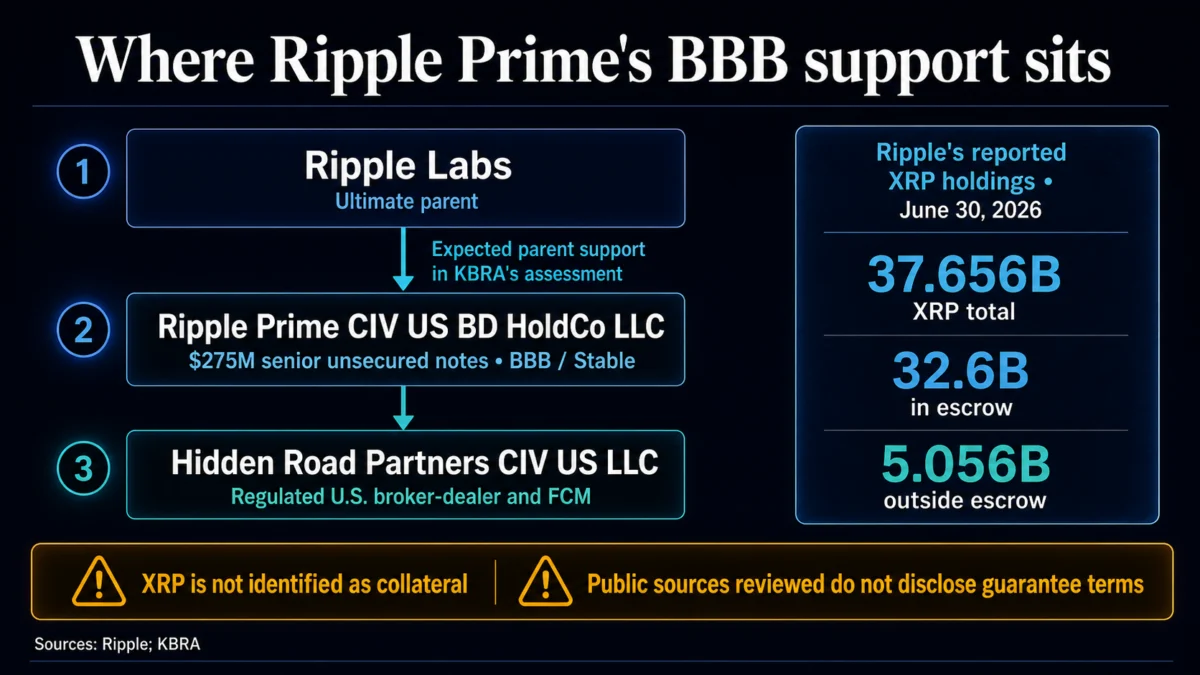
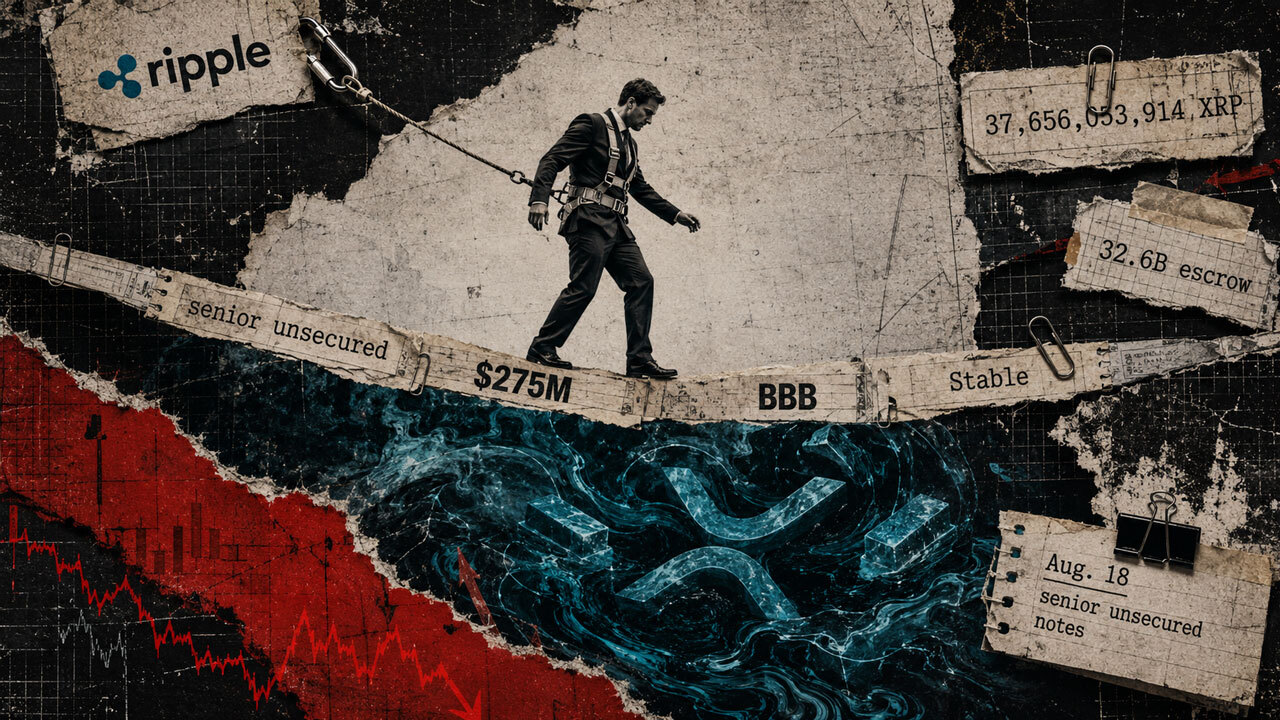
Ripple Prime, a burgeoning non-bank prime brokerage firm, has successfully concluded an upsized private placement of $275 million in senior unsecured notes. This significant capital infusion is earmarked to fuel the company’s aggressive expansion strategy within the United States. The transaction, which received an investment-grade assessment from Kroll Bond Rating Agency (KBRA), places a crucial emphasis on the parent-support mechanism as the central tenet of its credit profile. The BBB rating assigned by KBRA is intrinsically linked to the agency’s expectation that Ripple, the ultimate parent entity, would provide financial backing to the brokerage should liquidity constraints prevent capital from flowing freely from the regulated operating company. This scenario underscores a critical test for Ripple’s institutional finance division: to what extent has its growth trajectory diverged from the XRP-sensitive balance sheet that initially provided its foundation?
The offering officially closed on August 18th, with Ripple announcing that the proceeds would be allocated towards working capital and general corporate purposes within its regulated entity. Piper Sandler served as the lead placement agent for this significant debt issuance. While Ripple’s public statements have confirmed the aggregate amount, the ranking of the notes, and their intended use, specific terms pertaining to a parent guarantee or any pledge of XRP collateral remain undisclosed in the public domain. KBRA’s assessment articulates an expectation of parental support, a nuanced position compared to Ripple’s description of the issuance as senior unsecured notes. A thorough review of publicly available official sources does not identify XRP as collateral for these notes, nor does it reveal any disclosure of an enforceable guarantee signed by Ripple Labs, or the precise scope of any such potential guarantee. This distinction is vital for understanding the credit structure underpinning Ripple Prime’s operations and its reliance on the broader Ripple ecosystem.
The Issuer’s Distinct Legal Identity: A Structured Separation
A fundamental aspect of this financial arrangement is the legal architecture that delineates the borrower, the regulated brokerage entity, and the ultimate parent company whose support KBRA anticipates. KBRA has assigned its senior unsecured debt rating to Ripple Prime CIV US BD HoldCo LLC, an intermediate holding company. Positioned beneath this holding company is Hidden Road Partners CIV US LLC, the operational arm of the prime brokerage. This U.S. entity holds registrations with the Securities and Exchange Commission (SEC) as a broker-dealer and with the Commodity Futures Trading Commission (CFTC) as a futures commission merchant, according to disclosures provided by Ripple Prime.
This layered structure can be conceptualized as having three distinct tiers: Ripple Labs, the ultimate parent entity at the apex; the Ripple Prime brand, which encompasses the acquired prime brokerage platform; and the regulated U.S. broker, operating below the rated holding company. The flow of credit and financial resources across this structure is governed by the legal and regulatory frameworks applicable to each individual entity. Each layer plays a defined role: corporate resources are primarily housed within the parent entity, debt obligations are concentrated at the holding company level, and customer-facing regulatory responsibilities are managed by the operating broker.
In July, prior to the note offering’s closure, KBRA assigned a BBB rating with a Stable Outlook to the senior unsecured debt of the holding company. The agency did not apply any notching adjustments from the holding company’s issuer rating, as it determined that the recovery prospects for senior unsecured creditors were broadly consistent with the assigned rating. KBRA had previously issued BBB issuer ratings to both the holding company and the operating company in April. This alignment in ratings, however, does not negate the crucial legal separation that exists between these entities.
KBRA’s analysis acknowledges that should regulatory or liquidity constraints impede the distribution of dividends from the operating company, Ripple would likely step in with financial support. This expectation is driven by Ripple Prime’s strategic significance to the parent company and the substantial investments Ripple has already made in the venture. The agency explicitly identified Ripple’s financial backing as a key determinant in its rating assessments. In essence, the credit thesis for Ripple Prime is predicated on the assumption that financial support can be channeled from the parent entity when direct capital flows from the regulated brokerage are restricted. The precise quantitative impact of this parental support assumption on the credit rating has not been publicly disclosed, making it challenging to isolate Ripple Prime’s standalone borrowing capacity from the broader parent-support framework.
The Intertwined Support Case: A Lingering Connection to XRP
Ripple has demonstrably committed capital to the development of this business unit. KBRA has noted that following its acquisition of Hidden Road, the parent company injected approximately $500 million. This capital injection was instrumental in bolstering Ripple Prime U.S.’s balance sheet and enabling it to achieve profitability in 2025. Furthermore, KBRA’s April rationale for its ratings referenced Ripple’s substantial financial resources, including nearly $5 billion in cash and more than 40 billion XRP holdings as of the third quarter of 2025. While KBRA recognized these XRP holdings as representing significant unrealized value, it also highlighted that Ripple’s earnings were substantially derived from its digital asset activities, including XRP sales. This interconnectedness means that the parent company’s capacity to provide support is inherently exposed to fluctuations in XRP’s price and overall market liquidity, particularly during periods of prolonged downturns in the digital asset market.
Ripple’s own disclosures provide a more contemporary, albeit more constrained, view of its XRP holdings. As of June 30, 2026, Ripple reported holding 37,656,053,914 XRP. Of this total, 32.6 billion XRP were held in on-ledger escrow. Subtracting this escrowed balance leaves approximately 5,056,053,914 XRP reported as being outside of escrow.
It is important to note that even this non-escrowed XRP amount cannot be directly converted into debt-support capacity at current market prices. Such a calculation would fail to account for critical factors such as sale restrictions, existing corporate commitments, the depth of market liquidity, and the potential price impact of attempting to liquidate a substantial position. The escrowed portion of XRP is subject to even more stringent restrictions; Ripple has previously stated that these tokens are inaccessible until monthly release schedules are met, with any unused XRP reverting to escrow.
Moreover, direct comparisons between different reporting periods have limitations. Ripple’s June 2026 total is lower than KBRA’s reported figure of "over 40 billion" XRP as of the third quarter of 2025. However, the older figure represents a rounded lower bound, and the disclosure scopes may differ. While these sources indicate a general trend, they do not provide an exact measure of decline.
What these figures collectively establish is the critical distinction at the heart of the senior notes offering. XRP contributes to the overall value of Ripple’s balance sheet, and KBRA has factored this value into its assessment of the parent company’s financial strength. However, XRP is not to be construed as collateral for Ripple Prime’s creditors, nor does it impose direct responsibility on XRP holders for the issuer’s debts.
Navigating the Growth Trajectory: The Brokerage’s Path to Maturity
While parental support forms a significant pillar of the BBB credit assessment, it is not the sole determinant. KBRA acknowledges that Ripple Prime U.S. achieved profitability in 2025 but characterizes the business as being in its nascent stages of scaling. Currently, the firm’s revenue is heavily concentrated in spread-based financing activities.
The brokerage’s platform for exchange-traded derivatives commenced operations in 2024, while its fixed-income repurchase agreement (repo) activities reached a significant scale in 2025. Revenue generation remains susceptible to fluctuations in balance sheet size and prevailing interest rates. KBRA anticipates that emerging revenue streams, including Delta-1 products and equity prime brokerage services, will contribute to revenue diversification. However, the realization of these benefits is contingent upon successful execution rather than a long-standing track record.
The firm’s balance sheet model inherently introduces counterparty and liquidity exposures. KBRA suggests that these risks are partially mitigated by a matched-principal structure, the utilization of high-quality repo collateral, centrally cleared derivatives, conservative exposure limits, real-time monitoring protocols, and short-duration financing arrangements. Publicly available financial statements for the operating subsidiary further underscore the critical role of matched repo and reverse-repo activities in supporting the balance sheet.
It is important to distinguish the recently closed $275 million offering from a previously announced debt facility. In May, Ripple Prime secured an up-to-$200 million facility from Neuberger Specialty Finance, intended to expand its capacity for client financing and margin requirements. The disclosed terms of this facility do not indicate that the full $200 million has been drawn. Consequently, these two transactions do not represent a combined $475 million of funded or outstanding debt.
KBRA has outlined potential pressures on the rating, including weaker earnings, liquidity, or capital levels, a reduction in parental support, or an increase in risk-taking activities. Conversely, positive rating momentum would necessitate sustained operational execution at projected scales, durable earnings generation, and a more diversified revenue base.
The successful closure of the $275 million note offering signifies Ripple Prime’s capacity to access traditional credit markets and secure an investment-grade rating. Nevertheless, the underlying credit thesis for the BBB rating remains intrinsically linked to Ripple’s ongoing commitment to funding the brokerage and to the financial health of a parent balance sheet that carries material exposure to XRP. Achieving greater revenue diversification and establishing a more extensive operating history would significantly bolster the separation of Ripple Prime’s borrowing capacity from its reliance on anticipated parental support. The strategic implications of this capital raise extend beyond immediate financial needs, signaling a deliberate move to solidify its position in the competitive prime brokerage landscape, even as the intricate relationship with its parent entity and its XRP holdings continues to be a focal point for credit analysts and market observers. The coming quarters will be crucial in demonstrating Ripple Prime’s ability to translate this capital injection into sustained growth and operational resilience, thereby solidifying its independent credit standing over the long term.