admin
admin
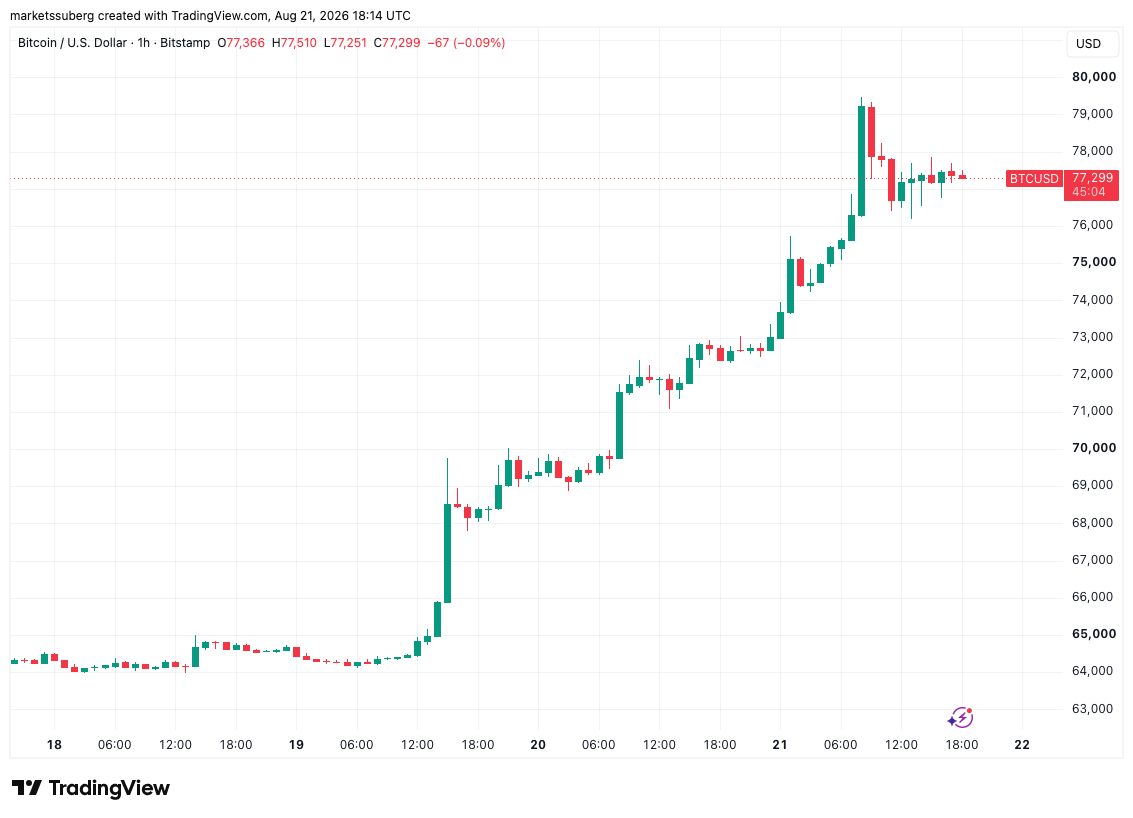
Bitcoin (BTC) recently solidified its position above the $77,000 mark following Friday’s Wall Street open, a significant milestone that coincided with gold’s rally to a 14-week high. This synchronized ascent of both digital and traditional safe-haven assets has drawn considerable attention from market analysts, who point to a confluence of macroeconomic factors, including persistent inflation, escalating government deficit spending, and strategic shifts in US Treasury policy, as the primary catalysts. The parallel movement of these distinct asset classes underscores a growing market sentiment of caution and a search for value outside conventional financial instruments.
The digital asset leader, Bitcoin, demonstrated remarkable resilience and upward momentum, cooling slightly after reaching its highest valuation since May 15. Despite this minor consolidation, BTC/USD remained up by nearly 6% on the day of the rally, showcasing robust investor confidence. This performance pushed Bitcoin’s monthly gains to an impressive 13%. Concurrently, gold, the perennial store of value, mirrored Bitcoin’s trajectory, achieving multi-month highs of $4,632 per ounce. The precious metal recorded a daily gain of 2.2% at the time of writing, contributing to its substantial 16% rise over the monthly period. This dual rally, involving assets often perceived as hedges against economic instability, signals a significant shift in investor behavior and broader market dynamics.
Chronology of Recent Market Dynamics
The recent surge in both Bitcoin and gold prices has been building over several weeks, culminating in the significant movements observed after the Wall Street open on Friday. Bitcoin’s journey past the $77,000 threshold marks a critical psychological and technical level, signaling a strong bullish sentiment that has been absent since mid-May. This upward trajectory was not an isolated event but rather a continuation of a broader trend influenced by global economic indicators.
Earlier in the week, anticipation mounted regarding the Federal Reserve’s stance on interest rates, with many market participants interpreting signals as indicative of a prolonged period of elevated rates or a potential shift in monetary policy. Such uncertainty often drives investors towards assets perceived as resistant to inflation or economic downturns. As the week progressed, concerns over persistent inflationary pressures in major economies, coupled with burgeoning government debt levels, intensified. The US Treasury Department’s announcement to double the size of certain debt buyback operations to $4 billion further fueled these concerns, as such actions can be interpreted as an attempt to manage liquidity in a strained bond market, indirectly supporting alternative assets.
By Friday, as trading commenced on Wall Street, the cumulative effect of these macroeconomic factors became evident. Bitcoin, already exhibiting strong performance throughout the week, accelerated its gains, decisively breaking resistance levels. Gold, traditionally a haven during times of economic uncertainty, simultaneously experienced a robust rally, confirming its role as a preferred asset amidst inflationary fears. The simultaneous and sustained gains in both Bitcoin and gold highlight a synchronized market response to perceived financial vulnerabilities, with investors seeking refuge in assets outside of traditional fiat-denominated instruments. This timeline underscores a proactive shift by investors in anticipation of, and reaction to, evolving global economic conditions.

The Macroeconomic Undercurrents: Inflation, Debt, and Treasury Policy
The synchronous ascent of Bitcoin and gold is deeply rooted in the current macroeconomic environment, characterized by persistent inflationary pressures, unprecedented government deficit spending, and evolving US Treasury policies. These factors collectively create a fertile ground for assets perceived as inflation hedges or stores of value.
Inflationary Pressures: Global economies continue to grapple with inflation rates that, while showing signs of moderation in some regions, remain elevated compared to historical averages. Supply chain disruptions, robust consumer demand, geopolitical tensions, and expansive fiscal policies have all contributed to this persistent challenge. When the purchasing power of fiat currencies erodes due due to inflation, investors naturally seek out assets that can preserve or even grow their capital. Gold has historically served this purpose, acting as a reliable hedge against currency devaluation. Bitcoin, often dubbed "digital gold," has increasingly adopted a similar role in the modern investment landscape, attracting those who view it as a finite, decentralized asset impervious to government monetary policy. Recent Consumer Price Index (CPI) and Producer Price Index (PPI) data, while subject to monthly fluctuations, have consistently indicated that inflationary forces are not entirely subdued, reinforcing the appeal of these alternative investments.
Government Deficit Spending: Many leading economies, particularly the United States, have engaged in substantial government deficit spending, a trend exacerbated by pandemic-era stimulus measures and continued investment in infrastructure and social programs. This spending, often financed through borrowing, leads to an increase in national debt. Record levels of government debt can trigger concerns about long-term fiscal stability and potentially lead to further currency debasement if central banks resort to quantitative easing or other measures to manage the debt burden. The sheer scale of borrowing creates an environment where investors look for assets outside the traditional debt markets, which are perceived as being under pressure. The Kobeissi Letter, a prominent market commentary, explicitly linked the rapid gains in precious metals and crypto to "record government deficit spending," highlighting its role in driving demand for assets that are not directly tied to government liabilities.
US Treasury Policy and Debt Buybacks: A crucial component of the current rally is the US Treasury Department’s pledge to significantly increase its debt buyback operations. Specifically, the Treasury announced plans to at least double the size of certain debt buyback operations to $4 billion. Debt buybacks involve the Treasury repurchasing its own outstanding bonds from the market. This action is typically undertaken to improve liquidity in the Treasury market, smooth out the maturity profile of government debt, or provide cash to market participants. While intended to stabilize the bond market, such operations can also be interpreted by some as a form of "stealth quantitative easing" or an acknowledgement of underlying stress in the financial system. By injecting liquidity into the market, even through debt management, it can reduce the attractiveness of holding traditional government bonds, indirectly pushing capital towards alternative assets like Bitcoin and gold. QCP Capital noted that the Treasury’s announcement led to an initial rally in Treasuries, which then largely retraced, whereas BTC and gold did not retrace to the same extent, underscoring the market’s sensitivity to these policy shifts and their implications for alternative assets. This divergence suggests that market participants are increasingly viewing Bitcoin and gold as superior hedges against the risks emanating from conventional financial policies.
Analysis: The Unconventional Rally of Digital and Traditional Gold
The simultaneous rally of Bitcoin and gold, often considered disparate assets due to their fundamental differences, warrants a deeper analysis. Market commentators and analysts have offered compelling insights into why this "unconventional" correlation is not only occurring but is also expected in the current economic climate.
Kobeissi Letter’s Perspective on "No Surprise" Gains: The market commentary from The Kobeissi Letter articulated that "What’s happening now in gold and crypto should not come as a surprise." This assertion stems from the understanding that both gold and, increasingly, Bitcoin, serve as hedges against systemic financial risks. In an environment characterized by inflation and expansive fiscal policies, the purchasing power of fiat currencies is diminished. Gold, with its millennia-long history as a store of value, naturally attracts investors seeking to preserve wealth. Bitcoin, though relatively nascent, has rapidly gained traction as "digital gold" due to its decentralized nature, finite supply, and resistance to censorship and government manipulation. Both assets offer an alternative to traditional financial instruments like government bonds, which become less attractive when real yields are low or negative, and when the solvency of government finances is questioned due to burgeoning debt. The confluence of inflation and aggressive deficit spending, as highlighted by Kobeissi, creates a strong impetus for capital to flow into these perceived safe havens, making their joint rally a logical market reaction rather than an anomaly.
QCP Capital’s Market Insights: Beyond US Borders: Trading company QCP Capital provided a nuanced view, emphasizing that financial stress signals extend "beyond the US." They specifically pointed to surging Japanese government bond yields, which occurred after a rare joint currency intervention in the yen earlier this month. This context is crucial. Japan, long characterized by ultra-low interest rates and a highly managed bond market, experiencing surging yields suggests a broader global re-evaluation of sovereign debt and monetary policy efficacy. The yen intervention itself was an attempt to stabilize the currency, but such interventions often signal underlying economic vulnerabilities and can have ripple effects on global liquidity.
QCP Capital’s analysis further detailed a significant "divergence after Treasury’s announcement." While Treasuries initially rallied following the US debt buyback pledge, they subsequently "gave back much of the move." In stark contrast, "BTC and gold did not retrace to the same extent." This divergence is pivotal. It indicates that while the Treasury’s actions might have offered temporary relief or re-pricing in the bond market, the underlying concerns driving investors into alternative assets persisted. The market’s interpretation appears to be that the long-term implications of fiscal and monetary policies favor non-sovereign assets. QCP concluded that while this divergence "does not establish a new liquidity or monetary regime," it "does highlight the sensitivity of alternative assets to changes in long-end rates and the dollar." This means that as interest rates on long-term government debt fluctuate, and as the US dollar’s global standing is re-evaluated, assets like Bitcoin and gold become exceptionally responsive, attracting capital from those seeking to de-risk their portfolios from traditional currency and bond exposures.
Historical Context and the Evolving Role of Safe Havens: Historically, gold has been the quintessential safe-haven asset, particularly during times of geopolitical instability, economic crises, or inflationary periods. Its tangible nature and scarcity have long made it a reliable store of value. Bitcoin, born out of the 2008 financial crisis, was designed with principles of scarcity and decentralization, mirroring some of gold’s fundamental attributes but in a digital format. Over the past decade, Bitcoin has gradually earned its reputation as "digital gold," particularly among a new generation of investors and those disillusioned with traditional financial systems. The current synchronized rally suggests an increasing acceptance of Bitcoin into the pantheon of safe-haven assets, especially as global macroeconomic uncertainties intensify. This co-movement is not merely a coincidence but a testament to how market participants are strategically diversifying their risk exposure across both traditional and emerging alternative asset classes.
Future Outlook and Market Sentiment
The impressive performance of Bitcoin and gold has naturally led to considerable speculation and analysis regarding their future trajectories. While some foresee continued upside, others caution that significant hurdles remain.
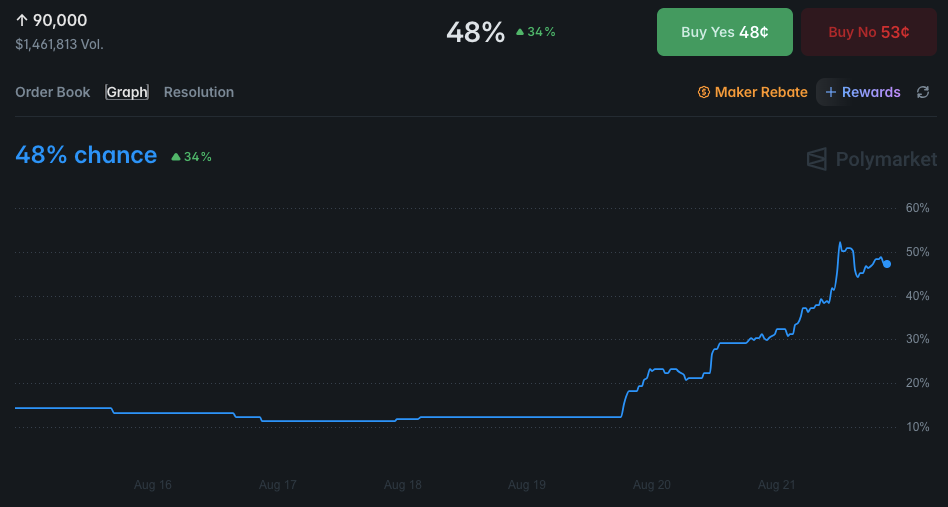
Polymarket’s Prediction and Growing Optimism: The prediction market service Polymarket has captured a palpable shift in market sentiment regarding Bitcoin’s future. At the time of writing, Polymarket placed the odds of BTC/USD hitting $90,000 before January 1, 2027, at a robust 48%. This figure represents a sharp increase since the beginning of the week, reflecting growing optimism among a broad base of participants who are willing to back their predictions with capital. Prediction markets like Polymarket aggregate the collective intelligence and conviction of a diverse group of individuals, often providing a more dynamic and real-time gauge of market expectations than traditional surveys or analyst reports. The near-50% probability suggests that a significant portion of the market believes Bitcoin’s current momentum, combined with ongoing macroeconomic tailwinds and increasing institutional adoption (such as Bitcoin spot ETFs), could propel it to new all-time highs within the next few years. This rising confidence indicates a potential shift from short-term trading speculation to a more long-term bullish outlook for the cryptocurrency.
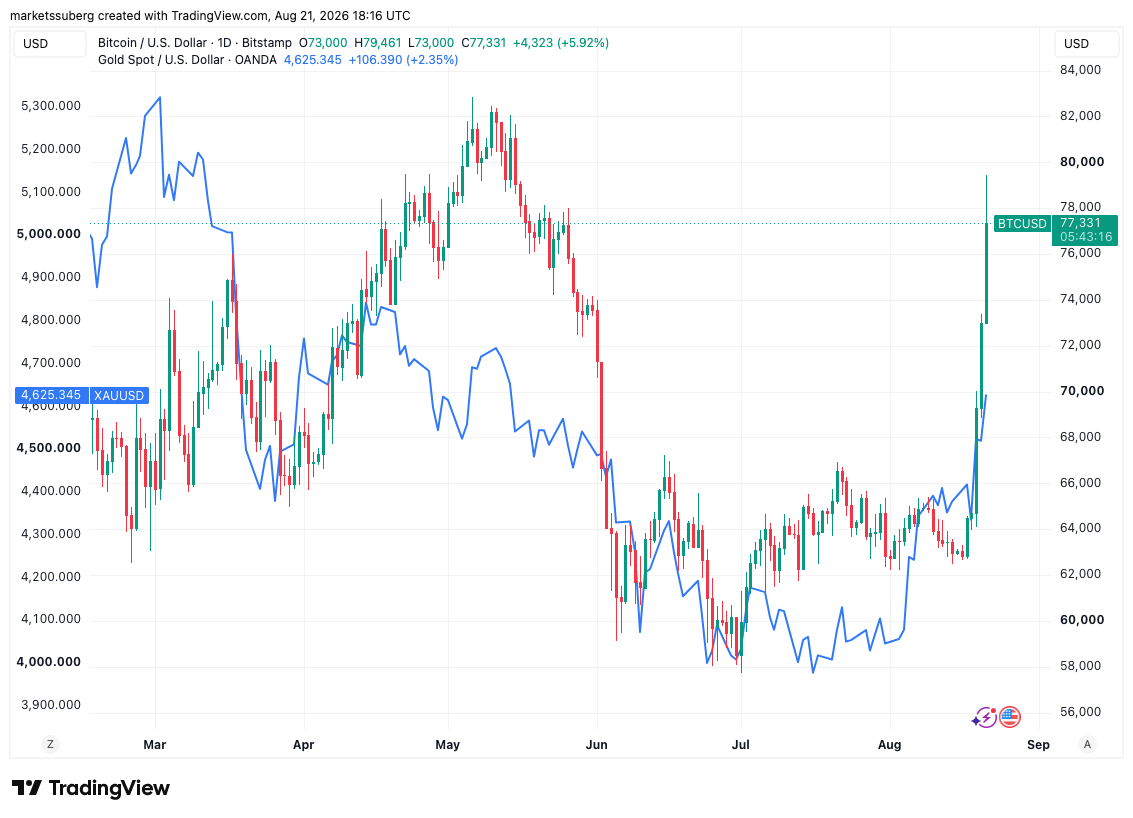
Technical Analysis and Cautionary Notes from Rekt Capital: Despite the prevailing optimism, seasoned traders and analysts often emphasize the importance of technical indicators and historical precedents. Trader and analyst Rekt Capital offered a more circumspect view, stressing a critical technical level that Bitcoin must reclaim to confirm a sustained uptrend. He highlighted the 50-week Exponential Moving Average (EMA) at $77,232 as a pivotal trend line. Bitcoin had previously rejected this level in January, which contributed to a period of consolidation or decline.
Rekt Capital’s analysis suggests two potential scenarios:
- "Break the Downtrend and Bitcoin will confirm entry into a new technical Macro Uptrend." This outcome would signify a decisive breach of a long-standing resistance level, signaling strong bullish momentum and potentially paving the way for higher price targets. Reclaiming the 50-week EMA would validate the recent rally as a foundational move for a sustained upward trajectory.
- "Reject from here however and price will maintain its series of Lower Highs." A rejection at the 50-week EMA would imply that the current rally is merely a temporary fluctuation within a broader downtrend. A "series of Lower Highs" is a classic technical pattern indicating that buyers are unable to push prices above previous peaks, suggesting that sellers remain in control and the asset could revert to lower levels.
Rekt Capital further cautioned, "History suggests there’s still time for price to continue its Downtrend." This statement likely refers to historical patterns where Bitcoin has experienced significant corrections after strong rallies, especially if key technical resistance levels are not decisively broken. His emphasis on historical context underscores that market cycles can be protracted, and previous movements do not always guarantee future performance, particularly when significant macroeconomic uncertainties persist. This dual perspective provides a balanced view, tempering the immediate enthusiasm with a dose of technical realism and historical awareness.
Broader Economic Implications
The synchronized rally of Bitcoin and gold carries significant broader economic implications, signaling potential shifts in investor confidence and the evolving landscape of global finance. This parallel movement suggests a collective market response to perceived instabilities within traditional financial systems.
Firstly, the sustained demand for both digital and traditional safe havens indicates a potential erosion of confidence in fiat currencies and government bonds, particularly in the face of persistent inflation and mounting national debts. Investors, both institutional and retail, appear to be actively seeking assets that are less susceptible to governmental monetary policy manipulation or the diluting effects of fiscal expansion. This could lead to a re-allocation of capital away from conventional fixed-income instruments and towards alternative assets, potentially impacting the cost of government borrowing and the stability of bond markets in the long term.
Secondly, this trend challenges the traditional paradigm of portfolio diversification. For decades, gold served as the primary hedge against economic uncertainty. Bitcoin’s increasing acceptance as "digital gold" expands this category, forcing financial advisors and fund managers to re-evaluate their asset allocation strategies. The inclusion of Bitcoin in major institutional portfolios, especially following the approval of spot ETFs, demonstrates a growing institutional embrace of cryptocurrency as a legitimate asset class for risk mitigation and growth. This could accelerate the mainstream adoption of digital assets and further integrate them into the global financial fabric.
Thirdly, the rally could put pressure on central banks to reconsider their monetary policies. If inflationary pressures persist and public confidence in fiat currencies wanes, central banks might face increased scrutiny regarding their mandates for price stability. A sustained shift of capital into Bitcoin and gold could be interpreted as a market signal that current measures are insufficient or that more aggressive tightening might be required, potentially leading to higher interest rates or other unconventional policy tools. Conversely, if central banks opt for more accommodative policies to stimulate growth, it could further exacerbate inflationary concerns and strengthen the appeal of inflation-hedging assets.
Finally, the divergence noted by QCP Capital, where Bitcoin and gold held gains while Treasuries retraced, highlights a growing sensitivity of alternative assets to long-end rates and the US dollar. This implies that the relative strength or weakness of the dollar and the yield curve could increasingly become key drivers for these assets, rather than solely traditional economic indicators. This dynamic suggests a more interconnected global financial system where the health of major currencies and sovereign debt markets directly influences the attractiveness of both digital and physical stores of value. The ongoing saga of Bitcoin and gold’s ascent is not merely a story of asset price appreciation but a profound indicator of evolving investor psychology and the structural shifts occurring within the global economy.
In conclusion, the recent surge in Bitcoin and gold prices above key psychological and technical thresholds underscores a significant moment in global financial markets. Driven by a complex interplay of persistent inflation, burgeoning government deficit spending, and strategic shifts in US Treasury policy, these assets have collectively responded as preferred hedges against economic uncertainty. While market commentators like The Kobeissi Letter view this synchronized rally as an expected outcome of current macroeconomic pressures, QCP Capital’s analysis highlights a crucial divergence from traditional assets like Treasuries, indicating a heightened sensitivity of alternative assets to changes in long-end rates and the dollar.
Looking ahead, the market remains divided. Prediction markets like Polymarket show increasing optimism for Bitcoin’s future, with a significant probability of reaching $90,000 by 2027. However, technical analysts such as Rekt Capital urge caution, emphasizing the need for Bitcoin to decisively reclaim critical trend lines like the 50-week EMA to confirm a sustainable macro uptrend. The broader economic implications of this dual rally are profound, signaling a potential erosion of confidence in traditional fiat currencies, a re-evaluation of portfolio diversification strategies, and a growing challenge to central bank monetary policies. As global economies continue to navigate an uncertain landscape, the intertwined fates of Bitcoin and gold will undoubtedly remain a focal point for investors and policymakers alike, serving as a barometer for market sentiment and the evolving nature of value in the 21st century.