admin
admin
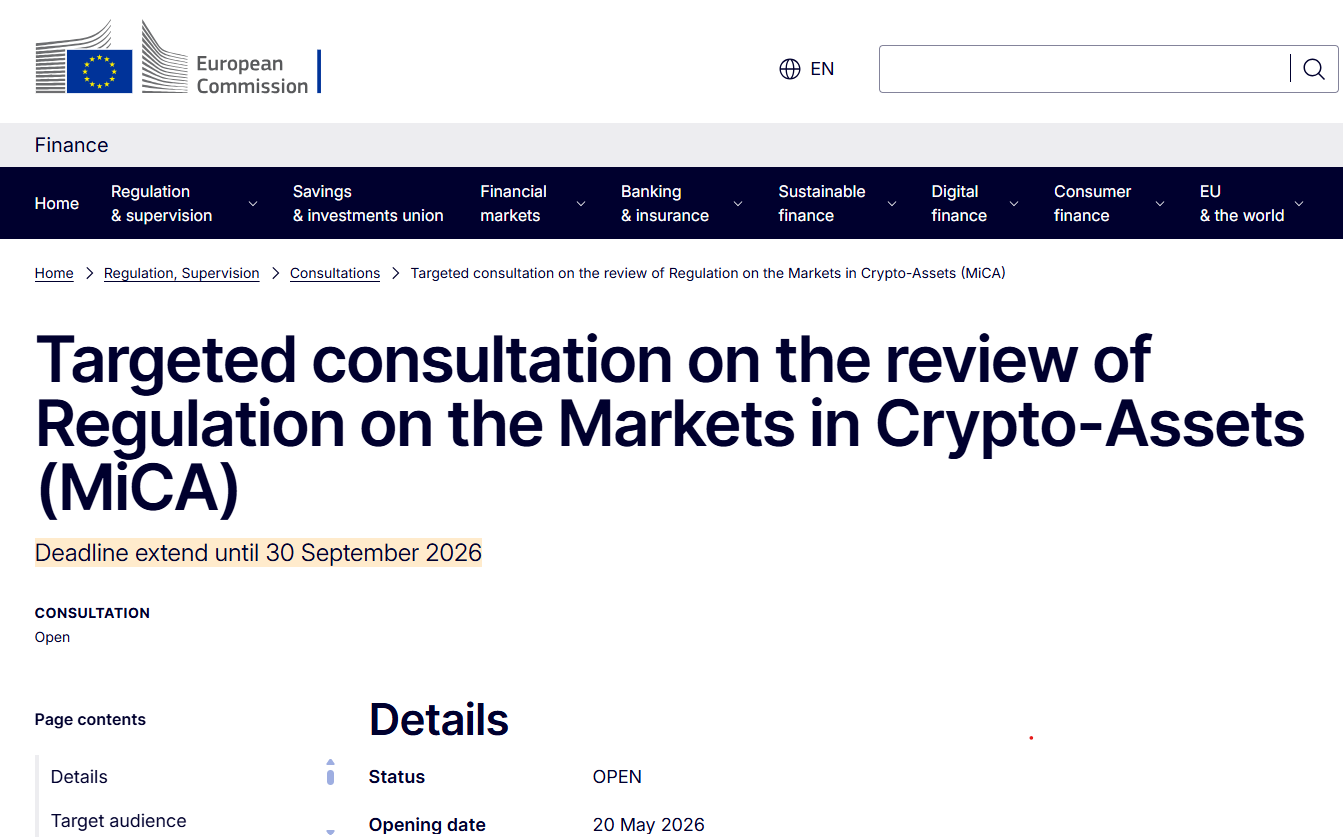
The European Union is embarking on a critical re-evaluation of its landmark Markets in Crypto-Assets (MiCA) regulation, specifically targeting the burgeoning and complex realm of crypto lending and decentralized finance (DeFi). This move, initiated by the European Commission, signals a significant potential expansion of the regulatory perimeter, with profound implications for the future of digital asset innovation and financial stability within the bloc. The consultation, launched on May 20, 2026, invites stakeholders to provide insights into areas that were deliberately excluded from MiCA’s initial scope, reflecting the rapid evolution of the crypto market and growing concerns about investor protection and systemic risk.
Background to MiCA: A Pioneering Framework
The Markets in Crypto-Assets (MiCA) regulation, formally adopted in May 2023, represents a groundbreaking legislative effort to establish a comprehensive legal framework for crypto assets within the European Union. Its primary objectives were to provide legal certainty for crypto-asset issuers and service providers, ensure financial stability, protect consumers and investors, and foster innovation while mitigating market integrity risks. MiCA covers a broad spectrum of crypto assets, including utility tokens, asset-referenced tokens (ARTs), and e-money tokens (EMTs), and regulates various crypto-asset services such as custody, exchange, and advice.
The legislative journey for MiCA was extensive, beginning with the Commission’s proposal in September 2020. It navigated complex negotiations among the European Parliament, Council, and Commission, ultimately reaching political agreement in June 2022 before its formal adoption. While parts of MiCA relating to stablecoins (ARTs and EMTs) are set to apply from June 30, 2024, the majority of its provisions, covering other crypto assets and service providers, will come into effect on December 30, 2024.
Crucially, MiCA’s initial design made a strategic decision to exclude certain areas, particularly those deemed too nascent or complex to regulate effectively at the time, or those operating in a "fully decentralized manner." DeFi, with its automated, permissionless protocols, and the specific mechanics of crypto lending and borrowing, fell into this category. Policymakers acknowledged that while these innovations held promise, their unique characteristics did not easily map onto traditional financial regulatory models, necessitating further observation and analysis.
The Emergence of a Regulatory Gap: DeFi and Crypto Lending
Since MiCA’s inception, the decentralized finance sector has witnessed exponential growth and significant market events, underscoring both its innovative potential and its inherent risks. DeFi lending protocols, which allow users to lend out their crypto assets to earn interest or borrow against their holdings, have become a cornerstone of the broader crypto ecosystem. These protocols often pool billions of dollars in liquidity, facilitating on-chain credit markets that operate without traditional intermediaries like banks.
A particularly challenging aspect of this market segment is the rise of "lending vaults." These sophisticated mechanisms can channel substantial capital into decentralized credit markets, performing economic functions akin to conventional lending but structured in a fundamentally different way. Their legal status under current EU law is ambiguous, often relying on non-binding interpretations that suggest they fall outside MiCA and existing EU fund regulations. This lack of clarity creates a regulatory vacuum, posing challenges for investor protection, market oversight, and the potential for regulatory arbitrage.
Yuriy Brisov, an EU digital assets lawyer and partner at Digital & Analogue Partners, highlights this definitional quandary. "EU law has no category called a ‘vault,’" Brisov states, emphasizing that regulators must "define it the way a regulator would qualify it: by function, not by label." This functional approach is critical given that vaults can distribute economic functions across smart contracts and multiple participants, rather than centralizing them within a single, identifiable company, as is common in traditional finance.

The Consultation: Seeking Stakeholder Input
The European Commission’s targeted consultation, launched on May 20, 2026, is a direct response to this evolving landscape. It seeks to gather comprehensive input from a wide array of stakeholders, including crypto companies, traditional financial institutions, legal experts, academics, and consumer groups, on how best to address these unregulated areas. The consultation specifically aims to:
- Assess the scope of MiCA: Determine whether current exclusions, particularly for DeFi and crypto lending/borrowing, remain appropriate.
- Identify specific risks: Understand the unique risks associated with these activities, including smart contract vulnerabilities, liquidity risks, and governance challenges in decentralized protocols.
- Explore potential regulatory approaches: Solicit views on different ways to integrate these activities into the regulatory framework, ranging from amending MiCA to proposing new, dedicated legislation.
- Examine the concept of "decentralization": Delve into what constitutes a "fully decentralized" activity and how to identify responsible parties in ostensibly leaderless protocols.
The consultation period is open until September 30, 2026, providing a crucial window for the industry to shape the future regulatory environment.
Case Study: Morpho and the Complexity of Decentralized Lending
The architectural intricacies of decentralized lending protocols like Morpho vividly illustrate the regulatory dilemmas facing Brussels. Morpho’s Vault V2 infrastructure, for instance, systematically divides responsibilities among an owner, curator, allocator, and sentinel. The curator configures strategy and risk parameters, the allocator executes allocations, and the sentinel possesses powers designed to mitigate risk.
This distributed responsibility model challenges conventional regulatory frameworks that typically identify a single, accountable entity providing a regulated service. While none of these individual participants might, in isolation, be deemed to be providing a regulated lending service under MiCA, their collective actions facilitate the economic function of lending. This highlights the difficulty in identifying the "provider" in a decentralized context, making it far less straightforward than with a traditional financial institution.
Jonathan Galea, a partner at Cahill Gordon & Reindel, has extensively analyzed the position of lending vaults under EU financial regulation. In a client update, he explored how these structures intersect with MiCA, stablecoin rules, and European fund law, underscoring their multifaceted nature. Galea cautions policymakers against a monolithic approach, arguing that "lending vaults solve more practical problems than they create." He emphasizes their role in directing fragmented liquidity into lending markets, but also points out that other types of vaults, which may primarily buy and sell crypto assets, should be treated differently. "Bring ‘DeFi lending’ into the perimeter as a single label, and structures that deserve opposite answers risk ending up captured together," he warns. This nuanced perspective suggests that a broad, undifferentiated regulatory brush could stifle innovation and misallocate regulatory burdens.
Identifying the Regulated Entity: A Core Challenge
MiCA currently excludes crypto-asset services provided in a "fully decentralized manner," but can apply where only part of an activity is decentralized. This distinction forms the crux of another major policy debate: who, if anyone, should be regulated in a decentralized ecosystem?
One proposed solution is to make decentralization the definitive dividing line. However, Galea argues that such a test could unfairly disadvantage newer protocols. "Decentralization is a spectrum and a function of time: a test built on it would penalize newer, more novel protocols while entrenching mature incumbents that have had years to distribute control," he explains. This suggests that a static definition of decentralization might stifle emerging innovations that naturally begin with a degree of centralization before progressively decentralizing.
Brisov advocates for a structural approach, focusing on the actual control exerted over a vault rather than a nebulous concept of decentralization. He suggests that "the safer ground is structural: there is no undertaking, no appointed manager, the holder has a direct coded claim on the pool, and the user can exit before any parameter change takes effect." This approach prioritizes verifiable, on-chain characteristics that demonstrate a lack of central control. He further recommends that if Brussels decides to regulate lending and borrowing, these activities should be explicitly added to the list of regulated crypto-asset services, rather than broadening the definition of a "crypto-asset service provider" itself, which could inadvertently capture unintended entities.
Towards a Tailored Regulatory Framework
Michael Egorov, founder of Curve Finance, underscores the necessity for a bespoke regulatory approach for DeFi lending. He contends that "if DeFi lending is ever brought into the scope of regulation, it should be treated completely differently." Egorov highlights that DeFi’s inherent transparency and algorithmic enforcement may negate the need for some traditional safeguards, while simultaneously requiring new ones tailored to its unique risks, such as smart contract exploits or oracle manipulation.
Egorov urges a "really careful" approach, suggesting that a dedicated framework could enhance safety and expand DeFi lending’s accessibility, provided it avoids imposing rules that protocols, by their very design, cannot comply with. This perspective resonates with a broader industry call for proportionate regulation that recognizes the fundamental differences between traditional finance and blockchain-native systems. Imposing legacy financial regulations wholesale could stifle innovation, drive activity offshore, or prove practically unworkable for protocols built on immutable smart contracts.
Broader Implications for the EU Crypto Market
The outcome of this consultation will have far-reaching implications for the European Union’s ambition to be a leader in the global digital asset space. A well-crafted regulatory framework for DeFi lending could:
- Enhance investor protection: By establishing clear rules and accountability, it could reduce risks associated with opaque practices, rug pulls, and smart contract vulnerabilities.
- Foster market integrity: By addressing issues like market manipulation and promoting transparency, it could build greater trust in the DeFi ecosystem.
- Promote financial stability: By monitoring systemic risks that could emerge from interconnected DeFi protocols, it could prevent contagion to the broader financial system.
- Legitimize DeFi: By integrating it into the regulatory perimeter, it could attract institutional capital and a broader user base, accelerating mainstream adoption.
Conversely, an overly broad or ill-conceived regulatory approach could:
- Stifle innovation: By imposing overly burdensome requirements, it could deter new protocols and developers from operating within the EU.
- Drive activity offshore: Projects might migrate to jurisdictions with more permissive or clearer regulatory environments, diminishing the EU’s competitiveness.
- Create regulatory arbitrage: Inconsistent application of rules could lead to loopholes and unintended consequences.
- Challenge core DeFi principles: Attempting to force decentralized, permissionless systems into traditional centralized frameworks could fundamentally alter their nature.
The Path Forward
As the September 30 consultation deadline approaches, the European Commission faces a monumental task. The challenge extends beyond the simple question of whether to regulate DeFi lending; it delves into the intricate "how." Policymakers must devise rules that accurately differentiate between the myriad forms of on-chain lending, carefully identifying the specific activities and, crucially, the individuals or groups (if any) that genuinely exercise control and should therefore bear regulatory responsibility.
The consultation marks a pivotal moment, setting the stage for either an expansion of MiCA or the potential creation of entirely new legislation tailored to the unique characteristics of decentralized finance. The decisions made in Brussels over the coming months will not only redefine the regulatory landscape for crypto lending but also significantly influence the trajectory of blockchain innovation and financial services across the European Union for years to come.