admin
admin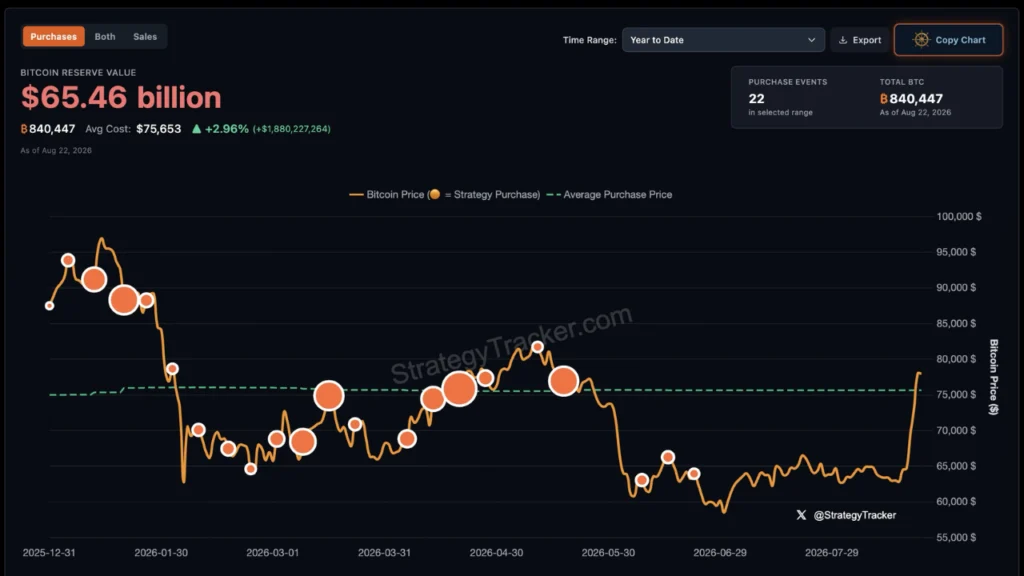
After a period marked by significant unrealized losses, Strategy, a prominent publicly traded entity known for its substantial Bitcoin holdings, has successfully navigated a sharp five-day market rally, pushing the price of Bitcoin (BTC) above its average acquisition cost. This pivotal shift has moved Strategy’s massive Bitcoin treasury back into the black, signaling a significant turnaround for the company and its digital asset-centric balance sheet.
On August 21, 2026, Bitcoin’s price surged to approximately $77,300, representing a robust 23% increase from its valuation of around $62,800 at the start of the week. This upward trajectory effectively erased months of paper losses for Strategy, transforming its formidable 840,447-BTC position into an approximate $1.4 billion unrealized gain, or about 2.4% above its aggregate purchase price. This development is particularly noteworthy given that Strategy had spent a considerable portion of 2026 underwater on its extensive Bitcoin investment. The company’s average acquisition price for its Bitcoin holdings stands at $75,385 per BTC, culminating in a total cost basis of roughly $63.36 billion. At the $77,300 mark, Strategy’s Bitcoin treasury was valued at nearly $65 billion, underscoring the swift and dramatic reversal of fortunes.
A Tumultuous Journey: Bitcoin’s Volatility and Strategy’s Enduring Vision
Strategy’s embrace of Bitcoin as a primary treasury reserve asset began in August 2020, under the stewardship of its then-CEO Michael Saylor. The company articulated a vision centered on Bitcoin as a superior store of value, a hedge against inflation, and a long-term alternative to traditional fiat currencies. This pioneering corporate strategy led to aggressive accumulation, positioning Strategy as one of the largest institutional holders of Bitcoin globally. The company’s consistent accumulation, often referred to as the "Bitcoin Standard" by proponents, saw it acquire hundreds of thousands of BTC over several years, steadfastly increasing its holdings through market cycles. This bold approach made Strategy’s financial performance inextricably linked to Bitcoin’s price movements, attracting both fervent supporters and skeptical critics.
The latest gain marks a dramatic reversal from the challenging market conditions experienced earlier in 2026. Following an exuberant period in October 2025, when Bitcoin reached an unprecedented peak of over $126,000, the cryptocurrency market entered a significant corrective phase. This downturn was influenced by a confluence of macroeconomic factors, including persistent inflationary pressures, rising interest rates by global central banks, and a general de-risking sentiment across financial markets. Regulatory uncertainties in various jurisdictions and a cooling of speculative fervor also contributed to the bearish trend.
By the end of June 2026, Bitcoin had plummeted to as low as $58,000. At this nadir, Strategy’s Bitcoin position was estimated to be approximately $13 billion underwater, translating to more than 20% of its total cost basis. This period of sustained unrealized losses placed considerable pressure on the company, both financially and in terms of market perception. While Strategy’s management consistently reiterated its long-term conviction in Bitcoin, the prolonged downturn necessitated strategic adjustments to safeguard the company’s liquidity and meet its financial obligations.

Strategic Adjustments: Fortifying the Balance Sheet Amidst Market Headwinds
The pressure on Strategy during the downturn was not merely theoretical; it prompted tangible actions. The company initiated the sale of a portion of its Bitcoin holdings, a significant departure from its long-standing accumulation-only policy. This move was primarily aimed at strengthening its liquidity position and fulfilling obligations tied to its preferred securities, particularly dividends and repurchase commitments.
The initial sale, which occurred in June 2026, marked a symbolic turning point. Strategy sold a modest 32 BTC, representing the first time in nearly four years that the company had divested Bitcoin rather than acquiring it. While the quantity was small relative to its vast treasury, the act itself signaled a pragmatic shift in immediate operational tactics, prioritizing balance sheet stability amidst severe market volatility. This initial sale was followed by a more substantial divestment in early August, when Strategy sold an additional 1,690 BTC, realizing approximately $108.6 million. These sales brought its total holdings to the current 840,447 BTC.
Despite these sales, Strategy’s overarching Bitcoin strategy remained fundamentally intact. The quantities sold were marginal compared to its enormous treasury, and management continued to articulate its long-term belief in Bitcoin while actively working to fortify the company’s financial resilience.
Building a Robust Cash Buffer and Diversifying Funding
Parallel to its selective Bitcoin sales, Strategy embarked on a concerted effort to build a much larger U.S. dollar reserve, a crucial move to navigate the inherent volatility of the cryptocurrency market. By August 17, 2026, the company’s U.S. dollar reserve had swelled to approximately $4.8 billion. This substantial cash buffer was strategically designed to provide extensive coverage for preferred dividends and other operational obligations, with Strategy reporting that the reserve offered roughly 2.8 years of coverage.
Crucially, Strategy achieved this enhanced cash position not solely through Bitcoin sales, but also by leveraging other financing avenues. During the week ending August 16, 2026, the company successfully raised $333.7 million through the sale of 3.46 million Class A shares. The proceeds from this equity offering were meticulously allocated across several key priorities: $52.4 million was directed towards preferred dividends, $132.2 million was utilized for the repurchase of STRC preferred shares, and a significant $149.1 million was added to the burgeoning dollar reserve. Importantly, Strategy did not engage in any Bitcoin buying or selling activity during that particular week.

This diversified funding approach holds significant implications. It underscores Strategy’s evolving financial management strategy, demonstrating a capacity to absorb market volatility without immediately resorting to selling its core Bitcoin position. By enhancing its cash reserves through equity offerings and careful allocation of funds, Strategy has gained greater operational flexibility, mitigating the direct impact of short-term Bitcoin price fluctuations on its immediate liquidity needs. This allows the company to maintain its long-term Bitcoin conviction while prudently managing its balance sheet.
Focus on Preferred Securities: The STRC Buyback Initiative
Alongside its Bitcoin treasury, Strategy has increasingly placed emphasis on managing its preferred stock, particularly the STRC series. The company has initiated an aggressive buyback program for STRC, aiming to restore the security’s value closer to its $100 par value. Over the four weeks leading up to the recent rally, Strategy repurchased approximately $347 million worth of STRC. This represents a substantial portion, more than one-third, of a previously authorized $1 billion buyback program. This initiative reflects management’s commitment to supporting its preferred shareholders and bolstering the company’s overall capital structure.
The impact of this buyback strategy, coupled with the improving market sentiment surrounding Bitcoin, has been tangible for STRC holders. The preferred shares, which had traded near a low of $71 in June 2026 during Bitcoin’s downturn, had recovered to approximately $95.62 by the time of the recent rally. The recovery in Bitcoin’s price is expected to indirectly bolster this effort by enhancing overall sentiment regarding Strategy’s financial health, thereby alleviating concerns about the company’s capacity to support its preferred securities and meet its financial commitments. This symbiotic relationship between Bitcoin’s performance and the perception of Strategy’s other financial instruments highlights the integrated nature of its capital structure.
Analysis and Implications: What This Means for Strategy and the Broader Market
While the return to profitability is a significant headline for Strategy, it is crucial to understand that the approximately $1.4 billion gain is currently an unrealized mark-to-market increase. This means the profit exists on paper and is subject to the inherent volatility of the cryptocurrency market. Should Bitcoin’s price recede below Strategy’s average acquisition price of $75,385, these paper gains could quickly diminish or even revert to losses. This distinction is vital for investors to comprehend, as it underscores the speculative yet potentially lucrative nature of a Bitcoin-centric treasury strategy.
The recent rally provides significant breathing room for Strategy, offering a reprieve from the intense scrutiny and financial pressures experienced during the extended downturn. It reaffirms, for many, the long-term viability of the company’s unconventional treasury strategy. Strategy’s CEO, Phong Le, has previously indicated that the company anticipates resuming Bitcoin accumulation. Data available in the supplied material further supports this, showing that Strategy’s overall Bitcoin purchases for the year still substantially exceed its sales, indicating a continued commitment to its core strategy of holding Bitcoin. The enhanced cash buffer and diversified funding methods now provide Strategy with greater flexibility to re-enter the market for accumulation without immediately compromising its liquidity position.

For investors, the implications are multifaceted. The improved financial position and the recovery in Bitcoin’s price are likely to positively influence sentiment around Strategy’s common stock (MSTR). A more stable balance sheet and a return to profitability can attract new investors and reassure existing ones, potentially leading to an upward revaluation of the company’s shares. Furthermore, Strategy’s journey serves as a critical case study for other corporations contemplating or implementing Bitcoin as a treasury asset. Its experience—navigating extreme volatility, making strategic adjustments, and ultimately returning to profit—offers valuable lessons on the risks and rewards of such a bold financial strategy.
Looking Ahead: The Road Still Paved with Volatility
The dramatic reversal from a $13 billion paper loss to a $1.4 billion unrealized profit within weeks vividly illustrates both the immense power and the inherent risk of Strategy’s Bitcoin-centered financial model. At approximately $77,000, the company’s treasury is comfortably above its average acquisition price. However, the critical threshold of $75,385 remains a constant point of reference; a renewed decline below this figure would swiftly place the treasury back underwater, reigniting concerns about unrealized losses.
For Strategy shareholders, the latest rally is therefore more than just a positive headline. It serves as a potent reminder of the dynamic interplay between the company’s financial health and the unpredictable nature of the cryptocurrency market. Strategy’s management faces the ongoing challenge of balancing aggressive Bitcoin accumulation with prudent liquidity management and fulfilling obligations to its preferred shareholders. The ability to leverage equity sales for cash reserves, rather than solely relying on Bitcoin divestments, represents a maturation of its financial strategy, offering a blueprint for navigating future market cycles.
As Strategy continues its journey, its performance will remain a closely watched barometer for institutional Bitcoin adoption. The company’s unique position, intertwining enterprise software solutions with a pioneering digital asset treasury, makes its narrative a compelling study in corporate innovation and risk management in the evolving landscape of digital finance. The road ahead for Strategy, while currently illuminated by profitability, will undoubtedly continue to be paved with the characteristic volatility of the Bitcoin market, demanding constant vigilance and strategic adaptability.