admin
admin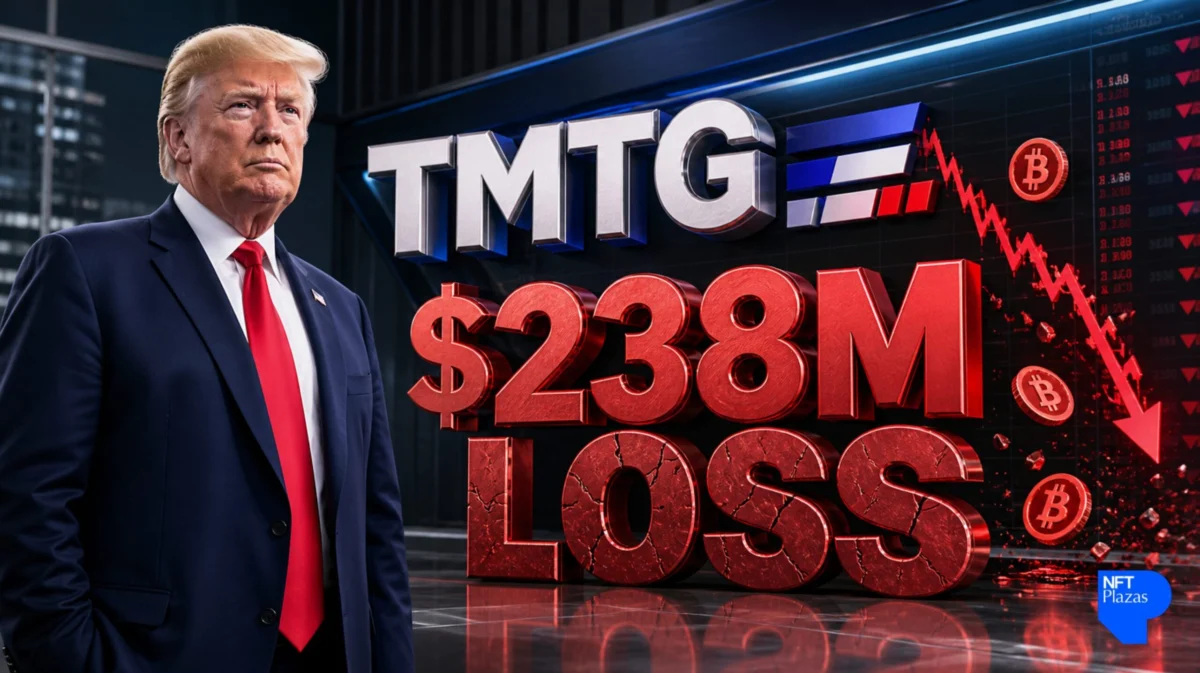
Trump Media & Technology Group (TMTG), the parent company behind the social media platform Truth Social, reported a staggering net loss of $238.1 million for the second quarter of 2026. This figure represents a dramatic increase from the $20 million loss recorded in the same period last year and primarily stems from significant declines in the valuation of its digital asset holdings and bitcoin-related securities. The company’s 10-Q filing with the Securities and Exchange Commission (SEC) revealed that while quarterly revenue reached a modest $1.7 million, its financial performance was overwhelmingly influenced by its substantial, and increasingly volatile, cryptocurrency portfolio, raising questions about its core business identity and future financial stability.
A Deep Dive into Q2 Financials: Revenue Stagnation Amidst Soaring Losses
For the three months ended June 30, 2026, Trump Media’s revenue stood at $1.67 million. While this marked an 89% increase from approximately $883,000 reported in Q2 2025, it remains minuscule when juxtaposed with the company’s escalating losses. The dramatic widening of the net loss to $238.1 million from $20 million year-over-year signals a critical shift in the company’s financial dynamics, moving from operational losses typical of a nascent social media platform to investment-driven downturns.
Further complicating the financial picture, Trump Media reported an Adjusted EBITDA loss of $223.5 million for the quarter, a sharp contrast to the $12.8 million loss in the prior-year period. Adjusted EBITDA is a non-GAAP (Generally Accepted Accounting Principles) metric favored by the company, which excludes certain items such as interest expense, taxes, depreciation, and stock-based compensation. While designed to provide a clearer view of operational profitability, the substantial increase in this adjusted loss figure still underscores significant underlying financial challenges that extend beyond mere accounting adjustments. The company’s reliance on such non-GAAP metrics, while common, often draws scrutiny from financial analysts seeking to understand the full scope of financial health under standard accounting principles.
A critical point emphasized in the company’s financial disclosure is that the vast majority of the quarter’s loss, approximately $190.4 million, was non-cash. These non-cash losses primarily comprise unrealized losses from digital assets, pledged digital assets, and equity securities. This distinction highlights that while the losses are substantial on paper, they do not necessarily reflect immediate cash outflows but rather mark-to-market adjustments based on current asset valuations. Despite the modest growth in advertising, Truth+ subscriptions, and management fees from Truth.Fi, the core media revenue streams were overshadowed by these asset markdowns, dominating the bottom-line results and shaping the company’s financial narrative for the quarter.
The Volatile Core: Cryptocurrency Holdings as a Double-Edged Sword
The most significant factor contributing to Trump Media’s precipitous Q2 loss was the substantial decline in the value of its digital asset segment. The 10-Q filing meticulously detailed this erosion, showing that the company’s digital assets line item plummeted from $904.4 million at the end of 2025 to $597.7 million as of June 30, 2026. This represents a staggering decline of approximately $306.7 million in just six months. When factoring in pledged or restricted digital assets, the total value of these holdings dropped from an approximate $1.08 billion to $719.8 million during the same period, underscoring the profound impact of crypto market volatility on TMTG’s balance sheet.
On the income statement, the company formally recorded $116.7 million in realized and unrealized losses from digital assets specifically within the second quarter. For the entire first half of 2026, these losses accumulated to a colossal $360.6 million. Trump Media explicitly attributed this decline to the period-end prices of Bitcoin and Cronos, two major cryptocurrencies held in its portfolio, across leading digital asset markets. The Q2 2026 period was characterized by a broad market downturn in the cryptocurrency space, with many digital assets experiencing significant corrections following earlier highs. This broader market trend directly impacted TMTG’s substantial holdings, flowing directly into its bottom line through mark-to-market accounting.
This heavy exposure to volatile digital assets positions Trump Media uniquely among its peers in the social media industry. Unlike traditional media companies whose financial performance is typically tied to advertising sales, subscription numbers, and user engagement, TMTG’s quarterly results are now profoundly sensitive to the unpredictable swings of the cryptocurrency market. This financial structure distinguishes Trump Media, making it as much an investment vehicle for digital assets as it is an operator of a social media platform. The strategic decision to hold such a significant portion of its assets in cryptocurrencies, particularly given the inherent volatility, has created a high-risk, high-reward profile that, in Q2 2026, tilted heavily towards risk.
A Media Company with a Crypto-Heavy Balance Sheet: An Unconventional Model
Trump Media operates its flagship social media platform, Truth Social, alongside Truth+ (a premium content offering) and Truth.Fi (a financial information service). However, its second-quarter filing clearly illustrated that the dominant forces driving its financial fluctuations did not originate from these core media operations. With quarterly revenue of only $1.67 million, the scale of its media business appears dwarfed by its investment portfolio. As of June 30, 2026, the company’s total assets remained substantial at $2.02 billion.
The company’s financial structure is further illuminated by its disclosure of holding approximately $1.9 billion in financial assets. This includes a diversified portfolio of cash, short-term investments, equity securities, and, crucially, digital assets. Despite reporting massive losses, TMTG’s cash and short-term investments alone stood at approximately $424.6 million, indicating that the company still retains significant liquid financial resources. This robust cash position provides a buffer against immediate liquidity crises but does not negate the impact of the paper losses on shareholder equity and overall valuation.
This unconventional balance sheet structure sets Trump Media apart from typical social media companies like Meta Platforms (Facebook, Instagram) or X (formerly Twitter), whose financial health is almost exclusively judged by user growth, engagement metrics, and advertising revenue. For TMTG, investment fluctuations, particularly within its digital asset segment, can and demonstrably do overshadow any growth or operational performance from its media operations in any given quarter. This duality presents a complex investment proposition, as investors must not only evaluate the prospects of Truth Social as a media platform but also assess the company’s strategy and exposure to the highly speculative cryptocurrency markets. This model raises questions about the long-term sustainability and strategic direction of a company that, on one hand, aims to be a prominent voice in social media, and on the other, functions as a de facto cryptocurrency investment fund.
Truth API: A New Revenue Frontier Amidst Financial Headwinds
Following a quarter predominantly defined by asset markdowns, Trump Media is strategically pivoting towards Truth API as a central component of its revenue expansion plans. Launched on August 1, 2026, this new product represents a significant move into commercial data licensing. It offers enterprise clients high-speed access to public posts from several high-profile accounts on Truth Social, aiming to monetize the platform’s unique data streams.
The company has reported encouraging initial traction for Truth API, having secured more than 10 customer agreements by the time its second-quarter results were announced. Interim CEO Kevin McGurn confirmed that the product has already begun generating revenue and indicated plans to continuously expand its partner base. According to a report by the Associated Press (AP), McGurn disclosed that the service commands a fee ranging from approximately $60,000 to $100,000 per month. The primary clientele for Truth API are reportedly high-frequency trading firms, which value real-time data from influential sources to inform their trading strategies, particularly those that might be sensitive to political or public sentiment shifts.
At this price point, Truth API possesses the potential to rapidly evolve into a substantial and diversified revenue stream for Trump Media, provided that client retention remains strong and the customer base continues to grow. This initiative is crucial for the company, offering a pathway to generate revenue independent of traditional advertising models and insulated from the volatility of its crypto holdings. However, the product is not without its sensitivities. Truth Social serves as a frequent publishing platform for former President Donald Trump, whose statements can exert significant influence on financial markets and public discourse. The commercialization of data linked to such an influential figure introduces a layer of scrutiny regarding data usage, potential market manipulation, and ethical considerations.
Despite these sensitivities, Trump Media has preemptively rejected criticisms surrounding Truth API. The company argues that providing public data under commercial licensing agreements is a widely accepted and common practice across the technology, media, and financial information industries. They maintain that this move aligns with established industry standards for monetizing valuable data assets, positioning it as a legitimate and strategic business endeavor rather than a contentious one. The success of Truth API will be a key indicator of TMTG’s ability to diversify its income and establish more predictable revenue streams in the coming quarters.
Debt, Merger Aspirations, and the Road Ahead
Beyond its operational and investment challenges, Trump Media faces significant considerations regarding its capital structure and strategic future. As of June 30, 2026, the company reported approximately $970.3 million in debt, excluding lease obligations. A critical point highlighted in its 10-Q filing is the potential need to refinance convertible notes if bondholders choose to exercise their right to demand cash redemption in November 2026. This potential demand for a substantial cash payout could place considerable strain on the company’s liquidity, despite its current cash reserves.
The company has, however, expressed confidence in its current financial standing, stating that its existing funds are sufficient to cover operational expenses for at least the next 12 months. Nevertheless, it also acknowledged the possibility of needing to raise additional capital. This may become necessary for various strategic purposes, including funding potential acquisitions, making new investments, or supporting other strategic expansions that could accelerate growth or diversify its business further. This forward-looking statement suggests that while immediate liquidity may not be a concern, the company is actively assessing its longer-term capital needs for growth initiatives.
Adding another layer of complexity and strategic ambition, Trump Media continues to pursue its proposed merger with TAE Technologies, a fusion energy enterprise. This unconventional proposed acquisition aims for completion in the fourth quarter of 2026, contingent upon securing necessary regulatory approvals and satisfying customary closing conditions. A merger with a cutting-edge energy company would represent a radical departure from TMTG’s current identity as a media and digital asset holding company. Such a move could fundamentally reshape its business model, potentially diversifying its portfolio into advanced technology sectors. However, it also introduces substantial integration challenges, regulatory hurdles, and the need to convince investors of the strategic synergy between a social media platform and a fusion energy developer. The successful execution of this merger could redefine Trump Media’s future trajectory, but its inherent complexities and the significant capital requirements it might entail will be closely watched by financial markets and investors alike. The road ahead for Trump Media is clearly one marked by significant financial volatility, strategic diversification attempts, and ambitious corporate maneuvers.