Dwi Wanna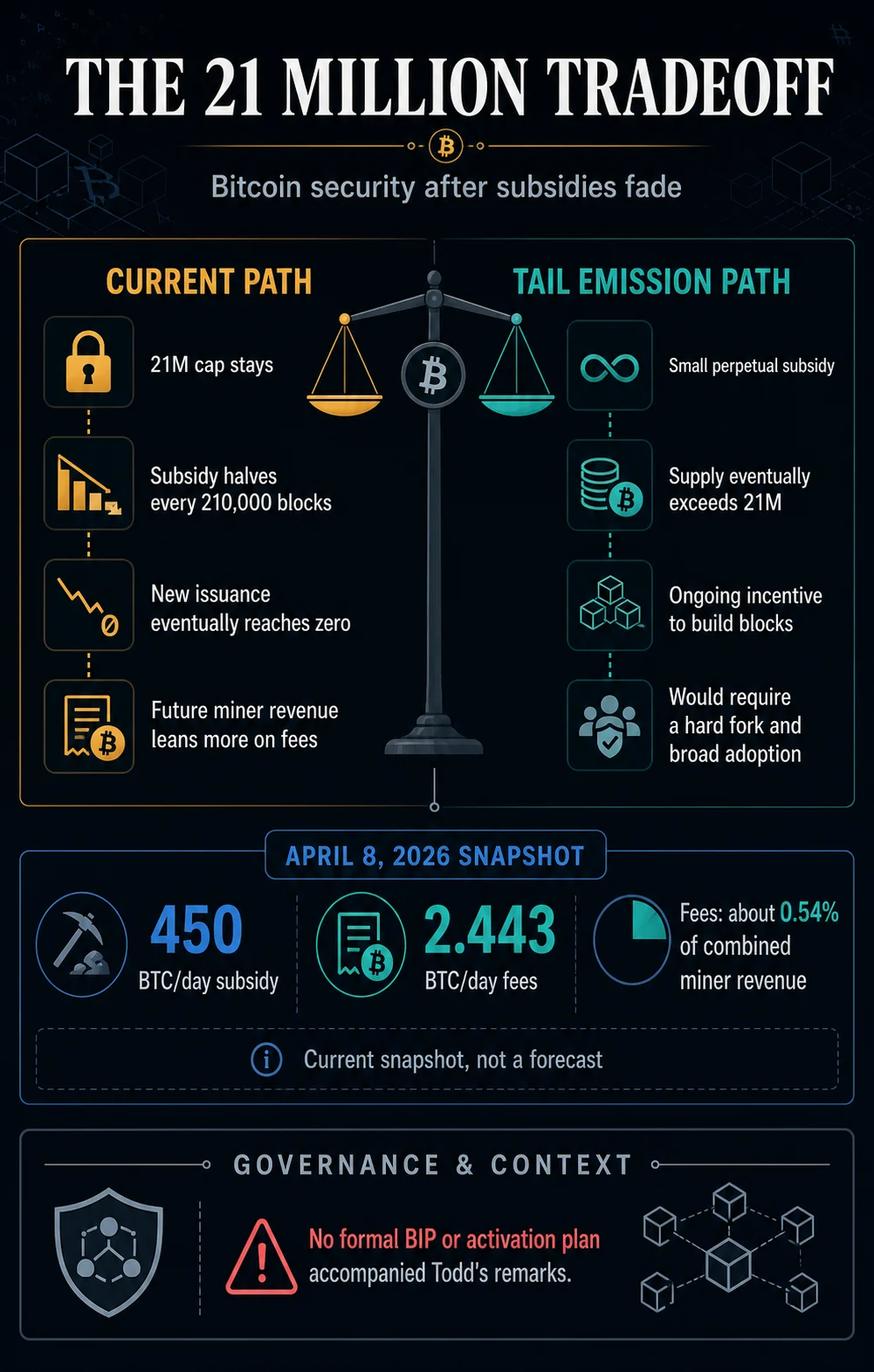
The long-standing ideological pillar of Bitcoin—its hard-capped supply of 21 million coins—has once again become the center of intense scrutiny within the digital asset community. Peter Todd, a prominent early developer and influential figure in the Bitcoin ecosystem, recently reignited a debate regarding the long-term viability of the network’s security model. The crux of the discussion centers on whether transaction fees alone can provide sufficient incentive for miners to secure the network as the block subsidy, which currently provides the lion’s share of miner revenue, continues to diminish every four years.
This debate, while not new, gained fresh momentum following the circulation of a video clip from the Bitcoin++ conference held in Toronto in July 2024. In his presentation, Todd suggested that the transition from a subsidy-heavy revenue model to a fee-dominant one is an unprecedented "phase change" for a proof-of-work (PoW) blockchain of Bitcoin’s scale. With current data showing that transaction fees often account for less than 1% of total miner compensation, the question of whether a "tail emission"—a small, perpetual issuance of new coins—might be necessary to ensure the network’s survival is no longer confined to the fringes of technical discourse.
The Mechanics of Bitcoin’s Security Budget
To understand the gravity of Todd’s concerns, one must examine the fundamental architecture of Bitcoin’s issuance schedule. Since its inception in 2009, Bitcoin has operated on a programmatic monetary policy where new coins are issued to miners for every block added to the blockchain. This "block subsidy" is halved approximately every four years, or every 210,000 blocks. At the network’s launch, the subsidy was 50 BTC; following the most recent halving in April 2024, it stands at 3.125 BTC.
The ultimate goal of this design, as envisioned by Satoshi Nakamoto, was for the network to eventually transition to a system where miners are compensated exclusively through transaction fees paid by users. However, the "security budget"—the total amount paid to miners to protect the network from double-spending and 51% attacks—must remain high enough to make an attack prohibitively expensive.
Recent data highlights a significant gap in this transition. In a snapshot from April 8, 2026, projections indicated that miners collected approximately 2.443 BTC in daily transaction fees, compared to a daily subsidy of roughly 450 BTC. In this specific instance, fees accounted for a mere 0.54% of total miner revenue. If the market price of Bitcoin does not rise exponentially or if transaction volume and fee density do not increase dramatically, the total security budget could drop significantly as the subsidy nears zero, potentially exposing the network to vulnerabilities.
Chronology of the 21 Million Cap Debate
The debate over Bitcoin’s supply limit has appeared in various forms throughout the network’s history. While the 21 million figure is often treated as a sacred "social contract," technical discussions regarding its sustainability have surfaced during periods of low network activity or price stagnation.
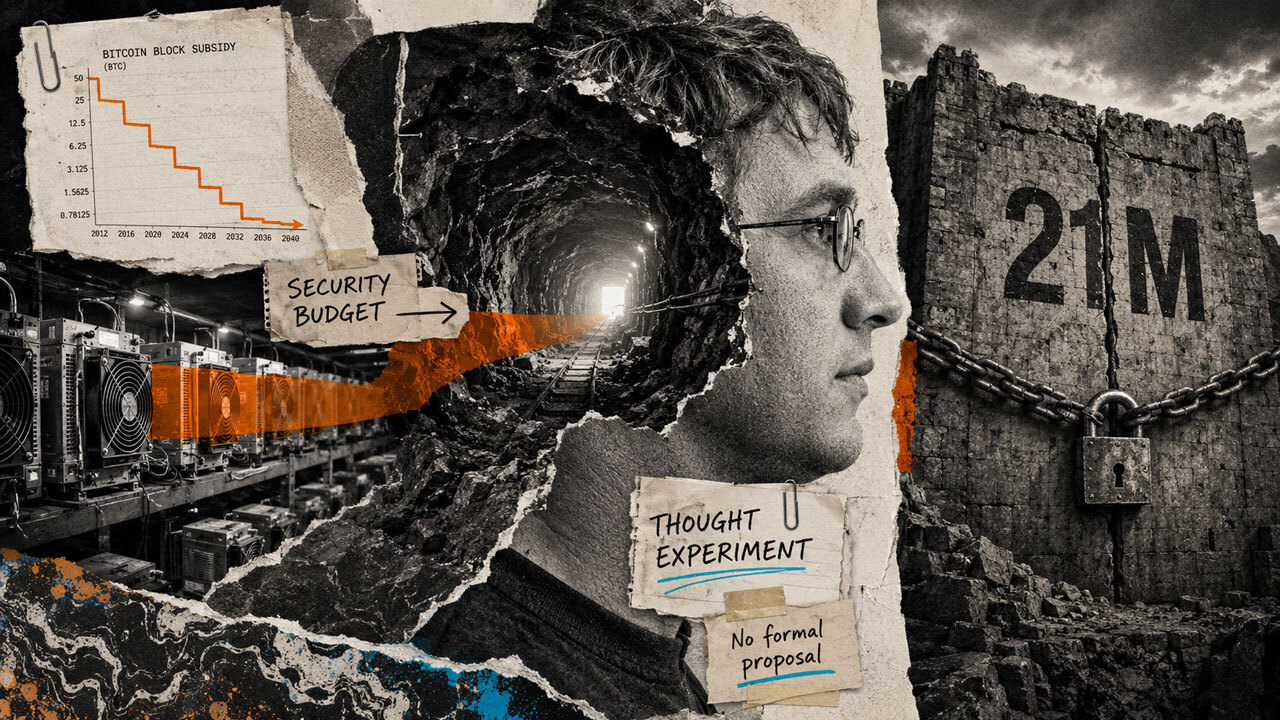
In 2022, Peter Todd addressed these concerns during a public Ask Me Anything (AMA) session. At that time, he described the shift to a fee-only model as a "major state change" that no other major proof-of-work currency had successfully navigated at scale. He noted that while other coins like Monero have implemented a "tail emission" to provide a permanent security floor, Bitcoin has remained steadfast in its commitment to a fixed supply.
The most recent escalation began on July 23, 2024, during Todd’s talk at Bitcoin++ Toronto. He argued that there is no empirical evidence to prove that a multi-trillion-dollar network can be secured solely by a fluctuating fee market. On August 16, 2024, a clip of this talk went viral on social media platforms, leading to a polarized reaction from the community. Critics accused Todd of attacking Bitcoin’s core value proposition, while supporters argued that he was merely highlighting a mathematical reality that the community must eventually confront.
Analyzing the Tail Emission Proposal
A tail emission would involve a permanent, small percentage of annual inflation—perhaps as low as 0.5% or 1%—that would continue indefinitely after the 21 million coins have been mined. Proponents of this idea, including Todd in his theoretical framing, argue that a predictable, low-inflation subsidy provides several benefits:
- Security Stability: It ensures miners have a consistent revenue stream regardless of transaction volume, maintaining a high hash rate and network difficulty.
- Market Predictability: It avoids the "fee death spiral" where low fees lead to lower security, which in turn reduces the network’s utility and further lowers fees.
- Economic Minimal Impact: Todd argued that a 1% or lower annual issuance would be economically negligible compared to Bitcoin’s historical price volatility, yet technically significant for miner incentives.
However, Todd himself has acknowledged the primary obstacle to such a change: the requirement of a hard fork. Unlike a soft fork, which is backward-compatible, a hard fork to change the supply cap would require every node operator in the world to upgrade their software. In the decentralized and contentious world of Bitcoin governance, such a move is widely considered a "nuclear option" that could lead to a permanent split in the network, similar to the Bitcoin/Bitcoin Cash schism of 2017.
Responses from Key Industry Figures
The reaction to Todd’s reopening of the debate was swift and largely defensive of the status quo. Prominent voices within the Bitcoin space emphasized the importance of the 21 million cap as a foundational element of Bitcoin’s identity as "digital gold."
Dan Held, a well-known Bitcoin educator and marketing executive, dismissed the proposal, linking to his 2019 essay on the importance of predictable monetary rules. Held argued that the value of a monetary system is derived from the participants’ confidence that the rules will not change when they become inconvenient. From this perspective, the 21 million cap is less a technical parameter and more a psychological and social guarantee.
Giacomo Zucco, a Bitcoin researcher and consultant, provided a more nuanced critique. Zucco suggested that while a low tail emission might not technically "break" Bitcoin’s utility, the act of arbitrarily changing the network’s established economic fundamentals would be existential. He warned that if the 21 million cap can be changed once, it can be changed again, undermining the scarcity that drives Bitcoin’s investment thesis.

Hodlonaut, another influential figure in the Bitcoin community, echoed these sentiments, warning that a "gradual erosion" of Bitcoin’s ethos and culture would weaken the social defenses necessary to protect the network from more significant external pressures.
The Technical Reality of Changing Bitcoin Core
From a technical standpoint, the 21 million cap is enforced by the consensus rules within the Bitcoin Core software. Specifically, the chainparams.cpp file in the Bitcoin source code defines the 210,000-block halving interval. To change this, a developer would need to submit a Bitcoin Improvement Proposal (BIP) or a pull request to the Bitcoin Core repository.
However, the power to change Bitcoin does not reside solely with the developers. The network is composed of thousands of independent node operators, miners, and exchanges. For a change to the supply cap to take effect, the majority of these participants would need to voluntarily run software that recognizes the new issuance schedule. Given the current cultural climate surrounding Bitcoin, any attempt to increase the supply would likely be rejected by the vast majority of the network, leaving any "tail emission" chain as a minority fork with significantly less value and security than the original.
Broader Implications and Future Outlook
The debate reopened by Peter Todd highlights a fundamental tension in Bitcoin’s long-term roadmap. On one side is the ideological commitment to absolute scarcity, which has fueled Bitcoin’s rise as a global reserve asset. On the other side is the pragmatic, engineering-focused concern for the network’s physical security in a post-subsidy world.
If transaction fees do not grow to fill the gap left by the subsidy, the network may have to rely on other forms of security or structural changes. Some suggest that the growth of "Layer 2" solutions like the Lightning Network or the emergence of new protocols like Ordinals and Runes—which increase demand for on-chain block space—will naturally drive up fee revenue. Indeed, periods of high activity related to these protocols have occasionally seen transaction fees exceed the block subsidy, providing a glimpse of a potential fee-based future.
As of late 2024, Bitcoin continues to dominate the cryptocurrency market with a valuation exceeding $1.4 trillion. Its price remains sensitive to macroeconomic factors and institutional adoption, such as the approval of spot ETFs. While the "security budget" debate is unlikely to impact the immediate price action of Bitcoin, it remains a critical long-term consideration for developers and large-scale stakeholders.
The consensus among the majority of the Bitcoin community remains firm: the 21 million cap is non-negotiable. However, as the block subsidy continues to shrink with each passing halving, the technical community will be forced to keep a close eye on the ratio of fees to subsidies. Whether through the organic growth of a fee market or through future technical innovations that enhance security efficiency, Bitcoin’s ability to maintain its "digital gold" status will depend on its capacity to remain secure without compromising its most famous promise.