admin
admin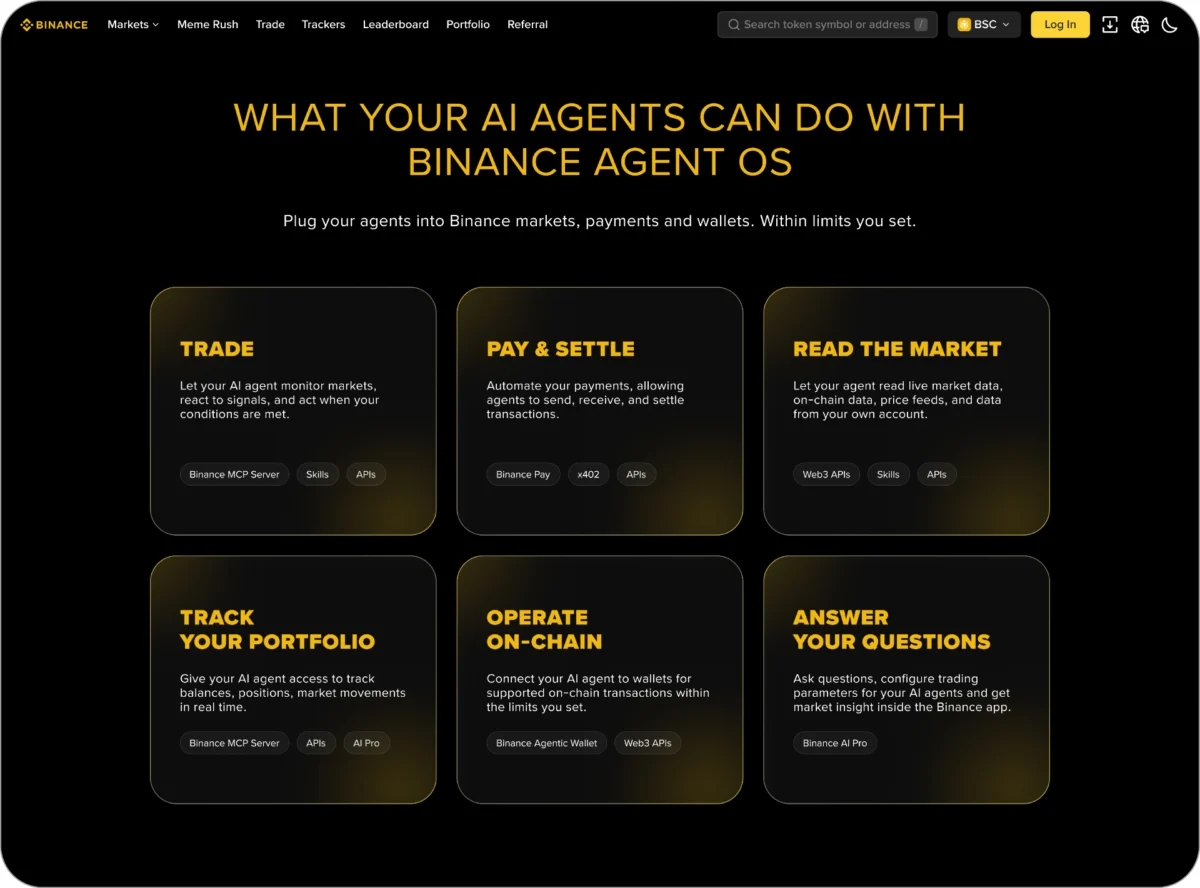
Binance, the world’s largest cryptocurrency exchange by trading volume and user base, has officially entered the era of autonomous finance with the launch of Agent OS. This new platform, unveiled on Thursday, is designed to allow artificial intelligence (AI) agents to analyze complex market data and execute trades on behalf of users, effectively moving the needle from AI as a conversational tool to AI as a functional financial operator. With more than 300 million registered users, Binance’s move signals a major shift in the retail and institutional landscape, where the management of real-world capital is increasingly being handed over to automated, intelligent systems.
The Agent OS platform serves as a bridge between the exchange’s deep financial infrastructure and the rapidly evolving ecosystem of AI development. By providing a suite of specialized tools, Binance aims to enable developers to build agents that are not only capable of identifying market trends but are also empowered to interact directly with the exchange’s order books, wallets, and payment protocols. This integration represents a significant milestone in the intersection of decentralized finance (DeFi) and machine learning, offering a structured environment for the deployment of "agentic" applications.
Technical Architecture and Integration Capabilities
At its core, Agent OS is a developer-centric environment that consolidates several of Binance’s existing and new technological offerings. The platform integrates the Binance APIs, the Binance Wallet Agentic Hub, and the Binance Skill Hub. A standout feature of the new launch is the support for the Model Context Protocol (MCP), an open-source standard that allows AI models to connect more seamlessly with external data sources and tools. By adopting MCP, Binance ensures that its infrastructure is compatible with the industry’s leading AI models and development environments.
The platform is built to work with a variety of high-profile AI tools, including OpenAI’s ChatGPT and Codex, Anthropic’s Claude Code, and the AI-powered code editor Cursor. Through these integrations, users can authorize their chosen AI agents to access real-time market data, view comprehensive account information, and execute trades across various pairs. The inclusion of the Binance x402 transaction verification and payment facilitator API further extends the capabilities of these agents, allowing them to handle settlement and payment workflows that were previously restricted to human-initiated actions.
According to Jeff Li, Vice President of Product at Binance, the philosophy behind Agent OS is to provide a "sandbox" for innovation while maintaining strict boundaries. "Instead of total freedom, we put the power in users’ hands to give them the granular access control of what they can do through the agent," Li stated in a recent interview. This granular control is essential for a platform that allows non-human entities to interact with liquid assets in a 24/7 market.
The Security Framework: Sub-Accounts and Risk Mitigation
Entrusting financial decisions to an AI agent carries inherent risks, ranging from algorithmic errors to external manipulation. To address these concerns, Binance has built Agent OS around a robust "sub-account" architecture. Users do not grant agents access to their primary accounts; instead, they create dedicated sub-accounts that act as isolated environments for the agent’s activities. These sub-accounts can be configured for specific purposes, such as spot trading or futures trading, ensuring that an agent’s strategy is confined to a particular market segment.
One of the primary safety features is the default blocking of withdrawals from these sub-accounts. By preventing an agent from moving funds out of the Binance ecosystem, the platform mitigates the risk of an agent being hijacked for the purpose of draining a user’s wallet. Furthermore, users retain the ability to decide the level of autonomy granted to the agent. A user can configure the system so that the agent must seek manual approval for every individual order, or they can opt for full autonomy where the agent executes trades based on its internal logic once pre-set permissions are met.
Notably, Binance does not impose a universal cap on the amount an AI agent can trade or lose within the exchange’s trading environment. Instead, the total balance a user transfers into the sub-account serves as the effective limit. This places the burden of risk management squarely on the user’s shoulders. However, for transactions involving the Agentic Wallet—which interacts with on-chain protocols—Binance has instituted specific daily limits:
- Regular Swaps: Capped at $50,000 per day.
- DeFi Transactions: Default limit of $100,000 per day.
- x402 Payments: Limited to $20 per day.
The Challenge of AI Accountability and "Reasoning"
A critical aspect of the Agent OS deployment is the location of the AI’s "reasoning" process. Jeff Li clarified that the actual decision-making—the logic that leads an agent to buy or sell—occurs outside of Binance’s internal systems. The reasoning happens either on the user’s local hardware or within the cloud infrastructure of the AI provider (such as OpenAI or Anthropic). Consequently, Binance can monitor the resulting trades but cannot see the underlying rationale or the data points the agent used to reach its conclusion.
This creates a "black box" scenario that presents unique challenges for security. If an agent is compromised via a "prompt injection" attack—where a malicious actor provides the AI with deceptive instructions designed to bypass its guardrails—Binance would only see the final trade execution. Li emphasized that the sub-account structure remains the primary line of defense in such cases. While Binance applies its standard security, risk-control, and anti-money-laundering (AML) policies to Agent OS, the platform’s visibility into the "why" behind a trade is limited, placing a premium on the integrity of the external AI model.
Market Context and the Rise of Agentic Finance
Binance’s launch of Agent OS is part of a broader industry trend toward "Agentic Finance." As the crypto market matures, the demand for sophisticated, automated tools has moved beyond simple grid-trading bots to systems that can parse sentiment, read news reports, and adjust strategies in real-time.
The timeline of this evolution has accelerated rapidly over the past year:
- March 2024: Kraken launched an open-source command-line tool with a built-in MCP server, allowing agents to execute spot and futures trades.
- June 2024: Coinbase introduced "Coinbase for Agents," a platform allowing AI to trade, make payments, and execute financial workflows within user-defined limits.
- Mid-2024: OKX enabled "agentic trading" by releasing an open-source MCP toolkit for its developer community.
- August 2024: Binance enters the fray with Agent OS, leveraging its massive liquidity and user base to scale the technology.
This competitive landscape suggests that the major exchanges are no longer just competing on liquidity and fees, but on the quality of their developer tools and their ability to integrate with the AI stack. The goal is to become the underlying financial "operating system" for the next generation of autonomous applications.

Implications for the Future of Trading
The introduction of Agent OS has significant implications for both retail and institutional market participants. For retail users, it democratizes access to high-frequency and complex algorithmic trading strategies that were previously the domain of sophisticated hedge funds. An AI agent can monitor global markets across multiple time zones, reacting to breaking news or price fluctuations faster than any human could.
However, the widespread adoption of AI agents could also lead to increased market volatility. If a large number of agents are programmed with similar logic or trained on similar datasets, they may react to market events in a synchronized fashion, potentially leading to "flash crashes" or exaggerated price movements. Furthermore, the reliance on external AI models introduces a new layer of systemic risk; a service outage at a major AI provider could theoretically paralyze a significant portion of the market’s trading volume.
From a regulatory perspective, Agent OS sits at a complex intersection. Financial regulators worldwide are currently grappling with how to oversee AI in finance. The fact that Binance’s platform allows agents to operate with real money—even with sub-account restrictions—is likely to draw the attention of oversight bodies concerned with market manipulation, consumer protection, and the "flash crash" risks mentioned above.
Conclusion: A First Step Toward an Autonomous Economy
Jeff Li described Agent OS as Binance’s "first step" in a long-term strategy to provide a platform where AI can act across both crypto and traditional financial markets. By bridging the gap between LLMs (Large Language Models) and financial execution, Binance is betting that the future of wealth management is not just digital, but autonomous.
As the technology evolves, the industry can expect to see more specialized "skills" added to the Binance Skill Hub, potentially allowing agents to perform even more complex tasks such as tax optimization, cross-chain arbitrage, and automated participation in decentralized governance. For now, Agent OS stands as a powerful, if experimental, tool that places the immense power of AI directly into the hands of the global crypto-trading community, shifting the responsibility of risk management from the exchange to the algorithm and its human architect.