Dwi Wanna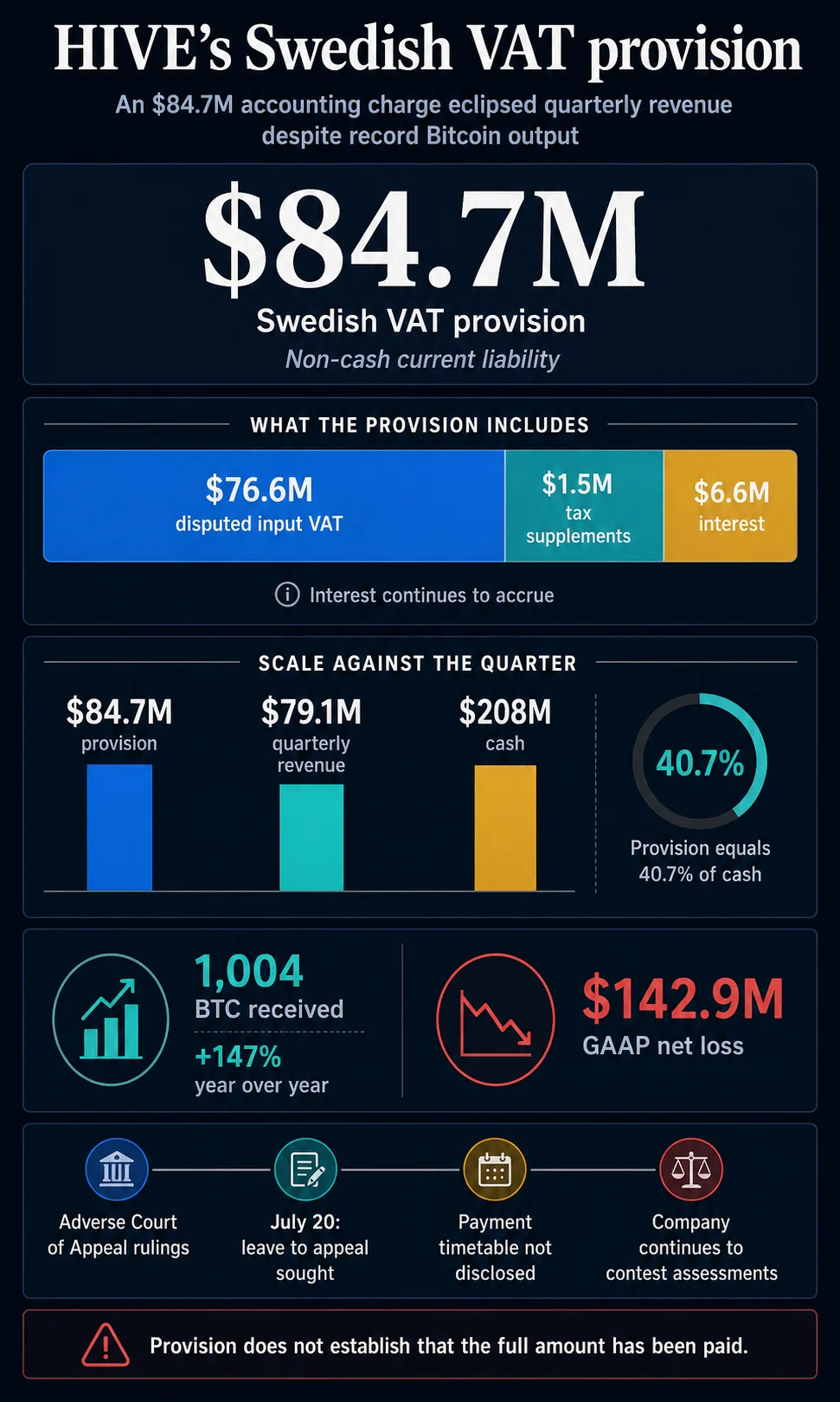
HIVE Digital Technologies, a prominent player in the global cryptocurrency mining and high-performance computing sectors, recently disclosed a financial quarter defined by a stark contrast between operational excellence and a mounting regulatory burden. The company’s latest filings reveal an $84.7 million non-cash Swedish tax provision related to a long-standing and increasingly complex Value Added Tax (VAT) dispute with the Swedish Tax Agency. This provision, which is classified as a current liability, significantly impacted the company’s bottom line, overshadowing a quarter where HIVE achieved a record-breaking Bitcoin production of 1,004 BTC.
The financial magnitude of the tax provision is substantial, representing approximately 40.7% of HIVE’s $208 million cash and cash equivalents reported at the end of the period. More notably, the $84.7 million figure surpassed the company’s total quarterly revenue of $79.1 million. When calculated against the market price of Bitcoin on August 18, 2026—approximately $65,058 per coin—the tax provision is equivalent to roughly 1,215 BTC. This amount is 21.5% higher than the total number of Bitcoins HIVE produced during the entire quarter, illustrating the severe impact of the Swedish regulatory environment on the company’s financial health.
The Anatomy of a $142.9 Million Net Loss
HIVE reported a GAAP net loss of $142.9 million for the quarter. While the $84.7 million Swedish tax provision was the primary driver of this deficit, several other accounting factors contributed to the final figure. The company recorded $53.7 million in depreciation expenses, a standard non-cash charge reflecting the wear and tear on its extensive fleet of ASIC mining rigs and data center infrastructure. Additionally, $7.1 million was attributed to share-based compensation, and another $7.1 million stemmed from a change in the valuation of derivative instruments.
Despite these heavy accounting losses, HIVE’s operational performance showed significant year-over-year growth. The company generated $72.1 million in pure crypto mining revenue, a figure bolstered by the receipt of 1,004 BTC. This production level represents a 147% increase compared to the 406 BTC produced in the same quarter of the previous year. This growth highlights the company’s success in upgrading its mining hardware and expanding its hash rate capacity, even as the "halving" events and increasing network difficulty present constant challenges to the industry.
The Swedish VAT Dispute: A Chronological Overview
The core of HIVE’s current financial distress lies in a contested assessment by the Swedish Tax Agency (Skatteverket). The dispute centers on the eligibility of cryptocurrency mining activities for VAT recovery. In the European Union and Sweden, VAT is typically a tax on consumption, and businesses can often claim "input VAT" credits for taxes paid on business expenses, provided they are making taxable supplies of goods or services.

The Swedish Tax Agency has taken an increasingly restrictive view of this policy. Their current stance posits that Bitcoin mining, which involves solving cryptographic puzzles to secure a network and receive block rewards, does not constitute a "service" provided to a specific, identifiable counterparty for consideration. Consequently, the agency argues that mining operations are not eligible to recover the VAT they pay on electricity, hardware, and other operational costs.
The timeline of the dispute indicates a tightening legal noose:
- Early 2024: The Swedish Tax Agency began issuing decisions and proposed decisions challenging the VAT recovery claims of several large-scale mining operations within the country, including HIVE’s Swedish subsidiary.
- January 2026: A critical advance ruling from the Swedish Council on Advanced Tax Rulings suggested that certain electronic services provided by miners might not qualify for traditional VAT exemptions or credits, reinforcing the Tax Agency’s aggressive posture.
- March 31, 2026: In its annual filing, HIVE disclosed that it had not yet paid a separately demanded tranche of SEK 84 million (approximately $9.4 million), signaling the beginning of a more intensive legal standoff.
- July 20, 2026: Following adverse lower court rulings, HIVE applied for leave to appeal to the Supreme Administrative Court of Sweden. This is the highest legal authority for tax matters in the country.
- August 2026: HIVE officially booked the $84.7 million provision. This decision followed a reassessment by the company’s management and legal counsel, who determined that a favorable outcome in the Supreme Administrative Court was "remote."
Breakdown of the $84.7 Million Provision
The $84.7 million provision is not a monolithic figure but a combination of several liabilities accrued over multiple fiscal periods. According to the company’s SEC filings, the breakdown is as follows:
- Disputed Input VAT ($76.6 million): This is the principal amount that the Swedish Tax Agency claims HIVE was never entitled to recover from its operational expenses.
- Tax Supplements ($1.5 million): These represent penalties imposed by the Swedish authorities for what they deem to be incorrect tax filings in previous years.
- Interest ($6.6 million): Interest on the disputed amounts has continued to accrue while the case moved through the court system.
The provision covers decisions totaling SEK 769.6 million, plus an additional SEK 52.4 million for the period ending June 30, 2026. Because interest continues to accumulate until a final settlement is reached or the taxes are paid, the ultimate financial exposure for HIVE could potentially exceed the $84.7 million currently recognized on the balance sheet.
Regulatory Context and Industry Implications
Sweden was once considered a premier destination for cryptocurrency miners due to its abundant renewable energy, cold climate (which reduces cooling costs), and previously favorable tax environment. However, the Swedish government has pivoted significantly. In recent years, it has removed tax breaks for data centers and expressed concerns about the energy consumption of "proof-of-work" mining relative to its perceived economic benefit.
HIVE’s struggle is not an isolated incident. The Swedish Tax Agency’s guidance distinguishes between mining/verification without identifiable counterparties and the supply of external compute capacity for fixed consideration. The latter—often referred to as High-Performance Computing (HPC) or cloud service provision—remains a VAT-eligible activity. This distinction is a primary reason why HIVE and many of its peers are aggressively pivoting their business models toward AI and HPC services. By providing compute power to specific corporate clients, these companies can more clearly define their activities as taxable services, thereby safeguarding their ability to recover VAT.

The broader implication for the mining industry is a potential "exodus" from jurisdictions with high regulatory uncertainty. As miners face thinner margins following the 2024 Bitcoin halving, an $80 million tax bill can be the difference between long-term viability and insolvency.
Official Responses and Legal Outlook
HIVE Digital Technologies continues to dispute the Swedish Tax Agency’s assessments, maintaining that its operations were conducted in accordance with the laws and guidance in place at the time. However, the company’s decision to book the provision suggests a shift in strategy from optimistic litigation to conservative financial management. Under Generally Accepted Accounting Principles (GAAP), a company must record a provision for a loss contingency if the loss is both "probable" and "estimable." By recognizing this liability, HIVE is signaling to investors that the likelihood of avoiding the payment is now low.
While the provision is currently labeled as a "current liability," HIVE’s filings have not yet disclosed a firm payment timetable. The company has not stated whether it has posted security or if the Swedish authorities have granted a stay of execution while the Supreme Administrative Court considers the application for an appeal. This leaves a significant question mark regarding the timing of the actual cash outflow. If the Supreme Administrative Court refuses to hear the case—a common outcome for tax disputes that do not present a novel point of law—HIVE may be forced to settle the debt imminently.
Analysis of Future Stability
Despite the staggering nature of the Swedish tax provision, HIVE maintains a relatively strong liquidity position with $208 million in cash. The company’s ability to produce over 1,000 BTC in a single quarter demonstrates that its core "engine" remains functional and efficient. However, the "non-cash" nature of this provision is temporary; eventually, the liability must be settled in cash or assets.
To mitigate such risks in the future, HIVE is expected to continue diversifying its geographic footprint. The company has already established significant operations in Canada and Iceland, where the regulatory environments have historically been more predictable. Furthermore, the expansion into the HPC and AI sectors provides a "Plan B" that is less susceptible to the specific VAT challenges currently plaguing the pure-play Bitcoin mining sector in Sweden.
In conclusion, HIVE’s latest financial report is a tale of two realities: a company that has mastered the technical and operational demands of the Bitcoin network, yet remains vulnerable to the shifting sands of international tax law. The $84.7 million Swedish provision serves as a stark reminder to the entire cryptocurrency industry that regulatory risk is often the most significant "difficulty adjustment" of all. As HIVE awaits the final word from the Swedish courts, the market will be watching closely to see how the company manages its cash reserves against this looming obligation.