admin
admin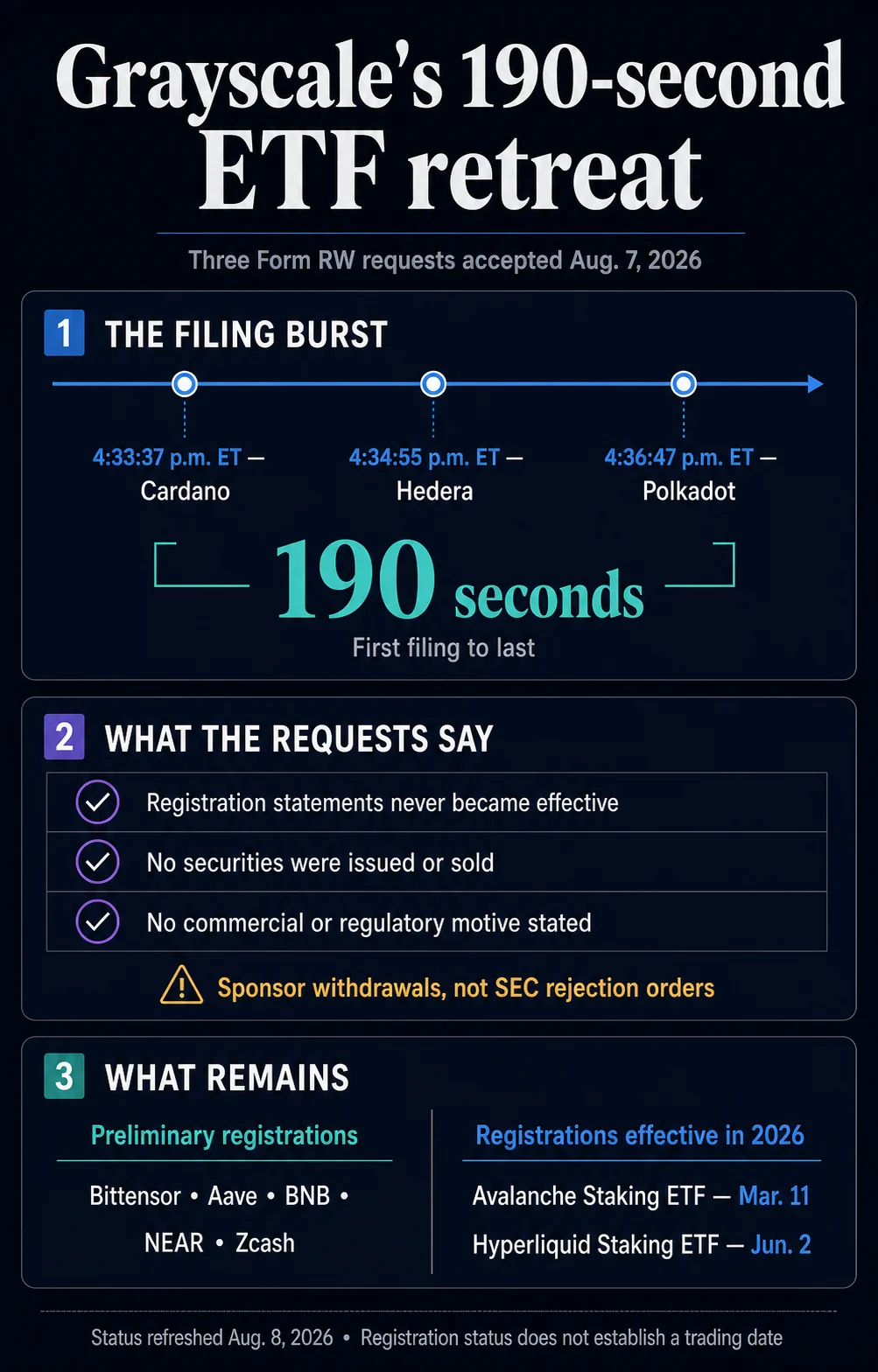
In a swift and largely unexplained series of events, Grayscale Investments, a prominent digital asset investment firm, has withdrawn the registration statements for three proposed exchange-traded funds (ETFs) focused on Cardano (ADA), Hedera (HBAR), and Polkadot (DOT). The withdrawals, filed on August 7th, occurred within a narrow 190-second window, raising questions within the cryptocurrency and investment communities about the firm’s strategic direction for these specific altcoin products.
The sequence of withdrawals began at 4:33:37 p.m. Eastern Time with the Grayscale Cardano Trust ETF filing. This was swiftly followed by the Grayscale Hedera Trust ETF at 4:34:55 p.m. ET, and concluded with the Grayscale Polkadot Trust ETF at 4:36:47 p.m. ET, according to official records from the U.S. Securities and Exchange Commission’s (SEC) Electronic Data Gathering, Analysis, and Retrieval (EDGAR) system. These filings, identified as Form RW, explicitly state Grayscale’s intent "not to proceed with the proposed distribution of shares." Crucially, the documents emphasize that the registration statements had not yet been declared effective by the SEC, meaning no securities had been issued or sold under them, and no preliminary prospectus had been distributed to potential investors.
A Pattern of Withdrawal: The Chronology of Events
The sudden withdrawal of these three altcoin ETF registrations is not an isolated incident but rather follows a pattern observed in earlier stages of the application process. For each of these proposed ETFs, the underlying exchange rule proposals, which are necessary for listing and trading on exchanges, had already been withdrawn by the respective exchanges.
Specifically, the U.S. Securities and Exchange Commission (SEC) records indicate that NYSE Arca withdrew its rule proposal for the Grayscale Cardano proposal on September 29, 2025. Similarly, Nasdaq withdrew its rule proposals for the Grayscale Polkadot and Grayscale Hedera ETFs on November 3, 2025. These exchange rule proposals, filed under Section 19(b) of the Securities Exchange Act of 1934, are distinct from the S-1 registration statements filed by the issuer, such as Grayscale. While the former addresses the listing and trading mechanics on an exchange, the latter pertains to the registration of the securities themselves with the SEC for public offering. The August 7th withdrawals, therefore, represent a subsequent and definitive step by Grayscale to formally retract their intention to launch these particular investment vehicles.
Unanswered Questions: The Lack of Explicit Rationale
A key aspect of these withdrawals is the absence of any detailed commercial or regulatory justification. The Form RW filings provide a standard operative explanation: Grayscale is choosing not to proceed with the proposed distribution of shares. They do not offer specific insights into market conditions, regulatory hurdles, or strategic re-evaluations that may have led to this decision. This lack of transparency leaves market observers to speculate on the underlying drivers.
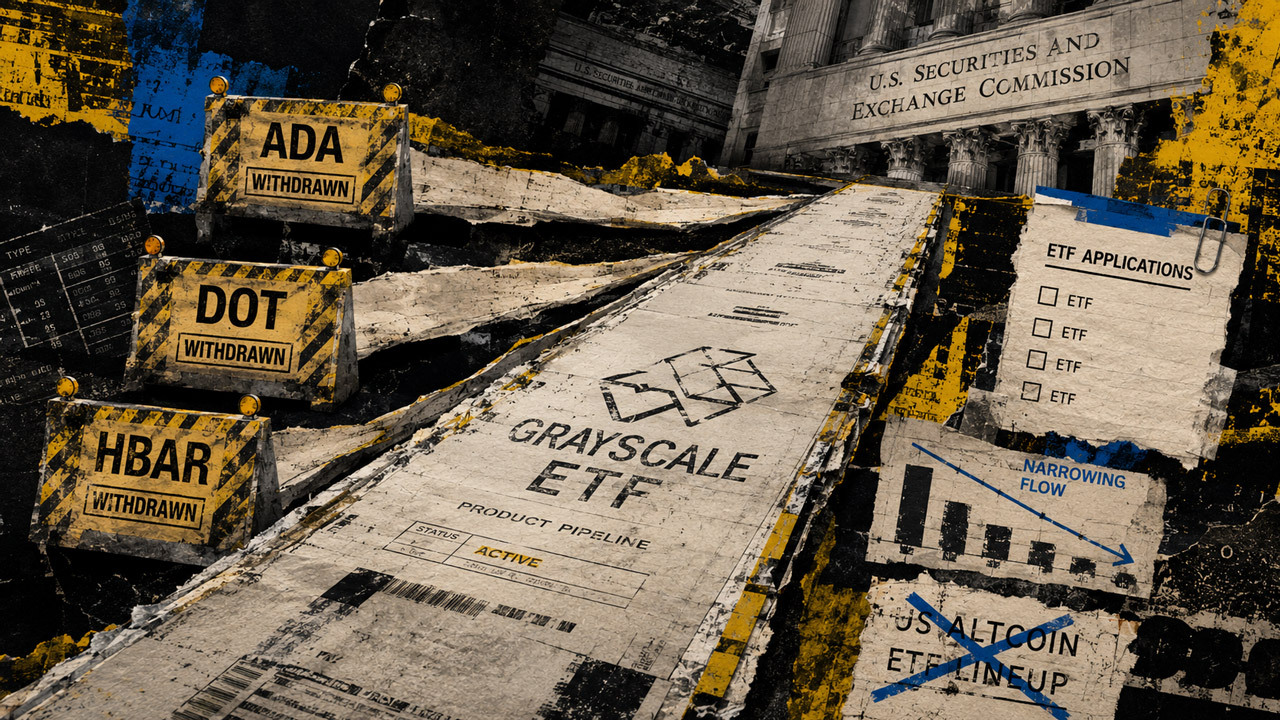
It is important to note that these withdrawals are not SEC orders rejecting the proposed ETFs. Instead, they are requests by Grayscale, under Rule 477 of the Securities Act of 1933, to withdraw their registration statements. This rule allows an issuer to withdraw a registration statement at any time prior to its effectiveness, provided that the withdrawal is requested by the applicant, the SEC has not issued an order for the suspension of the issuance or sale of securities, and the withdrawal is in the public interest.
Broader Context: The Evolving ETF Landscape
The recent moves by Grayscale occur within a dynamic and rapidly evolving landscape for cryptocurrency-related investment products. The SEC has shown increasing willingness to approve spot Bitcoin ETFs, a landmark decision that opened the door for other digital asset ETFs. In September 2025, the SEC approved generic listing standards for qualifying commodity-based trust shares. This regulatory shift allows eligible spot digital-asset products to potentially use these standardized listing rules, bypassing the need for individual product-specific Section 19(b) proposals. However, this approval did not automatically make registration statements effective nor did it eliminate the fundamental requirements of the Securities Act of 1933.
Grayscale’s previous filings for Cardano, Hedera, and Polkadot ETFs were likely attempts to navigate this regulatory framework, seeking to offer diversified exposure to these altcoins to institutional and retail investors. The decision to withdraw these applications, especially after the earlier withdrawal of exchange rule proposals, suggests a potential shift in Grayscale’s approach or a re-evaluation of the viability of these specific products in the current market environment.
Other Grayscale Altcoin Registrations: A Mixed Picture
The withdrawal of the Cardano, Hedera, and Polkadot ETF registrations leaves other proposed Grayscale altcoin products at various stages of the regulatory process. A review of EDGAR records as of August 8th reveals that registration statements for proposed ETFs focused on Bittensor (TAO), Aave (AAVE), and BNB (BNB) remain in a preliminary state and have not yet been declared effective. Similarly, registration statements for proposed NEAR Protocol (NEAR) and Zcash (ZEC) products are also listed as preliminary, indicating they have not achieved the crucial "effective" status. This preliminary status signifies that these applications are still under SEC review and do not guarantee future approval or market launch.
In contrast, two Grayscale altcoin staking products have advanced further in the registration process. The SEC declared the registration statements for the Grayscale Avalanche Staking ETF (AVAX) effective on March 11th, and the Grayscale Hyperliquid Staking ETF (HQLQ) effective on June 2nd. While the effectiveness of these registration statements is a significant regulatory milestone, it does not indicate when these products might begin trading or if they have commenced operations. The effectiveness merely signifies that the SEC has completed its review of the registration statements and finds them compliant with disclosure requirements, allowing for potential public offering of shares.
Potential Implications and Market Analysis
The strategic decisions behind these withdrawals are multifaceted and could stem from a combination of factors. One possibility is a reassessment of investor demand for ETFs focused on these particular altcoins. While Bitcoin and Ethereum have garnered significant institutional interest, the appetite for ETFs tracking smaller-cap or less established altcoins might be more limited or volatile.

Regulatory uncertainty, despite the recent approval of Bitcoin ETFs, could also play a role. The SEC’s approach to altcoin regulation remains a subject of ongoing debate and potential future scrutiny. Grayscale might be exercising caution, waiting for clearer regulatory guidance or a more favorable market sentiment before committing further resources to these products.
Furthermore, the cost and complexity of launching and maintaining ETFs are substantial. Grayscale may have concluded that the potential returns and market share for these specific altcoin ETFs do not justify the significant investment required, especially in comparison to other potential product offerings or their existing successful ETFs. The firm’s proactive management of its product pipeline, including the withdrawal of less promising ventures, is a standard practice in the asset management industry.
The withdrawals also highlight the ongoing distinction between the approval of generic listing standards and the effectiveness of individual product registrations. While generic standards can streamline the process, each proposed ETF still requires a thorough review of its specific structure, risks, and disclosures.
As the cryptocurrency market continues to mature and attract more traditional financial players, the demand for regulated investment products is expected to grow. Grayscale’s strategic decisions, whether to proceed with new offerings or withdraw existing ones, will continue to be closely watched by investors and industry participants alike. The firm’s ability to navigate the complex regulatory landscape and accurately gauge market demand will be critical to its future success in the burgeoning digital asset ETF space. The silent and swift withdrawal of the Cardano, Hedera, and Polkadot ETF registrations serves as a subtle yet significant indicator of the ongoing strategic recalibrations within one of the leading players in the digital asset investment sector.