Dwi Wanna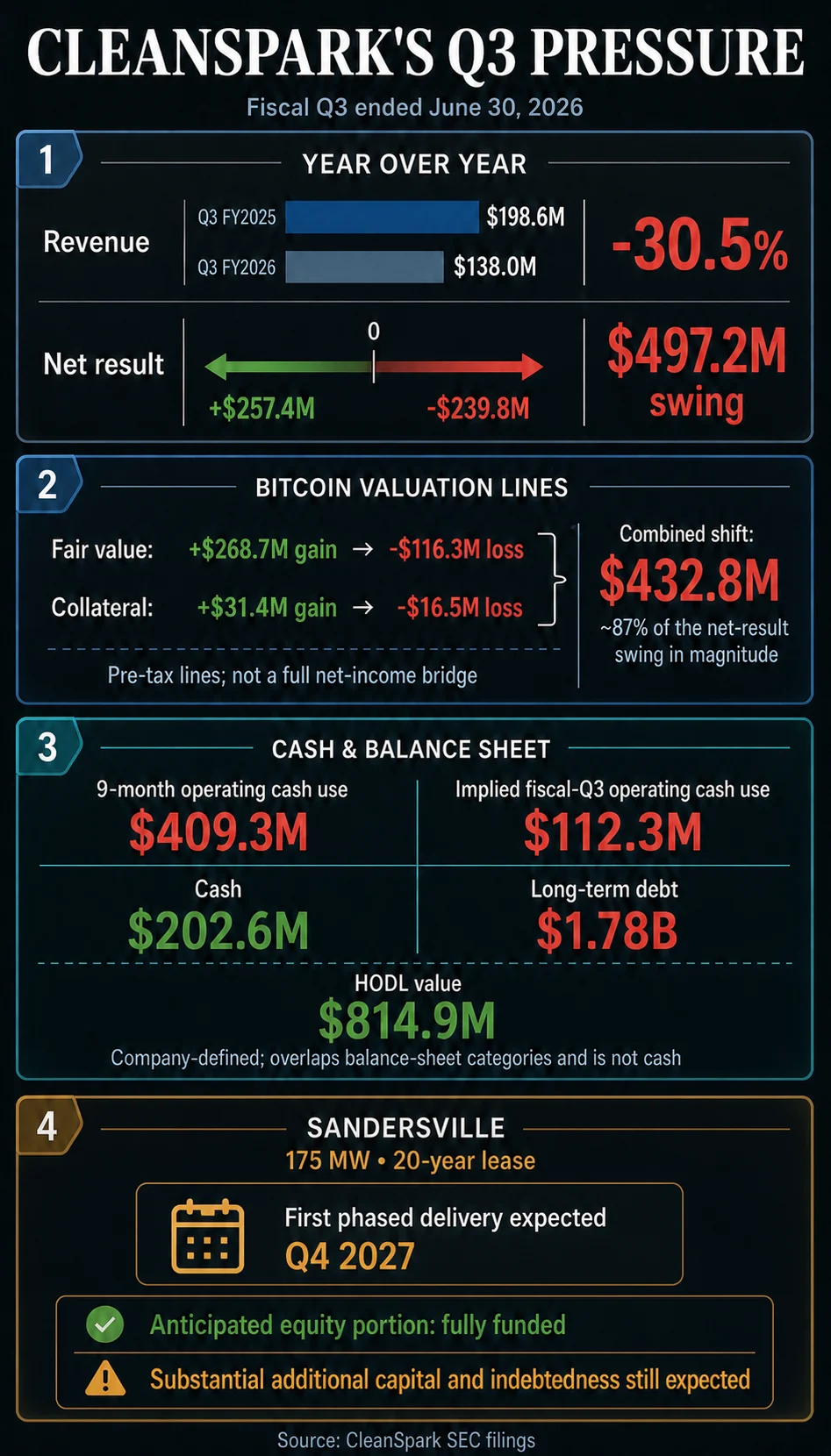
CleanSpark, a prominent player in the digital infrastructure and Bitcoin mining sector, has reported a significant downturn in its fiscal third-quarter results, characterized by a 30.5% year-over-year revenue decline and a staggering $497.2 million swing from profitability into a net loss. The financial disclosures, released for the period ending June 30, 2026, underscore the intense volatility and accounting complexities inherent in the cryptocurrency mining industry. This financial deterioration arrives at a critical juncture for the company as it attempts to pivot toward high-performance computing (HPC) and artificial intelligence (AI) infrastructure. The centerpiece of this transition, the Sandersville AI project, is not expected to begin phased deliveries until the fourth quarter of 2027, leaving a substantial temporal and capital gap that CleanSpark must navigate.
Financial Performance and Revenue Contraction
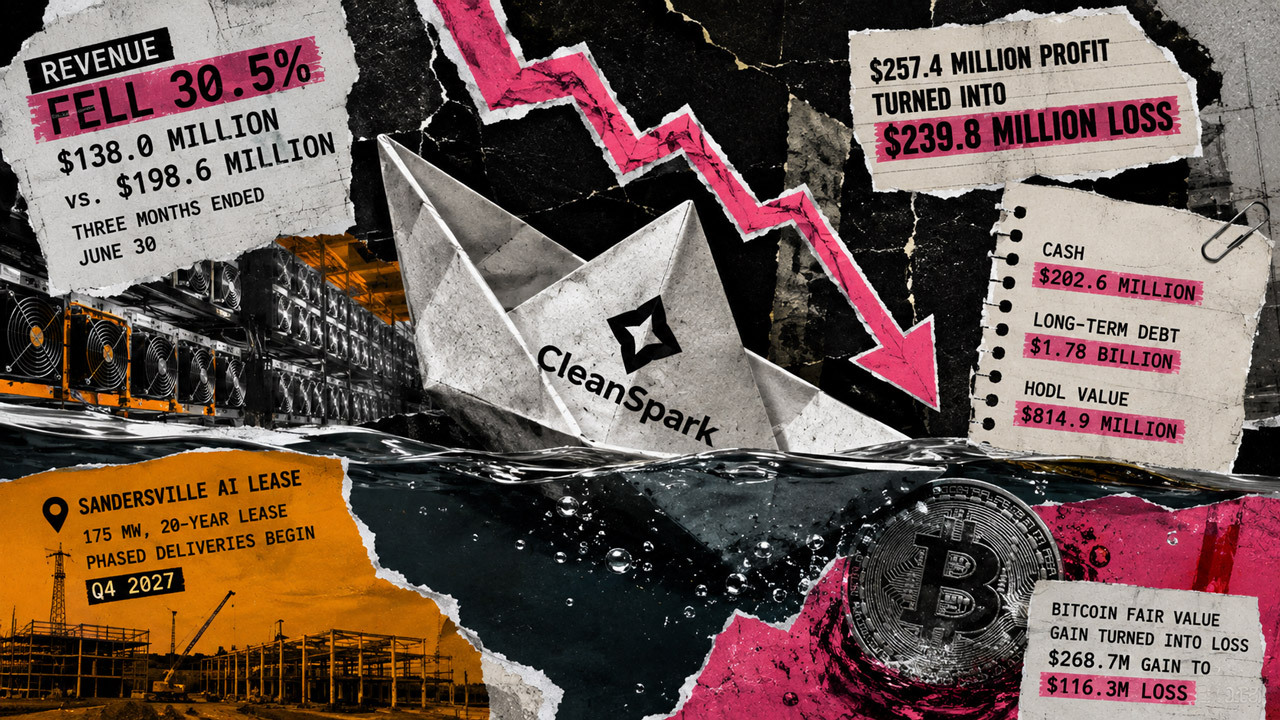
For the three months ended June 30, CleanSpark’s revenue fell to $138.0 million, a sharp contrast to the $198.6 million reported during the same period in the previous fiscal year. This 30.5% drop in top-line revenue reflects the broader challenges facing the mining sector, including increased network difficulty and the lingering effects of the Bitcoin halving, which reduced the block subsidy rewarded to miners.
The most jarring aspect of the report, however, was the bottom-line reversal. A prior-year quarterly profit of $257.4 million was replaced by a net loss of $239.8 million. This nearly half-billion-dollar swing was largely driven by non-cash accounting adjustments related to the valuation of the company’s Bitcoin holdings. According to CleanSpark’s 10-Q filing with the Securities and Exchange Commission (SEC), two specific Bitcoin valuation lines accounted for approximately 87% of the total net-income reversal.
The $433 Million Accounting Shift
The volatility of Bitcoin’s market price played a decisive role in the company’s GAAP (Generally Accepted Accounting Principles) earnings. In the previous year, CleanSpark benefited from a $268.7 million fair-value gain on its Bitcoin holdings. In the current quarter, that figure shifted to a $116.3 million loss—a delta of $384.9 million. Additionally, a $31.4 million gain on Bitcoin used as collateral in the prior year transformed into a $16.5 million loss this quarter, representing a further $47.9 million negative shift.
Combined, these two valuation adjustments totaled $432.8 million. While these figures represent pre-tax "paper" losses rather than realized cash outflows, they highlight the extreme sensitivity of CleanSpark’s balance sheet to the spot price of Bitcoin. Under current accounting standards, companies must reflect the fair market value of digital assets, which can lead to massive fluctuations in reported net income even if the company’s core operations remain stable.
Cash Flow and Operational Liquidity
While the income statement showed a massive GAAP loss, the cash-flow statement provided a more nuanced, albeit still challenging, view of the company’s liquidity. During the first nine months of the fiscal year, CleanSpark utilized $409.3 million in operating cash. Analysis of previous filings shows that $297.0 million of this use occurred in the first six months, implying that the fiscal third quarter saw an additional $112.3 million in operating cash use.
This quarterly cash burn was significantly lower than the reported GAAP loss, largely because mined Bitcoin is recognized as non-cash revenue. CleanSpark typically records the proceeds from the sale of mined coins under "investing activities" rather than "operating activities." Consequently, the operating cash use figure does not fully account for the liquidity generated when the company liquidates its mined assets to fund its operations.
As of June 30, 2026, CleanSpark’s balance sheet remained substantial but under pressure. The company held $202.6 million in cash and cash equivalents, with total current assets valued at $920.8 million. However, it also carried $155.8 million in current liabilities and a formidable $1.78 billion in long-term debt. The company’s "HODL" value—the total value of its Bitcoin holdings—stood at $814.9 million. This total included $592.1 million in current Bitcoin, $122.2 million in non-current Bitcoin, and a $100.6 million collateral receivable.
The Sandersville AI Transition: A High-Stakes Timeline
The financial pressure on CleanSpark is exacerbated by its ambitious strategic shift toward the AI and HPC sectors. The company recently entered into a 20-year, 175-megawatt lease in Sandersville, Georgia, intended to house a massive AI data center. This move mirrors a broader industry trend where Bitcoin miners are leveraging their access to power and electrical infrastructure to serve the booming demand for AI compute.
However, the timeline for this project presents a significant risk. CleanSpark management has indicated that phased deliveries of the Sandersville facility are not expected to commence until Q4 2027. This means the company must sustain its operations, service its debt, and fund construction for over a year before the AI lease begins to generate significant revenue.
Furthermore, the financing of the Sandersville project remains a point of concern for investors. While management stated that the "anticipated equity portion" of the project was fully funded, the 10-Q filing clarified that the company still requires "substantial additional capital." CleanSpark expects to take on significant additional indebtedness and may pursue further equity or equity-linked financing to complete the build-out. Given that the company’s long-term debt already stood at $1.78 billion as of June 30, the capacity for further borrowing may be constrained by prevailing interest rates and market sentiment toward the crypto-mining sector.

Chronology of Recent Events
To understand the current predicament, one must look at the timeline of CleanSpark’s fiscal year:
- October 2025: CleanSpark begins the fiscal year with aggressive expansion plans, acquiring new mining hardware to increase its exahash capacity ahead of expected market volatility.
- March 2026: Mid-year filings show an operating cash use of $297 million, signaling the high cost of maintaining a top-tier mining fleet.
- July 2026: CleanSpark announces the 175MW lease in Sandersville, Georgia, officially marking its entry into the AI infrastructure market.
- August 2026: The company releases its Q3 results, revealing the $497 million profit-to-loss swing and the $433 million accounting impact from Bitcoin valuation.
- Late 2027 (Projected): First phased deliveries of the Sandersville AI data center are scheduled to begin, representing the first potential revenue from the HPC pivot.
Strategic Implications and Industry Context
CleanSpark is not alone in its pursuit of AI-driven revenue. Competitors such as Core Scientific, Iris Energy, and TeraWulf have all announced similar pivots, seeking to diversify away from the volatile and increasingly difficult Bitcoin mining business. The attraction is clear: AI data centers offer long-term, stable contracts with "hyperscaler" clients (such as Microsoft, Amazon, or Google), which are far more attractive to traditional credit markets than the feast-or-famine nature of Bitcoin mining.
However, the "bridge" period—the time between being a pure-play miner and an AI infrastructure provider—is fraught with peril. For CleanSpark, this bridge is nearly 18 months long. During this time, the company remains highly leveraged to the price of Bitcoin. If Bitcoin prices remain stagnant or decline, the "accounting crashes" seen in Q3 could become a recurring theme, potentially complicating the company’s ability to raise the "substantial additional capital" needed for Sandersville.
Analysts suggest that the success of CleanSpark’s transition depends on three factors:
- Bitcoin Price Stability: The company needs Bitcoin to maintain a price floor that allows its mining operations to remain cash-flow positive (or at least manageable) while it builds its AI capacity.
- Capital Markets Access: CleanSpark must maintain investor confidence to execute equity raises or secure favorable debt terms despite its $1.78 billion debt load.
- Execution of Infrastructure: Building data centers for AI is technically more demanding than building mining farms. AI chips (like NVIDIA’s H100s or B200s) require more sophisticated cooling, power redundancy, and networking than ASIC miners.
Conclusion
The fiscal third-quarter results for CleanSpark serve as a stark reminder of the volatility that defines the digital asset space. While the $433 million valuation shift is largely an accounting phenomenon, its impact on the company’s net income and perceived financial health is very real. As CleanSpark moves toward its 2027 goal of becoming a major AI infrastructure player, it must navigate a narrow path of fiscal discipline and strategic fundraising. The "high-stakes gap" identified in this quarter’s results will be the primary focus for shareholders and creditors alike as the company works to transform its balance sheet from one dominated by crypto-volatility to one anchored by the steady, high-margin revenue of the artificial intelligence era.